Volvo CE Reshapes its Hauling Strategy with Rokbak Exit
Volvo Construction Equipment’s decision to close its Rokbak articulated hauler business marks more than the end of a product line. It reflects a broader recalibration taking place across the global construction equipment sector, where rising costs, supply chain disruptions and geopolitical trade tensions are reshaping long-standing industrial strategies.
The move follows mounting financial pressure on the Rokbak operation, driven by escalating operational expenses and persistent global trade challenges. Among these, tariffs and shifting trade policies, particularly those linked to the United States, have added complexity and cost to cross-border manufacturing and distribution. In an industry that relies heavily on global supply chains, such headwinds have proven difficult to absorb, even for well-established brands.
Volvo CE’s decision to withdraw from this segment underscores a pragmatic shift. Rather than maintaining a standalone articulated hauler brand under strain, the company is choosing to concentrate its resources on a broader and more integrated hauling portfolio. It is a reminder that even major OEMs are not immune to the economic realities currently reshaping construction and mining markets worldwide.
The Rise and Reinvention of Rokbak
The Rokbak story is closely tied to the evolution of articulated haulers themselves, a segment that has long been critical to quarrying, mining and large-scale infrastructure development. Originally part of Terex Trucks, the business was acquired by Volvo Group in 2014, bringing with it decades of engineering heritage rooted in Scotland.
Following the acquisition, Volvo CE invested heavily in modernising the product line, ultimately relaunching the brand as Rokbak in 2021. The introduction of the RA30 and RA40 articulated haulers signalled a renewed focus on durability, fuel efficiency and operator productivity. These machines were designed to perform in some of the toughest environments on earth, from remote mining sites to large infrastructure projects.
At launch, Rokbak quickly gained traction. Its machines became known for their reliability and uptime, attributes that are essential in industries where downtime translates directly into lost revenue. Yet despite this technical success and market acceptance, the financial realities behind the scenes told a different story. Sustaining a dedicated articulated hauler brand within a highly competitive and cost-sensitive market proved increasingly difficult.
Costs and Trade Barriers
The closure of Rokbak highlights a fundamental shift in how global equipment manufacturers are evaluating their portfolios. Rising input costs, from raw materials such as steel to energy and logistics, have squeezed margins across the board. At the same time, supply chain disruptions that emerged during the pandemic have not fully stabilised, continuing to impact lead times and production efficiency.
Trade barriers have compounded these issues. Tariffs, regional regulations and shifting geopolitical alliances are forcing manufacturers to rethink where and how they produce equipment. For a business like Rokbak, which relied on global distribution, these challenges created a cumulative financial burden that ultimately proved unsustainable.
Industry analysts have noted that OEMs are increasingly consolidating product lines and focusing on scalable platforms that can serve multiple markets. Volvo CE’s decision fits squarely within this trend. By concentrating on its wider hauling solutions, the company can leverage economies of scale, streamline production and reduce exposure to volatile trade conditions.
Supporting Customers Through the Transition
While the closure signals the end of Rokbak manufacturing, Volvo CE has been clear that it intends to honour its commitments to customers and dealer partners. A dedicated team will remain in place to provide aftermarket support, including parts supply, technical assistance and training services.
This continuity is crucial. Articulated haulers are long-life assets, often operating for many years in demanding conditions. Owners depend on consistent access to spare parts and technical expertise to keep machines running efficiently. Any disruption to this support infrastructure could have significant operational and financial consequences for contractors and fleet operators.
Paul Douglas, Managing Director of Rokbak, acknowledged the impact of the decision while emphasising the company’s commitment to a smooth transition: “This is an incredibly difficult time for our entire company, our valued employees, and our loyal customers and partners. We are extremely grateful for all the support we’ve received over the years. Our focus now is on ensuring a smooth transition, providing ongoing support to our fantastic team, customers and partners, and honouring our commitments.”
Volvo CE has also confirmed that it will work closely with unions, government representatives and regulatory bodies to manage the transition responsibly. This includes supporting employees affected by the closure, particularly those based in Scotland, where the Rokbak operation has deep roots.
Who Dominates the Global Hauler Market
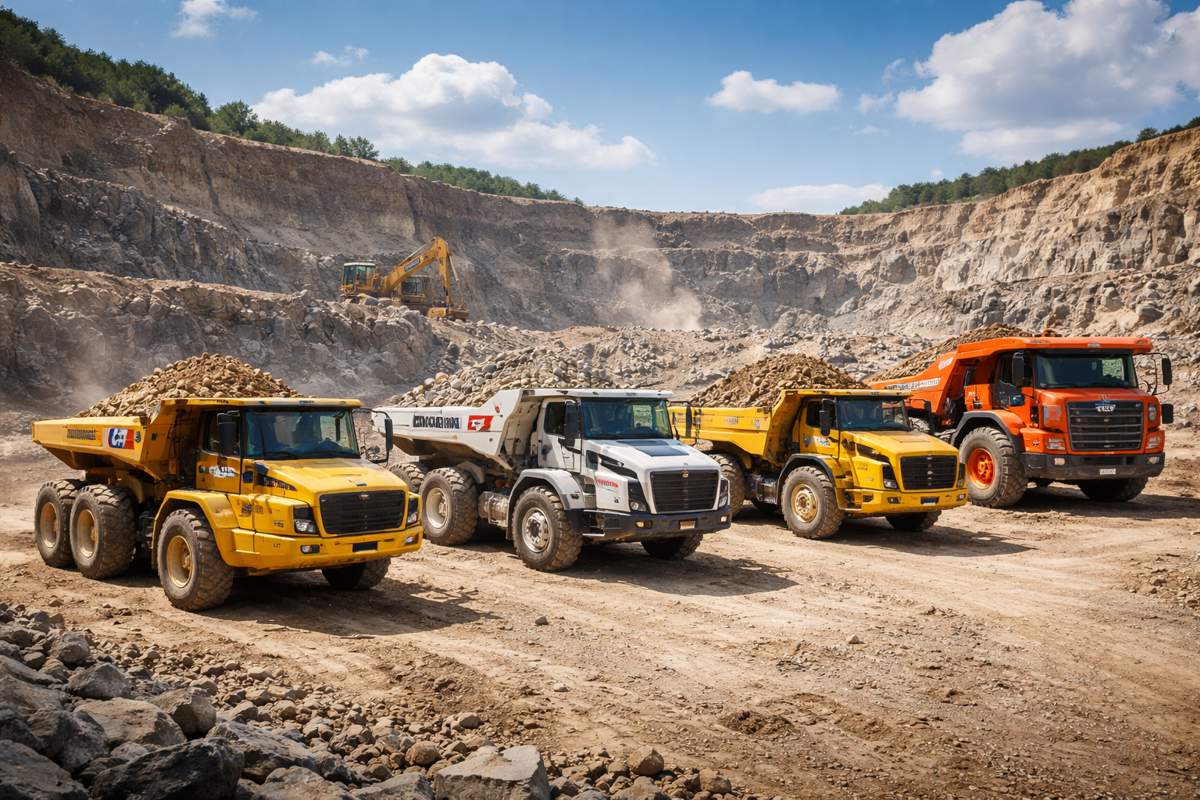
The articulated and rigid hauler market is dominated by a relatively small group of global manufacturers, each with strong regional footholds and distinct technological approaches. These companies operate at scale, which increasingly defines competitiveness in today’s environment.
At the forefront sits Caterpillar, widely regarded as the global leader in both articulated and rigid dump trucks. Its articulated range, including models such as the 730 and 745, is known for durability, advanced operator systems and strong dealer support networks. Caterpillar’s advantage lies not only in product performance but in its integrated ecosystem of services, telematics and financing.
Komatsu remains another major force, particularly in rigid mining trucks. Its haulage solutions are deeply embedded in large-scale mining operations, where productivity and automation are critical. Komatsu has also been at the forefront of autonomous haulage systems, deploying driverless trucks in some of the world’s largest mines.
Sweden’s Volvo Construction Equipment continues to be a key player, particularly in articulated haulers. In fact, Volvo is widely credited with pioneering the articulated hauler concept in its modern form. Its A-series machines, such as the A40 and A60, are staples on infrastructure and quarrying sites worldwide, combining fuel efficiency with advanced safety systems.
South Africa’s Bell Equipment has carved out a strong niche in articulated dump trucks, particularly in emerging markets. Bell’s machines are known for their simplicity, reliability and adaptability, making them attractive in regions where service infrastructure may be less developed.
Meanwhile, Hitachi Construction Machinery plays a significant role in rigid mining trucks, often working in partnership with other OEMs. Its focus on electrification and energy efficiency reflects broader industry trends as mining operations seek to reduce emissions and operating costs.
Other notable players include Liebherr and XCMG, both of which have expanded their presence in haulage equipment, particularly in large-scale mining applications. Chinese manufacturers, in particular, are becoming increasingly competitive, leveraging cost advantages and growing technological capabilities to gain market share globally.
This competitive landscape helps explain why maintaining a smaller, standalone brand such as Rokbak has become increasingly difficult. Scale, integration and global reach are now critical factors, and the market is consolidating around those able to deliver all three.
A Portfolio Shift Towards Integration and Scale
From a strategic standpoint, Volvo CE’s decision reflects a broader move towards integration within its product portfolio. Rather than maintaining a separate brand, the company is likely to focus on strengthening its core offerings, potentially integrating articulated hauling capabilities more closely with its existing machines and digital ecosystems.
This approach aligns with a wider industry trend towards platform-based development. Manufacturers are increasingly designing equipment that can share components, technologies and software systems across multiple product lines. This not only reduces costs but also simplifies maintenance and improves fleet interoperability for customers.
Digitalisation is also playing a growing role. Modern construction equipment is no longer just about mechanical performance. Telematics, automation and data-driven optimisation are becoming central to how fleets are managed and operated. By consolidating its resources, Volvo CE may be better positioned to invest in these areas, delivering smarter and more connected solutions to its customers.
What It Means for the Articulated Hauler Market
The exit of Rokbak raises important questions about the future of the articulated hauler market. While demand for these machines remains strong, particularly in mining and large infrastructure projects, the competitive landscape is intensifying.
Major players are investing heavily in efficiency, sustainability and digital integration. Electrification and alternative fuels are also beginning to influence equipment design, although their adoption in heavy-duty applications remains in its early stages. At the same time, customers are placing greater emphasis on total cost of ownership, pushing manufacturers to deliver machines that are not only reliable but also cost-effective to operate over their entire lifecycle.
In this context, smaller or standalone brands may find it increasingly difficult to compete without significant scale or differentiation. Volvo CE’s decision to streamline its portfolio suggests that even established manufacturers are prioritising focus and efficiency over maintaining legacy product lines.
Managing Change in a Shifting Global Landscape
The closure of Rokbak is, at its core, a reflection of the changing dynamics within the global construction and mining equipment industry. Economic pressures, evolving trade policies and technological transformation are all converging, forcing companies to make difficult but necessary decisions.
For Volvo CE, the move represents a strategic realignment aimed at strengthening its long-term competitiveness. By concentrating on scalable solutions and integrated technologies, the company is positioning itself to navigate an increasingly complex and uncertain market environment.
For customers, the key concern will be continuity. Ensuring that existing fleets remain supported and operational will be critical in maintaining trust and stability during the transition. Volvo CE’s commitment to ongoing aftermarket services will play a central role in achieving this.
A Turning Point for Industrial Strategy
In many ways, the Rokbak closure serves as a case study in how industrial strategy is evolving. It illustrates the importance of adaptability in a sector where external pressures can quickly reshape the business landscape.
While the end of Rokbak marks the close of a chapter that spans more than four decades, it also signals the beginning of a new phase for Volvo CE. One defined not by the breadth of its brands, but by the depth and resilience of its core capabilities.
As the construction and mining industries continue to evolve, decisions like this will likely become more common. The companies that succeed will be those that can balance heritage with innovation, scale with flexibility and global reach with local responsiveness.