Africa Backs Cleaner Safer Transport Future Through Dual Mobility Frameworks
Africa’s transport and energy ministers have endorsed two continent-wide policy frameworks that could reshape how people and goods move across one of the world’s fastest-growing regions. Approved during the 5th Ordinary Session of the African Union’s Specialized Technical Committee on Transport and Energy, the Pan-African Action Plan for Active Mobility and the Continental Framework on Electric Mobility signal a coordinated push towards safer streets, cleaner air, lower fuel dependency and stronger industrial capacity.
The timing is notable. The decisions come during the opening phase of the UN Decade of Sustainable Transport (2026–2035), placing African nations in step with a global shift toward transport systems that are cleaner, more inclusive and less vulnerable to fossil fuel price shocks. For infrastructure investors, city planners and policymakers, the endorsements offer something often missing in emerging transport markets: strategic direction at continental scale.
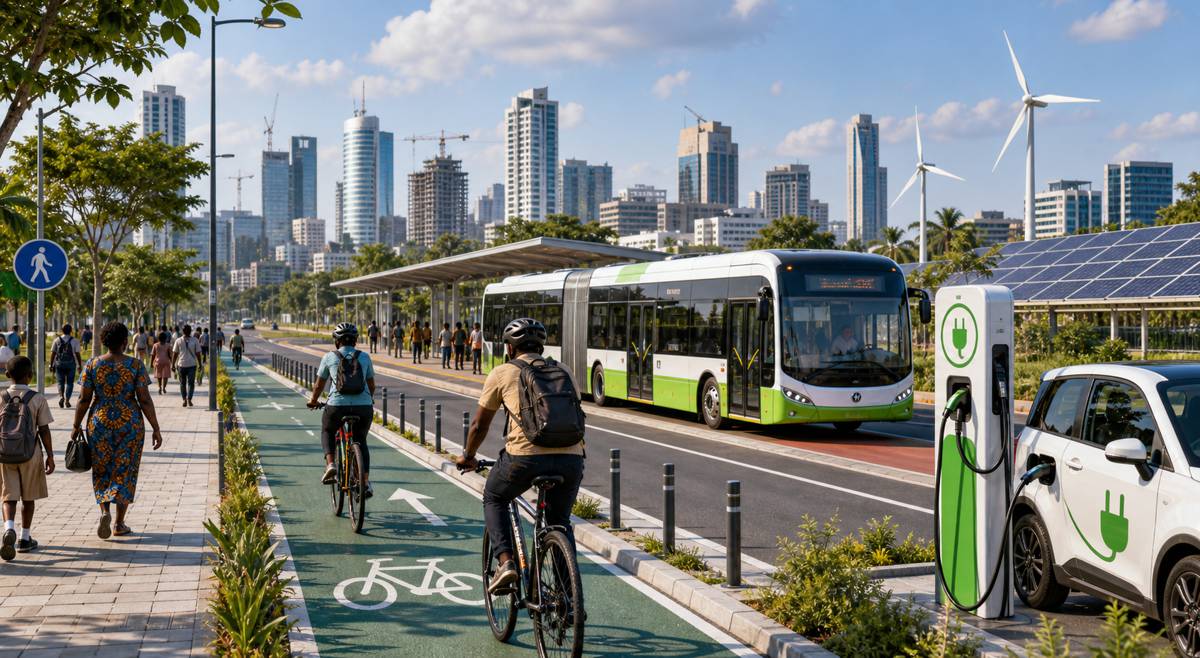
Rather than treating walking, cycling and electric vehicles as separate agendas, African leaders have chosen a joined-up model. That matters because transport challenges across the continent are interconnected. Congested cities, high logistics costs, imported fuel dependence, dangerous roads and limited public transport access all feed into productivity, health outcomes and economic resilience.
Briefing
- African ministers endorsed two major frameworks covering active mobility and electric mobility.
- Policies aim to reduce road deaths, air pollution, emissions and fuel import dependence.
- More than one billion Africans rely daily on walking or cycling.
- Around half of African countries are already involved in EV or charging equipment assembly.
- The move creates a clearer roadmap for investors, governments and infrastructure developers.
A Continental Shift in Transport Priorities
For decades, many transport strategies globally centred almost entirely on private vehicles and large road expansion. Africa’s new approach broadens the lens. Walking and cycling remain the most common modes of daily travel across the continent, while electrification offers a route to modernise fleets and reduce fuel imports.
African Union Commissioner for Infrastructure and Energy Lerato D. Martaboge said: “Today’s endorsement sends a clear signal that African governments recognise the urgency of shifting to electric mobility while at the same time investing in the safety and wellbeing of the billion people who walk and cycle every day. These two continental frameworks provide the strategic direction that will drive coordinated policy action and unlock the resources the continent needs to industrialize and build safer, cleaner, and more inclusive transport systems.”
That statement captures the wider economic significance. Mobility is not merely about transport. It influences labour markets, school access, healthcare reach, trade efficiency and urban competitiveness. Better mobility systems can raise productivity while lowering long-term public costs linked to pollution, crashes and imported energy.
Active Mobility for Africa
The Pan-African Action Plan for Active Mobility is the first framework of its kind designed to align national policy around walking and cycling. It has been coordinated by the African Union Commission alongside United Nations Environment Programme, UN-Habitat, World Health Organization Regional Office for Africa and United Nations Economic Commission for Africa.
The numbers explain the urgency. More than one billion people across Africa walk or cycle for close to an hour each day to reach work, schools, markets and healthcare. Yet in many cities and towns, pavements are missing, crossings are unsafe, cycle lanes are absent and roads are engineered primarily for vehicles.
The human cost is severe. Africa accounts for roughly 24% of global road traffic fatalities despite having only around 3% of the world’s vehicle fleet, according to figures cited in the source material. Pedestrians and cyclists represent more than a third of those killed. That makes road design reform as important as fleet modernisation.
For contractors and infrastructure consultants, this creates substantial opportunity. Sidewalk upgrades, protected cycling corridors, safer junction redesigns, lighting, drainage, traffic calming and urban realm improvements all become investable assets when backed by policy frameworks.
Electric Mobility Moves From Pilot Projects to Policy
The Continental Framework on Electric Mobility in Africa addresses another pressing challenge: dependence on imported refined fuels. The transport sector is said to account for 31% of CO2 emissions while more than 70% of refined fuel demand is met through imports.
That import exposure can strain public finances, particularly during oil price spikes or currency weakness. Electric mobility offers a partial hedge, especially in countries with abundant solar, hydro, geothermal or wind resources.
The framework, developed by the African Union Commission with UNECA and UNEP, outlines nine pillars to help member states accelerate adoption of electric vehicles, build charging networks, support local manufacturing and promote a fair transition.
This industrial angle may prove decisive. Africa is not simply being positioned as a buyer of imported EVs. The framework points toward domestic assembly, battery ecosystem development, component manufacturing and charger production. For investors, that widens the opportunity set well beyond retail vehicle sales.
Momentum Is Already Visible Across the Continent
Several African nations have already moved ahead, showing these frameworks are formalising trends already underway rather than launching from scratch.
Ethiopia adopted a Non-Motorised Transport Strategy covering 2020 to 2029. Addis Ababa has reportedly built more than 60 km of walkways and protected cycle tracks, with further expansion planned.
Uganda has updated road design guidance, while Egypt launched an Active Mobility Strategy Framework for 2025 to 2034.
On the electric mobility side, Rwanda has introduced zero-rated VAT, duty exemptions and taxation measures favouring cleaner vehicles. Kigali has also restricted new registrations of combustion-engine passenger motorcycles.
Dakar now operates a fully electric bus rapid transit corridor using more than 140 articulated e-buses across an 18-kilometre route. Kenya, which launched a National Electric Mobility Policy in early 2026, reportedly already has more than 24,000 electric motorcycles in use, many serving taxi markets.
These examples matter because Africa’s two-wheeler and shared mobility sectors may electrify faster than private passenger cars in many markets. That creates a different commercial pathway from Europe or North America.
What It Means for Infrastructure and Investors
The practical implications stretch across multiple sectors:
- Road builders may see more demand for safer urban street upgrades, footpaths and cycle infrastructure.
- Utilities and power developers could benefit from charging infrastructure and grid upgrades.
- Bus operators and fleet owners may gain from lower running costs over time.
- Industrial firms could enter assembly, battery servicing or charger manufacturing.
- Cities may reduce congestion, pollution and crash-related economic losses.
For international suppliers, consultants and financiers, Africa’s scale is significant. The continent is urbanising rapidly, with many cities still shaping their long-term transport form. That means investments made now can lock in better outcomes for decades.
Cleaner Cities Stronger Economies
Elizabeth Mrema said: “Walking, cycling and electric vehicles are among the most effective, affordable, and practical solutions we have for tackling the climate crisis, improving public health and building more livable cities. These endorsements mean African governments have a blueprint to accelerate investments that deliver benefits across sectors — from cleaner air and lower emissions to economic savings, stronger communities and energy independence.”
Strip away the diplomatic language and the message is straightforward. Better transport systems can improve quality of life while strengthening economic resilience. That is especially relevant in fast-growing cities where congestion, informal transport gaps and pollution already carry a heavy cost.
Execution, of course, will decide success. Frameworks need funding, standards, enforcement capacity and political continuity. Yet continental alignment reduces fragmentation and can help lenders and private investors evaluate opportunities with greater confidence.
A Defining Decade for African Mobility
Africa’s dual endorsement of active and electric mobility frameworks marks a notable policy moment. Instead of copying car-dependent models from elsewhere, governments are leaning into solutions suited to local realities: widespread walking, growing motorcycle use, dense urban corridors, renewable energy potential and rising industrial ambition.
If implemented well, the result could be safer roads, cleaner cities, stronger domestic industries and more affordable movement for millions. For the global infrastructure sector, that makes Africa one of the most consequential transport stories of the decade.