Indiana Expands Smart Freight Oversight with New Weigh In Motion Investment
State transport agencies rarely make headlines when they renew long-term technology frameworks, yet these decisions often shape how efficiently roads are managed, how freight moves and how infrastructure budgets are protected. Indiana’s latest move falls firmly into that category. The Indiana Department of Transportation has expanded its partnership with Quarterhill through two new Quantity Purchase Award agreements worth an estimated $13 million, focused on Weigh-in-Motion and Virtual Weigh-in-Motion systems across the state.
Running from May 2026 to April 2030, the agreements give Indiana a flexible route to scale roadside monitoring technology without repeatedly restarting procurement cycles. That matters because commercial freight traffic is only growing more complex. Heavier loads, tighter delivery windows, ageing pavements and rising bridge maintenance costs are forcing highway agencies to become smarter, faster and more data-driven in how they manage freight corridors.
Indiana sits at one of the most strategically important crossroads in the United States freight network. Interstates including I-65, I-69, I-70 and I-74 carry high volumes of regional and long-haul truck traffic linking the Midwest to the South, East Coast and Great Plains. For a state with such a pivotal logistics role, vehicle weight compliance and traffic intelligence are not optional extras. They are core infrastructure tools.
Quarterhill’s expanded role includes supplying equipment, software, installation, maintenance, calibration and repairs for existing and future monitoring sites statewide. The programme covers both continuity for already deployed assets and room for additional sites as transport priorities evolve.
Briefing
- Indiana has awarded two new agreements worth an estimated $13 million to expand Weigh-in-Motion technology through 2030.
- The systems help monitor truck weights, classify vehicles and support infrastructure planning.
- Indiana’s location at the heart of US freight corridors makes freight intelligence strategically important.
- Virtual Weigh-in-Motion adds connectivity, imaging and real-time roadside screening tools.
- AI-powered classification technology may reduce the need for disruptive in-road sensor installations.
Truck Weight Data
Roads and bridges are designed around expected traffic loads, not simply traffic volumes. A relatively small number of overloaded vehicles can create disproportionate wear on pavements, joints, bridge decks and supporting structures. The widely cited fourth power law in pavement engineering shows axle load increases can accelerate damage dramatically.
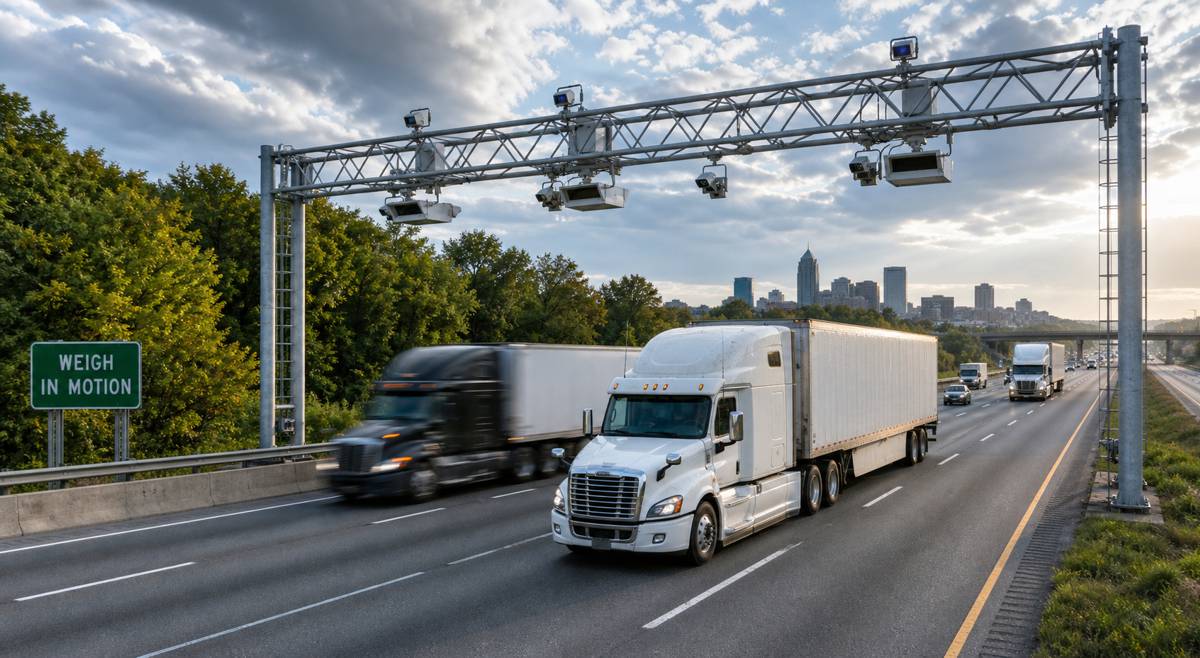
That is why weigh enforcement and freight monitoring systems have become so valuable. Rather than relying solely on static weigh stations or sporadic roadside inspections, Weigh-in-Motion systems measure vehicle loads while traffic remains in motion. This allows agencies to gather continuous streams of real-world freight data with minimal disruption to traffic flow.
For infrastructure planners, that information feeds everything from resurfacing schedules to bridge strengthening priorities. For policymakers, it provides evidence on freight trends, logistics demand and route pressures. For enforcement teams, it can improve targeting so compliant hauliers are delayed less often while suspect vehicles receive closer scrutiny.
What Indiana Is Buying
Under the new framework, Quarterhill will continue supporting Indiana’s existing WIM estate while helping deploy new systems over the four-year term. That includes hardware, software services, calibration and maintenance, all of which are critical if data is to remain reliable.
Weigh-in-Motion systems are only as useful as their accuracy. Sensors drift, weather affects equipment, and pavement conditions can alter readings over time. Ongoing calibration and lifecycle maintenance are therefore just as important as initial installation. Many agencies learn the hard way that buying technology is easier than sustaining it.
Indiana’s procurement structure appears designed to avoid that trap by combining expansion with long-term operational support. It gives the state room to respond to corridor changes, freight growth or enforcement priorities without being boxed into a rigid one-off project model.
Virtual Weigh In Motion Adds Real-Time Intelligence
Traditional WIM systems focus heavily on measurement and classification. Virtual Weigh-in-Motion broadens that capability through connectivity, image capture and real-time access to roadside intelligence.
That can allow enforcement officers to identify potentially non-compliant vehicles before they reach congested inspection sites. It also creates opportunities to integrate licence plate recognition, timestamped movements and network-wide freight pattern analysis, subject of course to local legal and privacy frameworks.
For compliant operators, smarter screening can be a win. Instead of stopping large volumes of trucks unnecessarily, agencies can focus resources where risk is highest. That reduces delays, fuel burn and operating costs across the freight chain.
In practical terms, this sort of selective enforcement is becoming increasingly important as e-commerce, just-in-time logistics and driver shortages put more pressure on delivery schedules.
AI Moves Classification Beyond Road Sensors
One of the more interesting elements of the agreement is Indiana’s access to Quarterhill’s ITHEIA AI-powered video classification technology. According to the company, the platform uses computer vision and machine learning to classify vehicles without relying entirely on traditional in-road sensors.
That could prove useful where lane closures, pavement cuts or traffic disruption make embedded sensor installations difficult. Urban corridors, bridge approaches and heavily trafficked freight routes often present exactly those challenges.
Video-based systems are gaining traction globally as camera quality improves and AI models become more capable of distinguishing axle groups, trailer combinations and vehicle classes. They are not always a total replacement for physical sensing, particularly where certified weight data is required, but they can complement conventional systems and add resilience.
For transport agencies managing tight budgets, hybrid approaches can sometimes deliver better coverage at lower lifecycle cost.
Indiana’s Strategic Freight Position
Indiana is not a peripheral market. It is one of America’s most important freight states. The broader Midwest region remains central to manufacturing, agriculture, warehousing and distribution. Indiana’s proximity to Chicago, Ohio Valley production centres and major interstate corridors gives it outsized importance in national logistics.
That means road wear from heavy vehicles is a constant strategic issue. It also means better freight data can produce tangible returns. Knowing where trucks travel, what classes dominate routes and how axle loads are changing helps agencies direct scarce capital where it matters most.
For example, bridge upgrades on a corridor carrying sustained heavy freight traffic may deliver stronger economic returns than cosmetic improvements elsewhere. Likewise, resurfacing priorities can be adjusted using evidence rather than assumptions.
This is where digital infrastructure quietly earns its keep.
Quarterhill’s Position in the ITS Market
Quarterhill operates in the wider Intelligent Transportation Systems sector, a market spanning tolling, enforcement, traffic management, connected roadside systems and analytics. Globally, governments are investing more in these tools as they seek to extract greater performance from existing roads rather than relying solely on expensive new capacity projects.
That trend is visible across North America, Europe and parts of Asia-Pacific. Ageing transport networks, climate resilience pressures and constrained public finances are encouraging smarter use of assets already in the ground.
For suppliers, the opportunity increasingly lies not just in hardware but in recurring services, analytics, maintenance and software integration. Indiana’s new framework reflects that shift. It is not simply a hardware order. It is an operational technology partnership.
Building Smarter Roads Through Better Data
There is a tendency to view intelligent transport technology as futuristic. In reality, much of the value lies in practical, everyday decisions: where to repair a road first, which bridge needs attention sooner, which trucks require inspection, which corridor is under rising pressure.
Indiana’s latest investment points to that more grounded reality. Data quality, enforcement efficiency and asset protection are becoming standard parts of modern highway management, especially in freight-intensive regions.
For contractors, investors and policymakers watching the infrastructure sector, this serves as another reminder that tomorrow’s road network will be shaped as much by sensors, analytics and AI as by asphalt and concrete. Indiana has chosen to keep moving in that direction.