How Engineers Are Mastering Uneven Terrain in Modern Urban Development
Cities have always expanded towards the easiest land first. Flat plains, firm soils and predictable drainage corridors traditionally attracted homes, roads, railways and commerce. Yet in many mature urban areas, that comfortable option has long since vanished. Growth pressure, land scarcity and rising property values are now pushing development onto steeper slopes, reclaimed plots, marginal ground and awkward parcels once dismissed as too troublesome to justify the risk.
That shift has changed the role of civil and geotechnical engineers. Uneven terrain is no longer treated as a nuisance to be flattened into submission. Instead, it has become a technical challenge that demands smarter surveying, sharper modelling and construction methods that respect how land actually behaves. Beneath every attractive hillside apartment block, stepped commercial district or terraced road scheme sits a quiet battle with geology, groundwater and gravity.
Across the world, infrastructure and housing projects are increasingly shaped by terrain constraints. In land-constrained cities such as Hong Kong, Rio de Janeiro and Athens, building on slopes and mixed geology is routine rather than exceptional. Meanwhile, climate pressures and intense rainfall are making drainage and slope stability even more critical. The old habit of assuming the ground will cooperate is fading fast.
For the construction sector, investors and policymakers alike, this matters because poor ground decisions are expensive. Foundation redesigns, retaining wall failures, drainage defects and settlement claims can derail budgets and damage public trust. When engineers get it right, however, uneven land becomes developable, resilient and commercially valuable.
Ground Investigation Comes Before Grand Designs
Experienced engineers know that topography only tells part of the story. Two neighbouring hillsides can behave entirely differently depending on rock depth, historic fill material, groundwater pathways or clay content. That is why serious projects begin with site investigation, not optimistic sketches.
Boreholes, trial pits, cone penetration testing and laboratory soil analysis help reveal bearing capacity, compressibility, contamination risks and moisture sensitivity. According to Institution of Civil Engineers guidance and international geotechnical practice, early investigation consistently reduces redesign risk and unforeseen costs. Put simply, spending modestly on ground truth at the start can save millions later.
Digital tools now strengthen this process. Building Information Modelling, terrain scans, drone surveys and geospatial data can merge surface and subsurface intelligence into a more realistic picture of site conditions. However, even the best software is only as reliable as the data entered. Sophisticated models built on poor assumptions still fail in expensive ways.
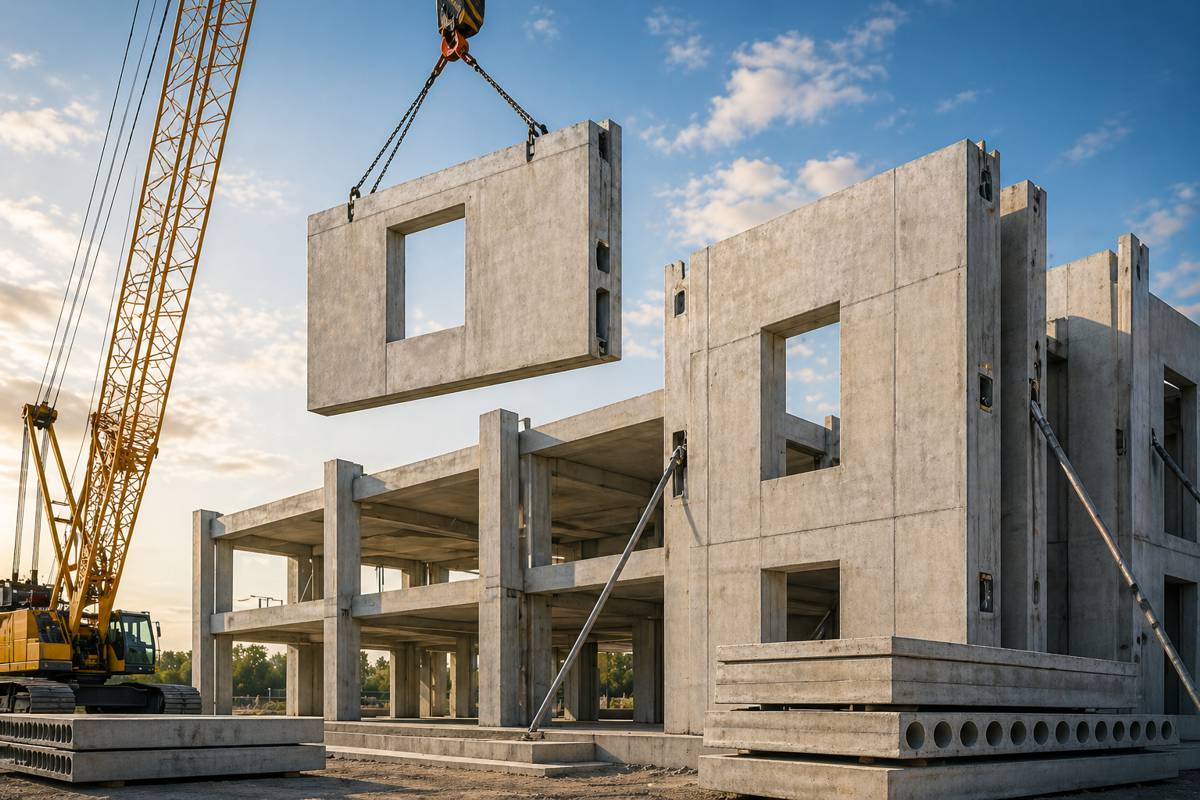
Off-site construction is also playing a growing role on uneven urban sites, where access constraints and safety risks can slow traditional methods. Precast retaining units, stairs, drainage chambers and structural elements can be manufactured under controlled conditions before rapid installation on site. Many project teams look to leading suppliers of concrete products, such as modularcubed.co.uk, when considering methods that improve programme certainty, quality consistency and faster deployment on challenging ground.
Foundations Built for Slopes and Movement
Traditional strip footings can work well on level, stable ground. On slopes or variable soils, they often struggle. Differential settlement, lateral movement and uneven loading can lead to cracking, sticking doors, distorted facades and long-term maintenance headaches.
Modern engineers therefore tailor foundation strategies to terrain. Piled foundations are common where weak upper soils overlay stronger strata. Steel, concrete or bored piles transfer loads deeper into competent layers, while pile caps and beams tie structures together. Raft foundations may also be used where loads need spreading across a wider footprint, particularly where variable soils increase settlement risk.
Stepped foundations are another common solution on gradients. Rather than forcing one continuous base across a slope, foundations follow the terrain in controlled level changes. This reduces excavation volumes, cuts waste haulage and can simplify structural load paths.
Ground improvement methods also play an increasing role. Techniques such as vibro compaction, grouting, lime stabilisation and geosynthetic reinforcement can turn marginal land into workable development plots. For developers, that can make previously unattractive sites commercially viable.
Retaining Walls Are Engineering Systems, Not Decorative Features
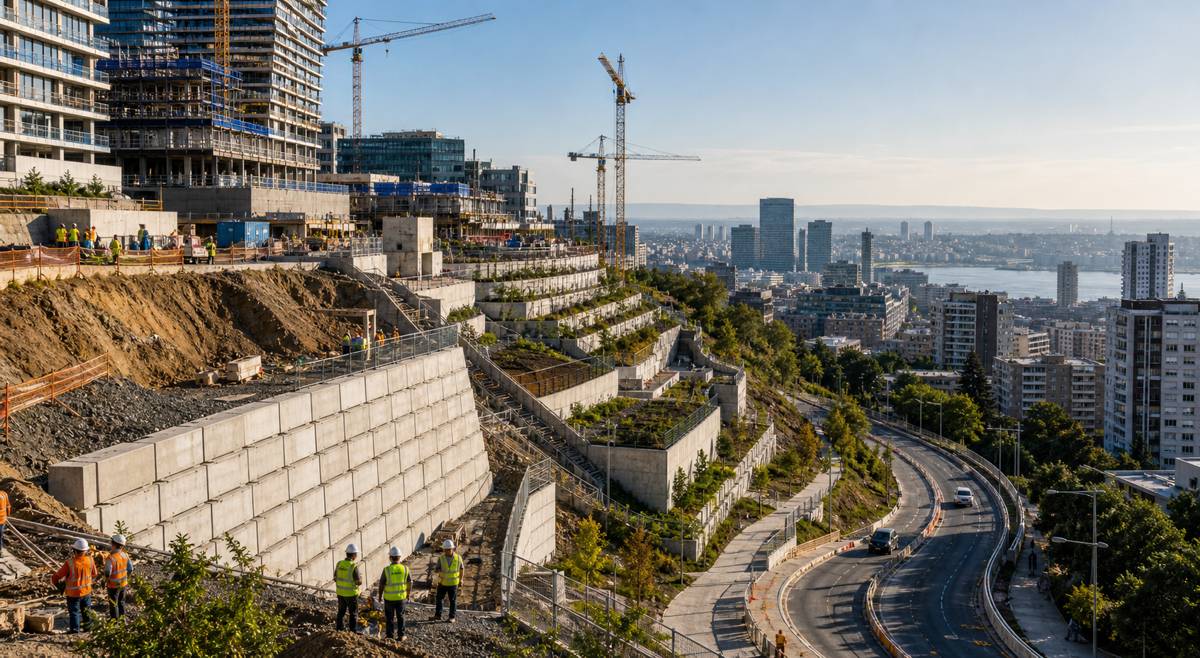
Retaining walls are often misunderstood as simple landscape elements. In reality, they are structural systems managing earth pressure, drainage loads and movement tolerance. When they fail, the consequences can be severe, ranging from road closures to property damage and personal injury.
Engineers choose retaining wall types based on space, height, soil conditions and groundwater behaviour. Gravity walls rely on mass. Reinforced concrete cantilever walls use structural leverage. Anchored systems transfer forces back into stable ground. Mechanically stabilised earth walls combine fill and reinforcement for larger transport corridors.
In dense urban settings, retaining walls frequently support roads, rail alignments, basements and utility corridors. That makes design quality vital. A wall is only as good as its drainage, detailing and maintenance access. Ignore those basics and even robust structures can deteriorate rapidly.
Water Usually Has the Final Say
If gravity shapes uneven land, water often decides whether a project succeeds. Rainfall runs downhill, but it also infiltrates soils, builds pore pressure, weakens slopes and exploits poor detailing. Hidden springs, perched water tables and blocked drains have undone many confident schemes.
Engineers therefore design drainage as core infrastructure rather than an afterthought. Cut-off drains intercept hillside flows before they reach structures. Subsoil drainage relieves pressure behind retaining walls. Filter media and geotextiles help prevent clogging. Surface channels and gullies manage intense stormwater events.
Sustainable Drainage Systems, widely known as SuDS, are increasingly integrated into terrain-sensitive developments. Swales, attenuation basins, permeable paving and planted terraces slow runoff and reduce downstream flooding. As climate volatility increases, these systems are becoming less optional and more essential.
For municipalities and investors, resilient drainage offers another advantage. It lowers lifecycle risk. A project that survives heavy rainfall without disruption protects revenue, public confidence and long-term asset value.
Designing for People, Not Just Structures
A technically stable hillside development can still fail if it ignores how people move. Roads that are too steep create winter hazards, strain heavy vehicles and complicate emergency access. Footways without rest landings or ramps exclude users. Poor lighting and drainage turn level changes into accident risks.
This is where urban engineers increasingly collaborate with transport planners, architects and accessibility specialists. Split-level buildings can follow contours while maintaining level entrances where needed. Terraced streetscapes can reduce retaining heights and preserve human scale. Lift cores, stepped plazas and pedestrian links can reconnect fragmented sites.
Construction logistics also demand attention. Cranes require stable pads. Temporary excavations need support systems. Material deliveries need safe turning space. On constrained slopes, the build sequence can be as important as the permanent design.
Unlocking Land Value Through Smarter Engineering
The economic argument for tackling uneven terrain is compelling. Prime urban land is scarce in many regions. Brownfield regeneration, hillside infill and transport-adjacent slopes often represent some of the last available opportunities near established infrastructure networks.
When engineering risk is managed properly, these sites can deliver housing, logistics space, civic facilities and commercial returns without forcing endless outward sprawl. That supports more compact cities, better transport efficiency and stronger use of existing utilities.
Investors increasingly understand this. Difficult land no longer signals automatic rejection. It signals the need for competent due diligence, realistic contingencies and experienced technical teams.
Working With the Ground Wins Every Time
Urban development is gradually abandoning the fantasy that every site should behave like a flat greenfield plot. Slopes, variable soils and concealed watercourses are now treated as design inputs rather than inconvenient surprises. That change reflects a more mature and commercially sensible approach to city growth.
Engineers who respect terrain rather than fight it are helping unlock safer, smarter and more resilient urban expansion. Better investigation reduces shocks. Better foundations prevent movement. Better drainage controls risk. Better access planning keeps developments usable for the people they are meant to serve.
Flat land may be simpler, but the future of many cities lies elsewhere. The winning projects will be those that understand one timeless truth: the ground always gets a vote.