TRL Sets New Course for UK Police Blue Light Safety Standards
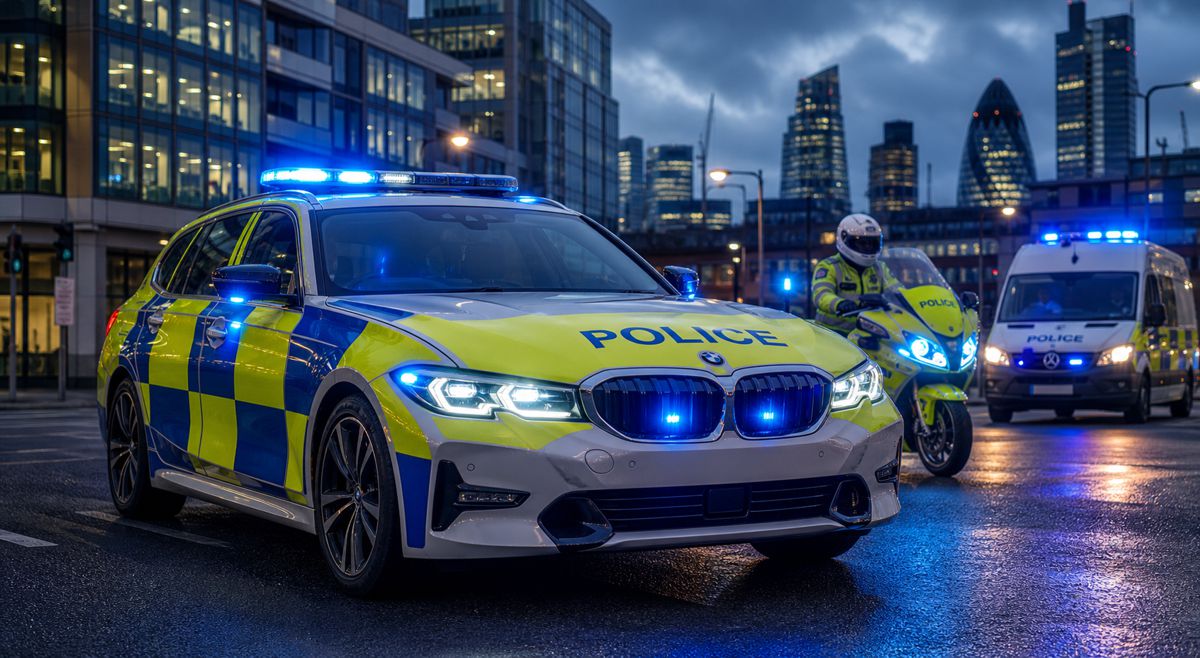
The UK policing fleet is heading for one of its most significant vehicle safety reforms in decades, with TRL commissioned by the Metropolitan Police Service on behalf of the National Police Chiefs’ Council to develop a national Fleet Blue Light Standard for emergency vehicle lighting across Britain.
At first glance, flashing blue lights may seem straightforward. In practice, they are a critical operational tool that influences how quickly police vehicles are recognised, how safely traffic reacts, and how effectively officers can work at roadside incidents or during high-pressure response driving. When lighting systems vary widely between forces, the result can be inconsistency at exactly the moments when clarity matters most.
The new programme seeks to replace fragmented local approaches with a unified, evidence-led framework covering marked police motorcycles, cars, vans and heavy goods vehicles. It will examine how emergency lighting performs in urban streets, rural roads, daylight glare, darkness, pursuit conditions and static incident scenes. For transport professionals, fleet managers and policymakers, the move signals a more mature approach to emergency vehicle design, standardisation and risk management.
Across infrastructure and transport systems, standardisation often sits quietly in the background until something goes wrong. Whether road signs, traffic signals or vehicle markings, consistency reduces confusion and improves human response times. Blue light systems are no exception, and the decision to formalise national guidance reflects that reality.
Briefing
- TRL has been appointed to develop the first UK-wide evidence-based police blue light standard.
- The programme is backed by the National Police Chiefs’ Council and led via the Metropolitan Police Service.
- It will cover motorcycles, cars, vans and HGV police vehicles.
- The aim is to improve officer safety, public safety and interoperability across all 43 UK police forces.
- The project forms part of a broader police vehicle standardisation programme.
Lighting Standards on Real Roads
Emergency warning lights are more than a visual signal. They are part of the communication system between responders and the public. A driver approaching a junction must instantly recognise that a police vehicle is responding urgently. Road workers at a collision scene need clear cues that an operational vehicle is protecting a lane closure. Pedestrians and cyclists need enough visibility to react safely.
Human factors research has long shown that recognition speed, contrast, colour intensity and positioning all affect reaction times. Daylight visibility can differ sharply from night-time effectiveness, while heavy rain, fog and modern LED headlamp glare introduce new challenges. A lightbar that performs well on a dry city street may be less effective on a fast rural road or motorway shoulder.
That makes a research-led standard particularly valuable. Rather than relying on tradition, supplier preference or individual force practice, the new model can assess what genuinely works in operational conditions.
Ending the Patchwork Across 43 Police Forces
At present, all 43 territorial police forces in the UK operate their own vehicle lighting layouts and specifications. Over time, those local choices can create a patchwork of designs, mounting positions, flash patterns and vehicle integrations.
That variation may appear minor, but operational fleets increasingly work across boundaries. Mutual aid deployments, major public events, terrorism responses, regional crime operations and disaster recovery frequently bring multiple forces together. When vehicles present different warning signatures, consistency can suffer.
A national standard helps create a common visual language. Officers moving between forces encounter familiar systems. Fleet workshops can work to clearer specifications. Procurement teams may gain stronger buying leverage through aligned requirements. Training and maintenance also become simpler when baseline standards are shared.
This mirrors wider trends in public-sector fleet management, where harmonisation reduces lifecycle cost and operational friction.
The Technology Behind Modern Blue Light Systems
Police vehicle lighting has changed dramatically over the last two decades. Older rotating beacons and halogen systems have largely given way to LED technology, programmable flash sequences, lower power consumption and integrated control systems.
LED units offer brightness, durability and compact packaging, but they also introduce new design choices. Too much intensity can create glare at close range. Poor placement can be masked by vehicle bodywork. Over-complex flash patterns may distract rather than inform. What works on a patrol car may not translate well to motorcycles or large vans.
That is why a modern standard cannot simply state “fit blue lights”. It needs performance criteria, operational scenarios, environmental testing and practical installation guidance.
Jason Powell, Director of Fleet Services Metropolitan Police Service & NPCC portfolio Lead said: “This is the first time UK policing has developed a nationally coordinated, evidence-based standard for blue light warning systems, which are critical to keeping officers and the public safe. It brings together lessons learned and best practice from across forces to establish a clear, consistent national approach for one of the most safety critical aspects of police vehicles.”
Wider Benefits for Fleet Procurement and Public Spending
Beyond safety, national specifications often reshape procurement economics. If forces purchase against common standards, suppliers can respond with clearer product offerings, reduced customisation and potentially lower unit costs.
For taxpayers, that matters. Police fleets represent a substantial public asset base spanning patrol cars, armed response vehicles, motorcycles, vans and specialist support units. Better standardisation can improve residual values, simplify parts supply and reduce maintenance complexity over the vehicle lifecycle.
It may also encourage innovation. Suppliers know what evidence thresholds and operational criteria must be met, allowing investment in smarter solutions such as adaptive brightness control, integrated telematics alerts or low-energy standby scene lighting.
Jason Powell added: “By working with TRL, we are setting a clear national benchmark that is grounded in research and real operational experience. This work sits within the wider NPCC Police Vehicle Standardisation Programme, helping to bring greater consistency and assurance across the police fleet, while ensuring standards remain practical, proportionate, and able to adapt to future technology and policing needs.”
TRL’s Role in Safety and Transport Innovation
TRL is well placed to lead the work. The organisation has a long history in transport research, vehicle safety, highways engineering and mobility systems, with projects spanning more than 100 countries.
Its experience with police fleets, road safety strategy and technical standards gives it a rare bridge between operational enforcement needs and engineering evidence. That blend is important because emergency vehicle standards must be technically sound while remaining practical for officers using them every day.
Ianto Guy, Principal Consultant at TRL, said: “This project represents an important step towards improving safety and consistency across UK policing. By developing a national standard based on robust evidence and real-world operational needs, we can help ensure that emergency vehicle lighting is as effective as possible in supporting officers and protecting the public in a wide range of environments and scenarios. This work builds on TRL’s extensive experience supporting police forces across the UK, including the development of the national police fleet technical standard, which helps forces manage their fleets effectively throughout the entire vehicle lifecycle.”
A Smarter Future for Emergency Response Vehicles
The timing is notable. Police fleets are already navigating electrification, connected vehicle systems, onboard cameras, advanced driver assistance systems and new communications technology. Every additional system competes for roof space, power demand and vehicle integration.
A clear lighting standard creates a stable platform for future upgrades. Electric patrol vehicles, for example, benefit from efficient power management. Connected systems may eventually alter flash patterns based on road context or incident type. Autonomous safety features could one day coordinate with warning systems.
What starts as a blue light project may therefore become a foundation stone for the next generation of emergency response vehicles.
For the wider construction and highways sector, safer and more recognisable police vehicles also improve incident management on live roads, helping contractors, traffic managers and recovery teams operate more safely when seconds count.