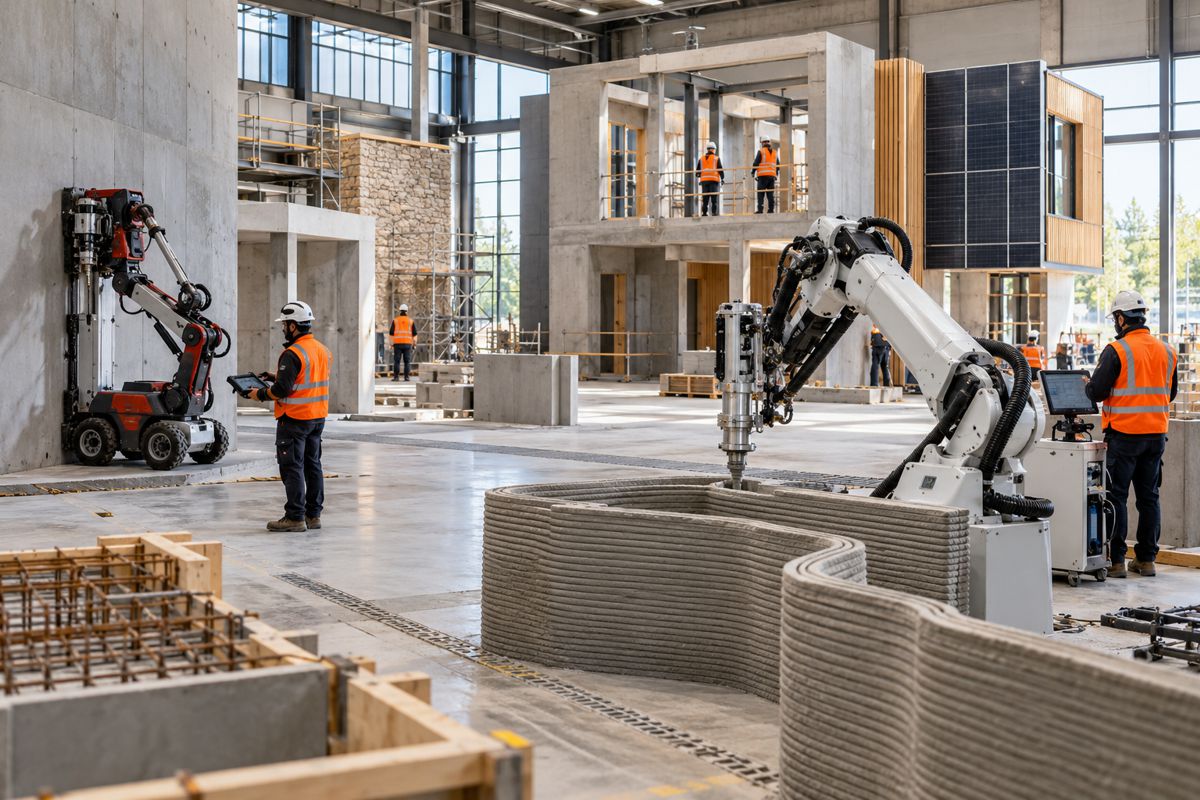
When Infrastructure Starts Listening
For years, smart cities were sold as something glossy, futuristic and just a little too neat. Control rooms with wall-sized screens. Autonomous vehicles gliding through traffic. Buildings talking to power grids. Sensors everywhere, apparently solving everything. Yet the most important shift now taking shape is far less glamorous and far more useful. It is maintenance.
Across roads, bridges, water networks and street lighting, AI infrastructure maintenance is moving from slide decks into the daily business of keeping cities working. Roads are being scanned by cameras mounted on ordinary municipal vehicles. Bridges are being monitored by strain gauges, fibre optic sensors, GNSS receivers and machine learning models. Water utilities are listening for hidden leaks through acoustic devices and permanent sensors. Streetlights, once little more than powered poles, are becoming monitored assets, digital nodes and maintenance triggers in their own right.
That does not mean cities are literally repairing themselves. Crews still have to patch the asphalt, replace the valve, strengthen the bridge, repair the cable and sign off the job. But the timing is changing. So is the intelligence behind the decision. The gap between deterioration and intervention is narrowing, and that changes the economics of public works.
In practical terms, the “self healing city” is shorthand for an urban network that can sense degradation earlier, interpret it faster, rank risk more intelligently and spend maintenance money before a fault becomes a closure, outage, burst main or political embarrassment. The OECD has described data-driven transport infrastructure maintenance as a growing policy priority, while the World Bank has backed the G20 view that maintenance should be treated as an investment rather than merely the cost of keeping assets in service.
The financial pressure behind this shift is enormous. ASCE’s 2025 Report Card for America’s Infrastructure gave the United States its highest grade since the report began in 1998, a C, yet still identified a $3.7 trillion gap between planned investment and what is needed to bring infrastructure into good working order. The Global Infrastructure Hub has also been associated with estimates of a global infrastructure investment gap running into the trillions by 2040, a figure that helps explain why owners are searching for better ways to preserve assets already in the ground.
For construction professionals, investors and policymakers, the lesson is plain enough. The next big infrastructure story is not only about building more. It is about making existing assets last longer, fail less often and cost less to operate over their full life. In that world, predictive maintenance roads, smart city sensors and AI-enabled asset management are not fashionable extras. They are becoming the nervous system of modern infrastructure.
Briefing
- Maintenance is shifting from corrective and complaint-led repair towards condition-based and predictive intervention.
- Roads are proving the easiest starting point because existing municipal fleets can collect visual defect data at scale.
- Bridges remain the highest-value use case because sensor data can reduce uncertainty around fatigue, displacement and structural deterioration.
- Water utilities are using acoustic sensing, smart meters and permanent leak detectors to find losses before they surface.
- Smart street lighting is evolving into a wider maintenance platform, linking outage detection, dimming, asset tracking and urban sensing.

Maintenance budgets are being rewritten
The financial logic begins with a simple distinction. Corrective maintenance happens after something has already gone wrong. Preventive maintenance aims to stop that failure before it happens. Condition-based and predictive maintenance go further still, using data to decide when, where and how intervention should take place.
That sounds technical, but it is really an accounting shift. Once an asset owner can see deterioration in near real time, maintenance stops being a vague annual allowance and starts becoming a measurable risk management exercise. Roads, bridges, pipes and lights are no longer just physical assets. They become data-producing assets, each with its own condition profile, failure probability and intervention window.
The World Bank’s summary of the G20 maintenance agenda put it neatly, arguing that governments should view infrastructure maintenance “not just as the cost of keeping assets in good order, but rather as an investment”. That reframes a long-standing political weakness. Prevented failures rarely produce ribbon cuttings. Emergency repairs almost always do. The result, too often, is a bias towards visible crisis spending rather than quiet prevention.
The costs of that bias are not abstract. ASCE’s 2025 assessment found that, despite recent investment, the United States still faces a huge gap in getting infrastructure into good working order. Bridges alone carry a heavy burden. FHWA-linked bridge estimates cited by ASCE-related reporting put system rehabilitation needs at around $191.3 billion, with poor bridge replacement costs estimated at $69.7 billion.
Water tells the same story in a different language. Hidden leakage drains treated water, energy, chemicals and public confidence. PUB, Singapore’s National Water Agency, supplies potable water through a 6,000 km pipeline network and has renewed more than 330 km of pipes since 2016 as part of a targeted maintenance programme using data analytics, pipe condition assessment and leak detection.
This is where AI infrastructure maintenance starts to earn its keep. The value is not in replacing engineers with algorithms. It is in giving engineers better evidence earlier. A model that flags a road section likely to fail after repeated freeze-thaw cycles, a bridge sensor that shows abnormal movement, or a water meter that detects suspicious night-time flow can change the maintenance conversation from “what broke?” to “what is most likely to break next?”
That shift has commercial consequences. Contractors are no longer being asked only to repair. They are being asked to inspect, classify, monitor, report, forecast and prove value. Technology providers are not simply selling dashboards. They are selling evidence chains, integration, cybersecurity, service support and credibility. For investors, better condition data can influence risk pricing, lifecycle cost modelling and asset valuation.
The industry has talked for years about whole-life value. Predictive maintenance is one of the first practical routes to making that phrase mean something in day-to-day operations.

Roads become the first proving ground
Roads are the obvious place to start because they are visible, politically sensitive and comparatively easy to monitor at scale. They also generate a constant stream of public frustration. Every pothole is a small failure of maintenance made visible to thousands of drivers.
Traditional road inspection is labour-intensive and uneven. Inspectors drive routes, log defects, respond to complaints and make judgement calls. That work is still vital, but it struggles to keep pace with large networks, limited staff and fast-changing surface conditions. The OECD has highlighted the potential of data-driven transport maintenance to improve how owners target interventions, particularly where digital technologies can support more consistent assessment.
The breakthrough is not that road scanning technology exists. Laser surveys, ground penetrating radar and specialist inspection vehicles have been around for years. The more interesting development is lower-cost sensing mounted on vehicles already moving through the city. Refuse trucks, buses, inspection vans, sweepers and council vehicles can all become rolling survey platforms.
Memphis, Tennessee, offers a practical example. The city has more than 6,800 lane miles of public streets and historically relied on street maintenance crews to find and fill potholes. Google’s public sector case study says AI-enabled road monitoring helped Memphis identify 75 per cent more potholes, with the city expecting better prioritisation of maintenance and potential savings on claims linked to vehicle damage.
The operational point is more important than the technology label. A pothole detected by AI is not fixed by AI. But it can be located, photographed, mapped, classified and added to a prioritised work queue before a resident complains or a claim lands on a city desk. That is not glamorous, but it is useful.
New South Wales is pushing the idea further through Asset AI, a smart places case study using cameras and sensors fitted to council vehicles. The programme is designed to help councils detect potholes and cracks, identify triggers for road defects, schedule preventive maintenance and improve public asset management efficiency.
Shellharbour City Council gives the same idea a local government flavour. Its AI camera system captures road, footpath and roadside defects, maps them with GPS and ranks them by severity. The system can also flag faded line markings, damaged signage, graffiti, vegetation overhang and uneven surfaces. Mayor Chris Homer summed up the payoff simply: “We’re able to identify hazards, triage them and better forward-plan works.”
The United Kingdom shows why this matters politically. Potholes have become a permanent national irritation, but the larger problem is asset deterioration. Funding increases help, but without reliable condition data, councils can still end up chasing visible failures rather than managing networks strategically. Linking funding to evidence of proactive maintenance and condition reporting is likely to become more common, not less.
Roads are, in effect, the gateway into the self healing city. They are the easiest asset class for AI infrastructure maintenance to prove itself on because the data is visual, the defects are familiar and the public impact is immediate. Once a city gets used to geotagged defects, severity scoring and evidence-led work orders, it becomes easier to apply the same logic elsewhere.
Bridges move from inspection cycles to continuous assurance
If roads are the easiest use case, bridges are the highest-stakes one. A failed road surface creates disruption, cost and danger. A failed bridge can be catastrophic.
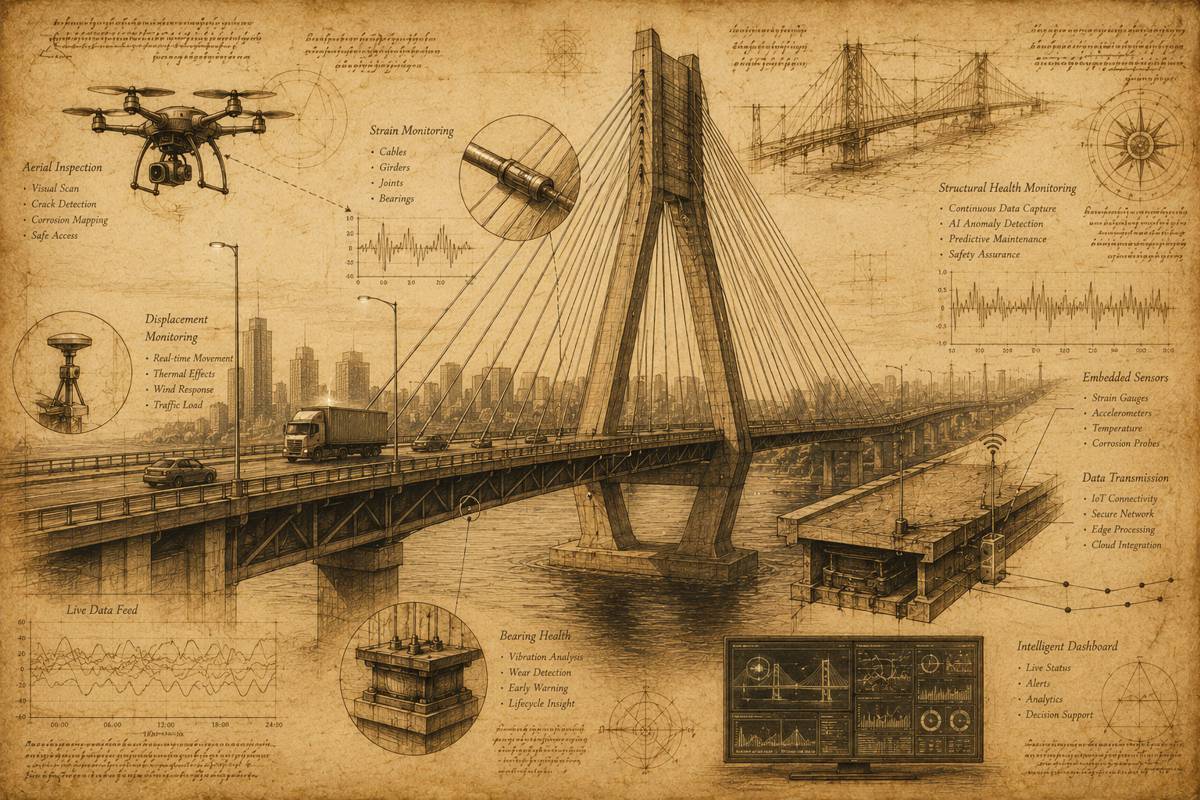
Bridge inspection has always required judgement, experience and caution. Traditional inspection cycles remain essential, but they can struggle with hidden fatigue, corrosion, movement, weather exposure and access constraints. Sensors do not remove that complexity. They make it more visible.
A 2024 review in Automation in Construction identified three broad areas where AI is reshaping bridge structural health management: computer vision for visual inspection, better use of structural health monitoring sensor data, and improved deterioration prediction and risk assessment. The Federal Highway Administration is also continuing work on non-destructive evaluation for bridges, tunnels and pavements to support better performance and lifecycle cost management.
Recent failures have sharpened the debate. The 2018 collapse of the Morandi Bridge in Genoa and the 2024 collapse of the Francis Scott Key Bridge in Baltimore were very different events, but both forced renewed attention on critical crossings, monitoring, resilience and risk. As bridge engineer Anil Agrawal put it: “The only way to prevent a collapse is to understand how a bridge can collapse.”
Long-span bridges have become global reference cases. Tsing Ma Bridge in Hong Kong has been monitored since 1997 and is widely cited as an important example of long-term structural health monitoring. Research published in 2025 on 26 years of field data found that the bridge’s overall condition remained very satisfactory, while the monitoring record helped distinguish structural behaviour from environmental effects such as temperature, typhoons and traffic loading.
The Forth Road Bridge in Scotland shows how real-time monitoring can support operational decisions. A European Space Agency case study describes the use of GNSS receivers and wind meters to provide real-time indicators of bridge movement. Bridgemaster Barry Colford described the value clearly: “This information is extremely useful for understanding how much the bridge can move under extreme weather conditions.”
That is the key phrase: understanding how much the bridge can move. Maintenance is not only about spotting visible damage. It is about knowing what is normal, what is abnormal and what demands action. With enough historical data, owners can begin to separate genuine structural concern from environmental noise.
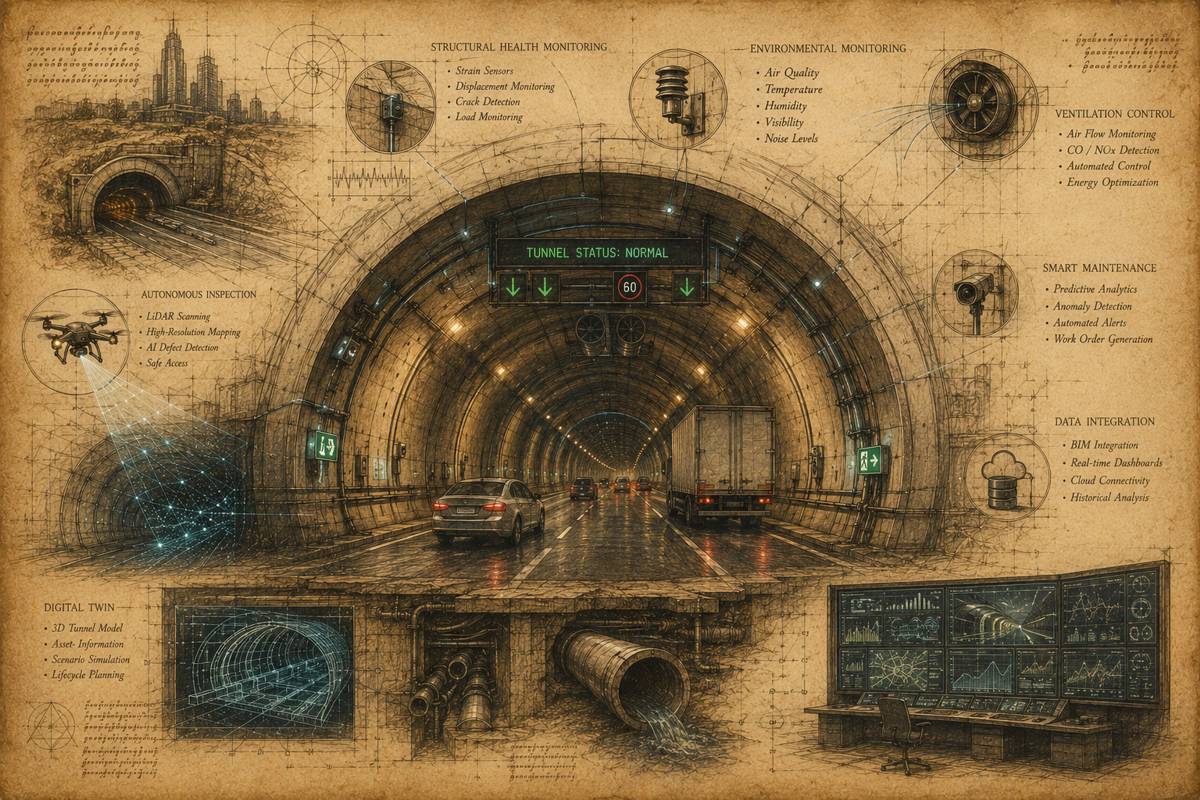
Fibre optic sensing is pushing this further. Distributed fibre optic sensing can measure strain and movement across long distances, while fibre Bragg grating sensors can support continuous monitoring on steel and concrete elements. Research in Oklahoma on the I-35 bridge over Walnut Creek in Purcell paired fibre Bragg grating sensors with unsupervised machine learning models for automated damage detection under real field conditions.
This is not just for landmark crossings. In fact, the biggest prize may sit in the ordinary bridge stock: ageing, hard to access, exposed to traffic, weather, de-icing salts and budget pressure. Routine bridges rarely receive the same attention as icons, yet they carry daily economic life. AI and sensor-based monitoring could help owners prioritise limited funds with far greater confidence.
There is also a materials story emerging. Self-healing concrete, including bacterial and capsule-based systems, is moving from laboratory research into field trials. Cardiff University has led UK work on real-world trials of self-healing concrete techniques, while international research continues into materials that can seal microcracks and reduce water ingress. This is still not a replacement for inspection and repair, but it points towards a future where materials, sensors and analytics work together.
For bridge owners, the direction of travel is clear. The old model is periodic inspection supported by engineering judgement. The new model is engineering judgement supported by continuous evidence.
Water networks stop leaking in silence
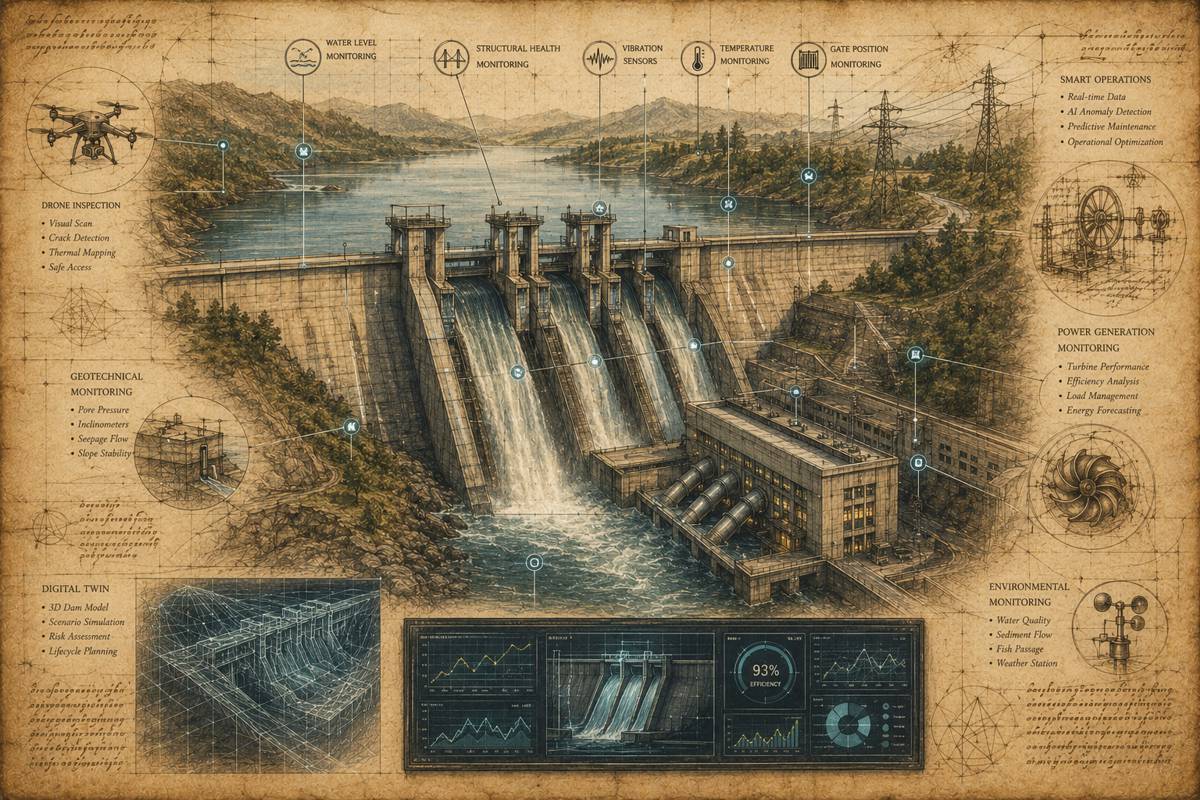
Water may be the most persuasive case for the self healing city because so much of the problem is buried. A road defect can be seen. A failed streetlight is obvious. A bridge crack may be accessible to inspection. But a leaking main can remain hidden underground until pressure drops, water surfaces or a pipe bursts.
The World Bank has estimated that developing countries lose around 45 million cubic metres of water every day through non-revenue water, with an economic value of more than US$3 billion a year. Reducing those losses can improve service quality, strengthen utility finances and delay or reduce the need for new supply infrastructure.
Acoustic sensing is one of the practical tools changing the picture. Noise loggers and acoustic devices can be attached to hydrants, valves and pipe fittings to detect the sound profile of escaping water. Left in place, they can collect data during low-use hours and help narrow the location of hidden leaks before excavation begins.
Singapore’s PUB is one of the clearest public examples. The agency says it uses data analytics and pipe condition assessment to identify at-risk pipes for renewal. Since 2016, it has renewed more than 330 km of pipes, while its leak detection programme uses acoustic data loggers, smartphone-based acoustic devices and 1,500 permanent leak detection sensors across the network.
PUB’s 2025 Global Innovation Challenge also shows how the agenda is moving from detection to faster intervention. The agency noted that its potable water network runs to around 6,000 km and that, despite acoustic devices and permanent sensors, urgent repair works can still disrupt customers. Its challenge statements sought solutions to reduce repair time, minimise disruption and improve operational resilience.
Smart meters extend the same logic to the customer edge. By recording consumption more frequently and transmitting data remotely, utilities can detect unusual usage patterns and suspected leaks. That creates value for both the network operator and the customer, particularly where small leaks would otherwise continue unnoticed for weeks or months.
The strongest water utilities are not pretending pipes will repair themselves. They are using sensors, analytics and asset data to make the invisible visible. Leaks that once announced themselves through a burst, a sinkhole or a complaint can now appear first as an acoustic signature, a pressure anomaly or an unexplained flow pattern.
The construction and civil engineering implications are significant. Better leak detection changes excavation planning, emergency response, renewal priorities and contractor mobilisation. It can also reduce the social cost of water works by narrowing repair zones and cutting the number of unnecessary digs.
As Gurdev Singh, PUB’s Chief Engineering and Technology Officer, said of the agency’s innovation drive: “We view technology as an enabler in enhancing our operational resilience and productivity.”
That phrase could apply across the whole self healing city. Technology is not the purpose. Resilience and productivity are.

Smart lighting becomes the urban maintenance backbone
Street lighting has become one of the most useful platforms in the smart city stack because it already occupies the right geography. Lighting columns are distributed, powered, publicly owned or publicly managed, and positioned across roads, footways and public spaces. That makes them attractive hosts for sensors, communications equipment, outage detection, dimming systems and asset tracking.
The Global Infrastructure Hub has described smart street lighting as a technology use case that can go beyond illumination, supporting energy efficiency, remote monitoring and wider urban management. At its most basic, smart lighting helps cities reduce power consumption and identify failed lamps without waiting for complaints. At its most ambitious, it becomes a citywide maintenance and sensing platform.
Chennai, India, shows the scale of the opportunity. C40 Cities has reported on a smart LED street lighting programme covering a large municipal lighting estate, including LED conversion, centralised monitoring, proactive maintenance and optimisation using traffic and daylight sensors. The city’s lighting estate runs to hundreds of thousands of streetlights, making even modest efficiency gains financially meaningful.
In Schenectady, New York, the city’s smart lighting programme highlights dimming, scheduling, outage monitoring, energy consumption monitoring and asset tracking. Automated fixture failure detection allows proactive repairs rather than relying on public reports. The same pattern appears again: a passive asset becomes a data-producing asset, and maintenance shifts from reactive to managed.
Barcelona has often been cited as an early smart lighting example, with LED streetlamps and sensors supporting dimming, remote management and urban data collection. The key lesson from Barcelona and similar schemes is not simply that cities can save energy. It is that the lighting network can become a digital spine for other services.
That creates opportunity, but also risk. A streetlight used only to report lamp failure is one thing. A streetlight carrying cameras, microphones or other sensing equipment is another. San Diego’s experience underlines the point. The city installed thousands of smart streetlights, then later faced public concern after police access to camera data became a civil liberties issue. The revised programme came with stricter governance and oversight. Mayor Todd Gloria defended the relaunch by saying: “Smart Streetlights and ALPR technology have proven to be essential tools for our police officers, helping to quickly identify suspects and solve crimes.”
Whatever view one takes on the public safety argument, the infrastructure lesson is unavoidable. Sensor networks require consent, governance and clear limits. Maintenance technology can lose public trust quickly if residents believe it has become surveillance by stealth.
For asset owners, that means smart lighting procurement has to cover far more than luminaires, gateways and software. It needs data retention rules, access controls, cybersecurity standards, workforce training, incident management and public communication. A smart pole without governance is not smart infrastructure. It is a future argument waiting to happen.
Procurement is becoming more demanding
The self healing city will not be delivered by sensors alone. It needs procurement models that reward outcomes, data quality and lifecycle performance rather than hardware counts.
That is a major shift for public works. Traditional maintenance contracts often focus on tasks, schedules and response times. Predictive maintenance contracts need to define condition thresholds, data ownership, interoperability, audit trails, cybersecurity responsibilities and the line between automated recommendation and engineering decision.
The OECD has warned that data-driven maintenance requires care around data quality, privacy, regulation, skills and organisational capacity. Poor data can produce false confidence. Weak models can misclassify defects. Black-box systems can leave public agencies dependent on vendors they do not fully understand.
This is where the construction sector has an opening. Contractors with genuine asset management capability, digital inspection workflows, field repair capacity and data governance discipline will be better placed than firms offering only reactive repair. The same applies to consultants and technology providers. The winning proposition will combine domain knowledge with analytics, not replace one with the other.
Cybersecurity is becoming inseparable from maintenance. A bridge sensor, water network monitor or street lighting controller is no longer just a device. It is an entry point into a critical system. That means authentication, encryption, vulnerability management, patching and incident response have to be built into contracts from the start.
Labour is part of the story too. Predictive maintenance does not remove the need for skilled people. It changes what those people need to do. Inspectors, technicians and engineers will increasingly be asked to validate AI flags, interpret dashboards, challenge anomalies and understand when a model is wrong. The most valuable worker may be the one who can combine practical field judgement with digital fluency.
That matters because infrastructure failure is rarely caused by one missing sensor or one poor inspection. It is usually the result of weak signals being missed, underweighted or trapped in the wrong part of an organisation. The self healing city depends on connecting those signals to decisions, budgets and crews.
The maintenance economy comes into view
For the global construction and infrastructure ecosystem, this is the bigger story. AI infrastructure maintenance is not simply a smart city subplot. It is becoming a market in its own right.
Road owners need pavement intelligence. Bridge authorities need structural health monitoring. Water utilities need leak detection and pipe condition analytics. Lighting managers need remote monitoring and energy optimisation. Cities need platforms that turn all of this into work orders, budget forecasts and procurement evidence.
Investors should be paying attention because maintenance intelligence changes asset risk. A concessionaire with reliable condition data should be able to defend lifecycle spending more convincingly. A water utility that can reduce non-revenue water improves both operational resilience and financial performance. A road authority that can prioritise interventions earlier can make limited maintenance budgets go further.
Policymakers should be paying attention because deferred maintenance is a hidden liability. It does not disappear because budgets are tight. It compounds. Eventually, it reappears as emergency repair, service failure, public anger or accelerated replacement cost.
Contractors should be paying attention because the repair market is becoming more data-led. A crew may still patch the pothole, repair the pipe or replace the luminaire, but the work is increasingly triggered, prioritised and documented through digital systems. That changes margins, reporting requirements and competitive advantage.
There is a useful warning in all this. The self healing city should not become another overpromised technology phrase. Cities do not need more jargon. They need fewer failures, better records, safer assets and maintenance budgets that stand up to scrutiny. Sensors and AI can help, but only when they are tied to clear operational decisions.
The best examples share the same pattern. Memphis uses AI to find more potholes before complaints dominate the process. New South Wales uses vehicle-mounted sensing to improve road condition intelligence. Singapore uses acoustic detection and data analytics to manage water pipe risk. Long-span bridges such as Tsing Ma and the Forth Road Bridge show how monitoring can support assurance. Smart lighting programmes show how distributed assets can report their own condition.
Together, these are not isolated pilots. They are early signs of a different operating model.
Infrastructure starts to listen
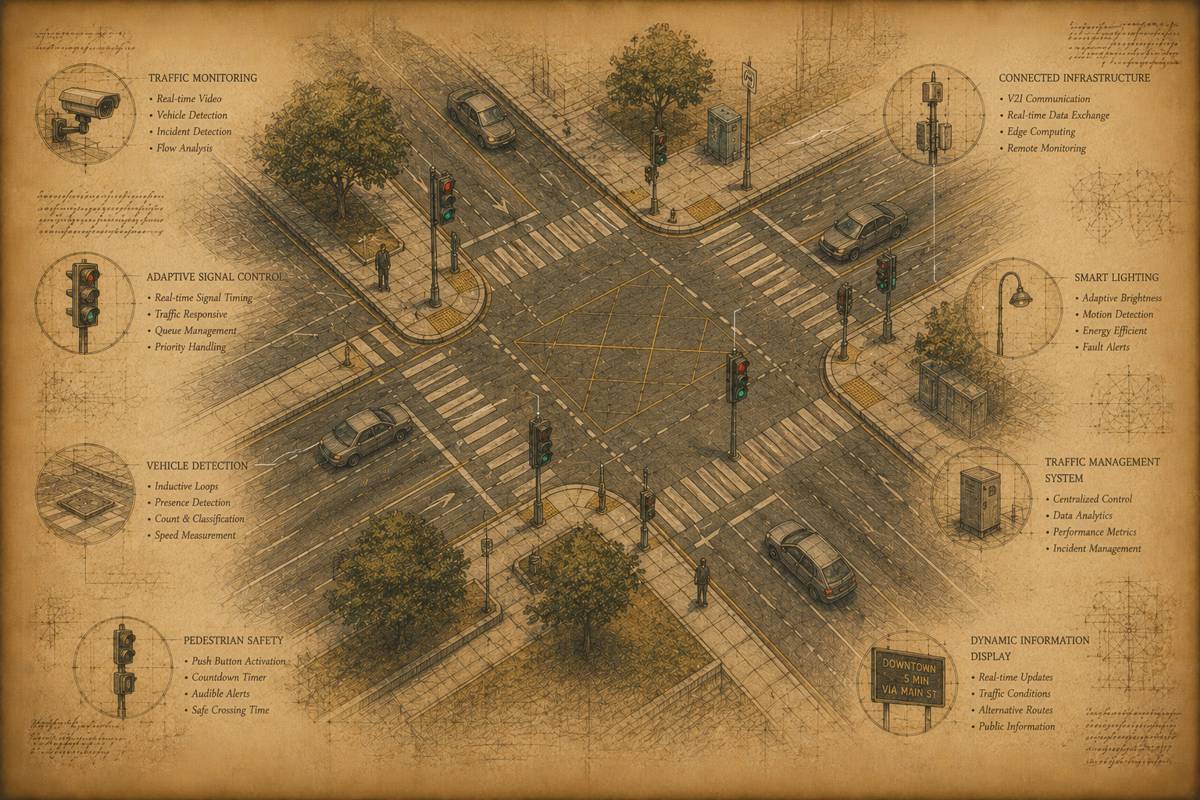
A decade from now, roads that report cracks, bridges that track fatigue, pipes that flag hidden leaks and streetlights that open their own repair tickets may feel as ordinary as traffic signals and CCTV do today.
The important point is that maintenance is becoming measurable, strategic and commercially significant. Public works is beginning to move away from a cycle of complaints, patrols and emergency repairs towards a discipline built on evidence, risk and earlier intervention.
That will not remove the need for asphalt crews, bridge engineers, utility workers or lighting technicians. Quite the opposite. It will make their work more targeted and, potentially, more valuable. The city may sense the problem, but people still have to understand it, prioritise it and fix it properly.