JCB to Showcase Their Largest Ever X Series Excavator at Hillhead
The global quarrying, aggregates and recycling sectors continue to face a familiar challenge: producing more material with fewer operators, tighter environmental constraints and rising pressure to maximise equipment utilisation. Manufacturers are increasingly focusing on larger, more productive machines capable of delivering higher output while integrating advanced digital management systems that reduce downtime and improve operational oversight.
JCB’s plans for Hillhead 2026 in the UK provide a clear indication of where the market is heading. The company will use the exhibition to introduce its largest crawler excavator to date while expanding its presence across earthmoving, compaction and articulated hauling. The announcements reflect a broader industry trend towards larger, more specialised equipment supported by connected technologies and streamlined aftermarket services.
For quarry operators, contractors and recycling businesses, the significance extends beyond the launch of individual machines. It signals continued competition within the heavy equipment sector, where manufacturers are investing heavily in productivity gains, machine intelligence, operator safety and lifecycle support as infrastructure demand remains robust across many global markets.
Briefing
- JCB will debut the new 520X, its largest and most powerful X Series crawler excavator to date.
- The company is also introducing the new 420X crawler excavator for demanding quarrying, demolition and extraction work.
- New additions include the VM138D single drum soil compactor and the 715 articulated dump truck.
- JCB’s Dual Drive technology continues to expand with the latest 9T site dumper design.
- Digital developments include enhanced LiveLink telematics capabilities and the new Parts Online e-commerce platform.
Heavy Excavation Takes Centre Stage
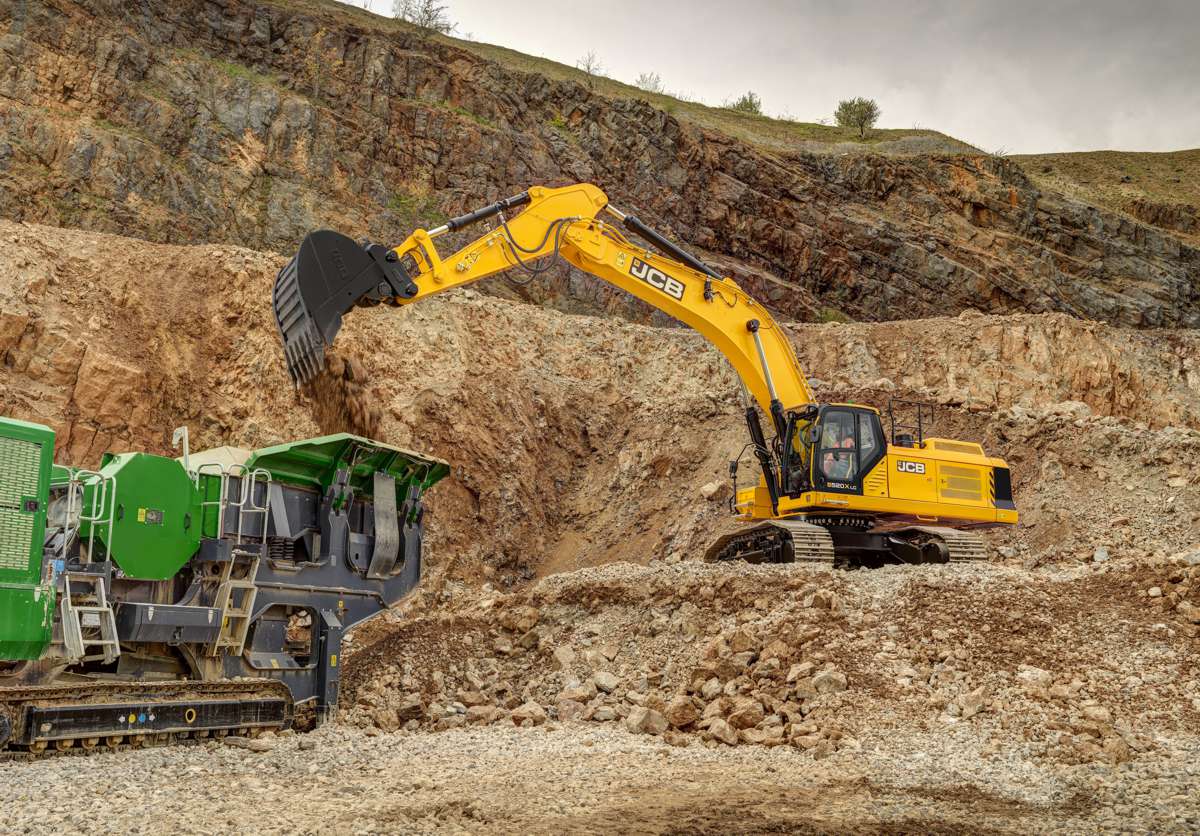
The headline attraction at Hillhead will undoubtedly be the new 520X crawler excavator. Entering the 50-tonne class, the machine represents the largest and most powerful model yet developed within JCB’s X Series excavator range and marks a significant expansion of the company’s Heavyline portfolio.
The introduction places JCB into a segment traditionally dominated by established heavy excavation specialists. Machines in the 50-tonne category are typically deployed on large-scale quarry operations, major infrastructure schemes, bulk earthworks projects and mining-related applications where productivity is measured in thousands of tonnes moved per shift rather than cubic metres per hour.
Demand for larger excavators has been steadily growing across international markets. Infrastructure investment programmes in regions including North America, the Middle East and parts of Asia continue to drive requirements for high-capacity excavation equipment. Large transportation projects, energy developments and resource extraction activities increasingly rely on machines capable of sustained production in demanding operating environments.
For equipment manufacturers, participation in this segment carries strategic importance. Larger excavators often serve as flagship models that showcase engineering capability while providing access to higher-value sales opportunities and long-term aftermarket support contracts.
The New 420X Strengthens the Heavyline Range
Alongside the 520X, JCB will unveil the new 420X crawler excavator, further strengthening its presence in the heavy excavation market.
Building on the platform established by the 370X, the 420X has been designed for intensive applications including mass excavation, aggregate extraction, demolition operations and crusher loading. These activities place substantial demands on machine structures, hydraulic systems and powertrains, requiring robust engineering capable of maintaining productivity under continuous operating conditions.
The launch reflects wider changes occurring throughout the quarrying and recycling sectors. Modern extraction sites are under pressure to improve operational efficiency while simultaneously addressing fuel consumption, emissions targets and labour shortages. Equipment capable of delivering greater productivity per operator has become increasingly attractive as businesses seek to optimise operational costs.
Heavy crawler excavators play a central role in these environments. Whether feeding crushers, loading articulated dump trucks or undertaking bulk excavation work, machine uptime and reliability have direct implications for overall site profitability. Consequently, manufacturers continue investing heavily in durability, operator comfort and machine monitoring systems that minimise unplanned downtime.
Growth in the Compaction Equipment Market
JCB’s exhibition presence will extend beyond excavation equipment with the introduction of the VM138D single drum soil compactor.
Compaction remains one of the most critical stages in infrastructure construction. From highway embankments and airport developments to industrial sites and renewable energy projects, achieving specified soil densities is essential for long-term structural performance.
Global demand for compaction equipment continues to benefit from extensive infrastructure investment. According to industry analysts, road construction, transportation upgrades and urban development projects are supporting steady growth across the compaction machinery sector worldwide.
The VM138D enters a market where operators increasingly expect integrated machine control systems, fuel-efficient operation and simplified maintenance access. Modern compactors are expected not only to achieve target compaction levels efficiently but also to provide data that supports quality assurance and project documentation requirements.
As infrastructure projects become increasingly data-driven, equipment that contributes to digital workflows is becoming more valuable throughout the construction supply chain.
Dual Drive Technology Advances Site Safety
Operator visibility and workplace safety remain major priorities across construction and quarrying operations. The latest evolution of JCB’s Dual Drive technology, featured on the 9T site dumper, addresses both considerations directly.
The system enables operators to rotate their seat and controls so they are always facing the direction of travel. Derived from technology already established within the company’s Dual Drive backhoe loader range, the concept seeks to reduce visibility restrictions associated with traditional dumper operation.
Site transport accidents remain a significant concern throughout the construction industry. According to guidance from organisations such as the UK’s Health and Safety Executive, visibility limitations and reversing manoeuvres continue to contribute to workplace incidents involving mobile plant.
Manufacturers have responded through a combination of camera systems, proximity detection technologies, improved cab design and alternative operating concepts. Rotating operator stations represent one approach that aims to provide a more natural driving position while enhancing situational awareness.
As project owners and contractors place increasing emphasis on safety performance, innovations that improve operator visibility are likely to become increasingly influential in equipment procurement decisions.
A New Compact Articulated Hauler Joins the Line-up
JCB will also provide an early preview of its forthcoming 715 articulated dump truck, introducing a compact two-axle articulated hauler designed for off-road material transport.
With a payload capacity of 12,750kg, the machine targets applications requiring efficient movement of material across challenging terrain while maintaining rapid cycle times. Compact articulated dump trucks occupy an important niche within construction, quarrying and infrastructure projects where larger haulers may be unsuitable due to restricted site conditions or transport constraints.
The articulated dump truck market continues to evolve as contractors seek greater flexibility from hauling fleets. Modern projects often require equipment capable of operating efficiently across varying ground conditions, steep gradients and confined work areas.
Advances in transmission technology, traction control systems and operator environments have improved productivity while reducing operator fatigue. Manufacturers are simultaneously focused on lowering fuel consumption and simplifying maintenance procedures to improve total cost of ownership.
The arrival of the 715 demonstrates JCB’s intention to broaden its presence within the articulated hauling sector while complementing its wider earthmoving product portfolio.
Digital Services Become Core to Equipment Ownership
Although new machinery will attract considerable attention, JCB’s latest digital developments may prove equally important from a commercial perspective.
The company’s aftersales team will use Hillhead to showcase enhancements to the LiveLink telematics platform alongside the launch of a new Parts Online e-commerce service providing access to more than 50,000 genuine parts and attachments.
Telematics systems have become a standard feature across modern construction fleets. Once viewed primarily as location tracking tools, contemporary platforms provide extensive operational intelligence including utilisation rates, fuel consumption data, maintenance scheduling and machine health monitoring.
Industry research consistently highlights growing adoption of connected equipment technologies as contractors seek greater visibility across dispersed fleets. Predictive maintenance capabilities, remote diagnostics and performance analytics increasingly influence purchasing decisions alongside traditional considerations such as power, capacity and reliability.
Parts procurement is undergoing similar transformation. Digital ordering systems allow equipment owners to identify, source and order components around the clock, reducing administrative overhead and potentially minimising machine downtime.
For large fleet operators managing equipment across multiple locations, integration between telematics data and aftermarket support services is becoming increasingly valuable. The ability to identify maintenance requirements and rapidly source replacement parts can significantly influence fleet availability and operating costs.
Hillhead Highlights the Future Direction of Heavy Equipment
Hillhead has long served as a showcase for emerging developments within quarrying and construction equipment, and JCB’s 2026 exhibition plans provide insight into broader industry priorities.
The emphasis on larger excavators reflects continuing demand for higher productivity in extraction and infrastructure projects. Simultaneously, developments in operator safety, machine connectivity and digital support services demonstrate how equipment ownership is becoming increasingly technology-driven.
Rather than focusing solely on horsepower and lifting capacity, manufacturers are now competing across a wider range of performance indicators. Productivity, operator experience, fleet visibility, maintenance efficiency and lifecycle cost management all play growing roles in purchasing decisions.
JCB’s latest launches illustrate this evolution clearly. From the flagship 520X excavator to telematics enhancements and online parts ordering, the common thread is operational efficiency. For quarry operators, contractors and infrastructure developers navigating increasingly competitive markets, that combination of productive machinery and connected support systems is becoming as important as the equipment itself.