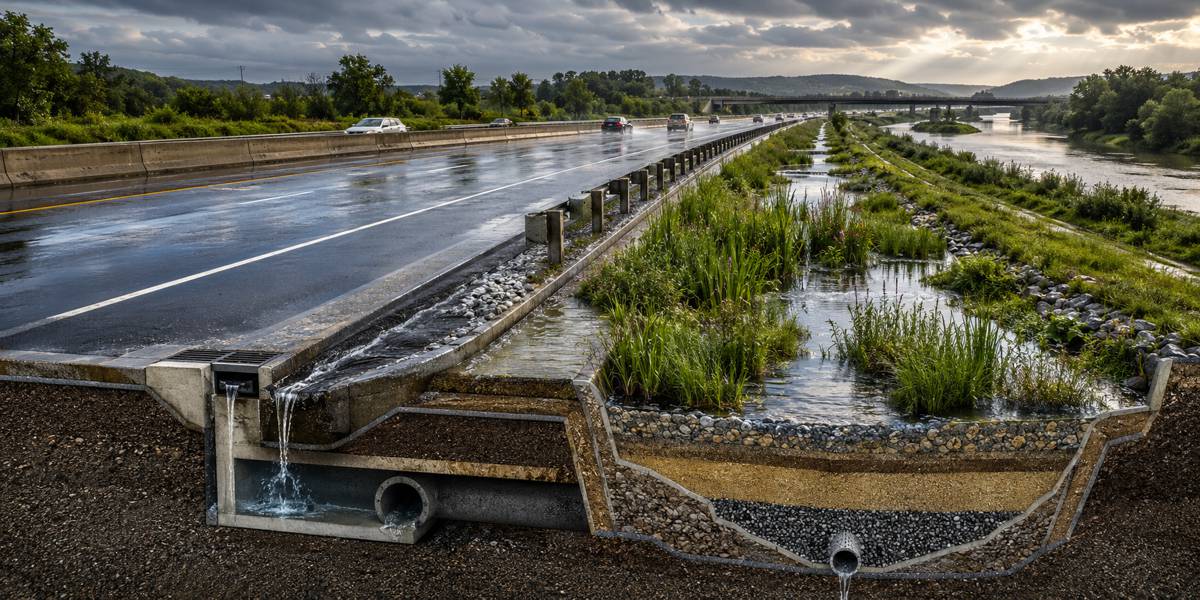
Cleaning Up Highway Runoff and Stormwater Pollution
Road networks are among the most visible pieces of public infrastructure, yet one of their most significant environmental impacts often goes unnoticed. Every rainfall event washes contaminants from pavement surfaces into drainage systems, streams, rivers, lakes and coastal waters. Tyre wear particles, brake dust, sediment, heavy metals, hydrocarbons, de-icing chemicals and other pollutants are carried away in highway stormwater runoff, creating a complex challenge for transportation agencies tasked with balancing mobility, safety and environmental protection.
A newly released report from the National Academies of Sciences, Engineering, and Medicine has placed this issue firmly in the spotlight. Commissioned by the United States Congress, the study examines how state departments of transportation (DOTs) estimate, manage and regulate pollutant loads in highway stormwater runoff under the requirements of the federal Clean Water Act. It finds that while substantial progress has been made, significant knowledge gaps remain regarding pollutant behaviour, monitoring methods and treatment effectiveness.
For transport agencies worldwide, the findings resonate far beyond the United States. As governments invest heavily in infrastructure modernisation, climate resilience and environmental stewardship, understanding how roads interact with surrounding ecosystems is becoming an increasingly important part of infrastructure planning and management. The report highlights not only regulatory challenges but also emerging opportunities to improve stormwater management through better science, improved monitoring technologies and more effective treatment systems.
Briefing
- New National Academies report examines how US state DOTs manage highway stormwater pollution under Clean Water Act requirements.
- Current stormwater infrastructure does not adequately remove all contaminants found in highway runoff.
- Significant gaps exist in data collection, pollutant monitoring and load estimation methodologies.
- Researchers recommend improved evaluation tools, enhanced monitoring approaches and stronger federal support for transportation agencies.
- Findings have implications for road authorities globally as environmental regulations and climate resilience requirements continue to evolve.
Highway Stormwater Is an Infrastructure Challenge Hiding in Plain Sight
Road drainage systems are traditionally associated with safety. Their primary function is to move water away from pavement surfaces quickly enough to reduce hydroplaning risks, prevent structural deterioration and maintain reliable transport operations. Yet these systems also serve as pathways through which pollutants can enter natural waterways.
The scale of the challenge is considerable. Modern highways accumulate contaminants continuously from vehicle operations, atmospheric deposition, maintenance activities and adjacent land uses. Rainfall events mobilise these pollutants, transporting them through drainage networks and ultimately into receiving waters. The composition of runoff varies depending on traffic volumes, vehicle types, weather patterns, local geology and surrounding development.
Research conducted internationally has identified a broad range of contaminants associated with road runoff. Common pollutants include suspended sediments, zinc and copper from tyre and brake wear, petroleum hydrocarbons, nutrients, chloride from winter maintenance operations and increasingly scrutinised microplastics generated by tyre abrasion. While many stormwater treatment systems remove a portion of these contaminants, effectiveness varies significantly depending on pollutant type, rainfall intensity and system design.
The National Academies report notes that transportation agencies continue to face difficulties accurately estimating pollutant loads and determining the effectiveness of management measures. These uncertainties complicate compliance efforts and can limit confidence in environmental performance assessments.
Understanding Pollutant Loads Remains a Scientific Challenge
One of the central themes emerging from the report is the difficulty associated with measuring and predicting pollutant loads in highway runoff. Transportation agencies typically rely on monitoring programmes, modelling tools and statistical methods to estimate the quantity of contaminants entering waterways.
However, highway environments present unique complexities. Pollutant generation rates can vary substantially between locations and seasons. Traffic patterns fluctuate. Storm events differ in intensity, duration and frequency. Even within a single watershed, runoff characteristics can change dramatically depending on road design, pavement condition and surrounding land use.
These variables create uncertainty when attempting to develop reliable pollutant load estimates. The report evaluates the methods currently used by state DOTs and identifies opportunities for improvement in both data collection and analytical approaches.
Improved understanding of pollutant transport mechanisms is increasingly important as environmental regulations evolve. Regulators and infrastructure owners alike require greater confidence in performance assessments, particularly when significant investments are being made in stormwater management infrastructure.
The Growing Focus on Emerging Contaminants
Environmental concerns surrounding highway runoff have expanded considerably over the past decade. Historically, attention focused primarily on sediment control, nutrients and heavy metals. More recently, researchers have identified a broader range of contaminants associated with transportation corridors.
Among the most closely watched are tyre-derived particles and associated chemical compounds. Several international studies have investigated the environmental impacts of tyre wear particles, which represent a significant source of microplastic pollution in urban watersheds. Researchers continue to examine how these materials move through aquatic ecosystems and what ecological effects they may produce.
Brake wear particles have also received increasing attention. These particles contain various metals and compounds that can accumulate in sediments and aquatic environments. Understanding how such contaminants behave within stormwater systems remains an active area of scientific investigation.
The National Academies report highlights the need for continued research into pollutant movement and environmental effects. Enhanced scientific understanding will be essential for developing more effective management strategies and ensuring that regulatory frameworks remain grounded in sound evidence.
Stormwater Infrastructure Must Evolve Beyond Traditional Designs
Many existing stormwater management systems were designed primarily to address hydraulic performance rather than pollutant removal. Their objective was to prevent flooding, protect road assets and maintain safe operating conditions.
Modern environmental requirements demand a broader approach. Infrastructure increasingly must perform multiple functions simultaneously, including flood control, water quality improvement, habitat protection and climate resilience. This shift has prompted transportation agencies to explore a wider range of treatment technologies and design philosophies.
Common stormwater treatment measures include detention ponds, retention basins, vegetated swales, infiltration systems, constructed wetlands and filtration technologies. Each offers advantages and limitations depending on local conditions and target pollutants.
The effectiveness of these systems can vary substantially. Some perform well for sediment removal but are less effective for dissolved pollutants. Others provide strong hydraulic benefits but limited contaminant treatment. As a result, transportation agencies must carefully evaluate site-specific conditions when selecting management approaches.
The report encourages more rigorous assessment of treatment effectiveness and improved methods for comparing alternative compliance strategies. Better evaluation tools could help agencies optimise investments while achieving environmental objectives more consistently.
Federal Support and Coordination Play a Critical Role
The report does not focus solely on state transportation agencies. It also examines the role of federal institutions in supporting compliance efforts and advancing stormwater management knowledge.
Transportation agencies often face resource constraints when conducting extensive monitoring programmes or evaluating emerging treatment technologies. Federal support can help address these limitations through research funding, technical guidance and standardised methodologies.
Consistency is particularly important when comparing data across jurisdictions. Differences in monitoring protocols, analytical techniques and modelling assumptions can make it difficult to draw meaningful comparisons or identify best practices. Greater coordination between agencies may improve data quality and facilitate knowledge sharing.
Federal leadership can also accelerate innovation. By supporting research into emerging contaminants, advanced treatment technologies and improved modelling approaches, national agencies help create tools that individual transportation departments can deploy more effectively.
The National Academies report provides recommendations aimed at strengthening this support framework and improving collaboration between federal and state stakeholders.
Climate Change Adds Another Layer of Complexity
Stormwater management challenges are becoming increasingly intertwined with climate resilience planning. Across many regions, rainfall patterns are becoming less predictable, while extreme precipitation events are occurring more frequently.
These changes can affect both hydraulic performance and pollutant transport dynamics. More intense storms may generate larger runoff volumes, increase erosion and overwhelm existing treatment infrastructure. Longer dry periods between rainfall events may allow greater pollutant accumulation on road surfaces, potentially leading to higher contaminant concentrations during subsequent storms.
Infrastructure designers and asset managers must therefore consider future climate conditions when evaluating stormwater management strategies. Systems designed using historical rainfall assumptions may not perform as intended under changing environmental conditions.
This growing uncertainty reinforces the report’s emphasis on improved monitoring, adaptive management and stronger scientific foundations. Agencies require robust data to understand evolving risks and ensure that investments remain effective throughout infrastructure lifecycles.
Digital Technologies Could Transform Stormwater Management
Advances in sensing technologies, data analytics and digital infrastructure offer promising opportunities for improving stormwater management outcomes. Transportation agencies are increasingly adopting intelligent monitoring systems capable of collecting real-time environmental data across large networks.
Remote sensors can measure rainfall, water quality parameters, flow rates and treatment system performance continuously. Combined with geographic information systems, predictive modelling and artificial intelligence tools, these technologies enable more detailed understanding of pollutant movement and treatment effectiveness.
Such capabilities align closely with broader smart infrastructure trends already reshaping transportation asset management. Data-driven decision making allows agencies to prioritise investments more effectively, identify underperforming assets and optimise maintenance programmes.
While the National Academies report focuses primarily on regulatory and scientific considerations, its recommendations support the development of more evidence-based management frameworks. Digital technologies are likely to play an increasingly important role in achieving those objectives.
Building Cleaner and More Resilient Transport Networks
The National Academies study arrives at a time when transportation infrastructure is facing growing expectations from regulators, communities and policymakers. Roads must not only move people and goods efficiently but also minimise environmental impacts and contribute to broader sustainability goals.
Managing highway stormwater quality represents a critical component of that transition. The report makes clear that substantial progress has been achieved, yet important uncertainties remain regarding pollutant behaviour, treatment effectiveness and compliance methodologies. Addressing those gaps will require continued investment in research, monitoring and innovation.
For transportation agencies around the world, the findings serve as a reminder that drainage infrastructure is no longer merely an engineering utility hidden beneath the pavement. It is becoming an increasingly important environmental asset. As scientific understanding improves and management approaches evolve, future road networks may play a more active role in protecting water resources while continuing to support safe and efficient mobility.