Astrolab to Drive Lunar Mobility Into a New Era
Returning astronauts to the Moon has never really been about planting flags. The hard part starts after landing.
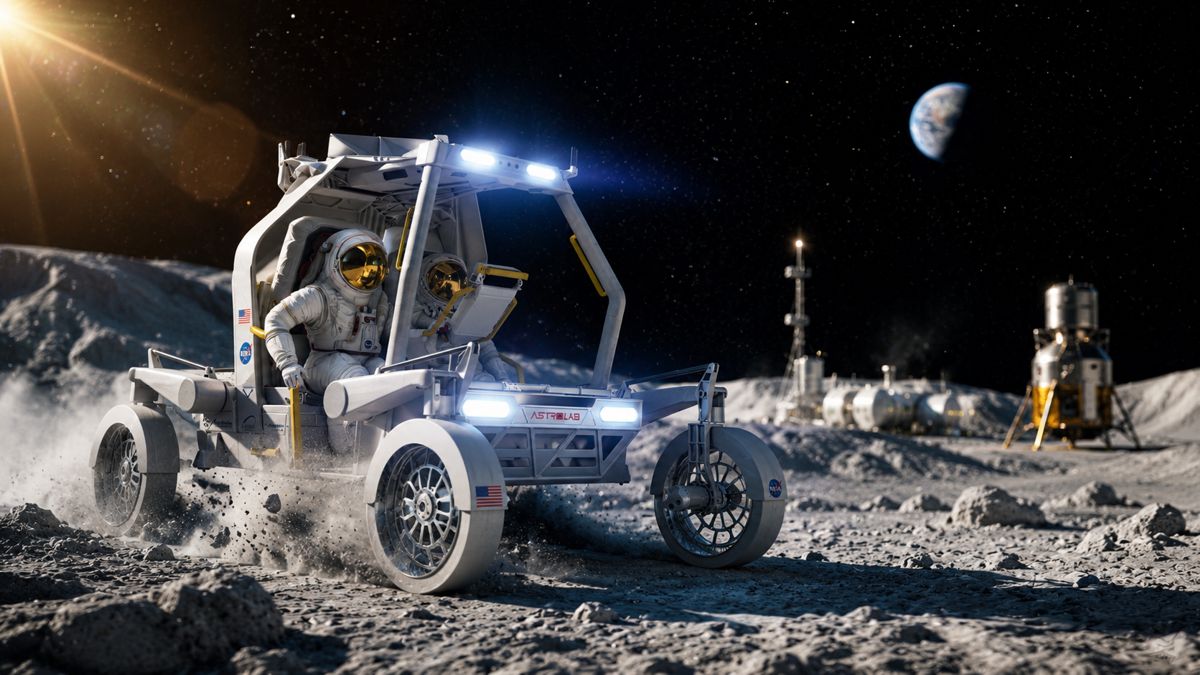
NASA’s latest decision to select Venturi Astrolab as one of two providers of a crewed lunar rover under the Artemis programme marks a shift from symbolic exploration toward something considerably more practical: mobility as infrastructure. Without dependable transport, even the most advanced habitat, lander or scientific payload remains constrained to walking distance from touchdown.
That makes the newly announced Crewed Lunar Vehicle, known as CLV-1, far more than another space technology demonstrator. It represents a functional component in what NASA increasingly describes as sustained surface operations at the lunar south pole. The objective is no longer simply reaching the Moon. The objective is working there.
The award follows NASA’s revised lunar mobility strategy through its Ignition initiative, which accelerated timelines and reduced vehicle scale requirements to encourage faster deployment. Rather than continue pursuing larger concepts developed under earlier assumptions, industry teams were challenged to deliver operational capability sooner. Astrolab responded by adapting its existing FLEX rover architecture into a more focused vehicle intended specifically for crew transport and operational support.
If successful, CLV-1 could become one of the machines that defines the opening chapter of permanent off-world infrastructure.
Briefing Summary
- NASA selected Astrolab as one of two providers for crewed lunar mobility under Artemis.
- The CLV-1 rover evolves from Astrolab’s FLEX platform and targets deployment by 2028.
- The award forms part of NASA’s Lunar Terrain Vehicle Services programme valued at up to US$4.6 billion.
- The rover supports astronaut transport, remote operations and sustained lunar surface activity.
- Commercial partnerships increasingly place private industry at the centre of lunar infrastructure development.
Lunar Exploration Begins to Resemble Infrastructure Delivery
Space exploration has historically celebrated launch vehicles and destinations while paying less attention to what happens once crews arrive.
Apollo demonstrated that mobility changes outcomes. During early lunar missions astronauts travelled only short distances on foot. Once the Lunar Roving Vehicle arrived during Apollo 15, exploration range increased dramatically and scientific return expanded accordingly. Modern lunar ambitions require an even greater leap. NASA’s Artemis programme is targeting regions around the lunar south pole where terrain is more complex and operational windows are longer.
Surface mobility now sits in the same category as roads, utilities and logistics networks on Earth.
NASA’s Lunar Terrain Vehicle Services approach reflects that reality. Rather than buying and owning a single rover design outright, the agency is procuring mobility as a service through long-term commercial arrangements. In 2024 NASA established an indefinite-delivery, indefinite-quantity contract structure worth up to US$4.6 billion across more than a decade of activity, creating competition while allowing technologies to evolve over time.
Astrolab’s latest task order, valued at approximately US$219 million, places the company directly into that transition.
From FLEX to CLV 1 Through Practical Engineering
One of the more notable aspects of this announcement is what Astrolab chose not to do.
Instead of starting from scratch, the company leveraged years of work completed on its FLEX rover platform. Since revealing FLEX in 2022, Astrolab has accumulated extensive laboratory and field testing covering crewed operation, remote driving capability, payload handling and movement across difficult terrain.
That matters because lunar hardware development cycles traditionally stretch over decades. Reusing tested architecture compresses schedules and reduces technical uncertainty.
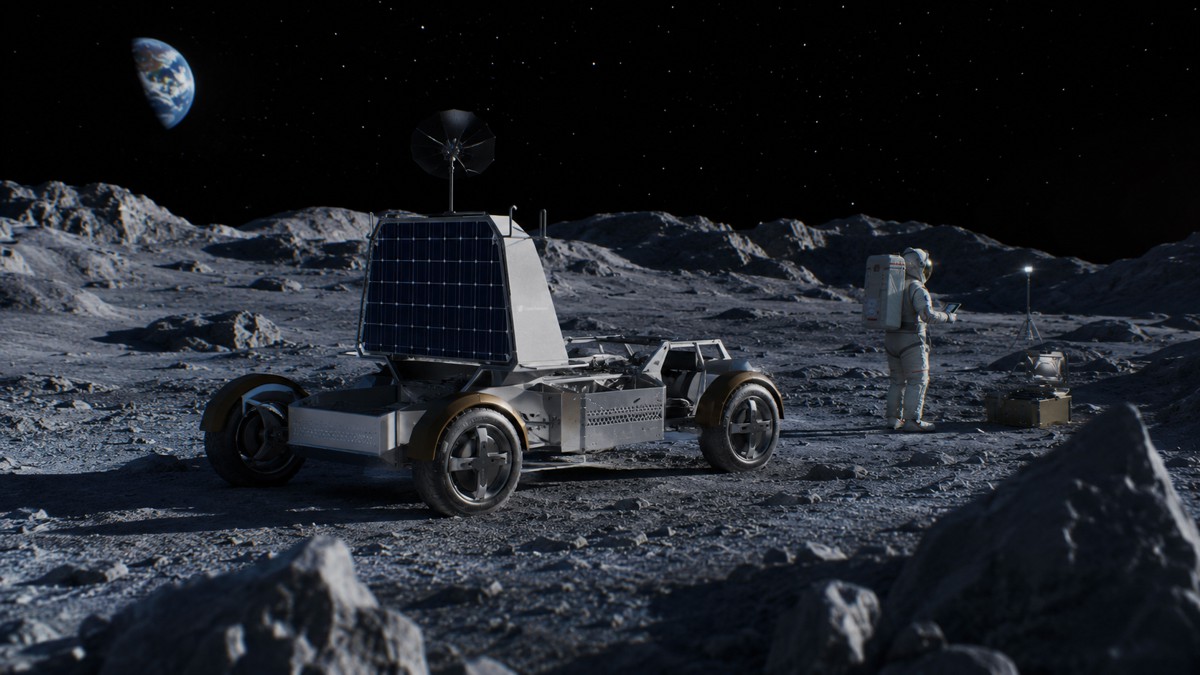
CLV-1 keeps many of FLEX’s underlying design principles but narrows its mission profile. Unlike Astrolab’s broader rover concepts intended to support payload deployment, CLV-1 prioritises astronaut transport and operational efficiency.
Stored configuration dimensions allow the rover to fit inside Commercial Lunar Payload Services delivery systems before unfolding after arrival. Once deployed, the vehicle expands into a larger operating footprint while maintaining relatively modest mass for launch economics.
Technical specifications indicate a deployed vehicle approximately four metres in length, weighing up to 950 kilograms and capable of travelling around 10 kilometres per hour across level lunar terrain. Remote operation capability also enables robotic use between crewed missions.
This isn’t simply engineering elegance. It is operational pragmatism.
A Commercial Consortium Built Around Specialisation
Space projects increasingly resemble large infrastructure consortiums rather than isolated prime contractors. Astrolab’s selected team combines expertise across mobility, operations, software, spacesuits and extreme environment systems.
Astrolab leads vehicle development while Axiom Space contributes extravehicular activity integration, crew interfaces and human systems engineering. Interlune supports lunar operational capability and resource experience, while Odyssey Space Research contributes spacecraft software, simulation and systems engineering.
Meanwhile, Venturi Space provides wheel systems, batteries and battery management technologies adapted for harsh lunar conditions.
This collaborative structure mirrors how major terrestrial infrastructure projects are delivered today. Airports, rail systems and megaprojects increasingly rely on ecosystems of specialists rather than vertically integrated contractors.
Lunar development appears to be following the same path.
Extreme Conditions Create Unexpected Engineering Lessons
Although the Moon often gets described as empty space, operating there creates an environment unlike almost anything encountered on Earth.
Temperatures swing dramatically. Lunar dust behaves more like abrasive powder than soil. There is no atmosphere to dissipate heat and terrain remains unpredictable. Vehicle design therefore becomes an exercise in compromise.
Battery systems must survive thermal extremes. Wheel technologies must avoid excessive sinkage and wear. Electronics require protection against radiation and vacuum conditions.
Interestingly, many of the technologies emerging from these programmes have direct terrestrial relevance. Electric drivetrain management, lightweight materials, advanced autonomy, energy storage optimisation and remote operations all overlap with trends already reshaping construction equipment, mining fleets and off-highway transport.
That crossover has become increasingly visible across NASA’s commercial partnerships and explains why industries outside aerospace continue watching lunar mobility developments closely.
The Moon Economy Moves From Theory Toward Delivery
Space economics has long suffered from a credibility problem. Concepts appeared faster than viable business models. What makes current developments different is that mobility contracts represent operational spending tied directly to infrastructure delivery.
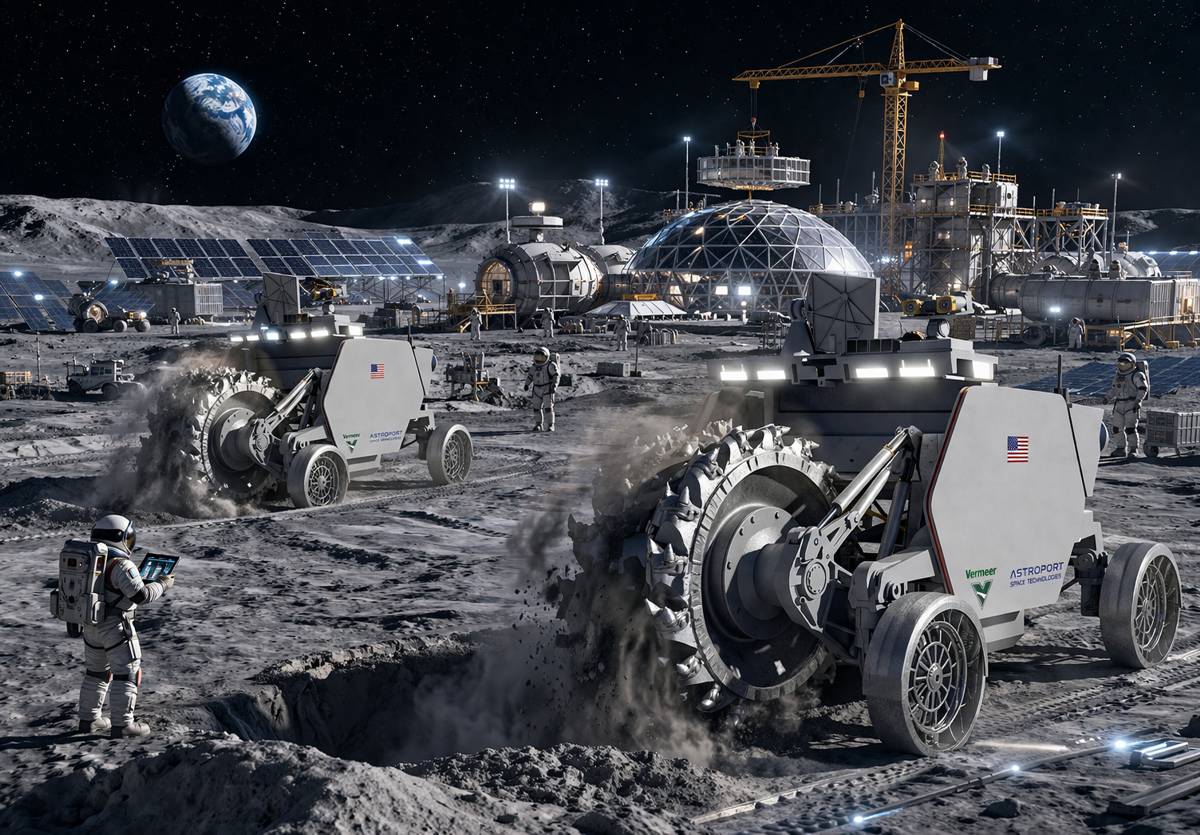
NASA’s broader Moon Base planning now includes landers, cargo systems, robotic deployment and surface transport operating together within a phased architecture targeting repeated missions and permanent capability growth at the lunar south pole.
Surface vehicles become multipliers as a rover extends science range, reduces astronaut fatigue, supports maintenance activity and enables deployment of future assets. In practical terms, every kilometre travelled increases the value extracted from every dollar spent reaching the lunar surface. That commercial logic may ultimately prove more influential than the engineering itself.
The Machine That Makes Expansion Possible
For construction professionals and infrastructure strategists, the significance of CLV-1 sits in an unexpectedly familiar place.
Transport enables development, just as roads unlocked industrial economies, railways reshaped continents, and ports transformed trade. On the Moon, mobility becomes the first layer of physical infrastructure upon which everything else depends.
Astrolab’s selection does not guarantee success, nor does it resolve the enormous technical and operational hurdles still ahead.
What it does signal is that lunar activity is beginning to move beyond isolated missions toward repeatable systems and commercial delivery models.
If astronauts begin operating routinely at the lunar south pole later this decade, there is a fair chance they’ll spend at least part of their working day behind the controls of vehicles like CLV-1.
And when that happens, lunar infrastructure will have moved from concept drawings into something far more tangible: transport that works.
“We’re honored that NASA has selected Astrolab to help provide the surface mobility astronauts will need as the Artemis program returns humanity to the Moon,” said Jaret Matthews, founder and CEO of Astrolab. “CLV-1 reflects the adaptability of our FLEX architecture and the years of testing our team has already completed. We look forward to putting that work to use for Artemis astronauts and helping establish a lasting human presence on the Moon.”