Canada Starts Mapping the Heat Beneath its Feet as Geothermal Money Pours in
Canada sits on one of the world’s richest stores of underground heat, yet it generates barely enough geothermal electricity to register on a national balance sheet. A partnership unveiled on the opening day of the World Geothermal Congress in Calgary is setting out to change that arithmetic, not by drilling a single well, but by drawing the map that tells investors where the drilling should happen in the first place.
Seequent, the subsurface software business owned by Bentley Systems, has joined forces with the Cascade Institute, a think tank based at Royal Roads University in British Columbia, to build what the partners are calling the Canadian Thermal Model. The plan is to stitch together the country’s scattered geological and geophysical records into a single coherent picture of deep heat resources, using machine learning to fill the gaps where hard data has always been thin. For an industry that lives and dies on subsurface certainty, that’s no small ambition.
The timing is hardly accidental. The Congress, held in Calgary from 8 to 11 June 2026, is the eighth edition of the triennial event and the first ever staged in North America, drawing well over a thousand decision-makers from across the sector. Launching a national resource assessment on that stage sends a clear signal about where Canada thinks its energy story is heading.
Briefing
- Seequent and the Cascade Institute are building the Canadian Thermal Model, a national map of deep geothermal heat designed to guide investment, policy and project development.
- The model combines geological and geophysical datasets through the InterPIGNN machine learning algorithm, supported by Seequent’s Oasis montaj geophysics software.
- Canada currently generates less than six megawatts of geothermal power, roughly 0.004% of its installed capacity, despite world-class subsurface expertise.
- Global financing for next-generation geothermal reached around CAD$3 billion in 2025, according to the IEA, with the United States and Indonesia leading the charge.
- The Cascade Institute leads the work through its deep geothermal programme, alongside Simon Fraser University, 400C Energy and the Geological Survey of Canada’s Pacific Division.
Why Subsurface Certainty Decides Where The Money Goes
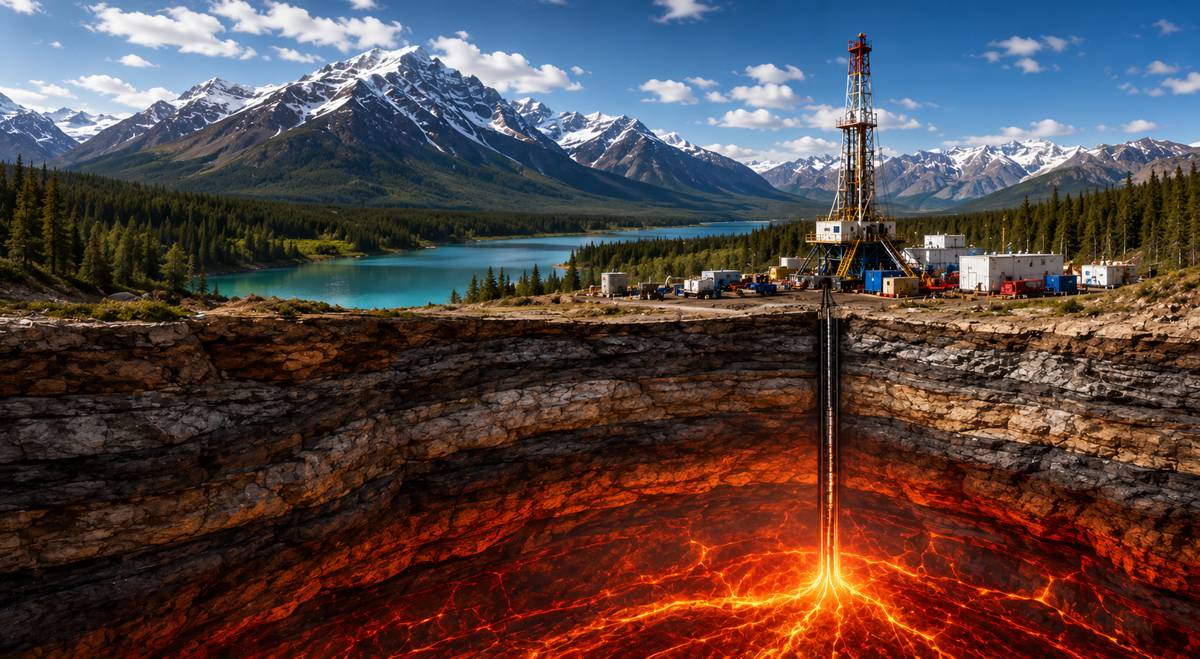
Geothermal has a peculiar problem for an energy source so abundant. The heat is there, kilometres down in hot, dry rock, but proving exactly where it sits, how hot it runs and how cheaply it can be reached has always been the expensive part. Drilling an exploratory well can cost millions, and a dry hole carries no consolation prize. That upfront risk is precisely what has kept capital cautious, even as appetite for round-the-clock clean power has grown.
A national heat map attacks that risk head on. By integrating existing datasets and modelling where resources are most likely to be viable, the Canadian Thermal Model is meant to give developers, financiers and governments a shared evidence base before anyone commits to a drill rig.
Jeremy O’Brien, Energy Segment Director at Seequent, framed the logic: “Canada has a significant opportunity to advance geothermal when the need for reliable, always-on clean energy has never been greater,” he said. “Realizing that potential starts with greater subsurface certainty and making data accessible to key stakeholders. Combining this access with best-in-class geophysics enables more accurate mapping of heat at depth. The Canadian Thermal Model brings these elements together to create a national view of deep geothermal resources, helping to reduce risk, guide investment, and accelerate development.”
A Surging Global Market And A Country Left Behind
The wider context gives the project its urgency. Financing for next-generation geothermal climbed to roughly CAD$3 billion in 2025, according to figures from the International Energy Agency and the venture investor Underground Ventures, with the United States and Indonesia setting the pace. The sector pulled in around US$1.7 billion in the first quarter of 2025 alone, much of it chasing the promise of firm, weather-proof electricity for data centres and grids straining under new demand.
Canada’s position in all this is faintly absurd, and the partners know it. The country has the geology, sitting on the edge of the Pacific Ring of Fire, and it has exported subsurface talent and Canadian-run geothermal operations around the globe for years. What it doesn’t have is domestic generation.
Canada produces less than six megawatts of geothermal power today, a rounding error against its total installed capacity, even though its first small commercial plant came online in Alberta in 2023 and a handful of projects in British Columbia, Alberta and Saskatchewan inch forward. Mapping the resource nationally is, in effect, the groundwork that should have been laid a decade ago.
Turning Patchy Data Into A National Picture
The technical heart of the project is the data itself, or rather the lack of it. Geothermal exploration in Canada has never enjoyed the dense, decades-deep records that the oil and gas sector built up across its basins, which leaves large stretches of the country effectively blank on any heat map. Plugging those holes by drilling would take years and a fortune. Plugging them with mathematics is the bet here.
The model will feed integrated geologic and geophysical datasets into the InterPIGNN machine learning algorithm, an approach designed to infer deep heat conditions across areas where direct measurements are sparse. Seequent is supplying its Oasis montaj geophysics software to process and visualise the inputs, the same toolset used across exploration projects worldwide to turn raw survey data into usable subsurface models.
The output is meant to do more than satisfy academic curiosity. It’s pitched as a working reference for energy markets, capable of informing both resource availability and the development costs that ultimately make or break a project’s bankability.
The Coalition Behind The Map
The Cascade Institute is leading the work through its deep geothermal programme, the same effort that drew more than CAD$3 million in philanthropic funding in 2024 from the Grantham Foundation, Founders Pledge’s Climate Change Fund and donors to Rethink Charity Foundation’s RC Forward fund. That programme has focused squarely on hot, dry rock five to ten kilometres down, the so-called ultradeep tier where the prize is largest and the engineering hardest. Pulling together the academic, technical and financial threads is very much its stated purpose.
Thomas Homer-Dixon, the Institute’s Executive Director, has long argued that the heat beneath Canada could be transformative if the country chose to chase it. “Canada has world-class subsurface expertise and a growing opportunity to lead in geothermal,” he said. “This project will provide a foundational resource to demonstrate the technical and economic viability of geothermal energy at scale.”
He’s working with a research bench that includes geoscientists from Simon Fraser University, the developer 400C Energy and the Geological Survey of Canada’s Pacific Division, the kind of cross-sector line-up that tends to lend a project credibility with both regulators and capital.
From Research Project To Buildable Infrastructure
Seequent brings a track record that matters here. The company says it supports more than 60% of the world’s geothermal power generation, with its software threaded through projects ranging from Fervo Energy’s Cape Station in Utah, currently the largest next-generation geothermal development anywhere and due to start feeding the grid in late 2026, to the long-established global fleet operated by Ormat. That sort of pedigree is what separates a national mapping exercise from a glorified spreadsheet, since the same modelling discipline that de-risks a 500-megawatt build in Beaver County can, in principle, be pointed at a blank Canadian basin.
What happens next is the part the whole sector will be watching. A heat map is only as useful as the projects it unlocks, and the leap from a research deliverable to financed, permitted, buildable infrastructure is where plenty of clean energy ambitions have stalled before.
Seequent and the Cascade Institute were due to set out the technical challenges and opportunities of deep geothermal at the Seequent booth during the Congress, in a session billed as an examination of Canada’s untapped heat.
The Canadian Thermal Model is worth keeping an eye on, because the country that finally maps its heat properly is the one most likely to start building on it.