Ouster Brings Native Colour Lidar to City Traffic Corridors
Roadside detection has long leaned on a patchwork of cameras, radar units and inductive loops buried in the tarmac, each handling a slice of the job and each carrying its own maintenance bill.
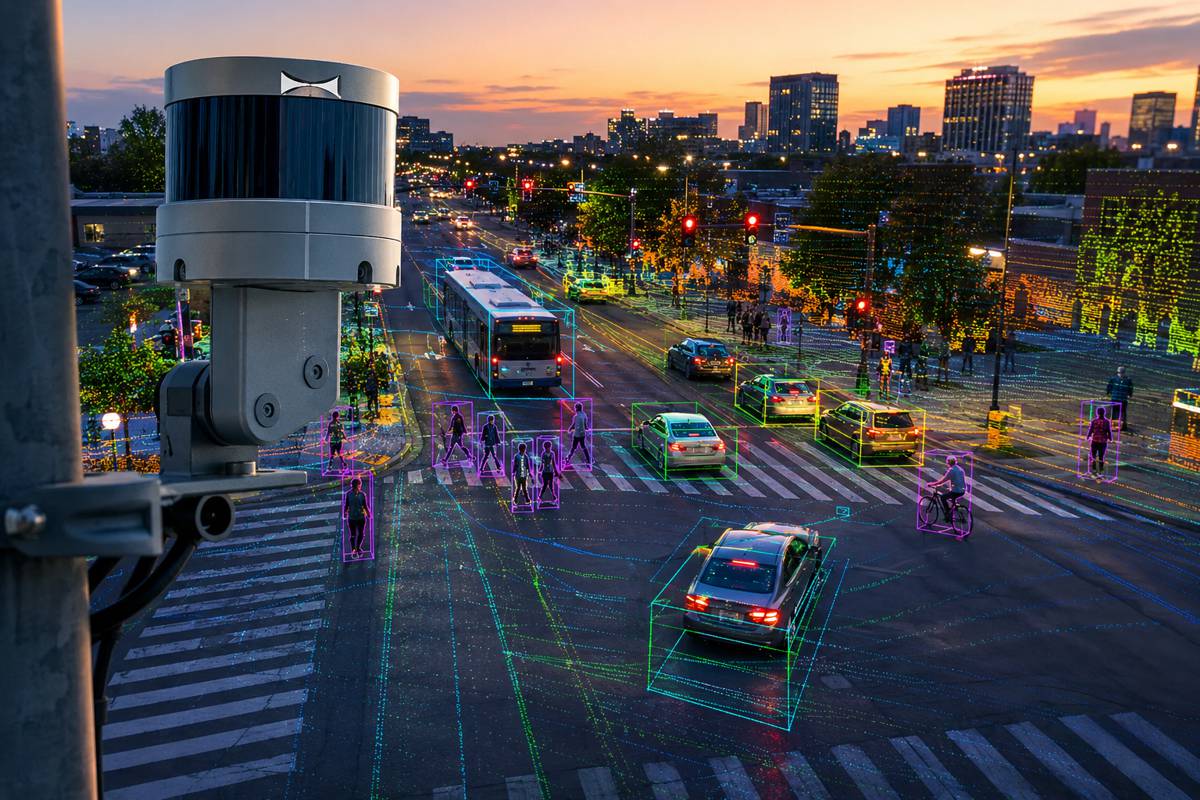
Ouster is betting that a single class of sensor can do most of it at once. The San Francisco company has released a new version of its BlueCity traffic management platform built around Rev8, a digital lidar it describes as the world’s first to capture colour and three-dimensional depth in the same pass, and it has gone live first on the streets of Stamford, Connecticut.
For the engineers and procurement teams who keep city corridors moving, the appeal isn’t the novelty of colour data on its own. It’s what that data, paired with longer range, lets them strip out.
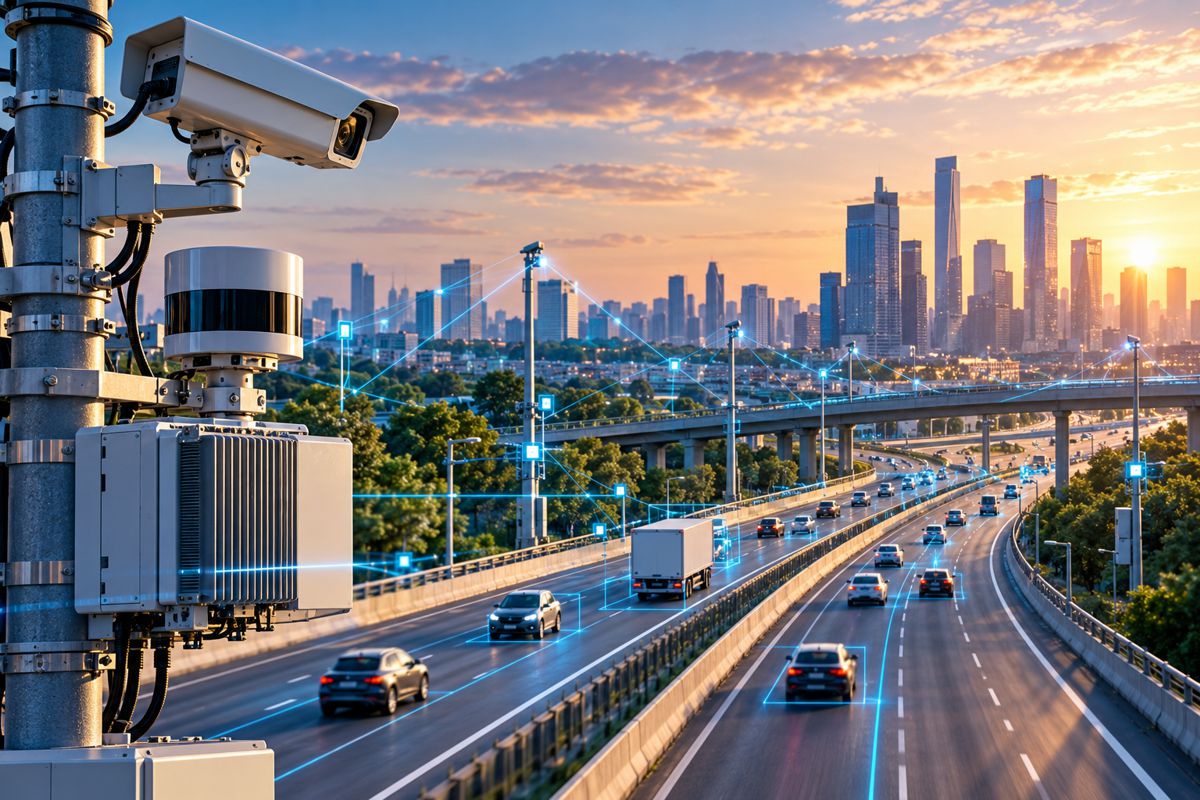
Ouster reckons one or two lidar units per intersection or highway approach can stand in for the cluster of cameras, radars and loops that authorities currently stitch together, which changes the arithmetic on installation, upkeep and the lane closures that come with both. That’s the pitch, at least, and it arrives just as transport departments across the United States are being asked to do more with tighter capital budgets.
Briefing
- Ouster has launched BlueCity with Rev8, which it calls the first native colour lidar detection system, capturing colour and 3D depth at the same time without complex calibration.
- The system detects road users up to 500 feet, roughly 152 metres, and claims up to double the range and resolution of the previous generation, supporting corridor-level rather than single-junction coverage.
- Stamford, Connecticut is the first city to deploy the colour version, following earlier BlueCity work by the Connecticut Department of Transportation.
- Ouster says one or two sensors can replace multiple cameras, radars and inductive loops, mounting on existing infrastructure in as little as three hours.
- BlueCity already counts more than 700 contracted site deployments, including a recent install around MetLife Stadium ahead of the 2026 FIFA World Cup.
Why Colour and Range Change the Job at the Kerb
Lidar builds a precise three-dimensional picture by timing laser pulses as they bounce back, which is why it tends to cope with darkness, glare and foul weather better than a camera leaning on visible light. The catch has always been that point clouds, however accurate on shape and distance, look abstract to a human operator scanning for a near-miss.
Ouster’s answer with Rev8 is to fold colour into the same capture, so the depth map arrives already tinted with the scene it represents. The company says this sharpens situational awareness, simplifies the job of drawing detection zones, and makes event review more intuitive, while keeping privacy controls at the edge so raw imagery needn’t leave the device.
Range matters just as much for the economics. By roughly doubling reach to a claimed 500 feet, a single mast can watch a longer stretch of road, which is what Ouster means by corridor-level detection. Cover more ground per sensor and you need fewer of them, and fewer sensors means fewer poles, less trenching and a smaller maintenance roster over the life of a scheme.
The colour data also feeds what the firm calls a digital traffic twin, a live model of the junction or corridor that signal engineers can lean on for timing decisions and that planners can mine after the fact.
Stamford Goes First
The City of Stamford took the first colour-equipped units, putting them to work on 360-degree, corridor-level detection aimed at smoothing traffic flow, cutting idle time and heading off the gridlock that spills back from a blocked junction.
Ouster says precise geolocation also lets the city act faster on awkward safety events, the near-misses, speeding and pedestrians stepping outside crossings that rarely show up cleanly in legacy data. The deployment follows earlier BlueCity work in the state by the Connecticut Department of Transportation and by Ouster’s distributor, New England Traffic Solutions.
Stephen Frycz, Transportation Manager for the City of Stamford, framed the move as a step change for the city’s network. “Ouster BlueCity with Rev8 lidar sensors allows us to take a massive leap forward in our transportation infrastructure. By capturing native color alongside longer multimodal detection range, our traffic teams gain unprecedented situational awareness to protect vulnerable road users and optimize signal timing along our busiest corridors – all while maintaining privacy for our residents,” he said. “We’re excited to be the first in the nation to deploy this cutting-edge technology.”
Detection Actuation and Analytics in One Box
BlueCity is pitched as a complete system rather than a sensor on its own. It promises continuous 360-degree detection of vehicles, pedestrians, cyclists and trams across lighting extremes and rough weather, building on the previous generation’s stated 99 per cent stop-bar accuracy. From that feed it drives real-time signal actuation through existing traffic controllers, supports transit signal priority and adaptive pedestrian walk-time, watches the dilemma zones where drivers must choose to stop or go, and issues vehicle-to-everything safety messages to connected cars.
An open API is meant to let it slot into the advanced traffic management systems authorities already run.
On the back end, Ouster leans on NVIDIA edge computing to turn movement into analytics, which it says it can deliver far faster and more cheaply than camera-heavy setups. Authorities can buy the kit outright or take scalable software licensing for edge and cloud analytics, a nod to the reality that public bodies budget in very different ways. Consolidating hardware like this is the crux of the cost argument, since every camera, radar and loop removed is one less thing to power, calibrate and eventually replace.
Built for a Decade in the Weather
Roadside kit lives a hard life, and Ouster has leaned into durability to win over infrastructure owners wary of short replacement cycles. Rev8 carries a planned 10-year production life, rated operation from minus 40 to plus 85 degrees Celsius, and IP68/69K sealing against dust and water.
The company says units fix to existing traffic infrastructure in as little as three hours, sparing authorities the mast arms, street trenching, lane closures and fiddly field calibration that legacy installs tend to demand.
The compliance boxes matter for public procurement too. BlueCity with Rev8 is certified under the Build America, Buy America rules that govern federally funded infrastructure, meets the NEMA TS2 standard for traffic control equipment, and is designed around edge-level privacy and cybersecurity requirements. None of that is glamorous, but it’s the sort of detail that decides whether a product clears a city’s purchasing process or stalls in it.
The Wider Bet on Lidar at the Kerb
The launch sits inside a broader push by Ouster to make smart infrastructure a dependable revenue line. BlueCity already claims more than 700 contracted site deployments, among them what the company says are the three largest lidar traffic schemes in the United States, recent million-dollar contract wins, and an expansion to more than 30 intersections in and around Atlanta.
The firm also recently finished installing the system at more than 40 locations on highways around MetLife Stadium, part of New Jersey’s preparations for the 2026 FIFA World Cup.
That commercial momentum has a financial backdrop. Ouster, which became its present self through a 2023 merger of equals with Velodyne and inherited the BlueCity software from that combination, reported first-quarter 2026 revenue of about 49 million dollars, up 49 per cent year on year and a thirteenth straight quarter of growth, with gross margin near 43 per cent.
Smart infrastructure and industrial customers did much of the heavy lifting. Whether colour lidar becomes the default at the kerb will hinge on cities proving the cost case in the field, and Stamford is where that argument starts.