Offshore Energy Supply Chains Reconnected in Shenzhen
The 28th Offshore China (Shenzhen) Convention and Exhibition, held on 16 and 17 June, arrived at a point when the offshore sector is quietly rewriting the rules of how it builds, buys and delivers.
For two days the event gathered senior figures from CNOOC, Petronas, Petrobras, Eni, Equinor, Bumi Armada, PT Medco E&P, Myanmar Oil and Gas Enterprise and Timor-Leste’s national oil company, alongside engineering contractors, shipyards and equipment suppliers spanning the full offshore chain. The programme moved across deepwater exploration, subsea production systems, floating production, FLNG, deep-sea wind and digital construction, but the most consequential activity took place away from the keynote stage.
In the matchmaking rooms, where operators arrived with live project briefs to negotiate directly with suppliers, the industry showed where commercial power now sits.
What made the Shenzhen gathering worth close attention was less the breadth of its agenda than the structural shift it confirmed. Offshore oil and gas remains a cornerstone of global energy supply even as decarbonisation targets tighten, and the basins now attracting capital are deeper, more remote and more technically demanding than those that defined the previous investment cycle.
Delivering them depends on fabrication yards, specialist vessels and integrated supply chains, and that industrial base has migrated decisively towards Asia. The convention functioned as a working illustration of that migration, with international operators travelling to China not simply to take the temperature of the market but to secure capacity, lock in specifications and build the supplier relationships that increasingly determine whether a project lands on time and on budget.
Briefing
- The 28th Offshore China Convention drew senior decision-makers from CNOOC, Petronas, Petrobras, Eni, Equinor and other operators around the integration of offshore oil, gas and wind.
- Dedicated procurement matchmaking sessions, pairing national and international oil companies and EPC contractors directly with regional suppliers, were positioned as the event’s commercial centre of gravity.
- China now accounts for more than half of global offshore engineering equipment output, and its shipyards are running close to full capacity, creating delivery pressure that buyers must plan around.
- FPSO decarbonisation, modular construction, FLNG evolution and the integration of floating wind with hydrocarbon assets dominated the technical agenda.
- The series continues at OEEG2026 in Shanghai from 17 to 19 November, where organisers intend to publish a global floating offshore supply chain report and supplier directory.
Procurement Matchmaking Moves to the Centre of the Story
The procurement matchmaking sessions that ran across both days were the clearest signal of how offshore project delivery is changing. Rather than relying on general networking, national oil companies, international operators, EPC contractors and shipyard operators arrived with concrete project briefs and held structured, one-to-one negotiations with regional equipment and service suppliers.
The format compresses a procurement process that has traditionally stretched across months of tendering and prequalification into direct conversations about specifications, schedules and price. For buyers facing tight delivery windows and for suppliers seeking to fill order books, the appeal of cutting out intermediaries and aligning on technical detail in a single sitting is considerable.
The commercial logic behind this approach reflects a wider reality in the offshore market. Yard capacity is now one of the scarcest commodities in the sector, and the operators who secure delivery slots early gain a material advantage over those who wait. By bringing demand and supply into the same room with live briefs, the convention created a mechanism for converting industry dialogue into contracted pipelines, which is precisely what a capacity-constrained market rewards.
The same model has been used at related events in the series, including the Kuala Lumpur summit earlier in the year, and its growing prominence suggests that matchmaking is shifting from a conference novelty to a recognised route to market. For Western suppliers and contractors, that carries an implicit warning, because a procurement channel built around direct access to Asian fabrication capacity is one in which they must now actively compete for relevance.
China’s Manufacturing Weight and the Capacity Bottleneck
The reason Shenzhen has become a fixture on the offshore calendar is straightforward. China has built the most comprehensive offshore manufacturing base in the world, and the numbers behind that position are difficult to overstate. According to China’s Ministry of Natural Resources, Chinese firms have supplied more than half of the global offshore engineering equipment market for several years, a field that runs from deepwater drilling machinery and floating production units to wind turbine installation vessels, heavy-lift crane ships and subsea cable layers.
Wider shipbuilding data points in the same direction, with Ministry of Industry and Information Technology figures showing Chinese yards taking the large majority of new global orders by tonnage in the opening quarter of 2026. That concentration gives Chinese suppliers a combination of scale, vertical integration and increasingly sophisticated engineering capability that competitors have struggled to match.
The strength of that position carries a complication that buyers cannot ignore. Demand for offshore equipment has rebounded sharply after the slump of the late 2010s, with global orders averaging in the region of twenty billion US dollars a year between 2021 and 2025, close to double the level of the preceding five years.
Senior figures within China’s shipbuilding association have noted that optimism about future growth has not yet translated fully into new orders, because the yards are already operating at or near full capacity and cannot commit to additional delivery schedules without further investment in new facilities. Expanding yard capacity involves multi-year construction timelines, regulatory approval and workforce development, which means the gap between order-book confidence and physical delivery capacity is likely to persist.
For operators and financiers, that bottleneck translates into real schedule risk, and it explains why early engagement and direct supplier relationships have become so commercially valuable.
Floating Production Faces a Decarbonisation Reckoning
Floating production was among the most heavily worked themes in Shenzhen, and for good commercial reason. The global FPSO market is forecast to grow from around thirteen billion US dollars in 2025 to close to twenty billion by 2030, while the broader floating production systems market is considerably larger and expanding fastest across Asia-Pacific as national oil companies prioritise domestic output.
Discussions at the convention centred on decarbonisation, modular integration and cost-efficient construction, alongside FLNG technology, LNG containment system testing and the reuse of existing infrastructure to shorten delivery timelines. These are not abstract engineering preferences but responses to a market that is demanding lower-carbon assets without surrendering the cost and schedule discipline that makes offshore projects bankable.
China’s progress in this segment has been rapid enough to reshape the competitive map. Yards that once trailed South Korean and Singaporean builders in FPSO construction and conversion have overtaken them on price and delivery speed, and localisation has climbed steeply. In one of the country’s leading marine engineering clusters in Jiangsu, the domestic content of FPSO builds has risen from around sixty per cent in 2019 to roughly ninety per cent, with construction cycles cut by more than half a year.
The country brought its first carbon-capture-equipped FPSO into service in early 2025, signalling that the decarbonisation conversation taking place on the conference floor is already being translated into delivered assets. For international operators weighing where to place floating production orders, the combination of lower cost, faster delivery and emerging low-carbon credentials is a difficult package to argue against, even where component dependencies in areas such as dynamic positioning and subsea control systems still favour non-Chinese suppliers.
Deep-Sea Wind and the Case for Integrated Energy at Sea
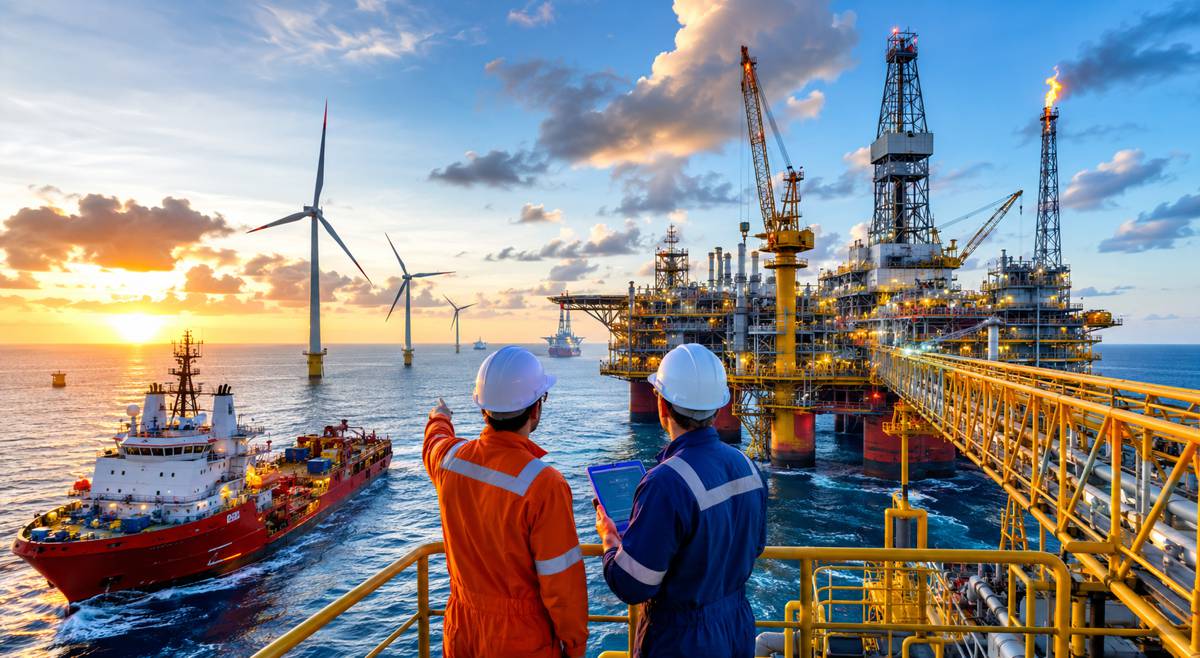
The forum on deep-sea wind power and oil-gas integrated development captured one of the more strategically significant currents running through the event. Energy institutes, engineering contractors and vessel developers reviewed marine zoning policy, hybrid oil-wind asset development, floating platform design, large-capacity turbine installation and the specialist service vessels that this work requires.
The timing is apt, because China has been moving its offshore wind ambitions into deeper water at speed. In early May the country installed what its developers describe as the world’s largest single-unit floating wind turbine, a sixteen-megawatt machine positioned roughly seventy kilometres off Yangjiang in water depths exceeding fifty metres, following earlier large-capacity floaters from Mingyang and a twenty-megawatt prototype from CRRC. With national offshore wind capacity already among the highest in the world and a target of one hundred gigawatts by 2030 under the fifteenth Five-Year Plan, the supply chain implications for vessels, mooring systems and subsea cabling are substantial.
The integration thesis that underpinned this forum has gathered credibility well beyond China. In the North Sea, Norway’s Hywind Tampen floating wind farm supplies power to the Snorre and Gullfaks oil and gas fields, TotalEnergies has deployed floating wind at its Culzean platform to reduce reliance on gas turbines, and Aker BP’s Yggdrasil development has been designed for hybrid operation from the outset.
The principle is that offshore wind can displace gas-fired generation on production platforms, lowering both fuel costs and emissions, while shared marine infrastructure and combined asset bases spread the heavy fixed costs of working at sea. Realising those benefits demands sophisticated power management and rigorous performance modelling, which is why digital twins and AI-led dispatch have become central to investment decisions. For contractors and equipment makers, the convergence of hydrocarbons and renewables into integrated offshore systems opens a market that did not meaningfully exist a decade ago, and it rewards firms able to engineer across both worlds rather than within a single discipline.
From Equipment Supplier to Integration Partner
A clear consensus surfaced over the two days, and it speaks directly to where competitive advantage in offshore energy is heading. The participants broadly agreed that competition no longer turns on the manufacture of standalone equipment or vessels. The decisive capabilities are now integrated project management, end-to-end engineering integration, technical verification, coordinated supply chains and the ability to operate and maintain complex assets over their full working lives.
That shift reframes what it means to be a supplier in this sector, because a yard or vendor that can only deliver a discrete component is increasingly exposed, while those able to take responsibility for whole systems and their long-term performance command far stronger positions.
This reframing has practical consequences for how projects are structured and financed. Operators and EPC contractors are placing greater weight on suppliers who can demonstrate verified performance, depth of supply chain and credible operation and maintenance support, rather than simply the lowest unit price. The subsea and deepwater development sessions reinforced the point, with speakers focusing on ultra-deep seabed resource exploitation, subsea system engineering and the optimisation of integrated exploration and production projects rather than isolated hardware.
For the wider construction and infrastructure community, the parallel is instructive, because the offshore sector is moving towards the same integrated, lifecycle-oriented delivery models that are reshaping major civil and transport projects on land. The premium is shifting from making things to making complex systems work reliably over decades.
Asia-Pacific Recalibration and the Regional Players
The first day’s strategic outlook underlined how much of the offshore growth story is now being written in Asia-Pacific and its adjacent frontier basins. CNOOC specialists set out experience in digital transformation across upstream operations and deepwater development in the South China Sea, while Petronas representatives outlined Malaysia’s digital roadmap for its upstream assets. Eni used its platform to present carbon capture, utilisation and storage deployment and a broader low-carbon transition framework, a reminder that the European majors are pursuing emissions reduction as an operational discipline rather than a distant aspiration.
A former senior Myanmar oil executive examined emerging deepwater exploration opportunities in Myanmar’s waters, and leaders from energy engineering firms discussed cross-industry collaboration and sustainable FPSO strategies. The presence of operators from Timor-Leste, Indonesia and beyond pointed to a Southeast Asian frontier that is drawing renewed attention as established basins mature.
This regional recalibration matters because it determines where the next wave of offshore demand will originate and how it will be served. National oil companies across the region are accelerating offshore development to reduce import dependence and strengthen energy security, channelling sovereign capital and export-credit support towards floating production and the yards that build it. For international suppliers, the message is that Asia-Pacific is not only the dominant manufacturing base but increasingly the dominant source of demand, and that serving it requires local relationships, regulatory fluency and a willingness to engage on the region’s terms.
The convention’s emphasis on building a resilient industrial ecosystem, rather than chasing one-off transactions, fits an environment in which long-term collaboration is becoming the price of entry. Established markets in the Middle East, Australia and Brazil retain their importance, but the centre of gravity has shifted, and the firms that recognise it earliest stand to benefit most.
The Road to Shanghai and What It Signals for the Wider Market
The Shenzhen convention was explicitly framed as a staging post for a larger gathering. The series continues at the OEEG2026 Offshore Energy and Equipment Global Conference at the Shanghai World Expo Exhibition and Convention Center from 17 to 19 November, where organisers intend to widen the scale and deepen the cross-industry matchmaking that defined the June event.
Among the planned outputs is a global floating offshore supply chain report and quality supplier recommendation list, a project designed to bring data-informed assessment to an industry where visibility into supplier capability, quality and delivery performance has long been patchy. If it delivers on that ambition, the directory could become a practical tool not only for operators and EPC contractors but also for financiers pricing project risk and governments seeking to strengthen domestic industrial participation, moving supplier selection away from anecdote and towards evidence.
For construction professionals, investors and policymakers watching from outside the offshore world, the developments coming out of Shenzhen carry lessons that travel well beyond the sea. The combination of concentrated manufacturing capacity, binding delivery constraints and a decisive move towards integrated, lifecycle-based delivery mirrors pressures already reshaping large infrastructure programmes on land. Capital is rewarding scale, vertical integration and the capacity to manage whole systems, while penalising fragmentation and short-term thinking.
The offshore energy supply chain is reconnecting around a new set of priorities, and the procurement rooms in Shenzhen offered an early and unusually candid view of how that reconnection is unfolding. The Shanghai event in November will show how far the model has matured, and whether the rest of the global industry has moved quickly enough to keep pace.