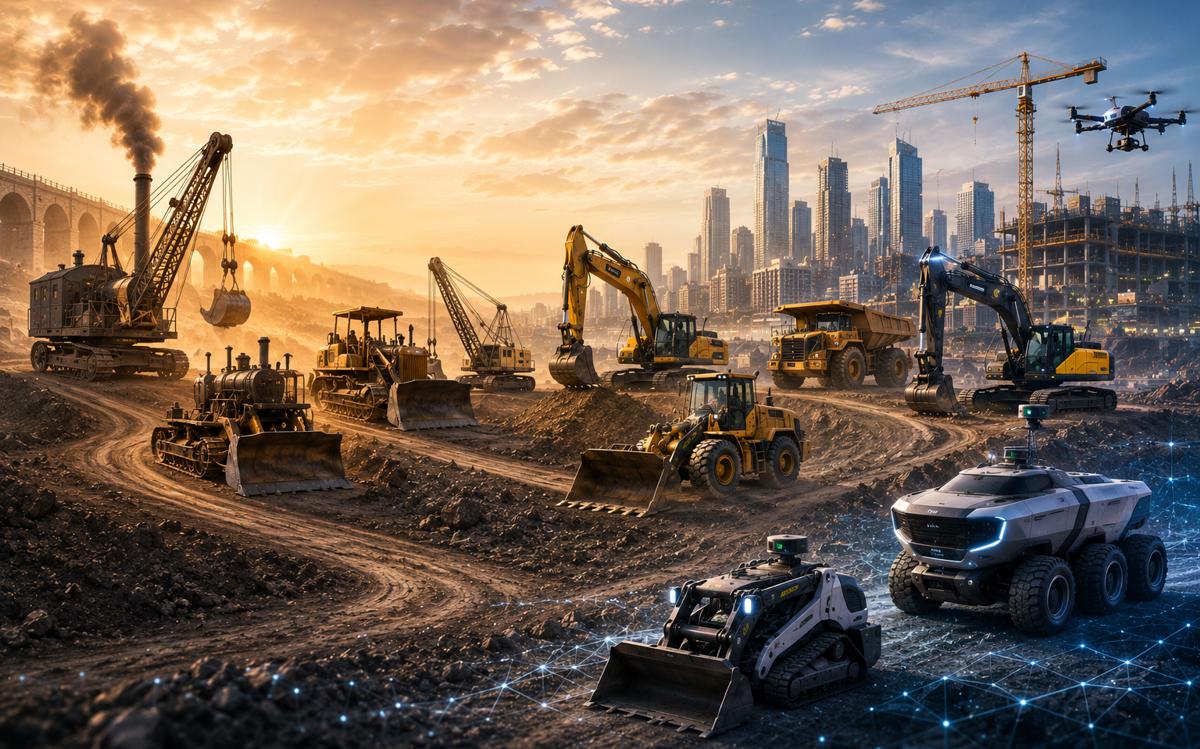
A Century of Earthmoving and Construction Machinery
Almost every road, runway, dam, harbour wall and city skyline of the modern age was shaped by a machine that did the work of dozens, and then hundreds, of people.
The history of construction is to a large degree the history of the equipment that made it possible, and each significant leap in that equipment reset what contractors could build, how quickly they could build it and how much it cost.
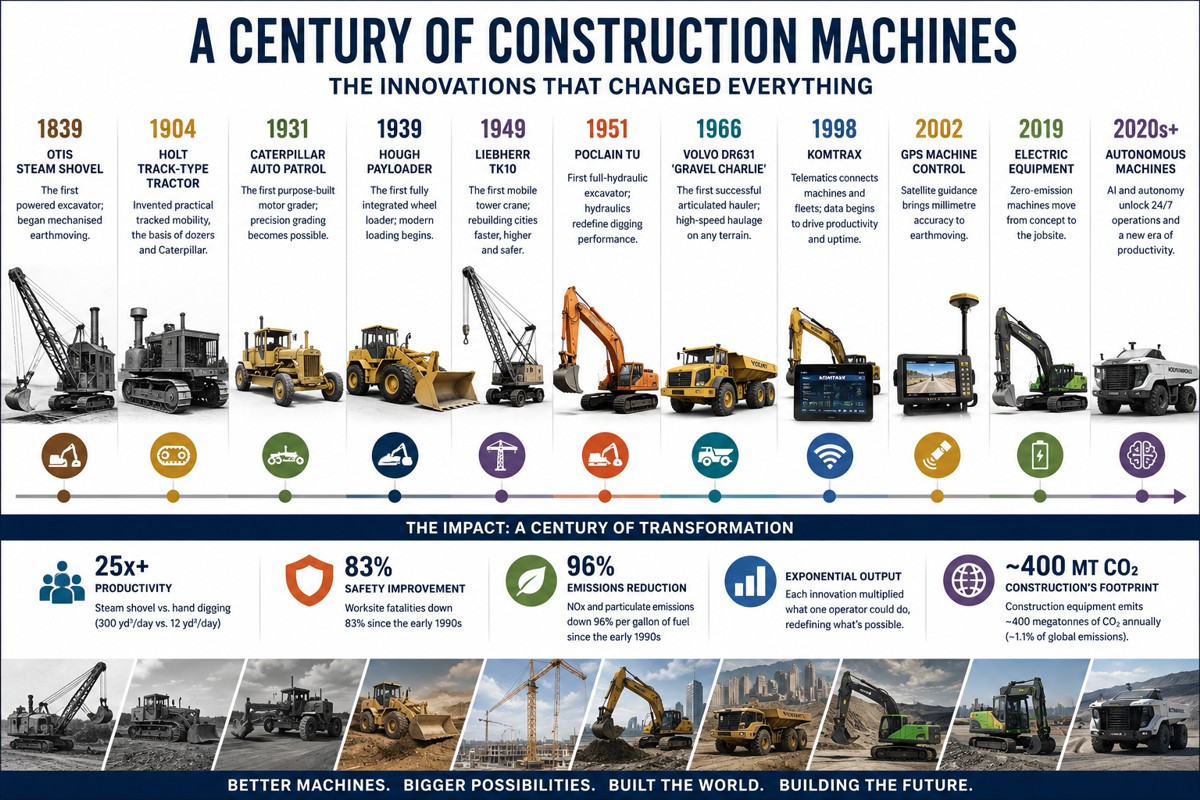
When William Otis patented a steam-powered shovel in 1839, a single machine could move around 300 cubic yards of earth in a day against roughly twelve for a labourer with a hand shovel, a productivity gap of about twenty-five to one. Every breakthrough that followed, from tracks to hydraulics to satellite guidance, compounded that original bargain of fewer people moving more material for less money.
That long arc matters now because the industry is in the middle of its most consequential change since diesel displaced steam. Battery-electric machines have moved from trade-show curiosities to working tools on live sites, autonomous haulage is already standard practice across large mines, and the data flowing off connected fleets has quietly become as valuable as the iron itself. For contractors the questions are about capital cost, uptime and residual value; for investors they concern which technologies and which manufacturers capture the transition; and for policymakers they touch emissions, safety and the skills base of a workforce that has always reorganised itself around the machine of the moment. Understanding how the earlier revolutions actually played out remains the most reliable guide to how this one is likely to unfold.
This account is built around the machines that changed the economics of building rather than simply the largest or the most celebrated. Some were single inventions that opened entire markets, others were configurations that became so dominant they are now simply assumed, and a few were giants that marked the limits of what a single machine could be asked to do.
Read together they describe one continuous engineering project, the steady substitution of mechanical, then hydraulic, and now digital and electric power for human and animal muscle. The story begins long before the first engine, because the problem the machines solved is as old as construction itself.
Briefing
- For most of history, output scaled only by adding bodies and animals; the Roman treadwheel crane lifted around 6,000 kilograms and was roughly sixty times more efficient per worker than the ramps of the pyramids, and mechanical advantage remained the only multiplier until steam.
- Steam shovels lifted earthmoving productivity around twenty-five-fold and built the era’s defining projects, with 77 Bucyrus machines cutting the Panama Canal; Holt’s track-type tractor of 1904 then freed machines from firm ground and seeded both the bulldozer and Caterpillar.
- The hydraulic excavator, pioneered by the Bruneri brothers and Poclain around 1951 and given its modern crawler form by Demag in 1954, became the universal earthmover, while loaders, articulated haulers, graders, rollers, pavers and cranes each took over a discrete task and compounded the gains.
- Telematics, GPS machine control and connected fleets turned equipment into data platforms; across roughly three decades, technology gains coincided with an 83 per cent fall in worksite fatalities and a 96 per cent cut in nitrogen oxide and particulate emissions per gallon of fuel burned.
- Electric and autonomous machines define the present frontier; construction plant emits around 400 megatonnes of carbon dioxide a year, close to 1.1 per cent of the global total and comparable to international aviation, and the non-road sector as a whole now exceeds the footprint of global shipping.
The Age Of Muscle
For thousands of years the only way to build bigger was to gather more people, more animals and more time. The pyramids of Giza were raised by tens of thousands of labourers dragging dressed stone up earthen ramps, an arrangement in which roughly fifty workers were needed to move a single two-and-a-half tonne block, or about fifty kilograms of lifting capacity per person. The fundamental constraint was not knowledge but power, because a human body and a draught animal can each exert only so much force, and the only way to amplify that force was through simple machines: the lever, the inclined plane, the pulley and the wheel. Construction at scale was therefore a problem of organisation and endurance rather than engineering as it is now understood.
The Romans pushed that logic about as far as muscle would allow, and their cranes show how much difference a clever mechanism could make. Roman builders adopted and refined Greek lifting gear into machines such as the trispastos, which let one man raise around 150 kilograms, and the polyspastos, a compound-pulley crane that four men working a winch could use to lift 3,000 kilograms. When the winch was replaced by a large treadwheel, in which workers walked inside a wooden drum, the same crane could lift around 6,000 kilograms with half the crew, because the wheel’s diameter multiplied the mechanical advantage. By the accounting of the engineers themselves, that arrangement was roughly sixty times more efficient per worker than the pyramid ramps, and it is what made the architraves of Baalbek, weighing up to sixty tonnes apiece, and the fifty-three tonne capital block of Trajan’s Column possible. The treatises of Vitruvius and Heron recorded these devices, and the surviving Haterii relief shows a treadwheel crane in use, evidence that the principle was understood and standardised across the empire.
What is striking across the centuries that followed is how little the basic toolkit changed. The same treadwheel crane raised the great Gothic cathedrals, and as late as the eighteenth and nineteenth centuries Britain’s canals were dug by hand. The men who excavated them were called navigators, after the inland navigations they created, a term soon shortened to navvies, and they worked with pick, shovel, barrow and black powder. When the railway age followed, the navvies moved with it, and hundreds of thousands of them cut the embankments and tunnels of the Victorian network using muscle, gunpowder and horse-drawn tipping wagons. The works were prodigious and the human cost was severe, and it was precisely the scale of that labour, expensive, dangerous and slow, that created the demand for a machine that could do the digging instead.
Steam Changes Everything
The decisive break with the pick and the shovel came from a young Philadelphia engineer. William Smith Otis built his first steam excavator in 1835 and was granted a United States patent for the design in 1839, describing a boiler and engine mounted on a railway car that drove a dipper on a swinging boom through a system of chains and pulleys. He died of typhoid the same year at the age of twenty-six, and his family kept tight control of the patent for years afterwards, which slowed adoption while immigrant labour remained cheap. The principle, however, was sound and it survived him, because a machine that could fill a one-yard bucket, swing it and dump it set the template for every powered shovel that followed.
What turned that idea into an industry was the scale of nineteenth and early twentieth century public works, which created earthmoving demand that no number of labourers could satisfy economically. Firms such as Bucyrus, Marion and Osgood built progressively larger steam shovels to meet it, and the clearest demonstration came at the Panama Canal, where 77 Bucyrus shovels chewed through the rock and spoil of the Culebra Cut over the better part of a decade. Theodore Roosevelt was photographed at the controls of one during a presidential visit to the works, an early instance of heavy plant serving as political theatre as well as engineering. Steam shovels were neither gentle nor safe by modern standards, but they replaced the manned digging gangs that had previously defined any large excavation, and they did so at a cost the gangs could not match.
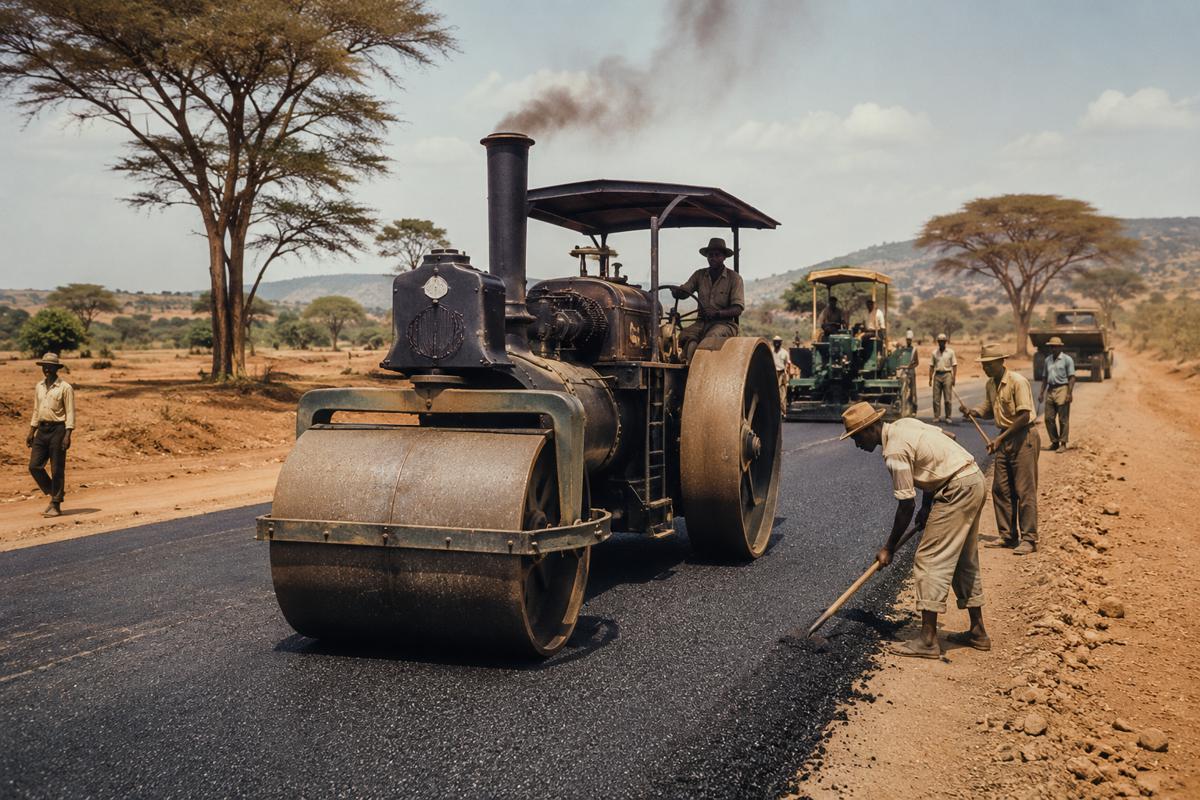
Steam reshaped compaction as well as digging. The earliest road rollers were horse-drawn farm implements, but from the late 1860s the British firm Aveling and Porter patented and built the first commercially successful steam rollers, exporting them around the world and replacing animal power on the roads. For the first time the pace of a major earthwork was set by a machine and its single operator rather than by the size of the crew, a shift in the basic arithmetic of construction that every later technology would extend. Steam’s own reign was long but finite, because by the 1930s simpler and cheaper diesel, petrol and electric machines were displacing it, offering faster starting, lower weight and far less labour around the boiler. The lasting legacy of the period was conceptual, the proof that one powered machine and one skilled operator could outperform an entire gang.
Tracks Change Everything Again
Power was only useful where a machine could stand, and on the soft peat soils of California’s San Joaquin Valley the heavy steam tractors of the day simply sank. Benjamin Holt’s answer, tested on his steam tractor number 77 on Thanksgiving Day in 1904, was to strip off the rear wheels and fit a pair of self-laying wooden tracks that spread the weight as the machine travelled, in effect carrying its own road with it. A company photographer is said to have remarked that the machine crawled like a caterpillar, Holt liked the name, and it was registered as a trademark in 1910. The track-laying principle did far more than rescue tractors from the mud, because it became the foundation of an entire class of machines able to work where wheels could not.
The commercial consequences were considerable and they reshaped the industry’s structure. Holt’s tracked tractors proved themselves in agriculture, then in road building and earthmoving, and were used heavily by Allied armies during the First World War, where they also influenced the development of the tank. After both Holt and his great rival, the C.L. Best Tractor Company, were weakened by the downturn of the early 1920s and by years of patent litigation, the two firms merged in 1925 to form the Caterpillar Tractor Company, the direct ancestor of today’s Caterpillar Inc. The track principle would in time carry excavators, dozers, drill rigs and cranes across ground that defeated wheeled machines, and it remains the defining feature of the heaviest earthmoving equipment. From a single experiment in a Californian delta came both a new mobility and one of the largest industrial companies in the world.
The Cable Giants
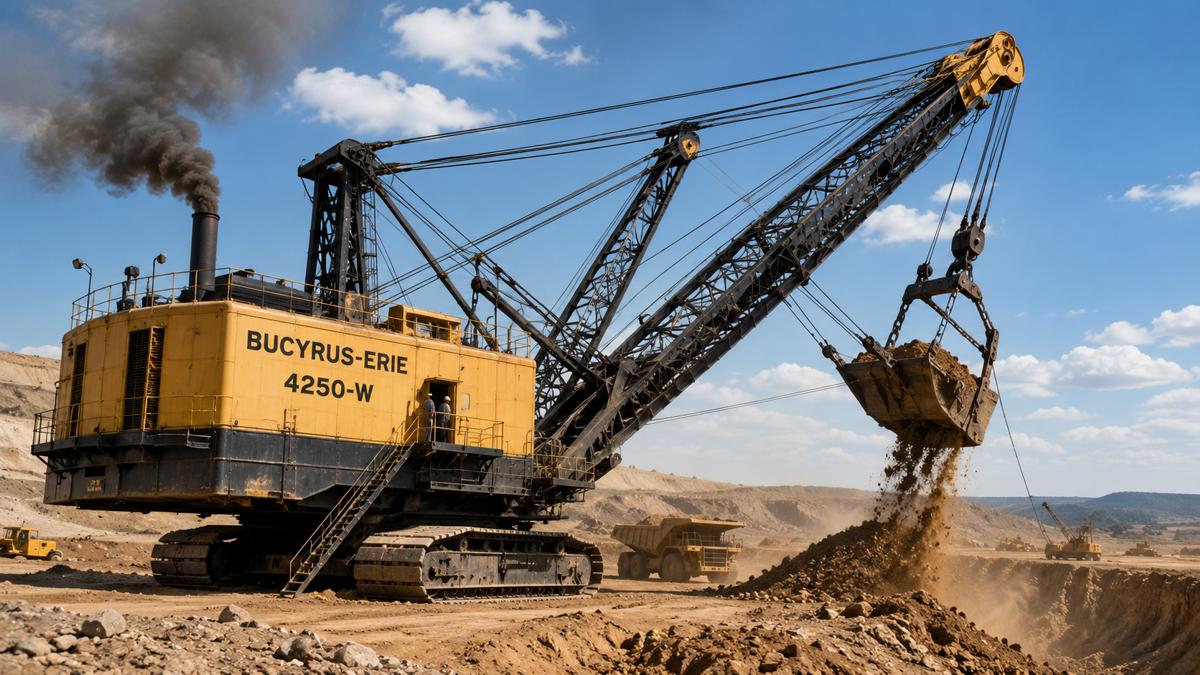
Before hydraulics matured, the way to make an excavator bigger was to make its cables stronger. Cable-operated shovels and walking draglines used winches and wire rope, driven first by steam and later by diesel and electric motors, to hoist enormous buckets, and through the middle of the twentieth century they grew into some of the largest mobile machines ever built. Manufacturers including Bucyrus-Erie, Marion and P&H supplied surface mines and mega-earthworks with rope shovels and draglines whose sheer capacity made other methods irrelevant for the biggest jobs. These were not subtle machines, but on the scale of overburden removal in coal and ore mining, subtlety mattered less than raw reach and bucket size.
The emblem of the category was Big Muskie, the Bucyrus-Erie 4250-W walking dragline, the only one of its kind ever built. Commissioned by the Central Ohio Coal Company and put into service in 1969, it weighed about 13,500 short tons, stood close to twenty-two storeys tall and drew its power from a 13,800-volt cable, with a bucket of 220 cubic yards large enough to swallow a bulldozer or two buses side by side. Over a working life that ran to 1991 it shifted roughly 608 million cubic yards of overburden, by one estimate about twice the volume of earth moved during the construction of the Panama Canal, uncovering some 20 million tons of coal in the process. Its Illinois contemporary, the Marion 6360 stripping shovel known as The Captain, was the largest shovel ever built before fire destroyed it in 1991, and the German Bagger bucket-wheel excavators remain larger still.
That era passed for reasons that were as much regulatory and economic as technical. Tighter air-quality rules, in particular the United States Clean Air Act amendments that curbed demand for high-sulphur coal, undercut the surface operations these draglines served, while rising electricity costs and the arrival of more efficient digging methods made the giants uneconomic to run. Big Muskie was retired in 1991 and scrapped in 1999, its preserved bucket now a roadside monument in Ohio. Cable shovels and draglines survive where capacity still trumps finesse, chiefly in large-scale mining, but for general construction the future belonged to a quieter and far more precise technology.
Hydraulics Rewrite Earthmoving
The machine that defines a building site today owes its existence to fluid under pressure rather than rope over a drum. Hydraulics let an operator control a boom, stick and bucket with proportional precision and, crucially, allowed the upper structure to rotate, which freed the digger from the constraints of cable geometry. The first hydraulic excavators emerged in the immediate post-war years and the credit is genuinely shared, because the Italian brothers Carlo and Mario Bruneri built a working hydraulic excavator prototype in Turin in 1948 and secured a patent in September 1951, a claim widely recognised as the world’s first, while in the same year the French firm Poclain produced its own hydraulic machine, the TU, on a modified truck chassis.
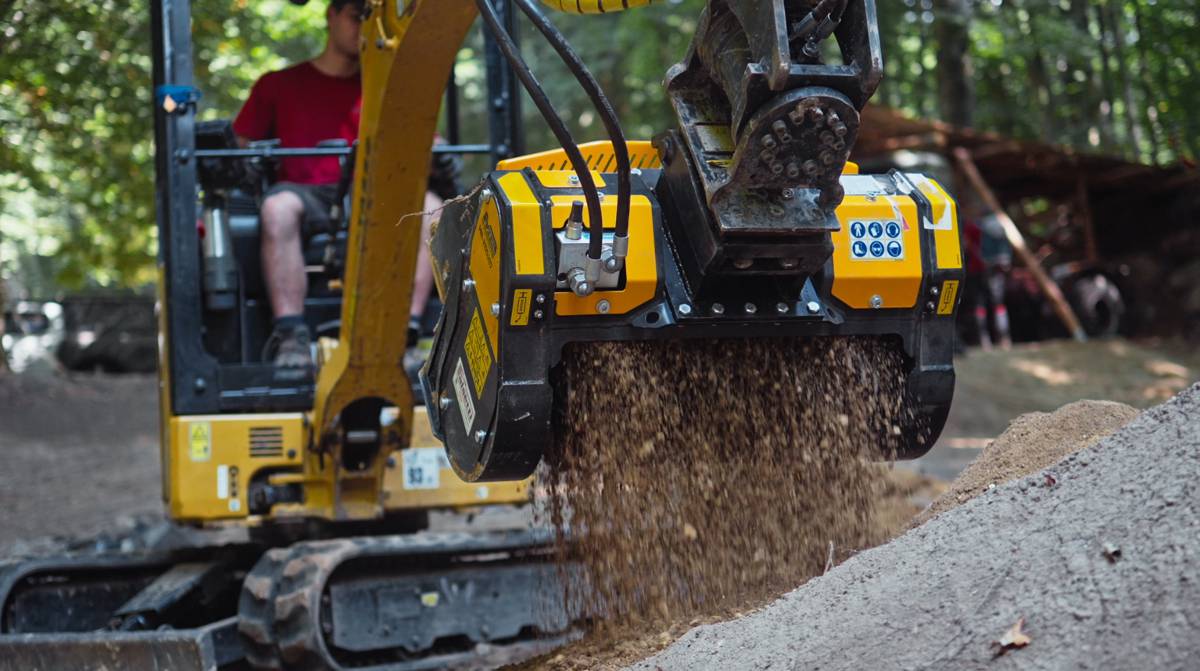
Those earliest machines were wheeled, truck-mounted and limited to partial rotation, and the configuration that became universal arrived a little later. Demag’s B504 of 1954 set the pattern for the modern excavator by combining a crawler chassis with full 360-degree rotation of the upper structure, the arrangement found on essentially every tracked digger built since, and the same year Hans Liebherr presented an early European hydraulic machine of his own. The breakthrough was as much about control as about power, because hydraulics let one operator feel the ground through the levers and place a bucket with an accuracy that cable shovels could not approach. Just as important, the circuits that drove the bucket could drive other tools, and the excavator became a platform for breakers, shears, grapples, augers and compaction plates, turning a single machine into demolition rig, materials handler and trencher by turns.
That versatility is why the hydraulic excavator, rather than any single specialised machine, became the workhorse of the global fleet, and why the word for it varies so widely. In much of the Middle East an excavator is still a Poclain, after the brand that first made the technology familiar, much as a vacuum cleaner is a Hoover in Britain. The class now spans compact mini-excavators of barely a tonne to the Caterpillar 6090 FS mining excavator at around 1,000 tonnes, a single product family covering more than three orders of magnitude in size. For contractors the implication is straightforward, because no other machine matches the excavator for flexibility across digging, loading, demolition and handling, which is why it remains the most-produced and most-rented piece of heavy plant in the world.
Bulldozers Build Nations
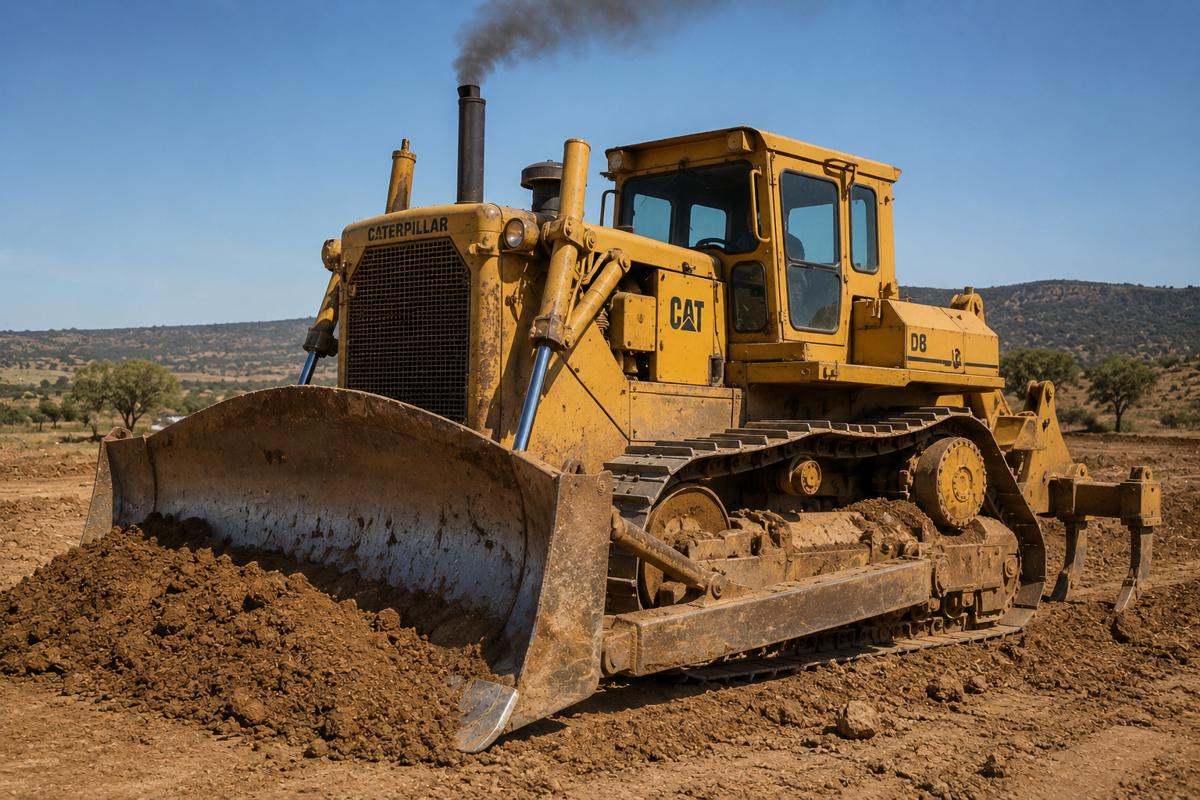
A crawler tractor becomes a bulldozer when a blade is hung on its front, and that simple combination produced the machine most associated with moving earth on a grand scale. Blade attachments spread through the 1920s, hydraulic blade control arrived in the 1940s and 1950s, and the result was a machine that could cut and fill, strip topsoil, rip rock and push scrapers on terrain that defeated wheeled equipment. The dozer’s value lies in its combination of traction, weight and a controllable blade, which together let it shape the ground itself rather than merely dig or carry it. For grading a road formation, clearing a site or building an embankment, nothing has displaced it in more than a century.
The Caterpillar D8 stands as the type specimen of the breed. Appearing in the mid-1930s and built in large numbers thereafter, it became the workhorse of wartime construction, where the United States Navy’s Seabees used it to carve airstrips and roads across the Pacific, and then of the post-war boom in highways, dams and airfields. Its successors climbed the power range to the heavy modern machines such as the Caterpillar D11, used in mining and the largest earthworks, while hydrostatic drive and computer-controlled blades refined the operator’s task without changing its essential character. The cultural imprint has been as durable as the engineering one, because when people picture earth being moved on a grand scale they tend to picture a crawler dozer, and the image is accurate. Whole landscapes of motorway, reservoir and new town were graded into being by these machines, which is why the dozer, more than any other, is the one that built nations.
The Wheel Loader Revolution
While the excavator excelled at digging, a different machine came to dominate the work of scooping and shifting loose material at speed. The first fully integrated rubber-tyred wheel loader was the Model HS Payloader, built in 1939 by the Chicago engineer Frank G. Hough, who had coined the term payloader for the idea of moving bulk material with mobile, hydraulically operated equipment. Hough’s company went on to define the modern loader, introducing the first four-wheel-drive machine with its HM model in 1947 and pioneering hydraulic bucket control, hydrostatic transmission and the Z-bar linkage that survives on loaders today. The articulated frame that gives the loader its tight turning circle was popularised by Clark’s Michigan machines in the early 1950s, Volvo built its first loader in 1954 and Caterpillar entered with its 944 in 1959, after which the field broadened into the global contest of Caterpillar, Volvo, Komatsu and Liebherr that continues now.
What the loader changed was the rhythm of a site, because a wheel loader can fill a bucket from a stockpile, reverse, turn and charge a truck or hopper in a cycle measured in tens of seconds, and it does so with enclosed cabs and visibility that older converted tractors never offered. Loaders pair so naturally with crushers, conveyors and haul trucks that they shaped the layout of quarries, recycling yards and material terminals around fast, repeatable loading, taking over the short-haul, high-frequency work that would otherwise tie up a more expensive excavator.
The same logic of combining functions produced the small machine that became ubiquitous on urban and minor works, the backhoe loader. Its origins lie with the Wain-Roy Corporation of Massachusetts, whose engineers built the first fully hydraulic backhoe swing frame in 1947 and sold the first unit, mounted on a Ford tractor, to a utility company in 1948. In Britain Joseph Cyril Bamford fitted a hydraulic loader and a rear digging arm to a tractor and launched JCB’s first backhoe loader in 1953, and in the United States J.I. Case introduced the Model 320 in 1957, the first factory-integrated machine built and warranted as a single product. The format proved so useful for trenching, loading and light excavation that in Britain and Ireland the word JCB became a generic term for any digger, recorded in the dictionary, a measure of how completely one machine came to define an entire kind of work.
Hauling The Impossible
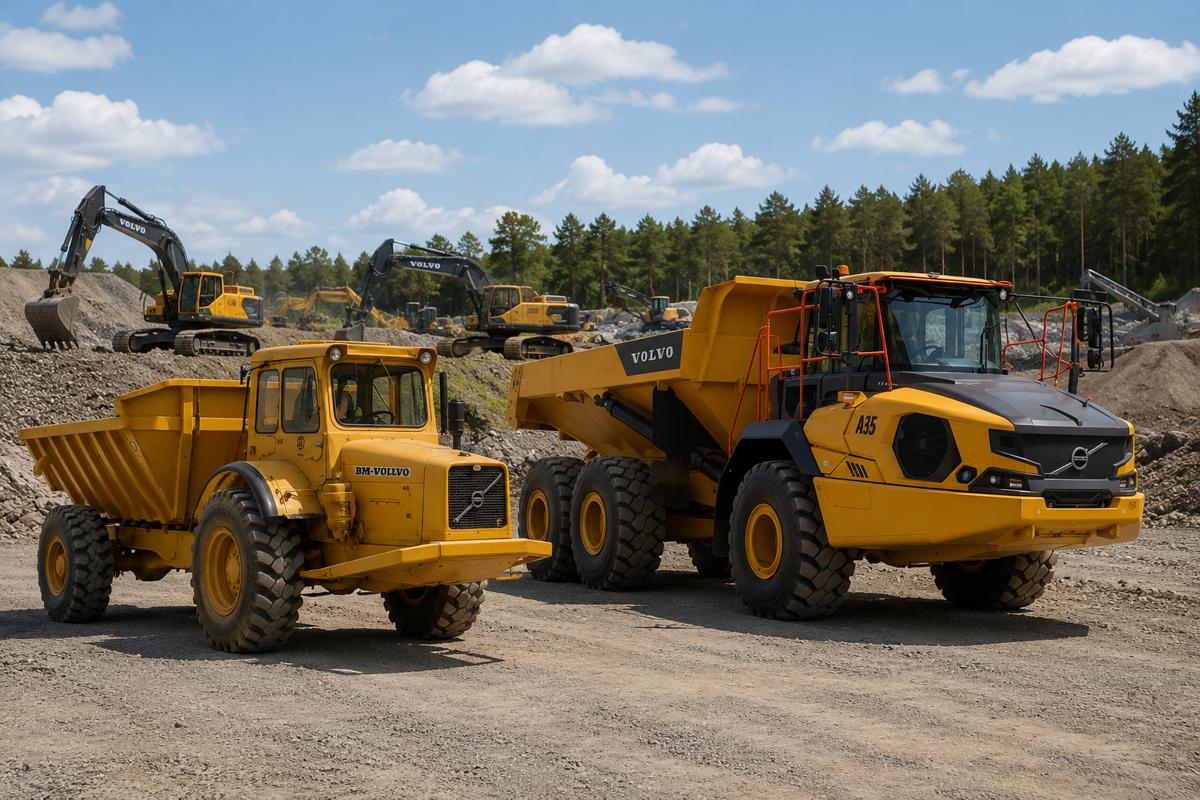
Moving material across a finished haul road is one problem, and moving it across mud, slopes and broken ground is another, which the articulated dump truck was built to solve. In 1966, at Braås in Sweden, Volvo introduced the DR631, a ten-tonne hauler assembled from an agricultural tractor with its front axle removed and a tipping trailer joined to it through a hydraulic articulating hitch. Nicknamed Gravel Charlie, it is credited with creating the articulated hauler as a category, a machine that keeps all wheels driven and lets the front and rear sections pivot independently so the truck can flex over terrain that would bog or beach a rigid hauler. Uptake was slow at first, confined for some years to the Swedish market, but once the wider industry grasped its value the format spread quickly, payloads climbed from ten tonnes to the 55-tonne Volvo A60H, and more than seventy thousand of the machines were built within half a century.
On the firm, engineered haul roads of large open-pit mines, the rigid dump truck rules instead, and here the scale becomes difficult to picture. Tracing its lineage to the rugged off-highway trucks pioneered by Euclid, the rigid hauler grew steadily until Caterpillar introduced the 797 in 1998, the largest mechanically driven mining truck in the world. The current 797F carries a payload of 400 short tons, around 363 tonnes, weighs more than 620 tonnes fully loaded, runs on six tyres each nearly four metres tall, and is shipped to site in pieces and assembled there by a dedicated crew. Larger still in payload is the diesel-electric BelAZ 75710 at 500 short tons, and the one-off Terex Titan of the 1970s held the title of world’s largest truck for two decades, but the principle is constant. The load-haul-dump cycle of a shovel or excavator filling a hauler that carries to a crusher or dump is the beating heart of mining and major earthworks, and the relentless effort to lower the cost of each tonne moved has driven the machines to their current, almost improbable size.
The Rise Of Specialist Equipment
Alongside the headline machines, the twentieth century produced a specialist tool for nearly every discrete task in construction, and each one compounded the productivity of the others. The motor grader is a clear example, descending from horse-drawn blades and the leaning-wheel grader patented by J.D. Adams in 1885, through Russell’s self-propelled Motor Patrol of 1920, to the Caterpillar Auto Patrol of 1931, the first machine designed as a single integrated unit with the engine at the rear, the operator above the blade and power-operated controls. The grader’s long wheelbase and finely adjustable mouldboard make it the tool of choice for trimming a road formation to precise grade, and its basic configuration has scarcely changed in nearly a century because the original solution was so nearly right.
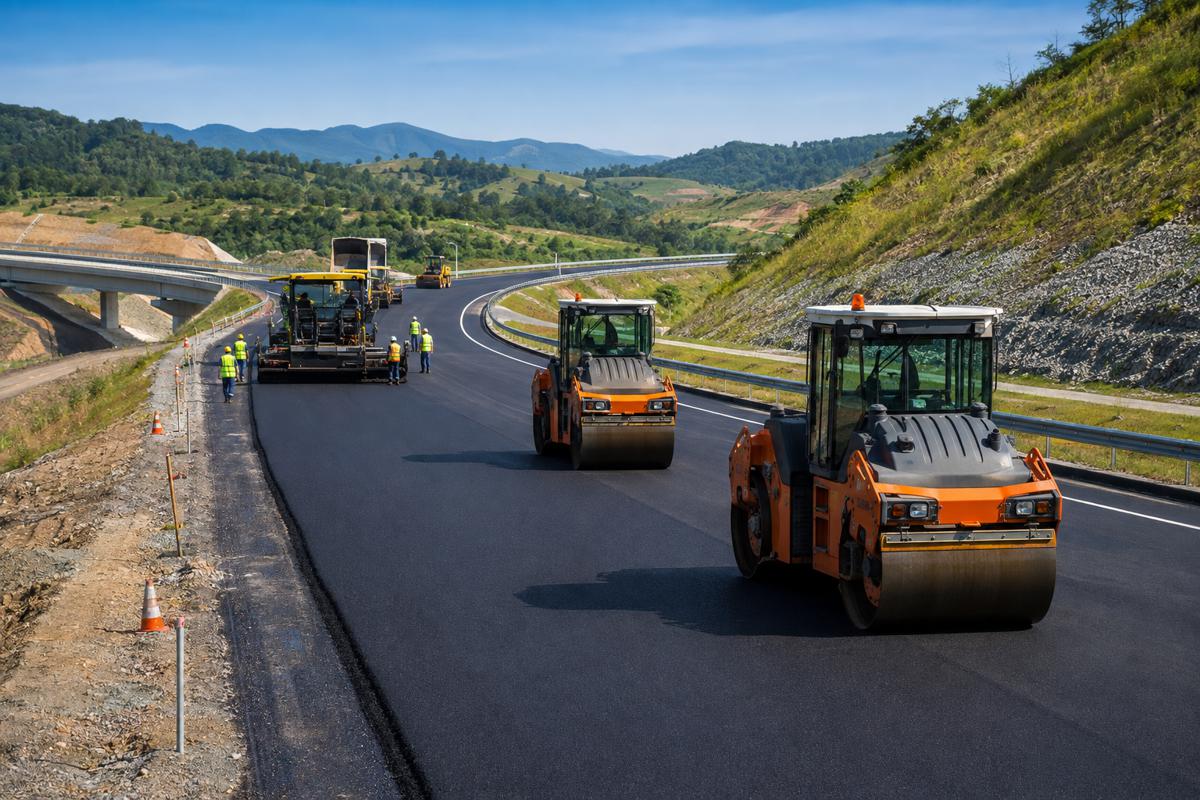
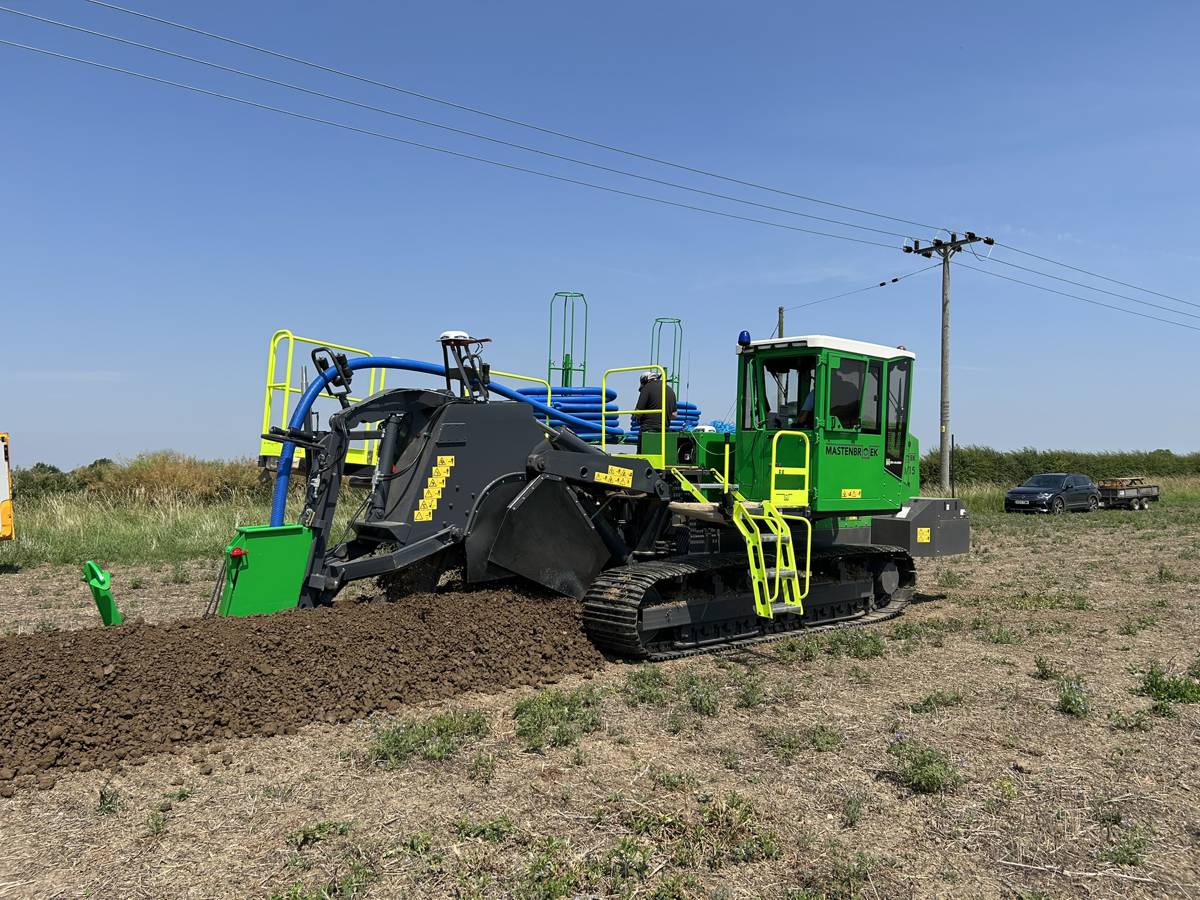
Compaction followed a parallel path from the steam roller to the vibratory drum. The static weight of a smooth or sheepsfoot roller gives way, on modern sites, to vibratory compactors whose eccentric weights drive far higher densities, a technology in which German firms such as Hamm and Bomag came to lead, and the most advanced machines now map their passes and measure soil stiffness in real time so that operators reach a target density with fewer passes and less waste. Trenching, once the hardest hand labour on any site, was mechanised by chain and wheel trenchers that cut a clean, continuous trench for pipe and cable, bringing the same logic of a purpose-built machine to a task that had consumed armies of labourers.
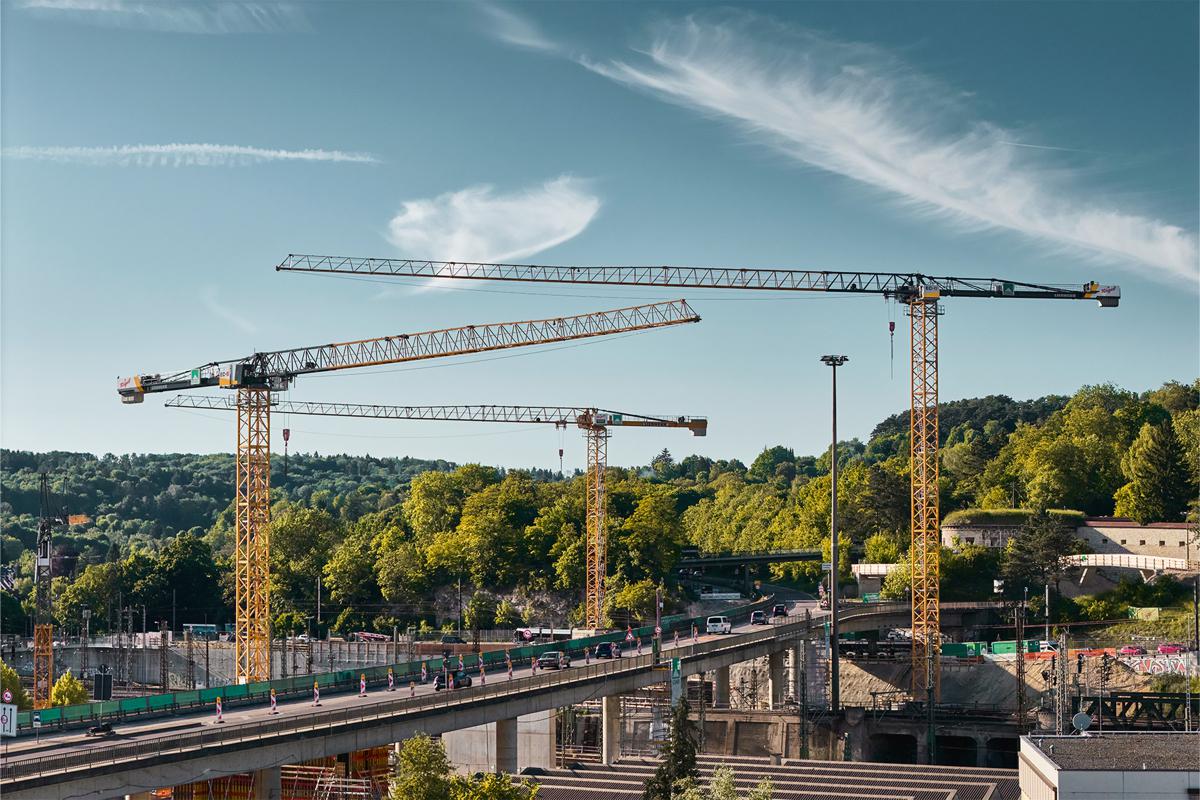
Paving and surfacing produced their own lineage of specialists. The modern asphalt paver descends from the Barber-Greene machine first shown in 1931 and, crucially, from the independent floating screed developed two years later, the feature that made a smooth, uniform mat possible and that survives on every paver today. Concrete paving lost its fixed forms with the slipform technique developed in Iowa in the late 1940s and 1950s, which let a single machine extrude a continuous slab, while road milling, or cold planing, pioneered by Wirtgen in the early 1970s, gave the industry a way to grind off a worn surface, recover the material for recycling and lay a fresh course in a single operation. Overhead, the crane completed the toolkit, evolving from the Roman treadwheel through the mobile tower crane that Hans Liebherr invented in 1949 to the all-terrain and crawler cranes that raise modern structures. Each of these machines is narrow in purpose and indispensable in practice, and together they turned construction from a sequence of manual operations into a chain of mechanised ones.
Electronics Enter Construction
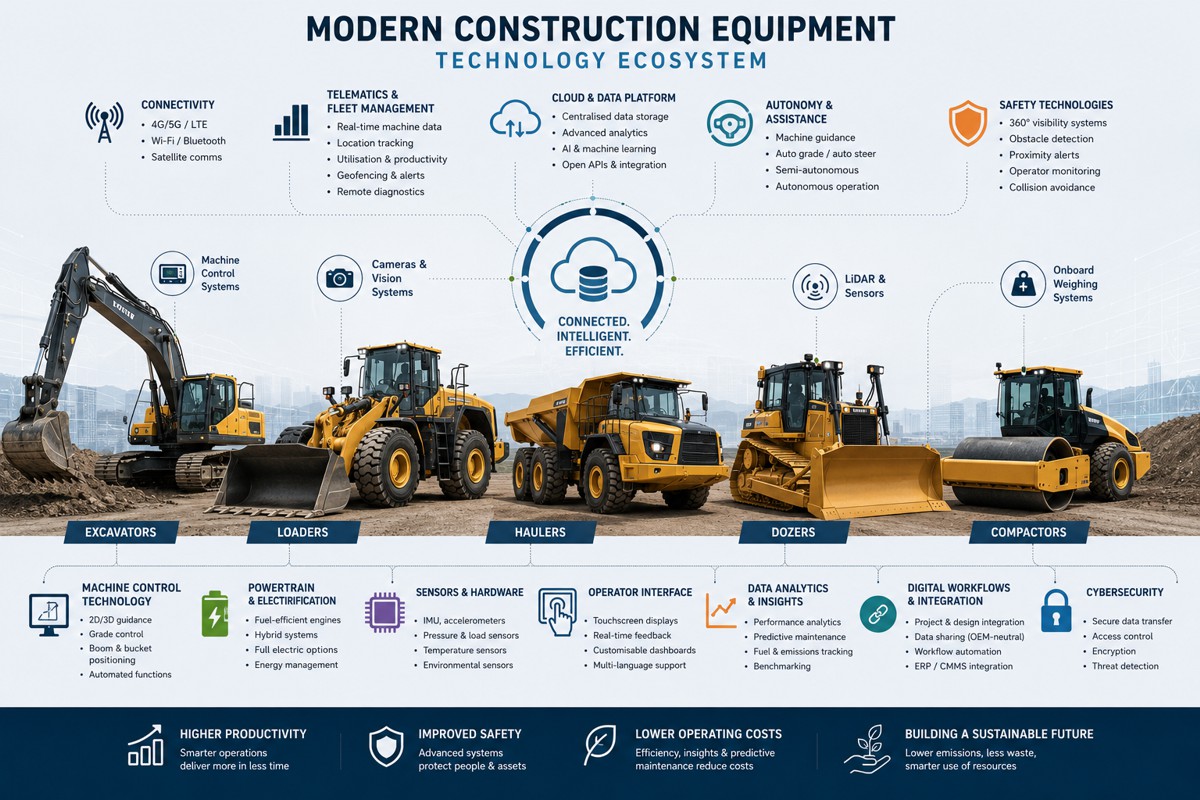
The most significant recent change to construction equipment is partly invisible, because it concerns information rather than iron. From the late 1990s, manufacturers began fitting machines with telematics, and Komatsu’s KOMTRAX, introduced in 1998 and progressively made standard across its construction range through the 2000s, was among the first systems to bring fleet monitoring into the sector at scale. Caterpillar’s Product Link served the same purpose on its own machines, and the capability is now expected as standard rather than sold as a novelty. A connected machine reports its location, engine hours, fuel burn, idle time and fault codes in something close to real time, which lets managers schedule maintenance before failures occur, cut wasted idling, deter theft through geofencing and remote engine locks, and compare utilisation across a mixed fleet.
The cumulative effect of connectivity and the other electronic advances that accompanied it is hard to overstate. The Association of Equipment Manufacturers, in its study of construction equipment technologies, attributes to roughly three decades of progress an 83 per cent reduction in worksite fatalities and a 79 per cent fall in injuries against United States labour statistics, alongside a 96 per cent cut in nitrogen oxide and diesel particulate emissions per gallon of fuel burned and an 11 to 15 per cent improvement in fuel efficiency since 1996. These figures should be read with care, because technology was one contributor among several, including regulation and changing site practice, rather than the sole cause. Even so the direction is unambiguous, and it reframes what an equipment fleet is, because a modern machine is now a data platform that happens to move earth, and the information it generates increasingly drives purchasing, financing and residual-value decisions. That shift moves the basis of competition from the specification sheet towards uptime, analytics and service, favouring the manufacturers and dealers best able to turn data into lower operating costs.
GPS Changes Accuracy Forever
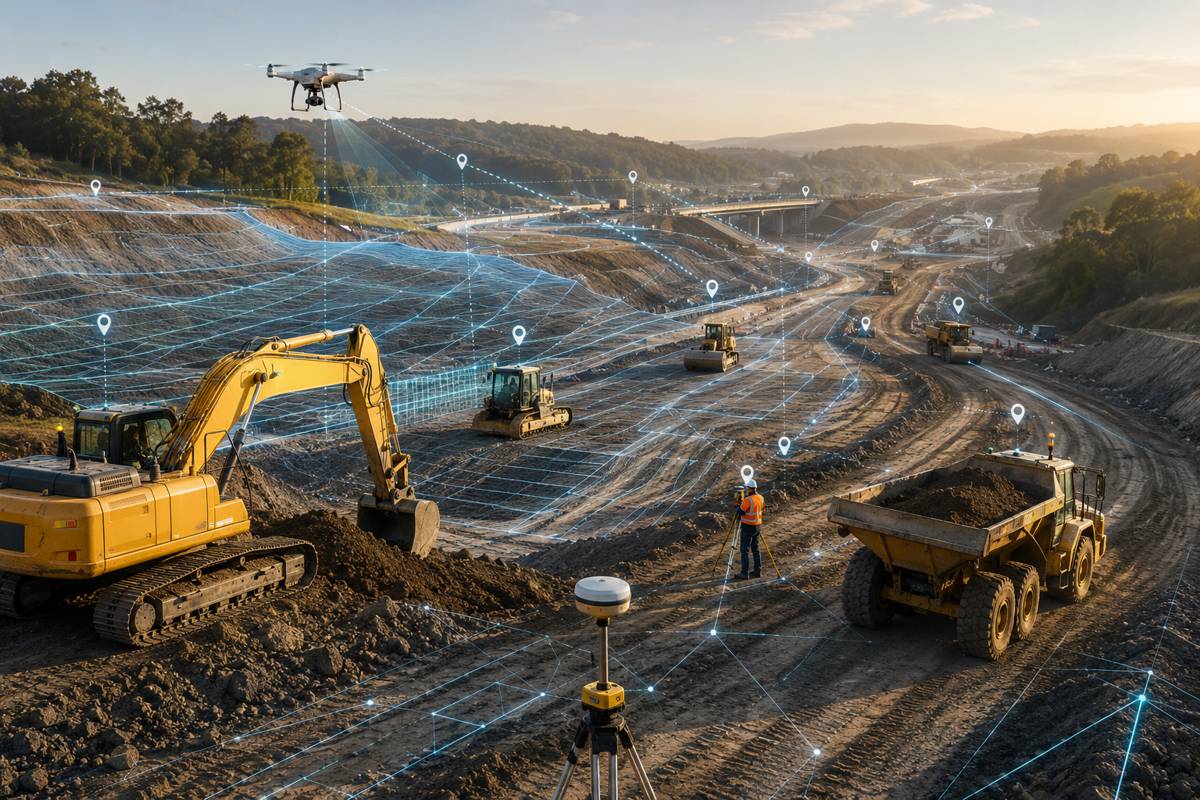
If telematics told owners what their machines were doing, satellite positioning changed how the work itself was executed. Grade control began with laser systems in the latter half of the twentieth century, but the decisive shift came with real-time kinematic GPS in the 1990s, which delivered centimetre-level positioning in the field. Caterpillar and Trimble began working together in 1995 to develop receivers rugged enough for heavy machines, producing a blade-mounted tool for dozers and then the Computer Aided Earthmoving System, and Trimble launched its first stakeless grade-control system before the decade was out. The two firms formalised the effort in the Caterpillar Trimble Control Technologies joint venture in 2002, while Topcon and Leica built competing systems, and three-dimensional machine control passed from experiment to mainstream.
The practical consequences reshaped the site and the profession alike. A dozer or excavator working to a digital design model can hold a target surface automatically, which removes most of the survey staking, the guesswork and the rework that used to accompany earthworks, and it lets a relatively inexperienced operator reach grade with an accuracy that once took years to acquire. Material is no longer over-excavated and then refilled, projects move faster, and the surveyor’s role shifts from setting out stakes to managing the data that drives the machines. The same positioning that guides a dozer’s blade also guided the dredgers that sprayed sand into the precise shape of an artificial island, a reminder that accuracy at scale is itself a form of productivity, and that the satellite has become as much a piece of construction equipment as the bucket.
Electrification
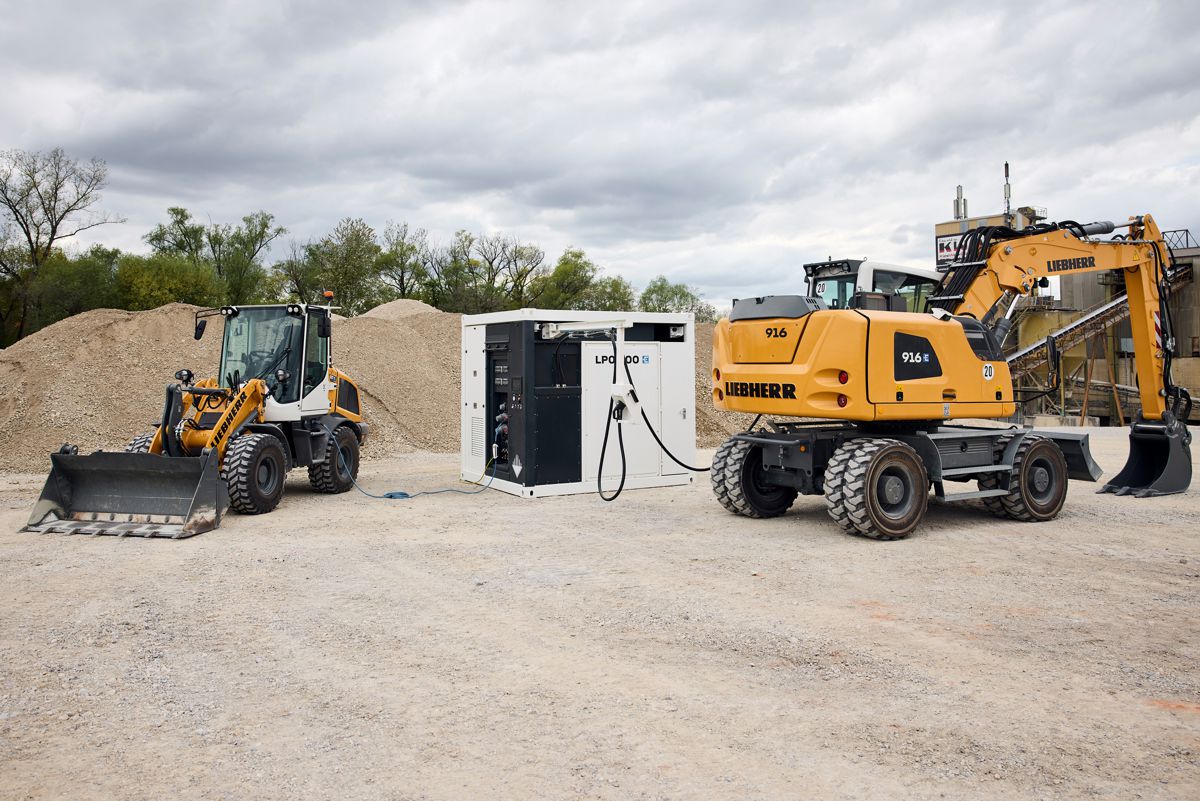
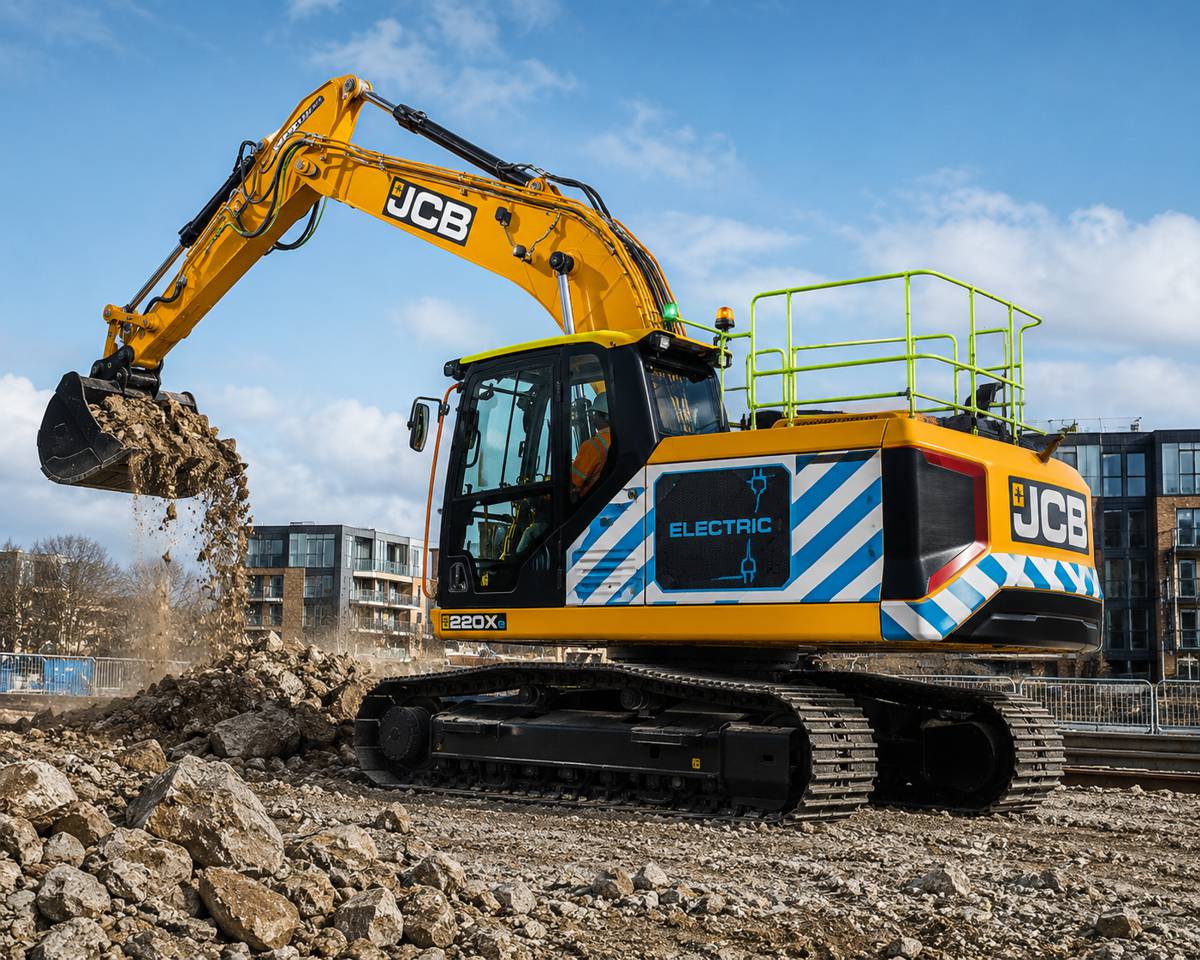
The clearest sign that the industry has entered a new phase is the appearance of credible electric machines on working sites. Volvo Construction Equipment unveiled its battery-electric ECR25 compact excavator and L25 compact wheel loader at the bauma exhibition in 2019 and, in the same announcement, committed to an electric future for its compact range and to halting new diesel development in those classes, with commercial machines following from 2020. Early trials, including a year-long programme with contractors in California and an excavator dug into a golf course near Paris, found no meaningful loss of digging depth, breakout force, tipping load or attachment performance against diesel equivalents, while cutting sound power by around 90 per cent and removing the engine maintenance that diesel machines require. Asked why a North American contractor would buy one, Volvo’s construction equipment president Melker Jernberg countered simply, why should they not?
The case for electrification rests on more than novelty, because the sector’s emissions are substantial. Construction machinery is estimated to emit around 400 mega-tonnes of carbon dioxide a year, roughly 1.1 per cent of the global total and comparable to the footprint of international aviation, with excavators above ten tonnes alone responsible for close to half of it. Set in a wider frame, the non-road sector of mostly construction and agricultural machinery emits more than a billion tonnes of carbon dioxide annually, exceeding the climate footprint of global shipping, according to a partnership of the Climate and Clean Air Coalition, the International Council on Clean Transportation and C40 Cities announced at COP30 in November 2025. Electric machines remove tailpipe emissions entirely, improve urban air quality and avoid charges in low-emission zones, and over a working life their lower energy and maintenance costs can offset a higher purchase price.
The obstacles are real and they are concentrated at the larger end of the range. Batteries still carry a significant price premium, charging infrastructure is scarce on remote or temporary sites, and heavy machines above twenty tonnes need more than 300 kilowatt hours of energy to complete a full shift, which makes wholesale electrification of the biggest classes a longer project. Chinese manufacturers including XCMG, SANY and LiuGong have moved quickly and now offer the widest electric model ranges, including heavy-duty machines, while solutions such as off-grid solar charging and battery swapping are being trialled to address the power-supply problem. As Volvo’s Stephen Roy has put it, real progress requires that larger machines need to be part of the equation, and it is there that the next phase of competition will be decided.
Artificial Intelligence And Autonomy
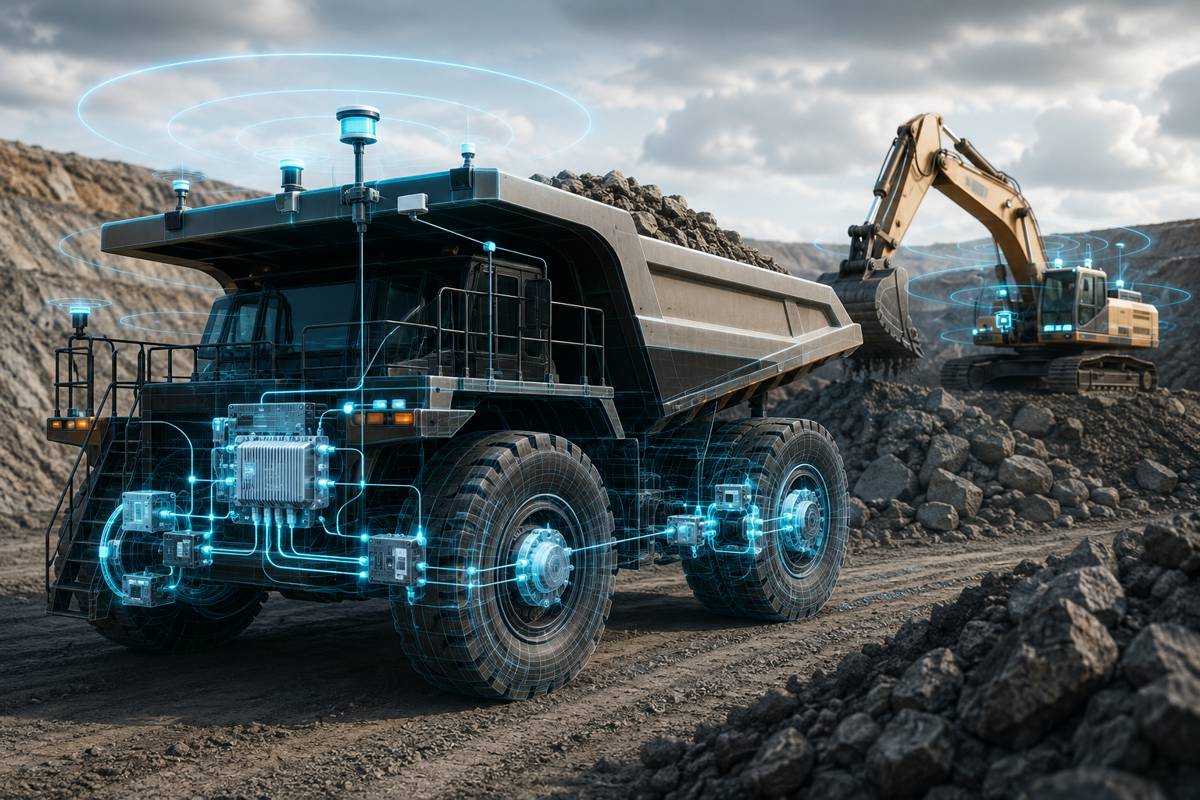
The logical extension of guidance and connectivity is to take the operator out of the cab, and in the most repetitive and hazardous settings that has already happened. Komatsu deployed the world’s first commercial autonomous haulage system in 2008, and large iron-ore operations in Western Australia’s Pilbara became among the earliest and largest adopters of driverless haul trucks at scale. The pace has not slackened, and in April 2026 Komatsu announced that it had commissioned its one-thousandth ultra-class autonomous haul truck, part of a fleet that has moved more than 3.5 billion tonnes of material. Removing the driver allows continuous operation without shift changes or fatigue, smooths loading and routing, and takes people out of the most dangerous positions on a mine site.
Construction proper is following mining, more cautiously, and the dozer led the way. In 2013 Komatsu introduced the D61i-23, the first factory-fitted dozer with intelligent Machine Control able to dose automatically from rough cut to finish grade, a step the company’s tracked products director Andrew Earing recalled bluntly: It was revolutionary. Start-up firms such as Built Robotics have since retrofitted standard excavators with the sensors and software to work under remote supervision against a three-dimensional model, artificial-intelligence perception systems are being trained to recognise obstacles and people, and the major manufacturers are advancing their own semi-autonomous and remote-control machines. The combination of satellite positioning, lidar and camera sensing, and onboard control lets a machine hold a design surface or follow a haul route with a consistency that human operators struggle to sustain over a long shift.
The implications for labour and skills are significant, and they are not simply about job losses. Autonomy shifts the operator’s role from the cab to a control room, where one supervisor may oversee several machines, and it creates demand for data analysts, systems specialists and remote technicians that did not exist a generation ago. Regulation, liability and safety assurance for autonomous operation on open construction sites remain works in progress, which is one reason adoption has been faster in the controlled environment of a mine than on a public scheme. The broad industry expectation is that supervised and semi-autonomous machines will become common across contracting over the next decade or two, following the same path from specialist novelty to assumed standard that telematics and grade control travelled before them.
Greatest Machines Hall Of Fame
Some machines mattered as ideas, and others as specific, named pieces of iron that did something nothing before them could. The selection below gathers the individual machines and models that changed the trajectory of the industry, from the first powered shovel to the beginnings of the zero-emission fleet.
| Machine | Year | Significance |
|---|---|---|
| Otis steam shovel | 1839 | The first powered excavator; began mechanised earthmoving and broke the link between output and crew size. |
| Holt track-type tractor (No. 77) | 1904 | Invented practical tracked mobility, the basis of dozers and most heavy machines, and the origin of Caterpillar. |
| Caterpillar Auto Patrol | 1931 | The first purpose-built motor grader, integrating tractor and blade into one machine; its layout is still standard. |
| Barber-Greene asphalt paver | 1931 | Mechanised hot-mix paving; the floating screed that followed in 1933 underpins every modern paver. |
| Liebherr TK10 | 1949 | The first mobile tower crane, quick to transport and erect, which mechanised the rebuilding of post-war Europe. |
| Caterpillar D8 | mid-1930s | The dozer that built airfields in the Second World War and highways, dams and new towns after it. |
| Poclain TU | 1951 | An early full-hydraulic excavator that helped move digging from cable and winch to fluid power. |
| Demag B504 | 1954 | The first recognisably modern crawler excavator, pairing a tracked chassis with full 360-degree rotation. |
| Hough HS Payloader | 1939 | The first fully integrated wheel loader, the template for the modern materials handler. |
| Volvo DR631 ‘Gravel Charlie’ | 1966 | The first successful articulated hauler, opening soft and broken ground to high-speed haulage. |
| Caterpillar 797 | 1998 | The largest mechanical-drive mining truck, carrying around 363 tonnes and redefining cost per tonne hauled. |
| Big Muskie | 1969 | The largest walking dragline ever built, the high-water mark of the cable-machine age. |
| Liebherr R9800 | 2010s | A modern ultra-class mining excavator, loading the largest haul trucks in roughly twenty-four second cycles. |
| Komatsu D61i | 2013 | The first factory dozer with intelligent machine control, bringing semi-autonomous grading into the mainstream. |
| Volvo ECR25 and L25 Electric | 2019 | The first compact range committed to an electric future, marking the start of zero-emission construction equipment. |
Manufacturers Who Changed History
The industry was shaped by a relatively small number of firms, each of which contributed something that outlasted it. Read in sequence, their stories are the story of the machines themselves.
Caterpillar grew from Benjamin Holt’s track-type tractor and the 1925 Holt-Best merger into the industry’s defining company, dominant in dozers and tracked machines, the maker of the first purpose-built motor grader in 1931 and of the 797 mining truck, and the owner since 2011 of the old Bucyrus mining lines. Its most durable advantage is arguably not a machine at all but its global dealer and parts network, the standard against which support in the sector is measured.
Volvo Construction Equipment invented the articulated hauler with the DR631 in 1966 and remains its market leader, built a reputation for operator safety and comfort, and led the industry into compact electrification by committing its small machine range to battery power in 2019. Its lineage absorbed earlier names including Michigan, Euclid and Åkerman, concentrating decades of earthmoving know-how in one group.
Liebherr began in 1949 when Hans Liebherr invented the mobile tower crane to rebuild post-war Germany, and the family-owned group grew into one of the largest construction and mining equipment makers in the world. It builds some of the biggest mobile cranes and mining excavators in existence, and its insistence on producing its own engines, transmissions, hydraulics and electronics gives it a depth of vertical integration few rivals match.
Komatsu is the great Japanese challenger, founded in 1921 and now second only to Caterpillar in scale, and its defining contributions are digital. It brought telematics to the mass market with KOMTRAX in 1998, fielded the first commercial autonomous haulage system in 2008 and the first intelligent-machine-control dozer in 2013, and has pushed hardest on linking machines, data and automation.
Hitachi distinguished itself by developing its hydraulic excavators in-house from the mid-1960s rather than licensing the technology, and that engineering independence made it a leader in both construction excavators and the giant machines used in mining. Its large hydraulic shovels remain a benchmark for loading the biggest haul trucks.
Case traces its roots to nineteenth-century threshing machines and steam engines, but its lasting mark on construction is the integrated backhoe loader, the Model 320 of 1957, the first such machine built and warranted as a single product. It turned a pair of tractor attachments into a purpose-built tool that became the workhorse of small and urban works worldwide.
John Deere carried its agricultural heritage, which reaches back to the steel plough of 1837, into construction from the mid-twentieth century, and it is now a major maker of dozers, loaders, graders and excavators. It has been among the most aggressive in building satellite grade control into its machines from the factory, integrating the digital and the mechanical rather than treating guidance as an add-on.
JCB was founded by Joseph Cyril Bamford in 1945 and built its first backhoe loader in 1953, and it did more than any other firm to make that machine ubiquitous, to the point that the word JCB became a generic British term for a digger and entered the dictionary. The family-owned company has since pushed into new ground, including hydrogen combustion engines for off-highway machines.
Poclain was the pioneer of hydraulic excavation, building one of the first hydraulic excavators in 1951, perfecting continuous 360-degree rotation and developing the high-pressure hydraulic wheel motor. Its early dominance was so complete in some markets that the brand name became the everyday word for an excavator long after the machines themselves had changed.
Bucyrus built the steam shovels that dug the Panama Canal and the draglines, including Big Muskie, that defined surface mining at its largest scale, then spent the twentieth century as a giant of mining excavation. It absorbed its old rival Marion in 1997 before itself being acquired by Caterpillar in 2011, folding more than a century of digging expertise into its former competitor.
Marion was Bucyrus’s great rival in steam shovels and stripping machines, and it built some of the largest shovels ever made, including The Captain. Beyond mining, Marion built the crawler-transporters that still carry rockets to their launch pads at the Kennedy Space Center, a reminder that the heaviest moving machines on earth came from the earthmoving trade.
Demag set the template for the modern excavator with the B504 of 1954, the first to combine a crawler chassis with full upper-structure rotation, and it went on to build very large hydraulic mining shovels. That mining lineage passed through later corporate owners, but the configuration Demag fixed in 1954 is now universal.
Hough gave the industry the integrated wheel loader in 1939 and the term payloader, and Frank G. Hough’s innovations in four-wheel drive, hydraulic bucket control and linkage geometry shaped every loader that followed. The company passed through International Harvester, Dresser and Komatsu, and its descendants are still built under the Dressta name.
Terex, whose name derives from the Latin for earth and king, was assembled from divested earthmoving operations and grew into a broad conglomerate spanning cranes, haulers and aerial equipment. Its one-off Titan haul truck of the 1970s held the title of the world’s largest truck for two decades, a marker of how far the rigid hauler had come.
Projects That Couldn’t Have Been Built Without These Machines
The clearest proof of a machine’s importance is a structure that could not exist without it. Each of the projects below was made possible by a particular class of equipment, and several defined the limits of what construction could attempt in their day.
The Panama Canal, completed in 1914, was won by the steam shovel. The 77 Bucyrus machines that cut the Culebra Cut removed rock and spoil on a scale no human workforce could have matched, and the canal stands as the first demonstration that powered earthmoving could reshape a continent’s geography.
The Hoover Dam, built between 1931 and 1936, depended on two pieces of equipment as much as on any design. Concrete was carried into Black Canyon in twenty-ton buckets slung from five aerial cableways, with a fresh bucket arriving roughly every seventy-eight seconds, while the heat of the curing concrete was drawn off through nearly 600 miles of embedded steel pipe fed by an on-site refrigeration plant, without which the dam would have cracked as it cooled. High scalers cleared the canyon walls by hand, and the tar-soaked hats they wore against falling rock were among the ancestors of the modern hard hat.
The Interstate Highway System, launched by the United States in 1956, was the largest public works programme of its age, and it was paved across the continent by fleets of scrapers, dozers, graders and asphalt pavers working in concert. The self-propelled scraper, advanced by inventors such as R.G. LeTourneau, was the signature earthmover of the effort, stripping, carrying and spreading soil in a single continuous pass.
The Channel Tunnel, opened in 1994, was driven by a fleet of eleven tunnel boring machines working from the English and French coasts, sealed against the water pressure of the chalk marl beneath the seabed. The British and French bores met beneath the Channel in 1990 and 1991, and several of the machines, unable to be retrieved, were turned aside and buried in the rock they had cut.
Crossrail, London’s Elizabeth Line, used eight thousand-tonne tunnel boring machines to excavate 42 kilometres of tunnel beneath the capital, one of them advancing 72 metres in a single day. The machines threaded between existing tube lines, sewers and building foundations with a precision that would have been unimaginable to the Victorian navvies who built the first Underground by hand.
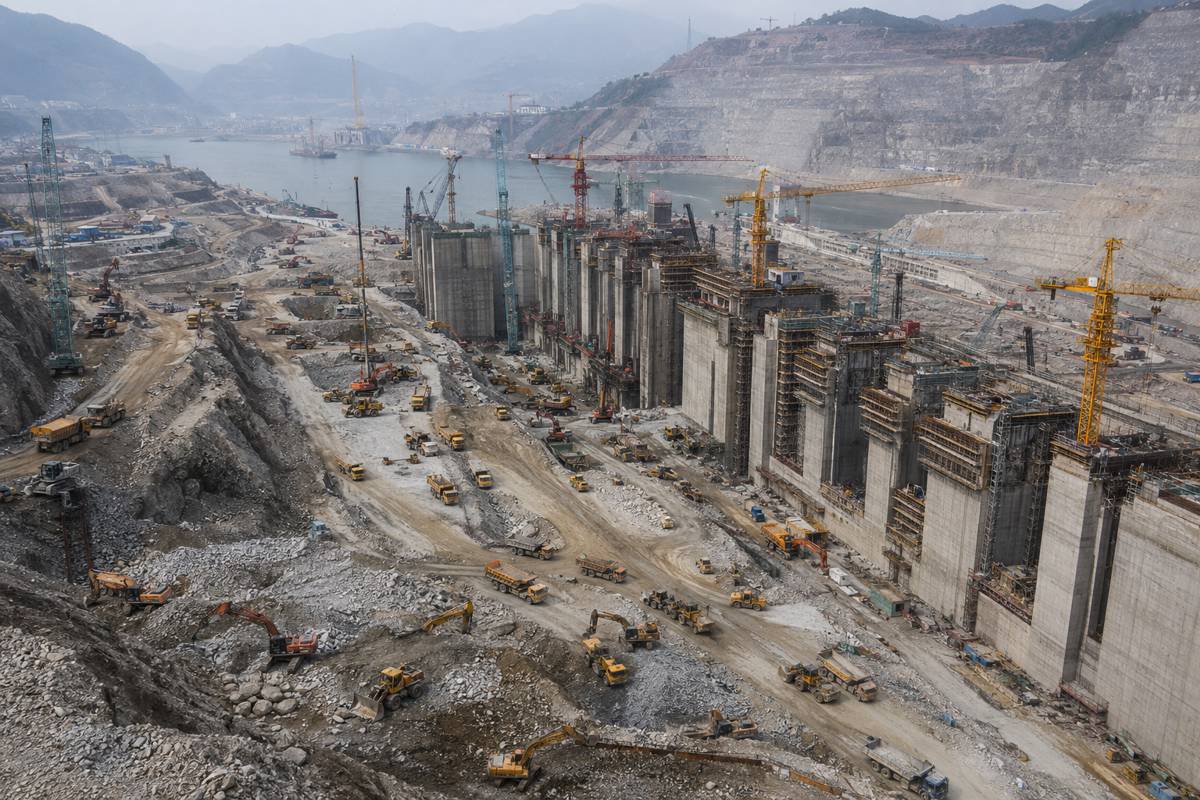
The Three Gorges Dam in China, the world’s largest hydroelectric power station, consumed on the order of twenty-eight million cubic metres of concrete and required a vast array of high-capacity tower and cable cranes to place it. It represents the modern continuation of the Hoover Dam’s logic at several times the scale.
The Palm Jumeirah in Dubai, reclaimed from the sea between 2001 and 2003, was built almost entirely by dredgers. Around 94 million cubic metres of sand were drawn from the Gulf floor by cutter-suction and trailing-suction hopper dredgers and sprayed into the shape of a palm by a technique called rainbowing, with satellite positioning guiding placement to within centimetres, before vibro-compaction stabilised the new land for building.
The Burj Khalifa, completed in 2010 as the world’s tallest building, set a world record for vertical concrete pumping when a Putzmeister pump developed specifically for the project pushed concrete to 606 metres. The mix was chilled with ice and poured at night to survive the Gulf heat, and three high-level tower cranes lifted material to the upper floors, one operator reportedly remaining near the summit for the duration of the work.
HS2, Britain’s high-speed railway, is being tunnelled by ten giant Herrenknecht boring machines, each around 170 metres long and 2,000 tonnes, designed for the specific chalk, flint and London clay of their drives and running continuously for years at a time. By 2026 they had already bored more tunnel than Crossrail, the Jubilee Line extension and Tideway combined.
NEOM, the vast development under construction in Saudi Arabia, marks the present-day frontier of mega-earthmoving, with one of the largest fleets of excavators, dozers and haulers ever assembled on a single programme. Whether or not its full ambitions are realised, it is the current test of the same machines and the same logic that have driven the industry for nearly two centuries, now at a scale that would astonish the engineers who built the Panama Canal.
The Next Hundred Years
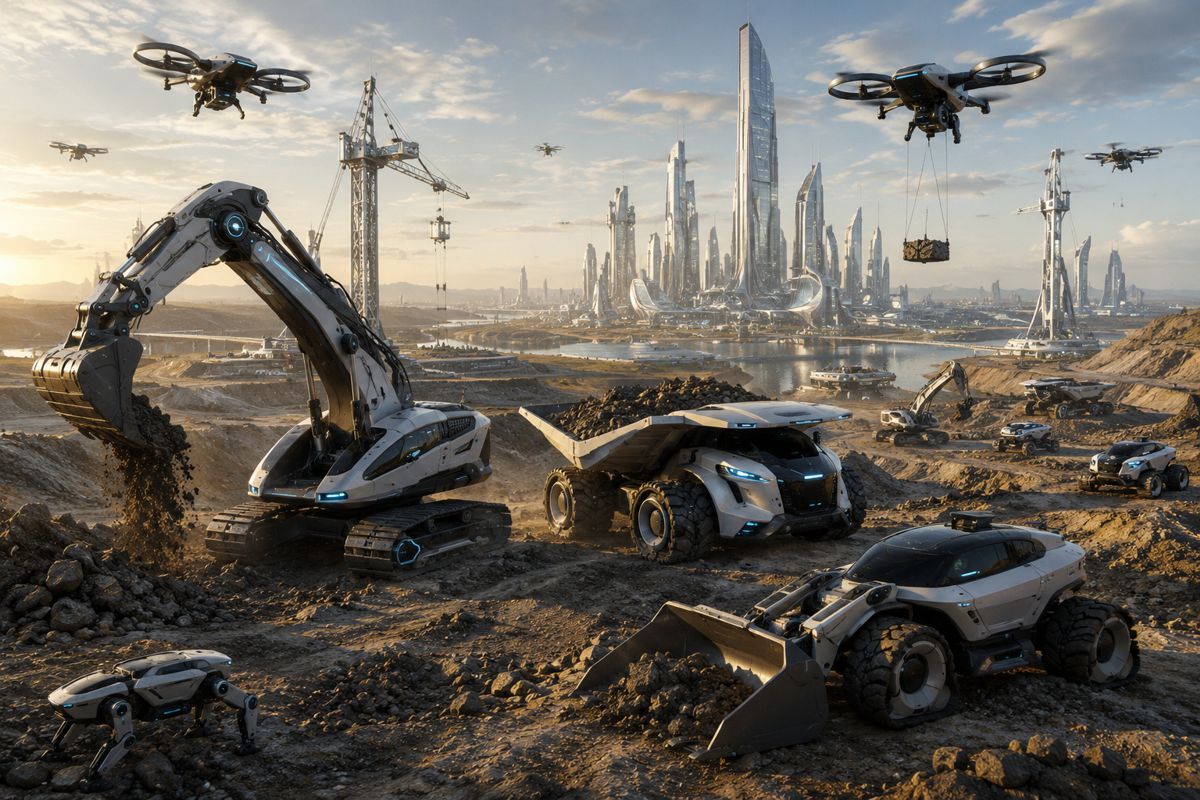
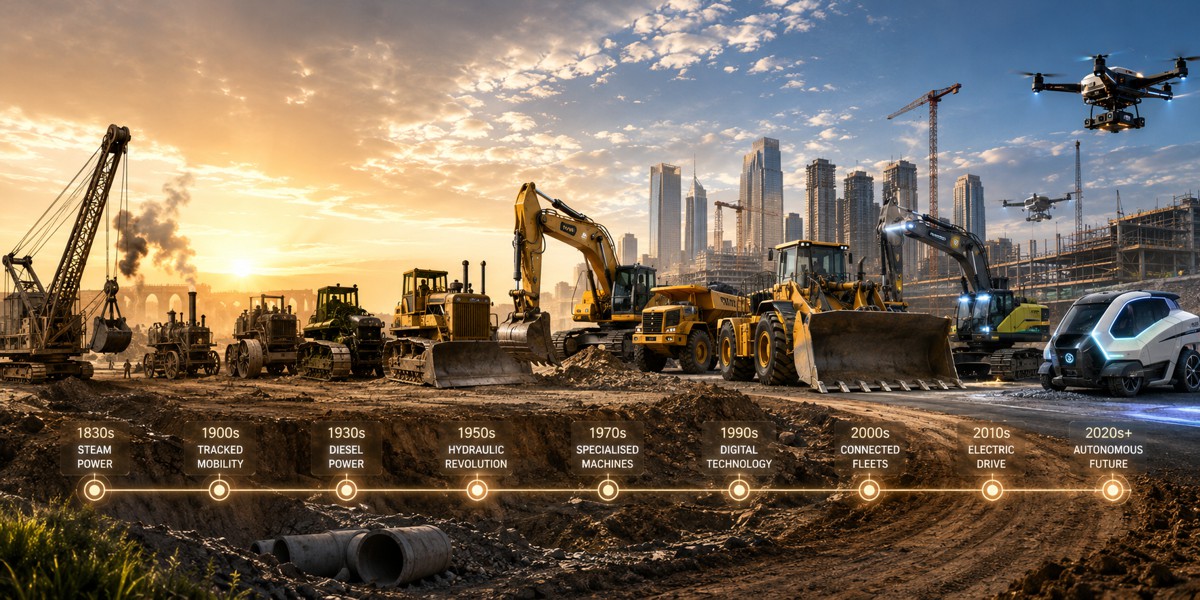
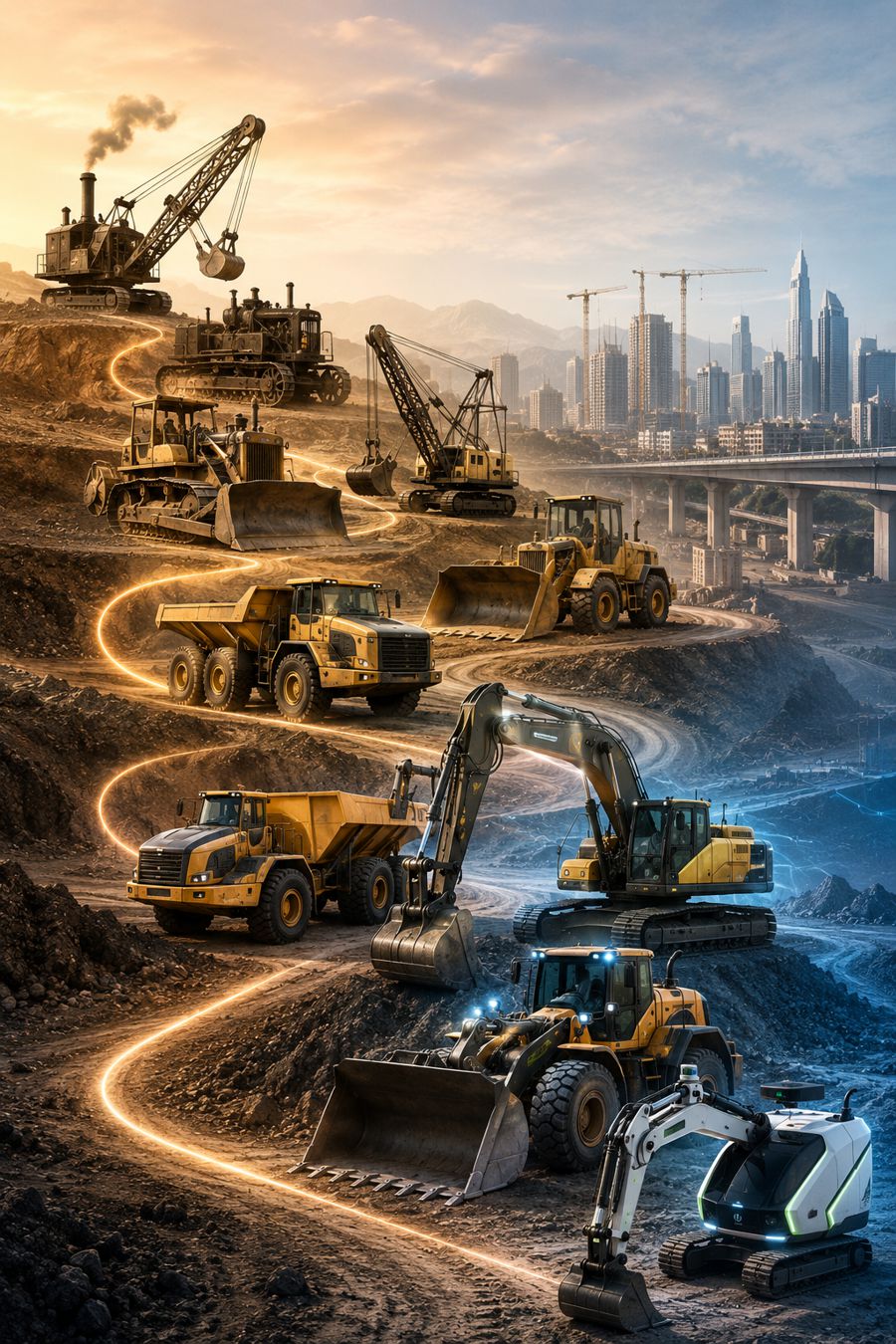
Read end to end, the story has a single through-line, which is output per operator. The treadwheel crane multiplied it, steam multiplied it again, tracks extended it to ground that had been unworkable, hydraulics made it precise, loaders and haulers made it fast and all-weather, the specialist machines refined it task by task, and data made it measurable.
Each leap displaced some workers while creating new roles around the machine, the navvy giving way to the shovel operator, the boiler-tender to the diesel mechanic and the survey gang to the grade-control technician, and the workforce reorganised itself each time around the tool of the moment. The pattern is consistent enough to serve as a forecast, because the current wave of electric, connected and autonomous machines is reshaping skills in exactly the same way, towards charging, software, analytics and remote supervision.
What makes this transition different from its predecessors is the motivation behind it. The earlier revolutions were driven almost entirely by productivity and cost, whereas this one is propelled at least as hard by regulation, climate targets and urban air quality, which means the economics no longer settle the question on their own.
That changes the calculation for everyone involved, because contractors must weigh a capital premium and charging logistics against fuel savings, quieter night-time working and access to low-emission zones; investors must judge whether the incumbents or the fast-moving Chinese manufacturers capture the electric and autonomous markets; and policymakers must align emissions rules, grid capacity and safety frameworks if the machines they are encouraging are to be usable on real sites. Hydrogen combustion, battery-electric drive and supervised autonomy are all being pursued in parallel, and it is not yet clear which will dominate which class of machine.
The honest assessment is that the outcome is not fixed. Battery costs are falling but remain high for the largest classes, charging and connectivity infrastructure lags the machines themselves, and the rules for autonomous operation on open sites are still being written. The history surveyed here suggests how it resolves, because every previous technology that genuinely lowered the cost of building eventually became standard, regardless of early scepticism about price or practicality.
The machines that changed everything did so by changing the arithmetic of construction, and the electric, connected and increasingly autonomous plant now entering the fleet will be judged, as the steam shovel and the hydraulic excavator were, on whether it lets fewer people build more for less. On the evidence of the past two centuries, the only safe prediction is that the machine which defines the next hundred years has probably already been prototyped, and that it will look, in retrospect, as inevitable as the bulldozer does now.