MIGA Guarantees $200m for Kazakhstan’s Middle Corridor Rail Modernisation
On its own, the latest tranche of financing for Kazakhstan’s national railway looks modest, but the structure behind it is the more telling part of the story. The Multilateral Investment Guarantee Agency (MIGA), which now houses the World Bank Group Guarantee Platform, has issued a guarantee covering a 156 million Swiss franc loan, equivalent to roughly $200 million, that Standard Chartered has extended to the state-owned operator Kazakhstan Temir Zholy (KTZ).
No public money flows directly into the track. MIGA instead provides risk cover, absorbing the danger that a state-owned borrower fails to honour its debt, and that single adjustment is enough to bring a commercial bank in at a tenor and on terms it would otherwise avoid. Across much of the developing world, this is now the default way strategic infrastructure gets paid for.
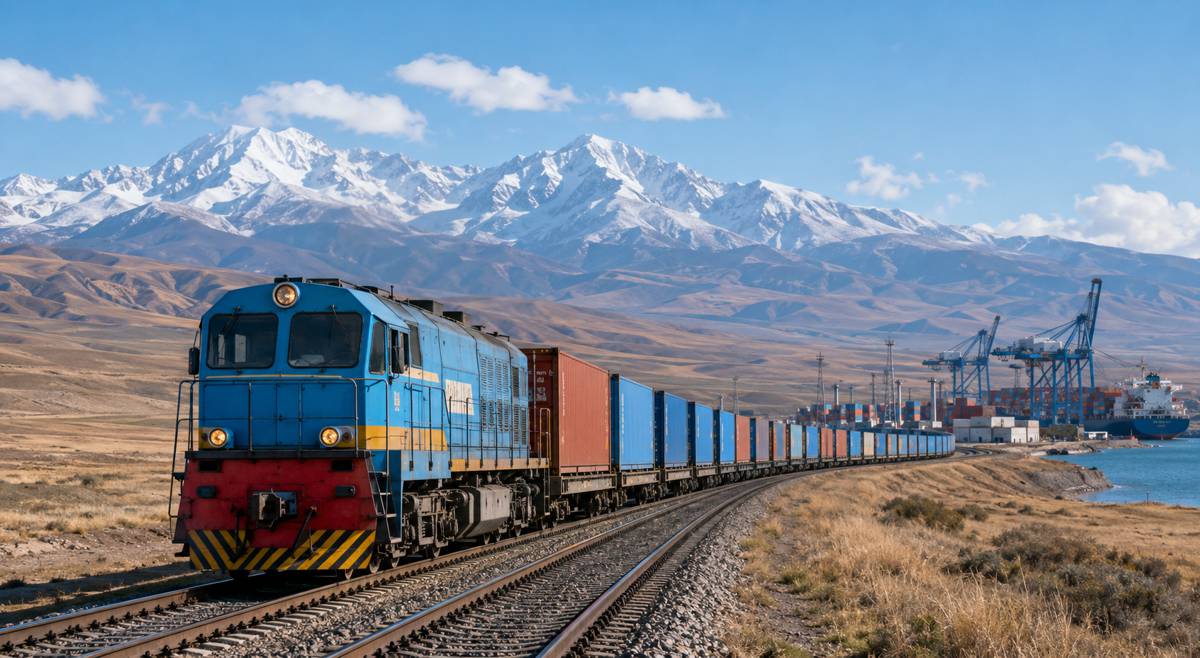
The destination matters as much as the mechanism. KTZ sits at the centre of the Trans-Caspian Transport Corridor, the multimodal route between China, Central Asia and Europe better known as the Middle Corridor. That route has shifted in a few short years from a marginal alternative into one of the fastest-growing freight connections on the Eurasian map.
Cargo crossing the Caspian along the corridor rose by more than 60 per cent in 2024 to somewhere above four million tonnes, against barely 500,000 tonnes before Russia’s full-scale invasion of Ukraine, and volumes were expected to reach above five million tonnes during 2025. The World Bank has estimated that, with sustained investment and reform, annual throughput could approach 11 million tonnes by 2030. Kazakhstan, landlocked and dependent on its railways for almost every external link, is the corridor’s load-bearing wall.
For contractors, suppliers and investors, the significance runs in two directions. The financing keeps a multibillion-dollar pipeline of track renewal, electrification and rolling-stock orders moving, work that flows through to engineering firms, equipment makers and materials suppliers well beyond Kazakhstan’s borders. It also reinforces a financing template, blended multilateral cover layered over private bank lending, that is steadily reshaping how large infrastructure programmes in higher-risk markets reach financial close.
Briefing
- MIGA has guaranteed a CHF 156 million loan, around $200 million, from Standard Chartered to KTZ under its non-honouring of financial obligations cover for state-owned enterprises, the agency’s third engagement with the operator.
- The funds will rehabilitate KTZ’s track infrastructure, work expected to extend the railway’s useful life by 40 years while lowering maintenance and operating costs and improving safety, speed and reliability.
- KTZ is running a multibillion-dollar capital programme across 2025 to 2029 covering new line construction, infrastructure modernisation and rolling-stock renewal.
- The loan supports the Middle Corridor, where freight volumes have climbed sharply since 2022 as cargo reroutes away from Russia.
- The structure channels private bank lending into a market many commercial lenders treat with caution, part of a World Bank Group push to lift annual guarantee issuance to $20 billion by 2030.
How the Guarantee Mobilises Private Capital
At the centre of the deal is an instrument that rarely makes headlines but increasingly determines which projects get built. MIGA’s cover is a non-honouring of financial obligations guarantee for a state-owned enterprise, which protects the lender against the risk that KTZ, despite being wholly owned by the Kazakh sovereign wealth fund Samruk-Kazyna, fails to meet its repayment commitments.
By transferring that risk to a triple-A rated arm of the World Bank, the guarantee turns a borrower many commercial banks would treat warily into a counterparty they can lend to over a longer horizon. Standard Chartered acted as sole MIGA coordinator, original lender and facility agent on the transaction, and structured the facility in Swiss francs at the borrower’s request, a detail that reflects how tailored these arrangements have become.
The purpose of the structure is tenor and mobilisation rather than headline volume. The seven-year facility gives KTZ longer-dated funding than a standard commercial loan to a Central Asian state enterprise would usually command, and it does so without adding to sovereign borrowing in the conventional sense. For Standard Chartered, the deal extends a run of activity in the market, following the close of a CHF 243 million facility for KTZ earlier in 2026.
Desislava Radeva, the bank’s Executive Director for Development and Agency Finance, framed the transaction in strategic terms: Supporting KTZ in this landmark transaction underscores our commitment to financing critical infrastructure that enhances regional connectivity and drives sustainable economic growth. This project is pivotal in strengthening Kazakhstan’s position as a key transport hub between Asia and Europe. For the bank, the appeal is a creditworthy, longer-tenor exposure in a market it has been steadily building out, while for KTZ it is access to commercial funding on terms that would be hard to secure unaided.
Why the Middle Corridor Has Become a Priority
The reason institutions are queuing to fund Kazakh rail lies in the corridor’s changing role. Before 2022, the overwhelming majority of overland China-Europe freight ran through Russia along the Northern Corridor. Western sanctions and the disruption that followed the invasion of Ukraine pushed shippers to look south, and the Middle Corridor, geographically the shortest rail route between western China and Europe, absorbed much of the diverted demand. Transit times along the route fell to roughly 18 to 23 days by 2024, down from well over a month previously, as operators smoothed border crossings and Caspian ferry connections. The European Union has folded the corridor into its Global Gateway strategy, pledging billions in connectivity investment, while China continues to back infrastructure along the route as part of its Belt and Road programme.
Kazakhstan’s railways are the spine of that system. KTZ connects the country’s 17 regions and links to five neighbouring states, ranks among the 15 largest railway companies in the world by freight turnover, and employs more than 117,000 people, making it one of the country’s largest employers. The operator’s reach explains why MIGA treats the relationship as strategic rather than transactional.
Muhamet Bamba Fall, MIGA’s Director for Industries, set the financing against that backdrop: For a large, landlocked country, Kazakhstan’s railway network plays a critical role in the country’s socioeconomic development and is the key and often only link connecting the country’s 17 regions. We are proud to partner with Standard Chartered to support Kazakhstan in its efforts to modernize its railway infrastructure and achieve its ambitions to become the largest transit and logistics hub in Central Asia. The project will create jobs while supporting over 117,000 people currently employed by KTZ. Behind the diplomatic phrasing sits a hard commercial logic, because a railway that carries both domestic supply chains and rising transit freight has to be reliable on both counts at once.
What the Money Actually Buys
The loan is tied to a defined programme of work rather than general corporate purposes. Its core target is the rehabilitation of KTZ’s track infrastructure, a category of spending that is unglamorous but decisive for a network where deteriorating permanent way has constrained speed and reliability. MIGA expects the work to extend the useful life of the rehabilitated track by 40 years, a long payback that helps justify the seven-year financing horizon. The same programme is designed to lower maintenance and operating costs, address climate-related risks to the infrastructure, and lift service quality through higher train speeds, better safety and a reduction in technical incidents. For a corridor whose competitiveness depends on dependable transit times, cutting the rate of track-related faults is as commercially important as adding raw capacity.
The financing also sits inside a much larger commitment. KTZ is running a multibillion-dollar capital-expenditure programme across 2025 to 2029 that spans new line construction, infrastructure modernisation and the renewal of rolling stock, and the MIGA-backed loan covers one component of that wider effort. Alongside the engineering, KTZ has committed to a Gender Action Plan intended to widen access to better jobs for women, including in leadership roles, a condition increasingly attached to World Bank Group-supported transactions.
Dair Kusherov, Managing Director at KTZ, placed the deal within the operator’s broader strategy: KTZ’s infrastructure modernization program is central to strengthening Kazakhstan’s role as a key transit and logistics hub between Asia and Europe. We highly value MIGA’s continued support and Standard Chartered’s partnership in financing projects that enhance the reliability, safety, and efficiency of our railway network. The emphasis on continuity is deliberate, because this is the third time MIGA has stepped in to support the company’s modernisation.
A Pattern of Blended Finance
The repeat engagement is part of a deliberate institutional strategy. MIGA first backed KTZ in October 2023 with a CHF 554.7 million guarantee, around $621 million, covering loans from Citibank and Banco Santander, in what was then the first non-honouring transaction MIGA had completed in Kazakhstan. Further support followed earlier in 2026, and the current guarantee is the latest in a sequence that has steadily drawn private and multilateral money into the same borrower. The pattern extends beyond MIGA’s own book. In January 2026 the IFC, the Asian Infrastructure Investment Bank and Standard Chartered assembled a financing package of up to $300 million for KTZ’s 130-kilometre electrified Almaty rail bypass, and in February the World Bank board approved an $846 million guarantee to help mobilise around $1.4 billion in commercial financing for corridor development.
Those deals share a common architecture, and that is the wider point. They package discrete corridor constraints into financeable projects, hold the operator to the financial and environmental due diligence that long-term private lenders demand, and use multilateral guarantees to crowd in commercial capital rather than substitute for it. The approach is being formalised through the World Bank Group Guarantee Platform, launched in 2024 to consolidate guarantee products and expertise at MIGA, with an explicit target of lifting the group’s annual guarantee issuance to $20 billion by 2030. For an infrastructure sector grappling with constrained public budgets and cautious lenders, the KTZ programme is becoming a working template for how that ambition translates into built assets.
The Constraints That Will Set the Ceiling
None of this guarantees the corridor will fulfil the projections attached to it, and the obstacles are physical as much as financial. The Caspian Sea, which the route must cross by ferry, has been falling by up to 30 centimetres a year since 2020, already reducing wagon and tanker capacity on key crossings and raising questions about the long-term reliability of its ports. Much of the regional network remains single-track, border procedures still add days to journeys, and per-container costs on the Middle Corridor sit well above those on the northern route through Russia. These are precisely the bottlenecks that targeted investment in track, electrification, ferries and customs systems is meant to ease, which is why the quality and sequencing of spending matters as much as the headline volume.
For construction firms, equipment suppliers and investors, the message is that Central Asian rail has moved from periodic upgrade to a sustained, externally financed programme with a visible pipeline running to the end of the decade. The de-risking model that MIGA and its peers have built lowers the barrier to private participation, and the steady cadence of KTZ transactions suggests further tranches are likely as the 2025 to 2029 capital plan is delivered. Whether the Middle Corridor ultimately becomes a permanent artery of Eurasian trade or a strategically useful alternative with a capacity ceiling will be settled over the next few years, and the financing now being mobilised for Kazakhstan’s railways is one of the clearest indicators of how seriously the question is being taken.