Monumental and NZEC Target Taranaki’s Wax Problem With Production Chemistry
For onshore producers working mature fields, the barrier to higher output is often not what lies in the reservoir but what happens to the oil once it starts moving. Waxy crude that flows freely at reservoir temperature can stiffen, gel and coat equipment as it cools on its way to the tank, throttling production long before geology becomes the limiting factor.
Monumental Energy Corp and its operational partner New Zealand Energy Corp have moved to address exactly that constraint in New Zealand’s onshore Taranaki Basin, commissioning a tailored chemical treatment intended to keep their crude mobile from the wellbore through to shipping. The announcement matters less for the chemistry itself, which sits within the established discipline of flow assurance, than for what a working solution could unlock across a basin where waxy oil is the rule rather than the exception.
The development is at an early stage, and it is worth being precise about what has and has not happened. The partners, working with Austin-based 13 Specialty Chemicals Ltd, say a bespoke formulation has been created and that they are now moving towards field pilots, with the operational benefits attached to it framed as projections rather than demonstrated results. Even so, the strategic reasoning is clear enough.
Taranaki’s terrestrially sourced crudes are typically light to medium in gravity but notably waxy, and the cost of managing that wax, through heating, mechanical cleaning, deferred production and equipment wear, lands directly on the bottom line. A chemistry that lowers those costs, and that can be sold on to others wrestling with the same problem, is a more interesting proposition than a routine supplier announcement would suggest.
Briefing
- Monumental Energy Corp (TSX-V: MNRG) and partner New Zealand Energy Corp (TSX-V: NZ) have commissioned a custom wax-treatment chemistry for their waxy crude in New Zealand’s onshore Taranaki Basin.
- The formulation, developed by Austin-based 13 Specialty Chemicals Ltd, pairs a recovery treatment branded NZ-START, which breaks down accumulated wax, with a maintenance product, NZ-FLOW, which keeps oil moving.
- The system is designed to run on existing field equipment with no permanent infrastructure changes, and is described as scalable from a single well to a full field.
- The headline operational effects, tanks pumpable within 24 to 48 hours, stable flow within seven days and optimised treatment cost within 30 days, are company expectations, with pilot locations still to be confirmed.
- Chief executive Maximilian Sali has signalled an intent to monetise the chemistry, which is exclusive to the partners, by supplying other producers operating in the basin.
The Production Constraint It Targets
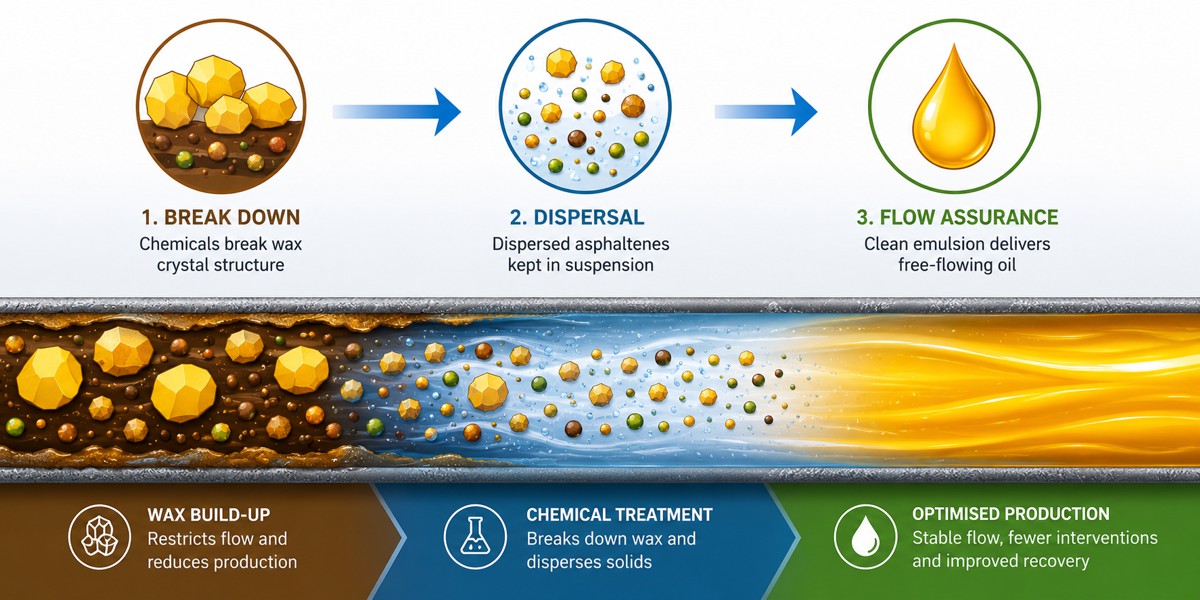
The problem the treatment is built to solve is a familiar one across waxy-crude provinces. As paraffin-rich oil cools below its wax appearance temperature, dissolved waxes begin to crystallise, raising viscosity and, in the worst cases, forming a gel that resists pumping altogether. The same crystals deposit on rods, pumps, tubing and flowlines, narrowing the path the oil has to travel and accumulating in tank bottoms, so the practical effect is lost throughput, more frequent interventions and steady wear on equipment that was never designed to handle a setting solid.
For operators of mature onshore wells, where margins are thinner and intervention crews are not always on hand, that drag on uptime can be the difference between a marginal well and a profitable one.
Taranaki crude sits squarely in this category, with industry literature describing the basin’s terrestrially derived oils as generally 30 to 40 degrees API and waxy, with low sulphur content. That profile is part of why the field reactivations Monumental and NZEC have pursued matter to this story.
The companies have reported genuine production from their workover programme, including the Ngaere-1 well, which flowed roughly 580 barrels of crude in its first six hours and has since produced around 3,000 barrels while stabilising near 120 barrels per day, alongside a commercial restart at Waihapa-H1 in the Mount Messenger formation.
These are precisely the kind of ageing, intervention-sensitive wells where flow assurance translates directly into realised volumes, which is why a reliable way to keep the oil moving carries weight beyond the laboratory.
The Commercial Calculation
What distinguishes this announcement from a standard chemicals contract is the business model the partners have sketched around it. The treatment is presented as requiring no permanent infrastructure changes, using standard field equipment, deployable immediately and scalable from a single well to a full field, which is the kind of low-capital, fast-acting intervention that suits a junior pursuing non-dilutive, cash-generative growth.
For a company funding workovers and earning royalties rather than carrying heavy fixed costs, a chemistry that lifts uptime without a capital programme fits the operating philosophy neatly, and it does so on a timescale measured in days rather than the months a hardware solution would demand.
The more ambitious idea is to turn an operational fix into a revenue line. Sali set out the thinking directly, noting that the formulation had been developed through testing earlier in the year and framing its expected benefits in the language of API behaviour and reduced wax build-up: “Earlier in the year, Monumental and NZEC contracted 13-Specialty Chemicals Ltd. to conduct testing on different chemical blends that will help increase production and flow stability in the crude oil that we see in our basin. I have personally been to this facility and seen how advanced and organized this company is when creating these specific products to assist with oil. This new chemical formula is expected to allow the oil to maintain its liquid state from when its produced at around 38 degree API all the way down to 16 degree API without creating a waxier product when shipping and also soaking this chemical in the well bore will allow less wax to build around the pumps and other parts allowing for better and stronger flow rates and field optimization. As this chemical will be exclusive to Monumental and NZEC, we are able to monetize this product by selling it to other companies that are producing in the Taranki basin.”
The premise is that exclusivity over a treatment proven on the partners’ own wells could open a supply opportunity to other operators across the basin, several of whom contend with the same waxy crude. That is a credible commercial angle, though one that rests on field results the partners do not yet have, and on a willingness among rival producers to buy chemistry from a competitor.
Inside the Two-Part System
The technical design splits the job into recovery and maintenance, which mirrors how flow-assurance programmes are usually run in the field. The recovery treatment, NZ-START, is intended to break down wax and solid structure and restore pumpability, the equivalent of clearing a well or line that has already begun to gel or foul. The maintenance product, NZ-FLOW, is then meant to prevent re-gelling and keep the oil in continuous movement, the role typically played by pour-point depressants, wax inhibitors and crystal modifiers that alter how wax crystals form so they no longer knit together into a flow-blocking network.
The “crystal engineering” framing the partners have used maps onto that established chemistry, in which the goal is less to remove wax than to change its shape and behaviour so it stays dispersed in the oil.
Around the system the companies have set out a sequence of expected outcomes, with tanks becoming pumpable and transfer operations resuming within 24 to 48 hours, flow conditions stabilising and interventions reducing within seven days, and treatment cost optimising into predictable performance within 30 days.
Those milestones are plausible in shape, since chemical wax treatments do tend to act quickly on pumpability and then settle into a steady dosing regime, but they remain projections supplied by the operators rather than independently measured results. The distinction matters for readers weighing the announcement, because the mechanism being described is well understood while the specific performance on Taranaki crude, at a given dose and cost, is the part the pilots are designed to establish.
What the Pilot Will Need to Prove
The partners have laid out a straightforward path from here, confirming pilot locations, finalising formulations with 13 Specialty Chemicals Ltd, deploying a field pilot and then optimising for cost and performance. The questions that pilot will have to answer are the ones any operator or prospective customer would ask. Sustained flow data over weeks rather than hours, a measurable drop in intervention frequency, a defensible treatment cost per barrel, reliable dosing and compatibility with existing handling, and performance through the colder conditions that push waxy crude towards its pour point will all determine whether the chemistry earns its place on the wells, let alone on anyone else’s.
For the wider Taranaki picture, the prize is real but contingent. Flow assurance is a persistent and costly problem for waxy-crude producers worldwide, and a low-capital chemical answer that travels well across similar wells is genuinely valuable, which is why the larger oilfield-chemicals players have built substantial businesses around exactly this niche.
Whether Monumental and NZEC can carve out a position alongside them rests first on proving the treatment on their own production, and then on converting that evidence into sales to operators who share the basin’s geology but not the partners’ commercial interests. The chemistry is sound in principle and the strategy is coherent, and the next set of numbers, drawn from the field rather than the lab, is what will tell the market whether this becomes a meaningful contributor or simply a sensible piece of housekeeping.