Construction Robotics Steps Up a Gear as Berlin Prepares to Host Robotics-2027
The distance between a robotics laboratory and a live construction site has been shrinking for several years, and the gap is now narrow enough that infrastructure owners, contractors and plant manufacturers can no longer treat academic robotics as a separate world.
When PAGES Conferences confirmed that the 4th International Conference on Robotics, Automation and Intelligent Systems, known as Robotics-2027, will take place in Berlin on 24 and 25 May 2027, it added another fixture to a research calendar that increasingly sets the direction for what appears on job sites two or three procurement cycles later. The event is pitched at scientists, researchers, academics and industry professionals, and its agenda reaches across machine learning, human-robot interaction, autonomous systems, smart manufacturing, Industry 5.0, the Internet of Things, cyber-physical systems, digital twins and advanced sensor technologies.
Much of that list reads like a forward map of where construction and infrastructure technology is heading.
For a sector under sustained pressure to build more with fewer skilled hands, the value of a gathering like this lies less in the headline talks and more in the pipeline it represents. Research presented at conferences of this kind rarely stays theoretical for long, because the same autonomous navigation, perception and control problems that occupy roboticists in manufacturing and healthcare also define the challenge of automating earthworks, inspection and material handling.
Berlin is a fitting host, sitting inside a German economy where automation investment runs deep and where the industrial base has long treated robotics as core infrastructure rather than novelty. The organisers describe the programme as a platform for knowledge exchange through keynote lectures, plenary talks, and oral and poster presentations, which places it firmly in the research tradition rather than the trade-show mould, and that distinction matters for anyone trying to read early signals rather than finished products.
Briefing
- Robotics-2027 runs on 24 and 25 May 2027 in Berlin, convened by PAGES Conferences as the fourth edition of its International Conference on Robotics, Automation and Intelligent Systems.
- The programme spans machine learning, human-robot interaction, autonomous systems, Industry 5.0, cyber-physical systems, digital twins and advanced sensors, several of which map directly onto construction and infrastructure use cases.
- Construction robotics sat at roughly USD 1.4 billion in 2024 and is forecast to approach USD 3.66 billion by 2030 on well-defined estimates, with double-digit annual growth across most credible projections.
- Persistent labour shortages remain the central commercial driver, with the UK alone needing an average of around 41,200 extra construction workers a year to 2030 and German employers reporting acute recruitment difficulty.
- The strategic frame is shifting from pure automation towards Industry 5.0 and Construction 5.0, where robots augment skilled workers rather than simply displace them.
The Labour Equation That Keeps Automation On The Table
The commercial logic behind construction robotics starts with people, or rather the shortage of them. Across the United Kingdom the Construction Industry Training Board projects that the sector will need an average of about 41,200 additional workers every year between 2026 and 2030, taking the workforce towards 2.68 million by the end of the decade even as a large share of experienced tradespeople approaches retirement.
The picture is structural rather than cyclical, driven by an ageing workforce, weak apprenticeship uptake and the loss of mobility that followed changes to European labour flows. Similar strains run across the continent, and in Germany, the host nation for Robotics-2027, an estimated 86 percent of employers reported difficulty filling roles in 2025. When labour availability becomes the most common cause of programme delay, automation moves from an efficiency conversation to a delivery one.
That backdrop explains why the construction robotics market has held a steady upward trajectory rather than the boom-and-bust pattern seen in some technology categories. Grand View Research put the market at around USD 1.4 billion in 2024 and forecast it to reach USD 3.66 billion by 2030, implying a compound annual growth rate close to 18 percent, with material handling, demolition and robotic arms leading current demand. E
stimates vary widely depending on how analysts draw the boundaries of the category, and broader definitions that fold in autonomous heavy equipment and inspection systems produce far larger figures, which is a caution worth carrying into any investment case. What the numbers agree on is direction and pace. Adoption is broadening from a handful of flagship contractors into mainstream civils and infrastructure delivery, and the machines are moving from pilot schemes into repeatable, priced-in line items on major programmes.
From The Laboratory Bench To The Live Site
The technical strands on the Robotics-2027 programme are not abstractions for anyone who has watched recent deployment on infrastructure sites. Autonomous systems, advanced sensing and machine control have already produced working plant, with Advanced Construction Robotics fielding IronBOT to lift, carry and place reinforcement bar and its companion TyBOT to tie it, a pairing credited with cutting rebar installation time by around half.
Built Robotics has taken a different route by converting standard excavators into autonomous units for repetitive earthmoving, while Komatsu has continued to extend its Intelligent Machine Control systems for precision excavation. Demolition specialists such as Brokk have refined remote-controlled robots for hazardous teardown work, and layout firms including Dusty Robotics have automated the transfer of digital plans onto slab. Each of these products traces its lineage back to the navigation, perception and control research that conferences like the one in Berlin exist to advance.
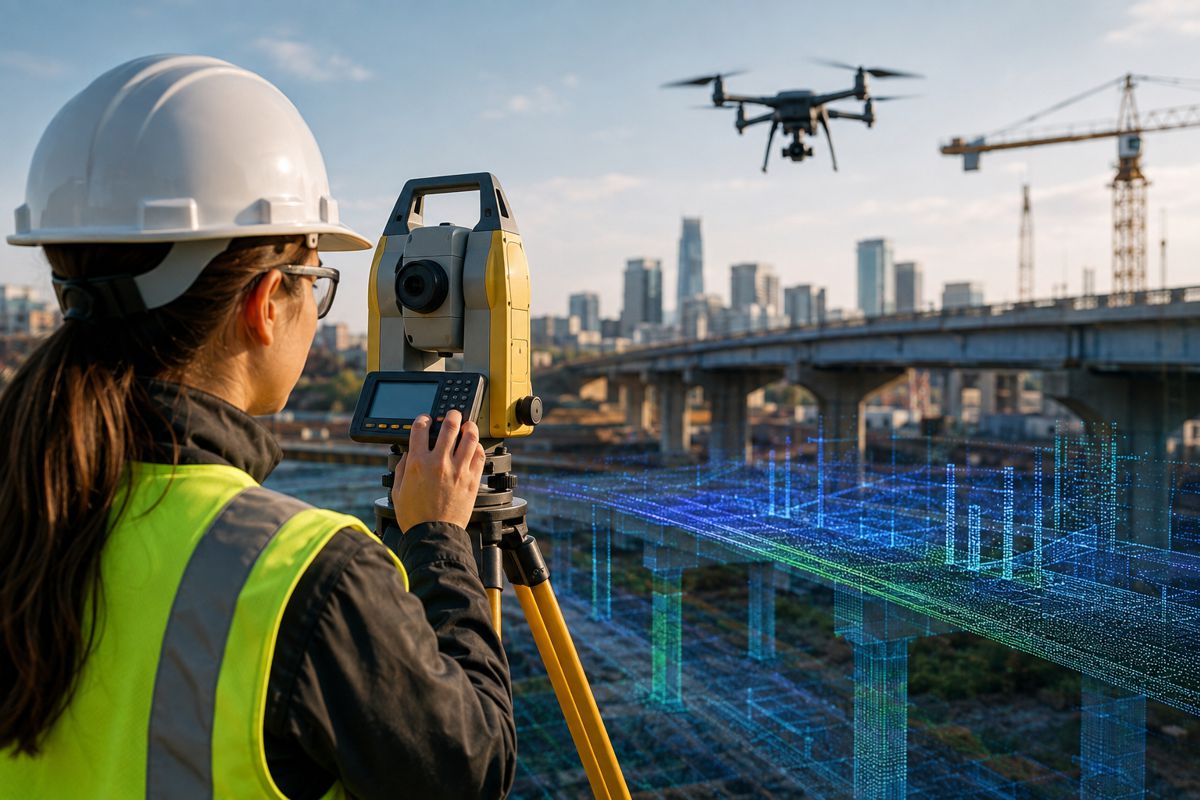
Two agenda items carry particular weight for infrastructure owners. Advanced sensor technologies and cyber-physical systems underpin the fast-growing field of robotic and drone-based inspection, where LiDAR surveys and automated structural assessment are displacing manual work at height and in confined spaces across bridge, tunnel and highway maintenance. The safety and cost arguments there are difficult to ignore, since removing an inspector from a rope access job or a live carriageway carries obvious value alongside the productivity gain.
Digital twins, the second strand, extend the same logic into whole-life asset management, linking sensor data from physical structures to virtual models that support predictive maintenance and scenario planning. For asset-heavy operators managing thousands of ageing structures, the combination of robotic data capture and twin-based analysis points towards a maintenance model built on condition rather than calendar, and that shift has real budgetary consequences for public infrastructure programmes.
Construction 5.0 And The Human-Centric Turn
The framing around Robotics-2027 is telling in one important respect, because Industry 5.0 sits alongside the more familiar automation topics on its agenda. Where Industry 4.0 emphasised connectivity, data and the automation of tasks, the Industry 5.0 concept pulls the human worker back to the centre and treats collaborative robots, exoskeletons and AI assistants as tools that augment skilled people rather than replace them.
Academic work has already begun mapping that shift into a distinct Construction 5.0 paradigm, in which human-robot collaboration, sustainability and ethical technology use become organising principles rather than afterthoughts. For an industry acutely worried about workforce numbers, that reframing is more than presentational, because it addresses the legitimate fear that automation simply hollows out employment and instead positions robotics as a way to make demanding trades safer, less physically punishing and more attractive to new entrants.
This human-centred emphasis also carries practical implications for how machines are specified and bought. Collaborative robots and wearable exoskeletons are designed to share a workspace with people, which changes the safety engineering, training and liability questions that procurement teams must resolve before deployment. It also alters the value proposition, since the return no longer rests solely on removing headcount but on extending the working lives of experienced operators, reducing injury rates and lifting the quality and consistency of output.
Contractors weighing these systems are increasingly assessing them against retention and safety metrics as well as raw productivity, and that broader scorecard tends to strengthen rather than weaken the case for adoption. The conference agenda’s pairing of hard autonomy topics with the human-centric Industry 5.0 vision reflects where thoughtful practitioners have already arrived.
Europe’s Regulatory And Competitive Backdrop
Berlin’s role as host places the event inside a European policy environment that will shape how quickly these technologies scale. The European Union’s AI Act introduces obligations around transparency, risk classification and accountability that will touch autonomous construction systems as they mature, and the emerging Construction 5.0 literature explicitly ties responsible AI and regulatory compliance to industry trust.
For manufacturers and contractors operating across borders, standards and certification are becoming as important to commercialisation as the underlying engineering, since a robot that cannot satisfy conformity requirements cannot be sold or safely deployed at scale. Europe’s approach, weighted towards human oversight and sustainability, aligns closely with the Industry 5.0 direction of travel, and that coherence between policy and research agenda gives the region a distinctive position in a market where North America and Asia-Pacific currently lead on raw adoption.
The competitive geography is worth keeping in view. Asia-Pacific has taken an early lead in construction robot deployment, propelled by rapid urbanisation and state-backed smart city programmes, while North America leans on acute labour shortages and large infrastructure funding to justify automation. Europe’s strength lies less in headline volume and more in the density of its industrial robotics research, its manufacturing base and its standards-setting influence, all of which a Berlin conference draws upon.
For infrastructure investors and policymakers, the practical question is how effectively European research translates into deployable products and exportable expertise rather than remaining confined to journals and prototypes. Events that bring academic and industry participants into the same room are one of the mechanisms through which that translation happens, which is why a research gathering deserves attention from readers whose day job is delivering roads, rail and utilities rather than writing papers.
What The Berlin Agenda Signals For The Next Building Cycle
Read as a whole, the Robotics-2027 programme offers a useful preview of the technologies that will define construction delivery through the second half of this decade. The convergence of autonomous plant, robotic inspection, advanced sensing and digital twins is no longer speculative, and each strand is supported by working products and a market that is broadening steadily rather than spiking.
What the Berlin agenda adds is the connective tissue, showing how machine learning, human-robot interaction and cyber-physical systems research feed the machines that will eventually appear on tender specifications and asset-management budgets. Infrastructure owners who treat robotics purely as a labour substitution play risk missing the wider shift towards data-rich, condition-based delivery and maintenance that these technologies enable.
The prudent stance for construction professionals, investors and policymakers is to track the research pipeline as deliberately as they track the equipment catalogue. Adoption will be uneven, constrained by the high entry cost of many systems and the unpredictable conditions of real sites, and the honest market picture includes those frictions rather than glossing over them.
Even so, the direction is settled, and the combination of an unrelenting skills shortage, maturing hardware and a human-centric Industry 5.0 framing gives robotics a durable place in the sector’s future. A two-day conference in Berlin will not build a single bridge or resurface a single carriageway, yet the ideas exchanged there will help decide how the next generation of infrastructure gets delivered, and that is reason enough for the industry to pay attention.
Key Industry Questions
- How soon will construction robotics move from pilot projects into mainstream infrastructure delivery? The transition is already under way for specific tasks rather than whole sites. Reinforcement handling, autonomous earthmoving, robotic demolition and drone-based inspection have moved beyond trials into priced, repeatable work on major programmes, particularly where labour is scarce or conditions are hazardous. Broader adoption across general civils will be slower and uneven, shaped by the high capital cost of many systems and the variability of live sites. Most credible forecasts describe steady double-digit annual growth rather than a sudden tipping point, which suggests a decade of gradual mainstreaming rather than an overnight shift. Contractors that build robotics competence now, on discrete high-value tasks, will be better placed as the technology base matures and unit costs fall.
- Does automation threaten construction employment or support it? The evidence points towards augmentation rather than wholesale replacement, especially under the Industry 5.0 and Construction 5.0 framing that treats robots as collaborators. With the UK needing tens of thousands of additional workers a year and much of Europe facing similar shortages, robotics is primarily filling gaps that human recruitment cannot close. Collaborative robots and exoskeletons are designed to reduce physical strain, improve safety and extend the working lives of experienced tradespeople rather than remove them. The more realistic risk is a skills transition, as demand shifts towards workers who can supervise, maintain and integrate automated systems. That makes training and upskilling central to any responsible automation strategy.
- What return on investment can contractors expect from construction robots? Returns depend heavily on task, utilisation and site conditions, and the strongest cases involve repetitive, hazardous or labour-intensive work. Rebar automation that reduces installation time by around half, robotic demolition that removes workers from dangerous environments, and autonomous earthmoving that runs extended shifts all offer measurable productivity and safety gains. The value calculation increasingly includes reduced injury rates, better output consistency and improved worker retention alongside direct labour savings. High purchase prices, typically ranging from tens of thousands to several hundred thousand dollars per system, mean utilisation is decisive, so robots earn their keep on programmes with sustained, predictable demand rather than one-off jobs.
- How do digital twins connect to construction robotics? Digital twins and robotics form a complementary loop rather than separate technologies. Robots and drones equipped with advanced sensors capture high-resolution data from physical structures, which feeds virtual twin models used for predictive maintenance, performance monitoring and scenario planning. That connection allows infrastructure owners to move from calendar-based maintenance towards condition-based regimes, targeting intervention where sensor and inspection data show it is needed. For operators managing large portfolios of ageing assets, the pairing offers a route to lower whole-life costs and better-informed capital planning. It also raises the value of robotic inspection, since automated data capture becomes the input that keeps the twin accurate and useful over time.
- What role does the EU AI Act play in construction automation? The AI Act introduces a risk-based regulatory framework that will apply to autonomous and AI-driven construction systems as they scale, with obligations around transparency, accountability and human oversight. For manufacturers, conformity and certification are becoming as commercially important as engineering performance, since systems that cannot demonstrate compliance cannot be deployed at scale in European markets. The emerging Construction 5.0 approach explicitly links responsible AI to industry trust, aligning regulatory expectations with the sector’s own safety culture. Rather than a pure constraint, this framework can support adoption by giving clients and workers confidence that automated systems meet clear standards. Firms operating across borders will need to build compliance into product and procurement planning from the outset.
- Why is Europe hosting robotics research if North America and Asia lead on adoption? Europe’s strength lies in the density of its industrial robotics research, its manufacturing base and its influence over standards, even where deployment volumes trail other regions. Asia-Pacific leads on raw adoption thanks to rapid urbanisation and smart city investment, while North America is driven by severe labour shortages and large infrastructure funding. A Berlin conference draws on Europe’s research depth and its human-centric, sustainability-focused policy direction, which shapes how the global market will eventually be regulated and specified. The strategic question for the region is how efficiently that research converts into deployable, exportable products. Gatherings that put academics and industry in the same room are one mechanism for accelerating that translation.
- Which construction tasks are most ready for robotic automation today? The most mature applications share three traits, being repetitive, hazardous or physically demanding. Reinforcement bar handling and tying, autonomous excavation and earthmoving, remote-controlled demolition, automated site layout and drone or LiDAR-based inspection are the clearest current examples, each supported by commercial products in active use. Material handling remains a leading segment because moving heavy, repetitive loads maps neatly onto robotic strengths while reducing injury risk. Tasks requiring fine judgement, adaptability to unpredictable conditions or complex manual dexterity remain harder to automate and are likely to stay human-led for longer. Contractors evaluating entry points should prioritise these proven, high-value tasks rather than attempting broad site automation.
- How should infrastructure owners and investors respond to these developments? The measured response is to track the research pipeline as closely as the equipment catalogue, since today’s conference topics preview tomorrow’s tender specifications. Owners can begin by identifying discrete tasks where robotics offers clear safety or productivity gains and by building the data infrastructure, particularly digital twins, that amplifies the value of robotic inspection. Investors should treat market sizing with care, given wide variation between estimates, and focus on companies with deployable products and credible utilisation rather than prototypes. Policymakers have a role in aligning skills funding, standards and regulation so that automation strengthens rather than strains the workforce. Across all groups, the priority is preparation for steady adoption rather than reaction to sudden disruption.
Strategic Takeaways
- Labour scarcity, not novelty, is the durable driver of construction robotics, which reframes automation as a delivery necessity and gives adoption a structural rather than cyclical foundation.
- Market growth is broad-based and steady rather than speculative, but wide variation between analyst estimates means investment cases should rely on well-defined figures and proven utilisation.
- The most valuable near-term applications are repetitive, hazardous or physically demanding tasks, so contractors should target discrete high-value use cases before attempting wider site automation.
- Robotic inspection and digital twins together enable a shift from calendar-based to condition-based maintenance, offering asset-heavy infrastructure owners a route to lower whole-life costs.
- The Industry 5.0 and Construction 5.0 direction, reinforced by European regulation, positions robotics as an augmentation of skilled labour, making workforce upskilling and standards compliance central to any adoption strategy.