Stevens Equipment Rental is Leading Britain’s Shift to Intelligent Wheel Loaders
Stevens Equipment Rental has taken delivery of its 1000th new machine, and the choice of asset says more about the direction of the UK plant market than the milestone itself. The Cumbrian rental business, trading for more than 50 years and formerly known as Peter Stevens Dumptruck Hire, has become the first UK company to put a Cat 980 medium wheel loader into service with Caterpillar’s new automatic emergency braking function.
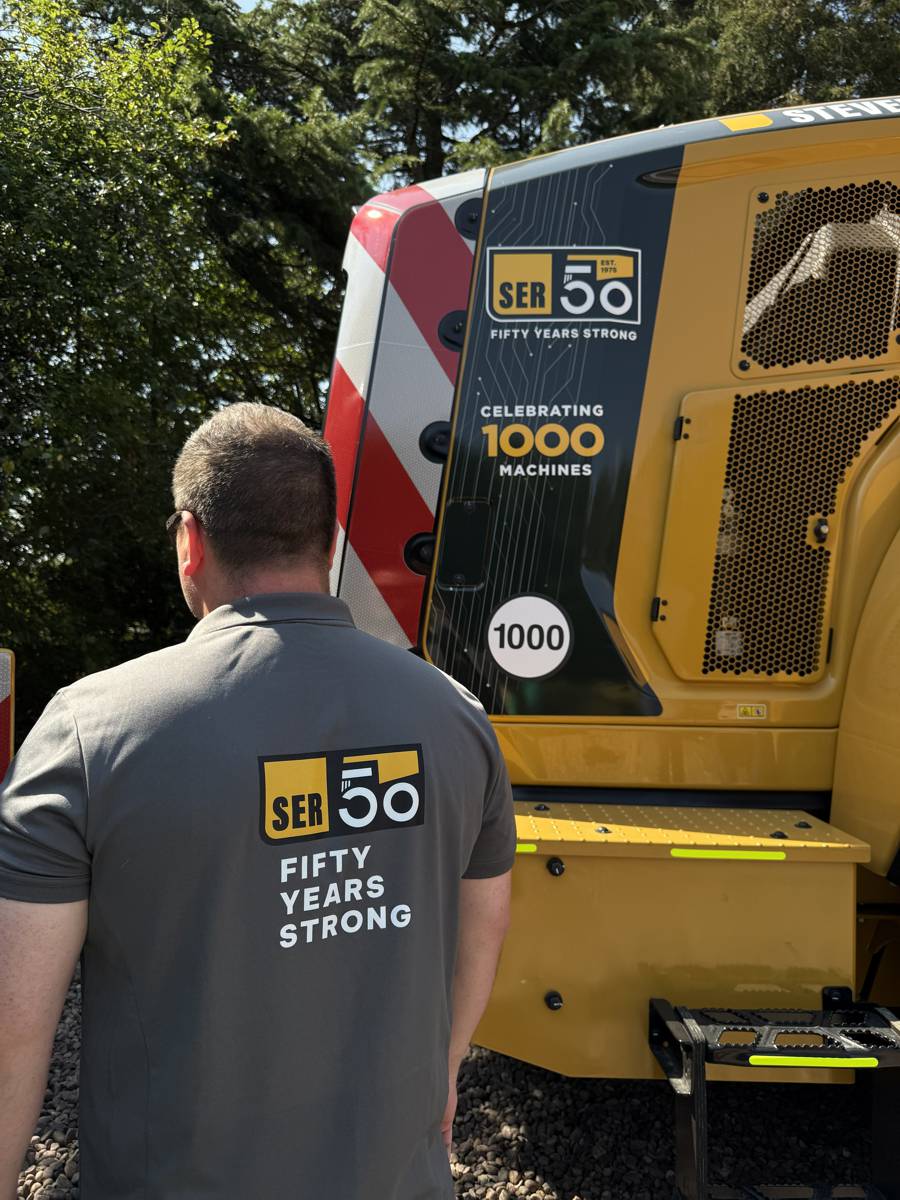
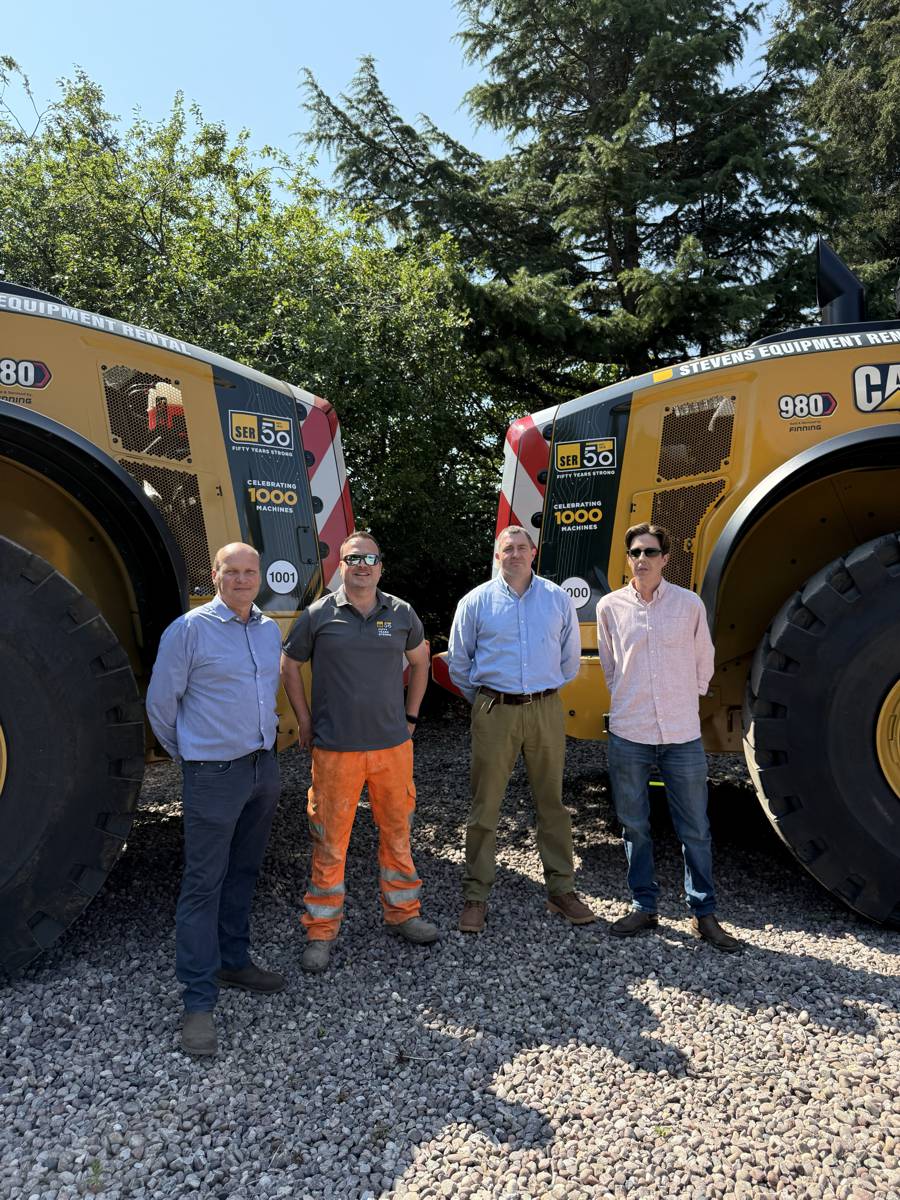
Two 30.9 tonne machines were supplied by Finning UK & Ireland in commemorative livery, taking the fleet count to 1000 and 1001, and both carry a technology package that no longer merely warns the operator about a hazard. It intervenes.
That distinction matters commercially. For the past decade, machine safety on wheel loaders has been sold as situational awareness: reversing cameras, surround vision, radar alarms and audible warnings, all of which depend on an operator reading a screen and reacting in time.
Automatic emergency braking removes that dependency at the final moment, handing the service brakes to the machine when a person or obstacle occupies the critical zone and the operator has not acted. The shift from advisory to interventional systems changes how risk is priced, how hire fleets differentiate themselves, and how quickly a capability spreads from a handful of early adopters to the accepted baseline on tier one sites.
Briefing
- Stevens Equipment Rental has become the first UK operator to specify the Cat 980 medium wheel loader with Cat Detect collision mitigation including the new automatic emergency braking (AEB) function, delivered by Finning UK & Ireland alongside Cat CPM Weighloader, surround vision cameras and object and people detection.
- The two 30.9 tonne loaders mark the company’s 1000th and 1001st new machines, and follow positive operating feedback from a Cat 972 with object detection and mitigation bought in 2025.
- Caterpillar’s Cat Detect architecture pairs rear radar operating across awareness, caution and critical alarm zones with a smart camera that identifies people, adding Motion Inhibit to block gear engagement from standstill and AEB to apply the service brakes when the operator does not respond.
- Provisional HSE figures for 2025/26 record 126 worker fatalities in Great Britain, of which 24 involved being struck by a moving vehicle, the second largest accident category after falls from height and a sharp rise on the 14 recorded in 2024/25.
- The machines are supported by a Cat Customer Value Agreement covering proactive maintenance, servicing and remote monitoring, plus Cat Equipment Protection Plans, reflecting a wider Caterpillar strategy that has taken services revenue to roughly $24 billion against a $28 billion target for 2026.
Detection Becomes Intervention Inside The Cat Detect Architecture
Cat Detect on the current medium wheel loader range is best understood as a layered system rather than a single sensor. Radar monitors the space behind the machine and grades what it finds across three zones described by Caterpillar as awareness, caution and critical alarm, escalating the operator prompt as the risk profile tightens.
A smart rear camera works alongside the radar to distinguish people from static obstacles and highlights them on the in-cab monitor, which matters because a stacked aggregate face and a banksman produce very different radar returns but demand very different responses. Surround vision extends the picture to 360 degrees including the articulation hitch area, the pinch point that has historically been the hardest zone on an articulated loader for an operator to see and the easiest for a person on foot to underestimate.
Motion Inhibit and AEB are the two functions that convert this awareness into control authority. Motion Inhibit prevents the machine engaging gear from a stationary position while a person or object sits in the critical zone, notifying the operator on screen rather than silently locking the transmission, and Caterpillar’s published documentation applies the logic once the loader has been stationary for a defined period.
AEB then covers the dynamic case, applying the service brakes if the operator fails to take evasive action, with Caterpillar’s product literature framing the intervention around reverse travel where visibility is poorest. Volvo Construction Equipment, which brought its own factory-fit collision mitigation system to market in 2023, has estimated that wheel loaders spend between 40 and 50 per cent of their working time travelling in reverse, which explains why every major manufacturer has concentrated automated braking behind the machine rather than in front of it.
The safety case behind this engineering has hardened considerably in the past twelve months. Provisional Health and Safety Executive data for 2025/26 records 126 workers killed in Great Britain, with construction accounting for 25 of those deaths, and being struck by a moving vehicle responsible for 24 fatalities across all sectors. That figure sat at 14 in 2024/25, and the year-on-year movement puts vehicle and plant interaction back near the top of the regulatory agenda after a period in which falls from height dominated the conversation.
Andrew Stevens, Managing Director of Stevens Equipment Rental, framed the purchase in exactly those terms, describing the function as one that will actively intervene and halt machinery to prevent struck-by incidents on site and is something we saw as an essential investment for improving site safety for our customers.
The Machine Underneath The Technology
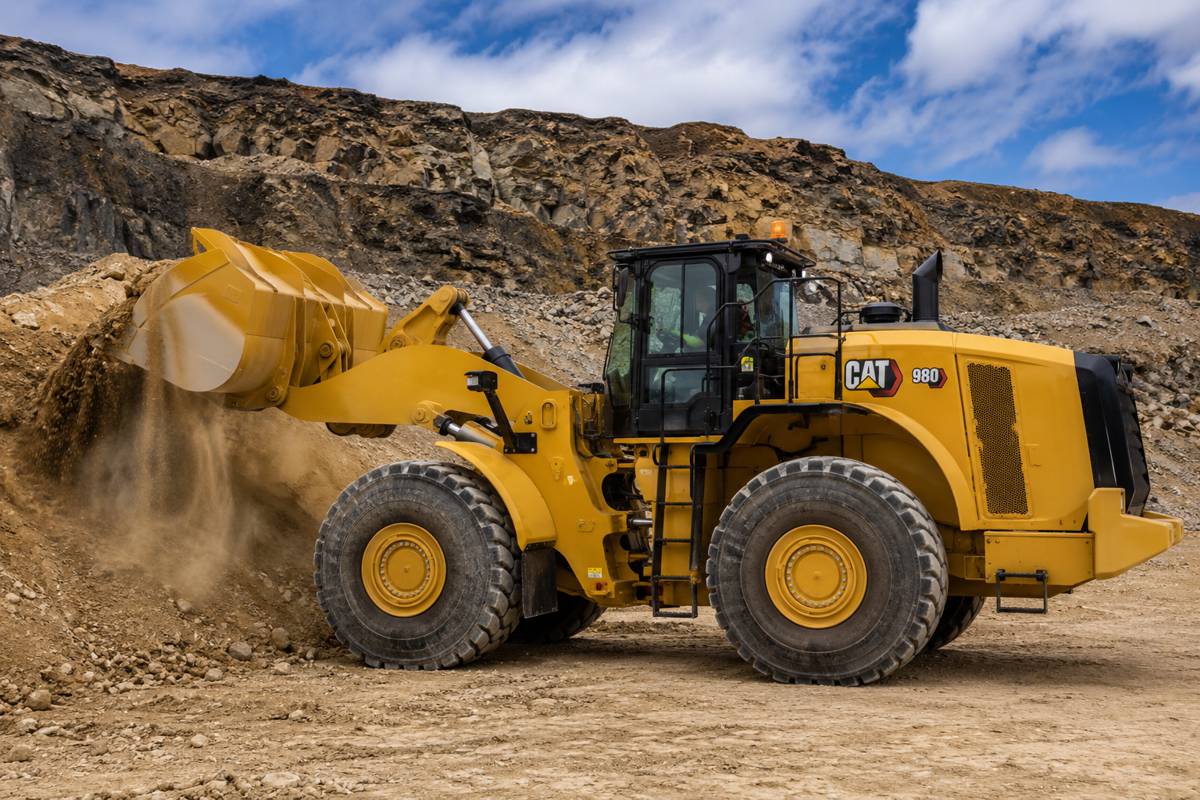
The 980 sits in Caterpillar’s medium wheel loader range between the 972 and the 982, and the current generation is a substantially different proposition from the 980M it replaced. Power comes from the 12.5 litre Cat C13, rated at 420 hp (313 kW) at 1,700 rpm under ISO 14396:2002, with gross output of 425 hp (317 kW) and net output of 393 hp (293 kW) under ISO 9249. Peak engine torque of 2,185 N·m arrives at 1,200 rpm, which is where a loader actually works when it is crowding a face rather than tramming across a yard.
The engine meets EU Stage V and US EPA Tier 4 Final, runs on ultra low sulphur diesel and is compatible with blends up to B20 biodiesel and with 100 per cent renewable diesel, HVO and GTL fuels, a specification that increasingly determines whether a machine can be placed on carbon-reporting infrastructure contracts.
Caterpillar lists a base operating weight of 30,344 kg for the 980, with the Stevens machines specified at 30.9 tonnes once the technology and application arrangements are fitted. Drive is through an automatic planetary powershift transmission with four forward and four reverse speeds and a lock-up clutch, using single clutch lock-to-lock shifting for acceleration on grades.
Caterpillar positions the 980 and 982 generation as up to 10 per cent more productive and up to 20 per cent cheaper to maintain than the M-series powershift machines, with the XE variants adding a continuously variable transmission that the manufacturer credits with fuel efficiency gains of up to 35 per cent. Performance Series buckets are matched to the linkage geometry rather than simply rated by volume, and Autodig with Auto Set Tires automates the loading pass to lift fill factors and reduce the tyre scrubbing that quietly erodes margin on any high-utilisation rental asset.
Around the powertrain sits the technology stack that Finning delivered with the Stevens machines. Cat Advanced Payload provides real-time bucket weighing with tip-off assist, recipe mode for blended materials and e-Ticket generation for over-the-air weighing tickets, while the Cat CPM Weighloader system specified by Stevens addresses the same commercial problem of loading accurately first time.
VisionLink handles telematics across location, hours, idle time, fuel burn and asset status, and reports collision mitigation events back to the office when subscribed, turning safety interventions into auditable data rather than anecdote. Single Life Cutting Edge ground engaging tools, integrated Autolube, tyre pressure monitoring, Remote Troubleshoot and Remote Flash software updates all reduce the number of times a fitter has to travel to a site, which is precisely the cost line a national rental operation needs to control.
Rental Fleets Are Becoming The Distribution Channel For Machine Safety
The most commercially interesting aspect of this order is who placed it. IBISWorld valued UK construction equipment rental and leasing at around £9.4 billion in 2025, rising modestly in 2026, spread across more than 3,300 actively trading plant hire firms. In a market that fragmented, capability spreads through fleets rather than through individual contractor purchases, and a rental company that specifies AEB across its wheel loader intake effectively places that technology on every site its machines visit for the life of the asset.
Stevens has historically run a young fleet, operating machines at around three years or 10,000 hours before replacement, which compresses the refresh cycle and accelerates how quickly a new safety function reaches the working population of machines.
That creates a genuine differentiation opportunity for hire businesses willing to move early. Principal contractors on major infrastructure programmes increasingly write plant safety requirements into supply chain prequalification, and a hire desk that can offer factory-fit people detection with braking intervention answers a question that a bolt-on aftermarket sensor kit answers less convincingly.
The distinction is not cosmetic, since a factory-integrated system talks directly to the transmission and brake circuits, is covered by the machine warranty, and is validated by the manufacturer rather than retrofitted into a control architecture that was never designed to accept an external stop command. Stevens has been building toward this position for some time, having already been an early UK adopter of factory-fit collision warning on the Cat 972, and having expanded into Cat D7 dozers and the Cat 352 excavator as customers took on larger earthworks packages.
The Standards Framework Is Arriving Behind The Hardware
Manufacturers have moved ahead of formal regulation on this technology, but the rulebook is catching up quickly. The ISO 21815 series now provides a technology-neutral framework for collision warning and avoidance on earth-moving machinery, with Part 1 setting general requirements for object detection, operator warning, automatic intervention and test procedures, Part 3 defining risk areas and risk levels for forward and reverse motion, and further parts addressing rotation, articulation and other movement types.
Significantly, the standard covers avoidance by speed reduction or motion inhibit rather than automatic steering, and states plainly that such systems assist the operator rather than replace competent operation. That framing gives fleet managers a defensible position when writing method statements, because it establishes what an intervention system is expected to do and what remains the responsibility of the person in the seat.
The regulatory layer arrives on 20 January 2027, when Regulation (EU) 2023/1230 replaces the Machinery Directive and introduces explicit requirements covering safety functions that use artificial intelligence, self-evolving behaviour and cybersecurity protection of safety-critical control systems.
Great Britain has not diverged on machinery, having recognised CE marking indefinitely through the Product Safety and Metrology etc. (Amendment) Regulations 2024, with the Supply of Machinery (Safety) Regulations 2008 and the Product Regulation and Metrology Act 2025 providing the domestic frame.
The practical consequence for UK fleet buyers is that the specification bar set in Brussels will apply to the machines offered here, and that manufacturers who have already engineered detection, classification and braking intervention into the base machine will be considerably better placed than those relying on third-party integration.
Uptime Contracts Carry The Long-Term Value
Both Stevens machines are supported by a Cat Customer Value Agreement covering proactive maintenance, expert servicing and remote monitoring, alongside Cat Equipment Protection Plans providing extended warranty cover for the operations team. This is the part of the transaction that determines whether a rental asset earns over eight years or merely runs, and it reflects a deliberate structural shift at Caterpillar.
Services revenue reached roughly $24 billion in 2025 against a stated target of $28 billion for 2026, more than two-thirds of new machines and engines are now sold with a CVA attached, and from the first quarter of 2026 Caterpillar began rolling out an upgraded Services Commitment offering next-day parts availability and a two-day repair undertaking on common repairs. For a hire company, a contractual repair window converts into forecastable utilisation, and utilisation is the variable that drives return on capital in plant rental.
Finning has been investing behind that proposition in the UK. The dealer’s Cannock headquarters is building a 1,230 square metre Rebuild Centre of Excellence, supported by more than £200,000 of advanced Cat engine testing technology including a £160,000 high-power dynamometer used to validate build quality and power on overhauled engines.
The workshop underpins the Rebuilt and Ready to Go programme, which offers fully rebuilt Cat machines at below the cost of new equipment, and it matters to a business like Stevens because it extends the credible economic life of an asset and firms up residual values at disposal. Neil Baxter, Key Account Manager at Finning, characterised the relationship in terms of sustained investment, noting that Stevens has consistently chosen to make investments in both their fleet and technology to ensure the very best for their customers, both in machine productivity and safety.
What The Next Fleet Order Should Specify
The competitive field around interventional safety is filling out rather than standing still, and that is healthy for buyers. Volvo CE has offered a factory-fit collision mitigation system on its larger wheel loaders since 2023 and extended detection sensitivity down to 0.5 km/h in its latest generation, while Komatsu, Liebherr and others continue to build camera and radar capability into standard specifications.
The direction of travel is unmistakable, and the practical question for fleet buyers is no longer whether to specify intervention but how to write it into a purchase order in a way that survives the residual value calculation five years out. Machines specified with integrated detection and braking are likely to hold value better in a used market where contractor prequalification requirements are tightening, particularly across quarrying, waste and recycling, and major civils where pedestrian and plant interfaces are unavoidable.
For infrastructure clients and principal contractors, the Stevens order offers a useful benchmark for what can now be asked of a hire supplier. Specifying people detection with automatic braking, surround vision, telematics reporting of safety events and a maintenance agreement with a defined repair commitment is achievable today on a standard medium wheel loader, and the technology is available through the normal dealer channel rather than as a bespoke engineering exercise.
Andrew Stevens put the fleet strategy simply, noting that over 50 years we have continually expanded our national fleet to ensure we can offer our customers the latest in low-emission, high performance machines, and adding that the 980 brings increased efficiency and ease of operation to customers working in the most demanding applications. The commercial lesson for the rest of the market is that safety specification has stopped being a compliance cost and started behaving like a competitive asset.
Key Industry Questions
- What exactly does automatic emergency braking do on a wheel loader? Cat’s AEB function forms part of the Cat Detect collision mitigation system and uses an integrated sensor array with a smart camera to track people and obstacles around the machine. When something enters the defined critical zone and the operator does not take evasive action, the system automatically applies the service brakes. Caterpillar’s published product documentation frames the intervention primarily around reverse travel, where operator visibility is weakest and where wheel loaders spend a substantial share of their working time. The system is designed to assist rather than replace competent operation, and ISO 21815 is explicit that collision avoidance systems of this type support the operator rather than transfer responsibility away from them.
- How does Motion Inhibit differ from automatic braking? Motion Inhibit addresses the stationary case rather than the moving one. When the machine has been at rest and the detection system identifies a person or object in the critical zone, Motion Inhibit prevents the transmission engaging gear and notifies the operator through an on-screen warning. It also applies the brakes to prevent unintended coasting, which matters on graded stockpile aprons and sloping haul roads. The two functions are complementary: Motion Inhibit stops a machine starting into a hazard that the operator has not registered before setting off, while AEB covers the situation where a hazard enters the machine path during travel and the operator does not respond in time.
- What are the headline specifications of the Cat 980? The current Cat 980 uses a 12.5 litre Cat C13 engine producing 420 hp (313 kW) at 1,700 rpm under ISO 14396:2002, with gross power of 425 hp and net power of 393 hp, and peak torque of 2,185 N·m at 1,200 rpm. Caterpillar lists a base operating weight of 30,344 kg, with the Stevens machines specified at 30.9 tonnes. Transmission is an automatic planetary powershift with four forward and four reverse gears and a lock-up clutch. The engine meets EU Stage V and US EPA Tier 4 Final and is compatible with up to B20 biodiesel as well as renewable diesel, HVO and GTL fuels.
- Is factory-fit detection genuinely better than an aftermarket retrofit? For interventional systems, the integration argument is strong. A factory-fit collision mitigation package communicates directly with the machine’s transmission and braking circuits, is validated by the manufacturer against defined risk zones, and is covered by the machine warranty and dealer support agreement. Aftermarket proximity systems remain valuable, particularly for mixed and older fleets where replacement is not imminent, and ISO 21815 Part 2 defines a J1939 communication interface specifically so that independently integrated collision avoidance devices can issue slow, stop or inhibit commands. The practical difference is accountability: with a factory system, one supplier owns the performance of the whole chain from detection through to brake application.
- Why does the HSE data matter to plant procurement decisions? Provisional HSE figures for 2025/26 record 126 worker fatalities in Great Britain, with 24 caused by being struck by a moving vehicle, against 14 the previous year, and construction remaining the sector with the highest raw fatality count at 25. Numbers of this size move regulatory attention and, in turn, contractor prequalification requirements. Principal contractors on major infrastructure programmes respond by tightening the plant specifications they will accept on site, which flows directly into what hire desks need to be able to offer. Buying interventional safety technology ahead of that requirement is a commercial hedge as much as an ethical one.
- How does the EU Machinery Regulation affect UK plant buyers? Regulation (EU) 2023/1230 applies from 20 January 2027 and replaces the Machinery Directive 2006/42/EC, introducing requirements covering safety functions that incorporate artificial intelligence or self-evolving behaviour, along with cybersecurity protection for safety control systems and extended documentation duties. Great Britain has recognised CE marking indefinitely for machinery under the Product Safety and Metrology etc. (Amendment) Regulations 2024, alongside the Supply of Machinery (Safety) Regulations 2008 and the newer Product Regulation and Metrology Act 2025. In practice, machinery offered in the UK will reflect the European specification bar, so UK fleets benefit from the tightened requirements without a separate domestic compliance route.
- What does a Customer Value Agreement actually change for a rental business? A CVA converts unplanned maintenance risk into a scheduled, priced commitment covering proactive servicing, genuine parts, remote condition monitoring and dealer support. For a rental operator, the value sits in utilisation predictability rather than in the maintenance line itself, because a machine standing idle awaiting a part earns nothing while still consuming capital. Caterpillar has attached CVAs to more than two-thirds of new machine and engine sales and, from the first quarter of 2026, began rolling out an upgraded Services Commitment featuring next-day parts availability and a two-day repair undertaking on common repairs. That structure also strengthens service records at resale, which supports residual value.
- Will this technology become standard on medium wheel loaders? The evidence points that way. Caterpillar now lists collision mitigation with people detection, Motion Inhibit and automatic emergency braking across its current medium wheel loader range from the 950 upward, Volvo CE has offered factory-fit collision mitigation on larger loaders since 2023 and extended detection to speeds as low as 0.5 km/h, and the ISO 21815 series has given the whole category a common performance and testing vocabulary. Once a capability is standardised, validated and available through normal dealer channels, it tends to migrate from premium option to expected specification within a small number of product cycles, particularly where regulators and principal contractors are actively watching the hazard.
Strategic Takeaways
- Interventional safety technology has crossed the line from operator assistance to machine control authority, and fleets that specify it now will be writing the baseline that principal contractors demand within the next product cycle.
- Rental businesses, not individual contractors, are becoming the primary distribution channel for new machine safety capability in a UK hire market worth around £9.4 billion, because fleet refresh cycles of roughly three years spread technology far faster than owner-operator replacement.
- The commercial case for AEB now rests on hard regulatory data rather than sentiment, with 24 struck-by-vehicle worker deaths recorded provisionally in Great Britain in 2025/26 against 14 the previous year.
- ISO 21815 and the EU Machinery Regulation applying from January 2027 will formalise how automated safety functions are specified, tested and documented, giving factory-integrated systems a structural advantage over retrofitted control interventions.
- Lifecycle support contracts are where the long-term economics sit, with maintenance agreements carrying defined repair windows increasingly determining utilisation, residual value and total cost of ownership rather than headline machine price.