Structural Monitoring Unlocks Leaner Excavation at Gothenburg’s Korsvägen West Link
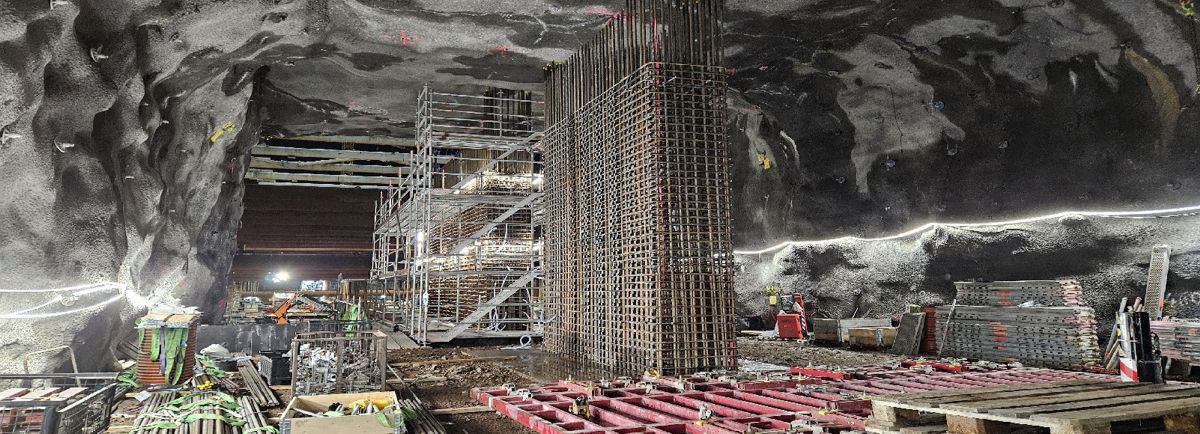
The most commercially interesting thing about the monitoring system Hottinger Brüel & Kjær has installed beneath Gothenburg is not what it prevented, but what it permitted. At Korsvägen station on Sweden’s West Link, engineers blasted three parallel pilot tunnels and deliberately left two temporary rock pillars standing between them to hold up the surrounding ground.
Those pillars were then removed and replaced with cast-in-place reinforced concrete columns, transferring load from rock to structure in a controlled sequence rather than excavating the full cavern and supporting it afterwards. The method cut excavation volume and rock movement, and with them both the environmental footprint and the overall project cost.
That sequence only works if the project team can watch the load migrate. Removing a rock pillar that is actively carrying stress and handing its job to a concrete column is a manoeuvre with a narrow margin, and the margin is invisible without instrumentation. HBK, working with the Swedish Transport Administration, Trafikverket, and structural designer COWI, delivered an integrated fibre-optic and multi-parameter system combining strain, temperature and humidity measurement with automated engineering interpretation.
The commercial reading is straightforward and rather more interesting than the usual safety argument, because monitoring here is not an insurance premium against failure. It is the enabling condition for a cheaper, lower-impact construction method, and its cost sits against savings in rock volume, haulage, disposal and programme rather than against the remote probability of an incident. As Mats Rydén, Business Development Manager at HBK, put it: “Major infrastructure projects require confidence in every decision made underground”, and at Korsvägen that confidence was converted directly into method selection.
Briefing
- Engineers at Korsvägen blasted three pilot tunnels, left two temporary rock pillars standing, then replaced those pillars with cast-in-place reinforced concrete columns, a sequence that reduced excavation volume, environmental impact and project cost but depends entirely on continuous visibility of load transfer.
- HBK’s system combines Fibre Bragg Grating strain and temperature sensors embedded in reinforced concrete with pressure cells, tape extensometers and relative humidity probes, providing deliberate redundancy and cross-checking rather than a single measurement path.
- Automated post-processing separates temperature, shrinkage and creep effects, then converts isolated strain into stresses, internal forces and utilisation ratios checked against Eurocode 2 interaction criteria, producing alert ranges and stop limits engineers can act on within an excavation cycle.
- Trafikverket awarded the E16 Korsvägen station execution contract to Implenia on 29 June 2026 for more than CHF 250 million on a cost-plus reimbursement basis, a model that raises the commercial value of verified structural evidence.
- KKR completed a £4.7 billion take-private of Spectris, HBK’s parent group, in December 2025, placing precision sensing and analytics inside a private capital thesis built on long-life installed bases rather than instrument sales.
The Ground Conditions That Made Conventional Methods Awkward
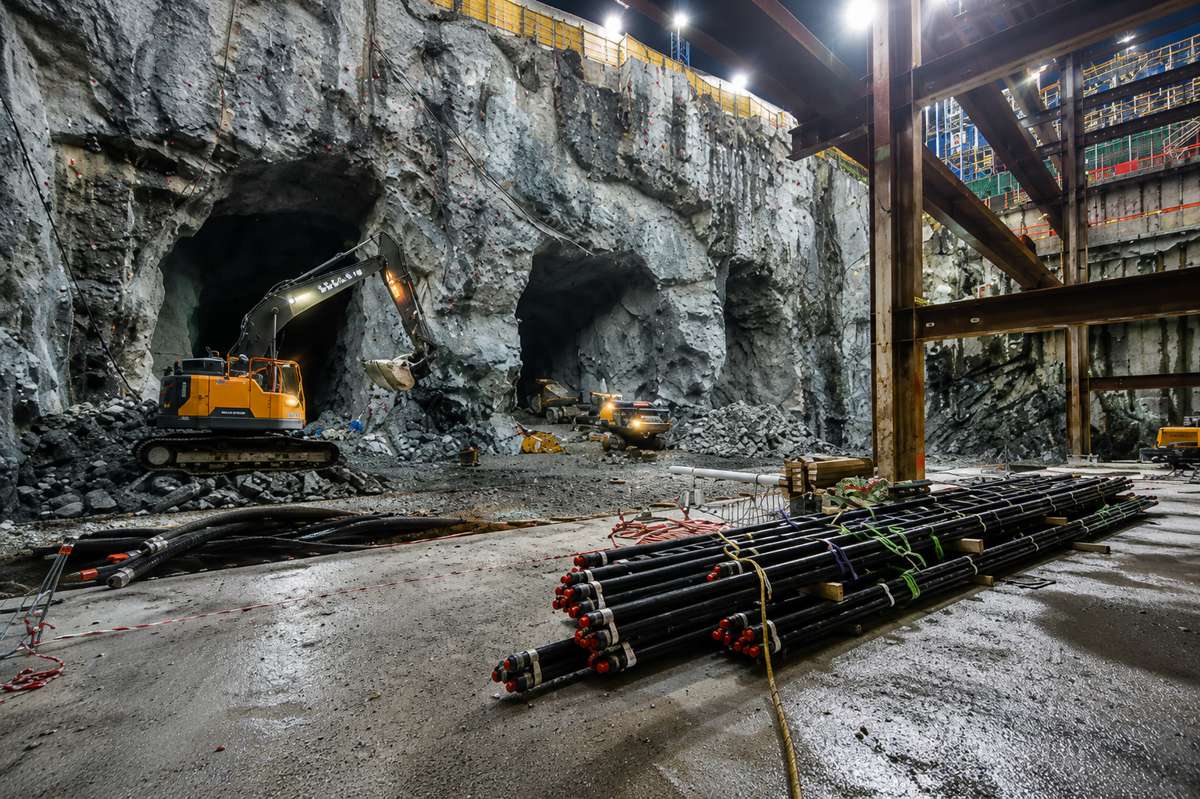
Korsvägen presented a combination of constraints that ruled out the comfortable options. The tunnels sit too shallow beneath the city to form a naturally self-supporting rock arch, which removes the mechanism that normally allows a tunnel to carry its own overburden and forces load into engineered supports much earlier in the sequence.
The bedrock is exceptionally hard and highly stressed, a combination that sounds advantageous until it is blasted, at which point stored stress makes fragmentation and overbreak considerably less predictable than a rock mass of the same strength at lower stress. Above all of this sits one of Gothenburg’s busiest surface interchanges, adjacent to the Liseberg amusement park, the Universeum science centre and the Swedish Exhibition and Congress Centre, with trams, utilities and commercial premises operating throughout.
The station itself is not a modest structure. Korsvägen comprises two platforms and four tracks, with spans of roughly 30 to 50 metres depending on the geology encountered, within a scheme that runs eight kilometres in total and carries more than six kilometres of that distance in tunnel. Excavating a cavern of those proportions in shallow, highly stressed rock beneath a live city leaves no appetite for a method that relies on generous safety factors and hopes for the best.
The rock mass was additionally treated by grouting, with a low-viscosity cement grout injected to reduce porosity and permeability while raising stiffness and load-bearing capacity, improving the predictability of the material before anyone attempted to redistribute its load. COWI, responsible for the design of the underground station and its structural systems, worked alongside Trafikverket through both design and construction, and the instrumentation strategy was developed as part of that structural design rather than bolted on as a site service.
The Contract Model That Changes What Monitoring Is Worth
Västlänken has been a long programme, and long programmes reward objective information. Trafikverket’s original budget stood at SEK 20 billion in 2009 price levels, the authority’s more recent assessed cost has been reported at SEK 32.2 billion on the same price basis, and completion of the full scheme is now expected within a range spanning 2029 to 2032 with a probable traffic start in 2030.
The first operational milestone arrives sooner, with the underground section at Gothenburg Central Station opening in December 2026 with four new tracks, initially functioning as a terminus until the tunnel through Haga and Korsvägen is complete. Every month of programme and every method decision on a scheme of this scale carries a measurable cost to the client, the contractor and the region funding the work through the West Swedish Package.
Trafikverket’s procurement behaviour has moved accordingly. On 29 June 2026 the authority awarded the execution contract for the E16 Korsvägen station package to Implenia, a deal worth more than CHF 250 million structured on a cost-plus reimbursement model, following a tender in which the client placed particular emphasis on efficient start-up, organisation and logistics.
Implenia had already been selected in 2024 to build a section of the scheme including rail tunnel and the new Haga underground station, while earlier tunnelling and excavation at Korsvägen sat within the E05 contract delivered by the West Link Contractors joint venture of Wayss & Freytag Ingenieurbau and NCC. Under reimbursable arrangements the client absorbs a larger share of production risk than under a fixed-price lump sum, and the quality of the evidence base determines how confidently that risk can be managed.
Instrumented structural data stops being a compliance overhead and becomes the shared factual record on which method changes, sequencing decisions and progress assessments all rest, which is a materially different commercial proposition for the vendor supplying it.
Redundancy As A Design Principle Rather Than A Luxury
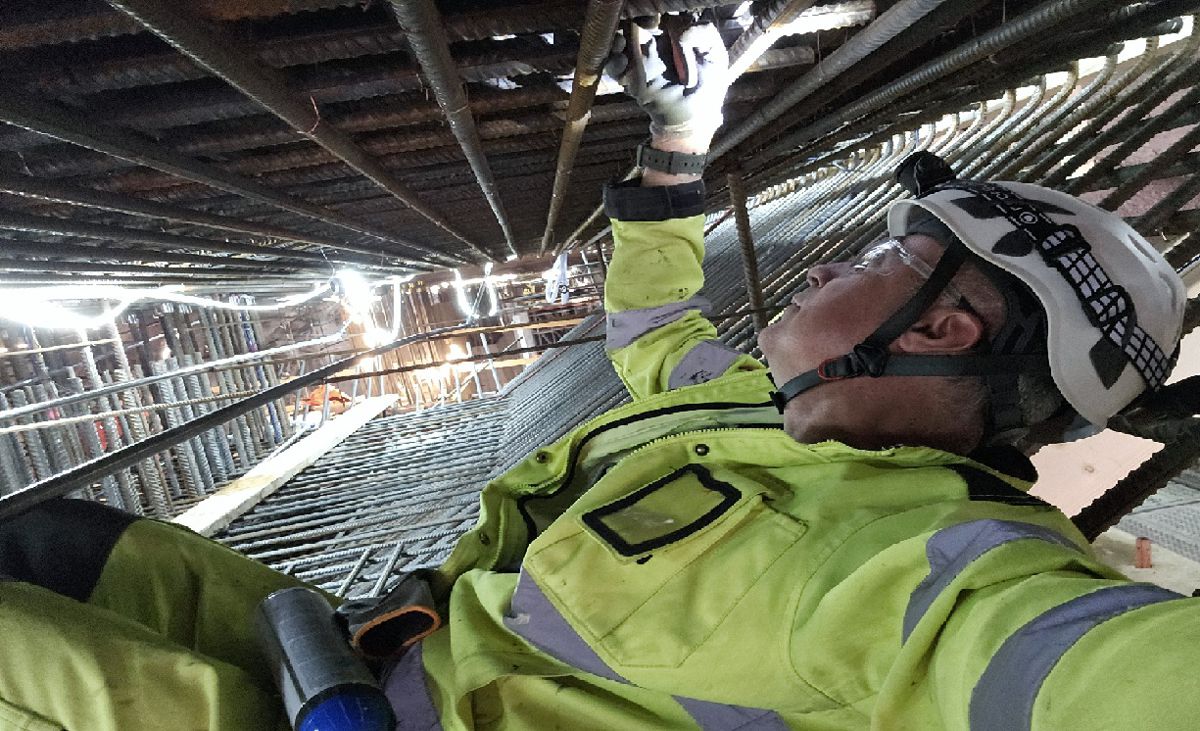
The instrumentation package at Korsvägen reflects a clear view about what goes wrong with monitoring systems in practice. Fibre Bragg Grating strain and temperature sensors are embedded in the reinforced concrete elements, supported by pressure cells, tape extensometers and moisture and relative humidity probes, so that any given structural question can be answered by more than one measurement route.
That redundancy is what allows an unexpected reading to be investigated rather than either acted upon blindly or dismissed, since a strain anomaly that appears in the fibre-optic data but not in the pressure cells or the extensometer record points toward an instrumentation issue rather than a structural one. Installation was phased to follow the construction sequence, with measurement access maintained during works and the final configuration arranged to support permanent monitoring once the station enters service.
Fibre Bragg grating sensing earns its place in permanent civil works for reasons that are practical rather than fashionable. Optical sensors carry no electrical current at the measurement point, are immune to the electromagnetic interference generated by traction power, welding plant and heavy electrical equipment, resist corrosion in the wet alkaline environment of fresh concrete and can be multiplexed so that many measurement points share a single fibre run back to an interrogator.
That last property matters most on a congested site, where cable routing through dense reinforcement is both a cost and a failure mode. HBK’s optical business is concentrated at HBK FiberSensing in Maia near Porto, founded in 2004 and acquired by Hottinger Baldwin Messtechnik in October 2014, and the Korsvägen deployment draws on that portfolio including the newLight optical strain gauge family and FBG temperature sensing, supplying the full chain from sensor through interrogator to software rather than components alone.
From Strain Readings To Eurocode Utilisation Ratios
The element of this deployment with the widest industrial relevance is what happens to the data after acquisition, and it deserves more attention than monitoring case studies usually receive. Continuous acquisition is combined with automated post-processing that applies temperature compensation and separates shrinkage and creep effects, isolating the strain actually caused by rock-load transfer from the background behaviour of curing high-strength concrete.
Those isolated strains are then translated into stresses, internal forces and utilisation ratios, and checked against Eurocode 2 interaction criteria. The output an engineer sees is therefore not a plotted signal requiring interpretation, but a statement of how far a specific column has consumed its design capacity under combined actions, expressed in the same terms the designer used.
That translation collapses the gap that normally sits between a monitoring system and a construction decision. On a conventional instrumented job, a specialist reviews plotted data, mentally subtracts thermal drift, cross-references pour records and forms a judgement, a cycle that typically runs weekly or fortnightly and cannot keep pace with a drill and blast operation advancing several rounds a day.
Automated reports at Korsvägen present trends, alert ranges and stop limits directly, which makes the resulting decisions fast and, more importantly, repeatable, since two engineers reading the same report reach the same conclusion. Repeatability is what turns monitoring output into an auditable basis for pausing or continuing excavation, and Trafikverket’s brief explicitly required alert thresholds and limit values tied to structural capacity so that the excavation could stop or proceed with confidence. Rydén framed the same shift in capability terms, describing HBK as “helping project teams move beyond data collection to engineering intelligence, providing the right product needed to manage risk, maintain progress and verify structural performance in one of Sweden’s most complex urban construction environments.”
There is a further consequence that matters to anyone specifying monitoring on a major project. Systems that stream raw measurement to engineers generate alarms that are usually artefacts of temperature or curing, and the professional response to repeated false positives is to raise thresholds until the system stops being useful. Compensating for known physics before raising a flag preserves the credibility of the alerts that do occur, which is the only reason a site team will halt a production cycle on the strength of one. The competitive ground in construction instrumentation has spent two decades sitting with sensor accuracy, and it has now moved decisively toward interpretation.
The 120-Year Question And The Handover Of Instrumentation
The most commercially interesting claim attached to the Korsvägen installation concerns time. Dorin Lungu, Site Manager for Concrete Works on the Trafikverket project, described the value of the approach in terms that combine both phases of the asset’s life, noting that “We highly value the ability to monitor concrete columns with high-strength concrete class, using strain sensors, temperature sensors, and humidity sensors. The sensors are used to monitor the concrete columns during the construction phase and mainly after, with an expected active lifespan of 120 years.”
That horizon aligns the instrumentation with the design working life expected of major civil engineering structures, where Eurocode Category 5 sets an indicative 100 years and several national annexes, including the United Kingdom’s, extend the requirement to 120 years for bridges and comparable structures.
Instrumentation designed to that horizon converts a construction expense into an operational asset, and the reframing is where the long-term revenue in this market sits. Once Korsvägen enters service, the embedded sensors continue reporting against a baseline established during construction, which is the single hardest dataset for any asset owner to obtain retrospectively.
Retrofitted monitoring measures behaviour relative to an unknown starting condition, whereas monitoring installed during construction records how each column behaved from the moment it first took load from the rock it replaced. For an owner facing decades of inspection cycles, maintenance planning and eventual capacity or life-extension decisions, that continuous record materially strengthens the engineering case that can be made, and the columns at Korsvägen carry an unusually well-documented loading history precisely because their installation was instrumented from the outset.
Lungu also noted the delivery side of that relationship, observing that “Throughout this process, HBK’s team provided fast technical support, visiting sites and conducting inspections as needed”, which is a reminder that long-life monitoring is a service commitment rather than a product sale.
Private Equity, Precision Measurement And Where The Margin Sits
The ownership context around this deployment deserves attention from anyone assessing where the infrastructure monitoring market is heading. HBK’s parent, Spectris, was taken private by KKR in a transaction valued at approximately £4.7 billion including debt, completed in early December 2025 after a competitive process against Advent International that produced one of the largest UK public-to-private deals of that year.
The offer valued Spectris equity at around £4.1 billion, representing a premium of roughly 96 per cent to the undisturbed share price, on a business employing about 7,600 people with combined annual sales approaching £1.3 billion across its two divisions. KKR framed the acquisition as a long-term strategic investment with an intention to support bolt-on acquisitions, which is the standard signature of a buy-and-build thesis in a fragmented technical market.
Precision sensing attracted that valuation because its revenue characteristics increasingly resemble an installed-base business rather than a capital equipment supplier. Sensors embedded in permanent civil works generate interrogator sales, software licences, calibration services, technical support and eventual replacement of surface equipment across the whole asset life, and a project such as Korsvägen creates that annuity at the moment concrete is poured.
The competitive field includes specialist optical sensing firms such as Luna Innovations, AP Sensing and Omnisens alongside instrumentation groups and geotechnical monitoring contractors, and consolidation pressure is real, since asset owners increasingly prefer a single accountable supplier across the sensor, acquisition and analysis chain.
Mordor Intelligence values fibre optic sensing for industrial and infrastructure monitoring at around USD 1.55 billion in 2025, forecasting roughly USD 2.85 billion by 2031, while Coherent Market Insights sizes the wider structural health monitoring market at approximately USD 3.6 billion in 2026 with growth toward USD 8.7 billion by 2033. The segments compounding fastest in both are those where the vendor supplies interpretation rather than instruments.
What Gothenburg Signals For Procurement Elsewhere
European infrastructure clients are converging on the same procurement logic, and Korsvägen is a useful marker of how far that convergence has travelled. Crossrail incorporated extensive digital retrofitting of stations and tunnels with real-time monitoring and digital asset management platforms, and Thames Tideway has used digital twins to track structural integrity alongside hydraulic performance.
At programme level, EU-Rail’s IAM4RAIL work has advanced common specifications for digital twin development and maintenance across the European network, with demonstrations including instrumented concrete bridges and an Arctic Test Arena involving Trafikverket, Bane NOR and Luleå University of Technology testing structural and rail integrity sensing at temperatures approaching minus 30 degrees Celsius. The direction of travel is toward monitoring specified as a permanent asset system with defined data standards, procured by the client, rather than a temporary construction service arranged by the contractor.
The practical lesson for contractors and consultants is that instrumentation and interpretation capability now shapes what methods can be bid at all. A pillar-replacement sequence of the kind used at Korsvägen is a cheaper and lower-impact answer than bulk excavation with heavy temporary support, but it can only be offered by a team that can demonstrate control of load transfer to the client’s satisfaction, which makes monitoring competence a tender differentiator rather than a subcontracted line item.
For asset owners, the question worth asking early is whether the monitoring specification defines data ownership, format longevity and interrogator replacement over a design life measured in decades, because a 120-year sensor connected to a proprietary format with a ten-year support horizon delivers a fraction of its potential value.
For investors, KKR’s Spectris transaction indicates that the market has already repriced this capability, and infrastructure programmes across the Nordics, Germany, the United Kingdom and the Gulf are supplying the demand that justifies it.
Gothenburg will get its tunnel around 2030, giving 100,000 residents and 130,000 workers walking or cycling access to a commuter station in the city centre, and its owner will also inherit something less visible but increasingly bankable, which is a structure able to report its own utilisation against the code it was designed to.
Key Industry Questions
- What was the pillar-replacement method used at Korsvägen and why does it matter? Engineers blasted three parallel pilot tunnels in the eastern part of Korsvägen station, deliberately leaving two temporary rock pillars standing between the excavations to support the surrounding rock mass. Those pillars were subsequently removed and replaced with cast-in-place reinforced concrete columns, transferring load from natural rock to engineered structure in a controlled sequence. The approach minimised the volume of rock excavated and moved, reducing environmental impact and overall project cost compared with opening the full cavern and supporting it afterwards. Its viability depends on continuously verifying when and how load migrates during pillar removal, which is why the instrumentation strategy was developed as part of the structural design rather than added later.
- Why were the ground conditions at Korsvägen particularly demanding? Three factors combined. The tunnels sit too shallow beneath the city to develop a naturally self-supporting rock arch, so load reaches engineered supports earlier than in deeper tunnelling. The bedrock is exceptionally hard and highly stressed, and stored stress makes blast fragmentation and overbreak less predictable than rock of comparable strength at lower stress. The site also sits beneath one of Gothenburg’s busiest surface interchanges, adjacent to Liseberg, the Universeum and the Swedish Exhibition and Congress Centre, with trams, utilities and businesses operating throughout construction. Grouting with low-viscosity cement was used to reduce porosity and permeability while increasing stiffness and load-bearing capacity, improving the predictability of the rock mass before load redistribution began.
- What does converting strain into Eurocode utilisation ratios actually achieve? Raw strain readings require interpretation before they mean anything structurally, because measured strain in curing high-strength concrete blends genuine load response with thermal effects, shrinkage and creep. The automated analysis at Korsvägen compensates for temperature, separates shrinkage and creep, then converts isolated strain into stresses, internal forces and utilisation ratios checked against Eurocode 2 interaction criteria. The engineer therefore sees how much of a column’s design capacity has been consumed under combined actions, expressed in the same terms the designer used. That removes the translation step between monitoring output and design basis, allowing alert ranges and stop limits to function as operational instruments rather than engineering opinions requiring case-by-case adjudication.
- Why does the instrumentation include several overlapping measurement types? Fibre Bragg Grating strain and temperature sensors embedded in the concrete are supported by pressure cells, tape extensometers and moisture and relative humidity probes, so most structural questions can be answered by more than one route. The value appears when a reading deviates from expectation, because an anomaly visible in one system but absent from the others points toward instrumentation error rather than structural change, and the investigation can be resolved quickly against construction records. Redundancy also protects the investment, since sensors cast into permanent concrete cannot be replaced. The modest additional installed cost is set against the far larger value of a data record intended to remain credible for decades.
- How does contract structure affect the value of monitoring data? Under a fixed-price lump sum, the contractor carries most production risk and monitoring largely serves compliance and safety obligations. Under reimbursable, cost-plus or collaborative models such as the one Trafikverket applied to the E16 Korsvägen station package, the client absorbs a greater share of that risk and needs an independent, continuous factual record of conditions underground. Verified structural data then supports method decisions, justifies sequence changes, evidences progress and reduces scope for retrospective disagreement over ground behaviour. That shift elevates instrumentation from technical necessity to commercial infrastructure, and it explains why European clients moving toward collaborative delivery are consistently specifying richer monitoring within the works package.
- Can sensors realistically function for 120 years? The figure cited by Trafikverket’s concrete works site management refers to expected active lifespan aligned with the structure’s design working life, and it reflects the physical simplicity of an optical grating written into a glass fibre with no active electronics at the measurement point. The practical constraints sit elsewhere in the chain, specifically in interrogators, cabling, connectors, power supplies and data formats, all of which will be replaced several times across that horizon. Owners procuring long-life monitoring should therefore specify open data formats, documented calibration records and a defined replacement pathway for surface equipment. The embedded sensor is rarely the component that determines whether a monitoring system remains useful in fifty years.
- What is the advantage of monitoring installed during construction rather than retrofitted? Monitoring installed during construction records behaviour from the moment a structure first carried load, establishing a baseline that cannot be recovered later. At Korsvägen this is unusually valuable, because each concrete column has a documented history of taking up load released by the rock pillar it replaced, which is precisely the information an owner would want when assessing long-term performance. Retrofitted systems measure change relative to an unknown starting condition, limiting how confidently observed movement can be attributed to deterioration rather than original as-built behaviour. For inspection regimes, maintenance planning and eventual capacity decisions, that distinction can defer or avoid intrusive investigation and strengthens the engineering case put to regulators and insurers.
- What does KKR’s acquisition of Spectris signal about the sensing market? KKR’s £4.7 billion take-private of Spectris, completed in December 2025, valued a precision instrumentation group at a substantial premium and signalled that private capital views industrial sensing as an installed-base business rather than a cyclical equipment supplier. Revenue from embedded monitoring accrues over decades through interrogators, software, calibration, support and component replacement, producing the recurring characteristics private equity favours. KKR indicated an intention to support bolt-on acquisitions, suggesting further consolidation among specialist optical sensing and monitoring firms. For infrastructure clients the practical implication is a market moving toward fewer, larger suppliers able to take accountability across the whole sensing and analysis chain rather than component-level procurement.
- When will the West Link open and what capacity will it deliver? The underground section at Gothenburg Central Station opens in December 2026 with four new tracks, initially operating as a terminus, marking completion of the first phase. Trafikverket assesses full completion within a range spanning 2029 to 2032, with a probable traffic start in 2030, at which point commuter and regional services will run through the city rather than reversing at the central station. The finished scheme comprises around eight kilometres of railway including more than six kilometres of tunnel, serving three underground stations at Centralen, Haga and Korsvägen, the last of which has two platforms and four tracks. Trafikverket estimates that 100,000 residents and 130,000 workers will have walking or cycling access to a commuter station in central Gothenburg.
Strategic Takeaways
- Monitoring capability increasingly determines which construction methods can be offered, since leaner, lower-impact sequences such as pillar replacement are only viable where load transfer can be verified continuously rather than assumed with generous safety factors.
- The competitive frontier in construction instrumentation has moved from sensor accuracy to interpretation, and systems that deliver code-referenced utilisation ratios rather than raw signals are the ones that actually change decisions on site.
- Redundant, overlapping instrumentation is a commercial rather than technical choice, because sensors cast into permanent concrete cannot be replaced and the credibility of the resulting dataset is worth far more than the marginal installation cost.
- Reimbursable and collaborative contract models transfer production risk toward the client, making independently verified structural evidence a shared commercial instrument rather than a compliance overhead.
- Private capital has already repriced precision sensing as a long-life installed base, and asset owners should expect a consolidating supplier field while specifying data ownership, format longevity and equipment replacement pathways to match the design life of the structure.