Bobcat Compact Equipment Moves to the Front Line of Europe’s Wildfire Prevention
Crews in rural Guadalajara spent the third week of July 2026 working a fire that had burned more than 32,000 hectares across a landscape where roughly 90 per cent of the affected ground sits inside a national park. Spain’s Minister for the Ecological Transition, Sara Aagesen, described it as the largest fire ever recorded in Castilla-La Mancha, and ministry figures cited by EFE placed it as the second largest single blaze in Spanish records, behind the roughly 37,000 hectares lost in the north west during 2025.
Prime Minister Pedro Sánchez put the national picture in blunter terms, noting that more than 100,000 hectares had already burned in the first half of the year, four times the area lost by the same point in 2025, across 22 fires exceeding 500 hectares. Two weeks earlier, a smaller but far more violent fire near Los Gallardos in Almería killed 13 people, making it one of the three deadliest in Spanish history.
The commercially significant development, however, is not the fire behaviour itself but the policy architecture that has been assembled around it during the past sixteen months. On 25 March 2026 the European Commission published its first Communication on integrated wildfire risk management, and on 29 June the Council adopted a formal recommendation built on the same framework. Both documents name active and sustainable forest management as a cornerstone of resilience, and the Communication confirms that the Common Agricultural Policy should remain the primary EU funding vehicle for land-based prevention in the 2028 to 2034 programming period, covering thinning, pruning, species diversification and firebreaks. Prevention has moved from advisory language into a funded, monitored and increasingly specified workstream.
For the construction and industrial equipment sector, that shift converts an intermittent emergency activity into something closer to a recurring maintenance contract. Reducing fuel load across a landscape is machine work: shrub and brushwood removal, stump grinding, understorey thinning, the cutting of safety strips around dwellings and infrastructure, and the opening and upkeep of forest tracks wide enough for appliances to reach a fire front.
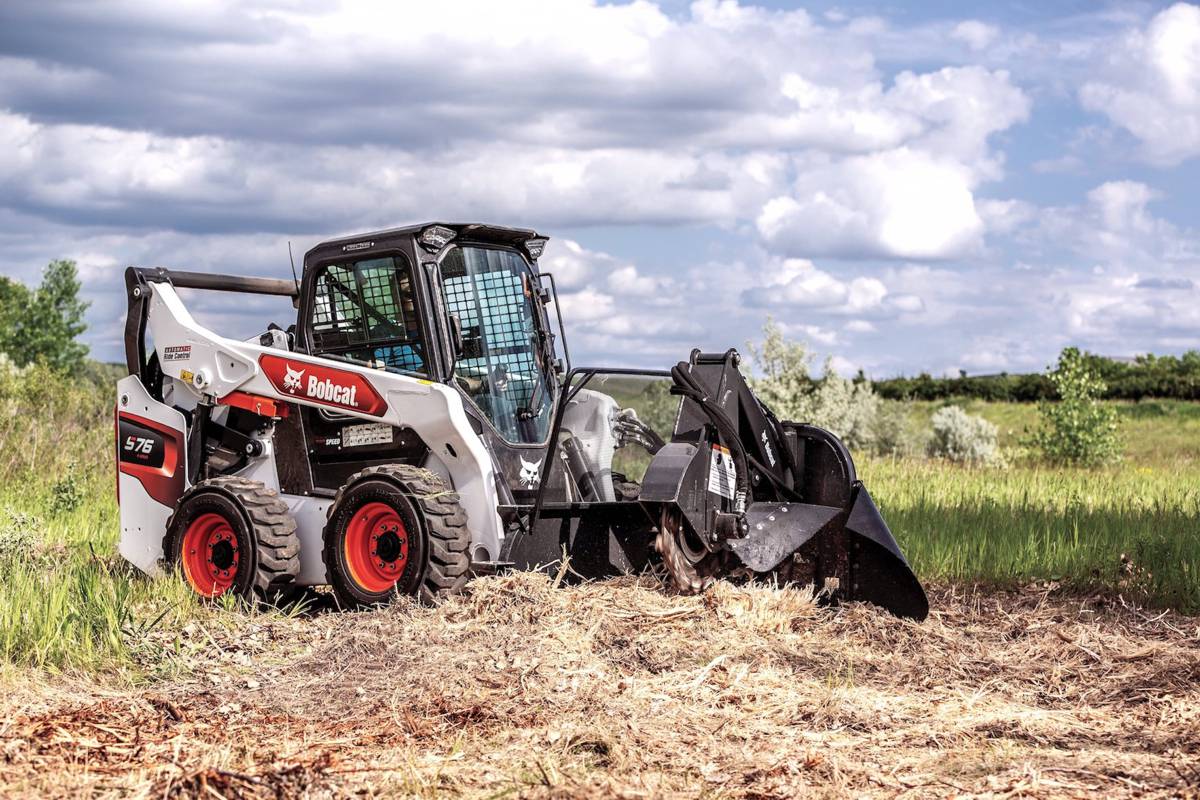
Bobcat has been positioning its compact carriers and its forestry attachment range against precisely that workload, offering forestry cutters, flail mulchers, stump grinders and excavator-mounted hammer and blade mulchers across the markets where the obligation is hardening fastest.
The strategic question for equipment buyers is where value settles once prevention becomes contractable. It is unlikely to settle in raw machine output, because the regulated dimensions of the work rule out the largest carriers. It is far more likely to concentrate in hydraulic compatibility between carrier and tool, in operator protection packages that determine who can bid for public work at all, in parts and service coverage that keeps a fleet productive during a compressed pre-season window, and in the utilisation economics of a single carrier able to switch tasks several times a day. Those are the fronts on which Bobcat, the European mulcher specialists and the full-line manufacturers will compete for the next decade.
Briefing
- The European Commission’s March 2026 Communication on integrated wildfire risk management, reinforced by a Council recommendation adopted on 29 June 2026, establishes active forest management as a funded prevention priority with the Common Agricultural Policy as its principal financing route from 2028.
- Spain has already lost more than 100,000 hectares in the first half of 2026, four times the equivalent 2025 figure, following a 2025 season in which 1,079,538 hectares burned across 25 EU member states, the highest total ever recorded by EFFIS.
- Regulated dimensions rather than machine capability define the equipment envelope, with Spanish civil protection guidance setting fuel-reduced strips of 30 metres around wildland-urban interface areas and access roads of three to five metres with gradients capped at 12 per cent.
- Hydraulic flow, not engine power, sets the productivity ceiling for mulching attachments, with Bobcat’s most capable loaders offering standard, high-flow and super-flow circuits rated up to 42 gpm at 4,061 psi.
- Doosan Bobcat reported first-quarter 2026 revenue of USD 1.534 billion, up 6.2 per cent year on year, with EMEA growing 18 per cent on recovering compact equipment demand, making Europe the group’s clearest growth region.
The Regulation Now Writes the Order Book
Europe’s wildfire policy has been rebuilt around a simple recognition that suppression capacity alone cannot keep pace with fire behaviour. The 2025 season made the argument unarguable: EFFIS mapped 7,783 fires across 25 member states producing 1,079,538 burned hectares, nearly double the 2006 to 2024 average, with 22 near-simultaneous very large fires on the north western Iberian Peninsula accounting for 460,585 hectares between them in the first three weeks of August. Germany, Spain, Cyprus and Slovakia all set national records. The Union Civil Protection Mechanism was activated more often than in any previous year, which is precisely the sort of cost signal that moves budgets.
Spain has responded on both sides of the ledger, though not symmetrically. The 2026 campaign was presented as the largest state deployment the country has assembled, with the official fire season brought forward by a fortnight to 1 June for the second consecutive year, a fleet of 15 amphibious aircraft, a new Airbus A400M firefighting kit, four Chinook and two Cougar helicopters, high-capacity drones, thermal cameras and additional surveillance systems. That is formidable response capability, and it is where the visible money has gone. The treated-hectares side of the equation remains the structural gap, and it is the side that generates equipment demand across a full working year rather than a summer emergency.
The scale of that gap has been documented for some time. The Pau Costa Foundation’s 2023 declaration on large wildfires, produced with forestry scientists, NGOs and firefighting services, estimated that only around 78,000 hectares of Spanish woodland, roughly 0.3 per cent of the total, were actively managed each year, and called for that figure to reach 1 per cent, or some 260,000 hectares, supported by annual forest management spending in the order of one billion euros. Closing a gap of that size is not a procurement rounding error. It implies a sustained, multi-year mechanical treatment programme across terrain that conventional forestry machinery cannot always reach, and it explains why prevention has begun to look like an infrastructure maintenance market rather than a civil protection line item.
Government commentary is now making the same connection explicitly. Following the Almería fire, the Spanish government spokesperson, Elma Saiz, emphasised the importance of preventive forest fuel management, noting that areas affected by earlier fires had helped to limit the spread of the new one. That observation matters commercially, because it reframes treated ground as functioning infrastructure with measurable performance, and infrastructure with measurable performance is the kind of asset that budgets, insurers and lenders eventually learn to price.
Why Regulation Defines the Machine Envelope
The most useful thing an equipment buyer can do with European wildfire policy is read the dimensions written into it, because those dimensions decide which machines can do the work. Spanish civil protection guidance requires a fuel-reduced strip of 30 metres, or eight times vegetation height, around wildland-urban interface areas, with the tree layer cleared and dead material removed. Access roads in high-risk zones must be three metres wide for single-lane and five metres for two-lane routes, with five metres of clear height, a five-metre minimum internal turning radius, gradients normally capped at 12 per cent and a turning area every 200 metres. In Catalonia, municipalities, isolated buildings and housing estates within 500 metres of woodland must maintain a perimeter prevention strip of at least 25 metres, publicly funded in many cases and maintained through a municipal levy. Galicia operates its own regime under Law 3/2007.
Those figures describe a working corridor rather than an open site, and they are the reason compact equipment sits at the centre of the delivery model. Spain holds roughly 1.1 million hectares of wildland-urban interface, above 4 per cent of its forested land, and has averaged around 12,500 forest fires a year over the past decade. Treating that interface means operating between standing trees, along ditch lines, on gradients, and inside residential perimeters where damage to surrounding vegetation, walls and services is an immediate cost. Machines that can be moved between sites on a standard trailer without special transport arrangements also change the economics of dispersed rural work, where mobilisation time frequently exceeds cutting time.
Carlos Campos, Bobcat Compact Equipment District Manager for Iberia, frames the range in terms of that task breadth, noting that “Bobcat equipment and forestry applications are the perfect combination for this work. Thanks to the solutions we offer, effective forest management becomes easier.” He describes machines that cover “land clearing to brush removal, log loading and planting new trees” while remaining, in his words, “capable of the most demanding jobs, while remaining manoeuvrable enough for selective tree removal or brush clearing.” The commercial substance behind that description is the ability to hold a contract that includes clearing, track maintenance and replanting without mobilising three separate fleets, which is how a contractor turns a seasonal prevention budget into a viable year-round business.
Hydraulic Capability Sets the Productivity Ceiling
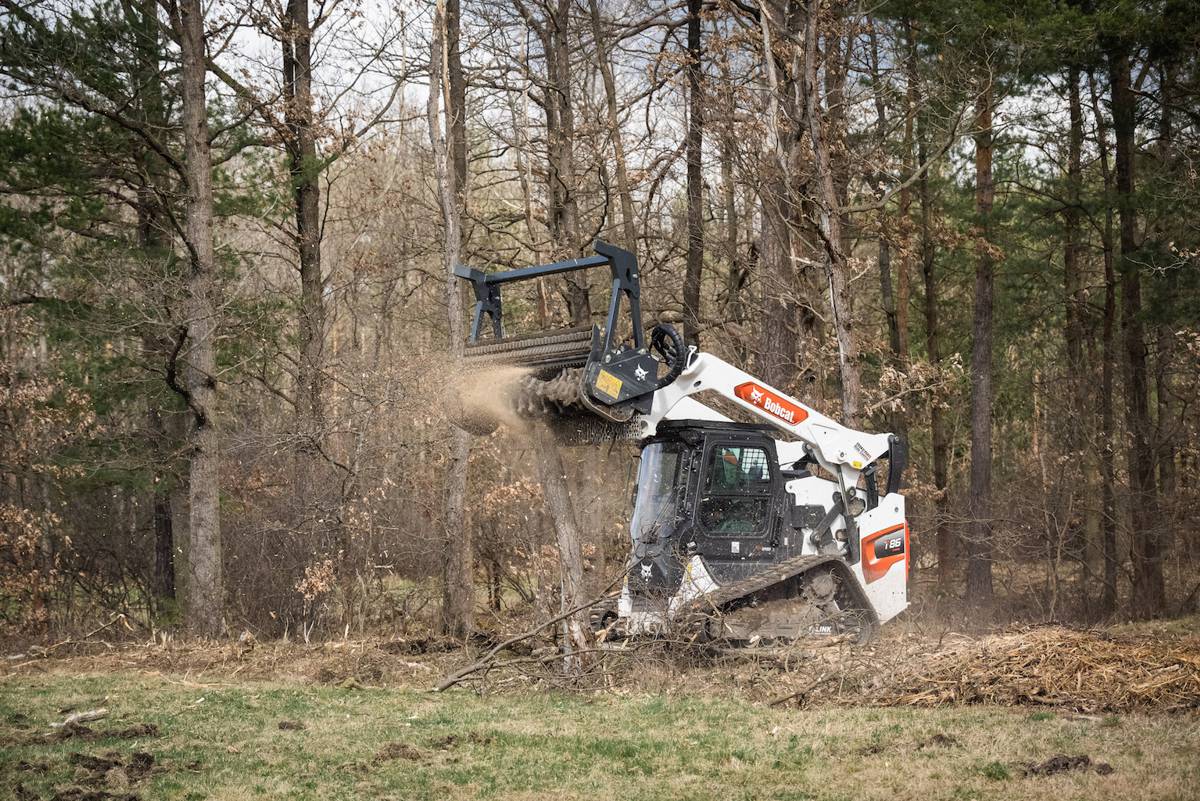
Mulching productivity is governed by hydraulic flow and pressure rather than by engine rating, and this is where carrier selection quietly determines project cost. Bobcat’s most capable loaders offer three circuits in a single machine: a standard flow of around 23 gpm at 3,500 psi for general clearing and grounds work, a high-flow option at roughly 36.6 gpm and 3,500 psi that lifts output on flail cutters, trenchers, planers and stump grinders, and a super-flow circuit rated to 42 gpm at 4,061 psi intended for the heaviest land-clearing and forestry drum mulching duties. Buying a carrier one circuit below the intended attachment is one of the more expensive specification errors in vegetation management, because the resulting loss of rotor speed shows up as slower travel, coarser mulch and accelerated tooth wear on every hectare thereafter.
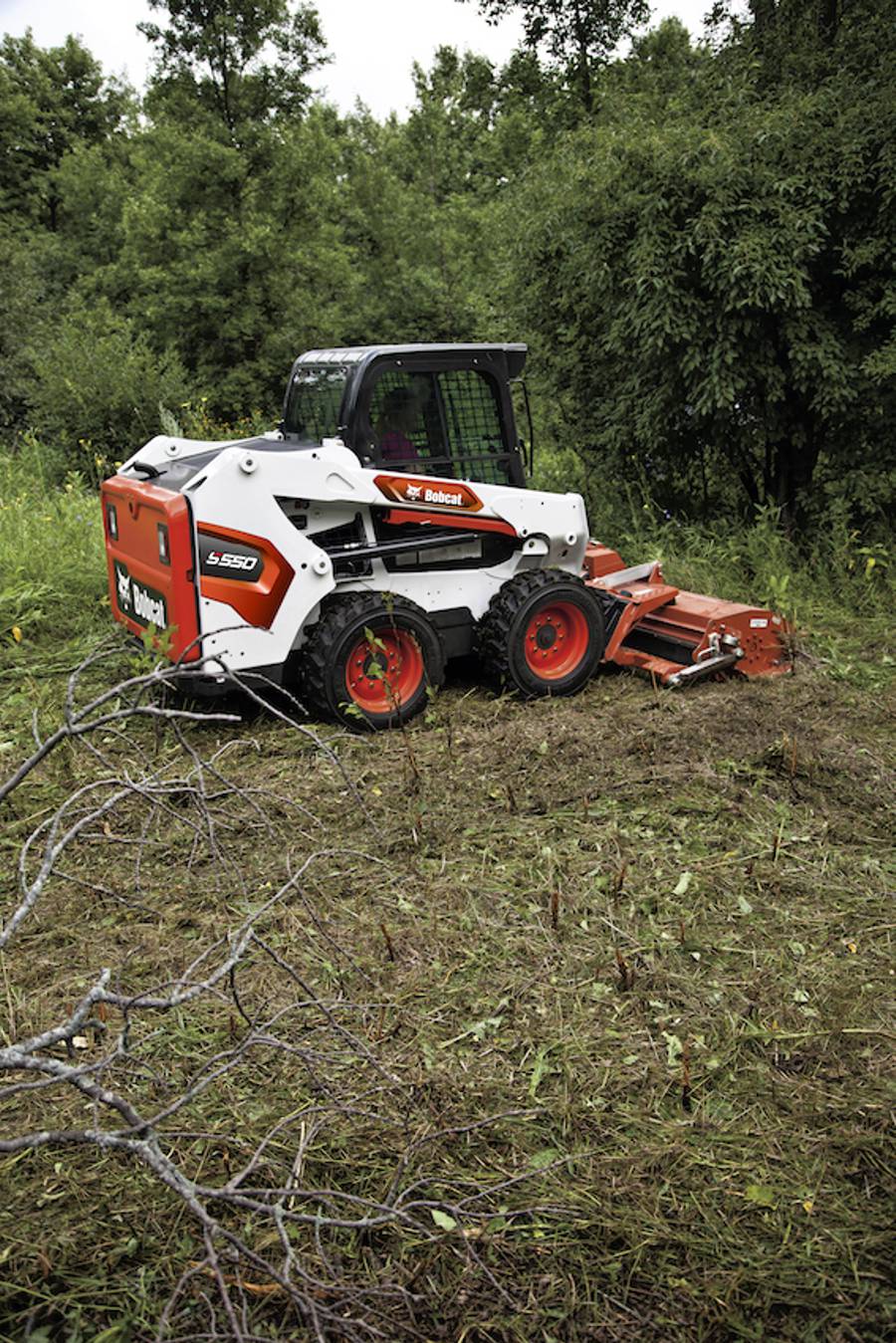
Campos is direct about the matching problem, describing the forestry cutter as “the most robust and powerful solution available” and noting that “it can operate in both high-flow and Super-Flow modes to perfectly match Bobcat equipment and harness its full power, delivering the best results when working alongside a tracked loader.” The flail mulcher occupies a different position in the fleet, and he characterises it as “ideal for cutting brush”, explaining that “it adjusts to follow the contour of the surface and is a perfect solution for working with both wheeled and tracked loaders. This attachment features a variable-displacement hydraulic motor, allowing the mulcher to adapt to the carrier machine.” Variable displacement is the commercially interesting detail, because it widens the population of carriers a single attachment can serve and therefore improves the utilisation of the most expensive item in the package.
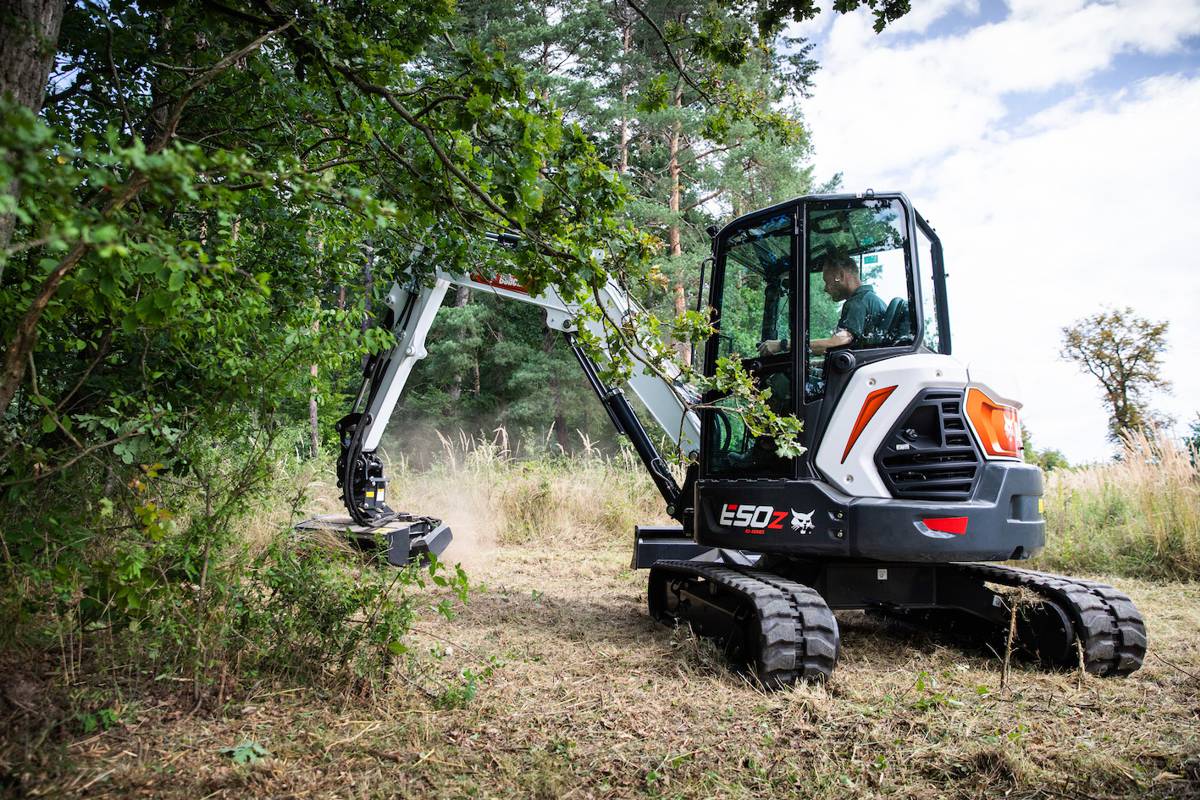
Excavator-mounted tools extend the same logic into terrain that loaders cannot treat efficiently. Campos points to “the combination of our excavators with hammer or blade mulchers equipped with auto-levelling, which allows vegetation to be cleared on any terrain, including ditches, as well as removing shrubs and tall grass from neglected areas”, adding that “with the help of the excavator arm, the hammer mulcher can reach places other mulchers cannot.” He goes further on differentiation, stating that “a distinctive feature of the Bobcat solution is that the mulcher can be used while moving the carrier excavator—something competitors cannot offer.”
Continuous cutting while tracking, if it holds up across a full working shift, addresses the largest hidden cost in linear vegetation work along ditches, verges and forest tracks, which is the repositioning cycle rather than the cutting itself.
Operator Protection Becomes a Commercial Qualification
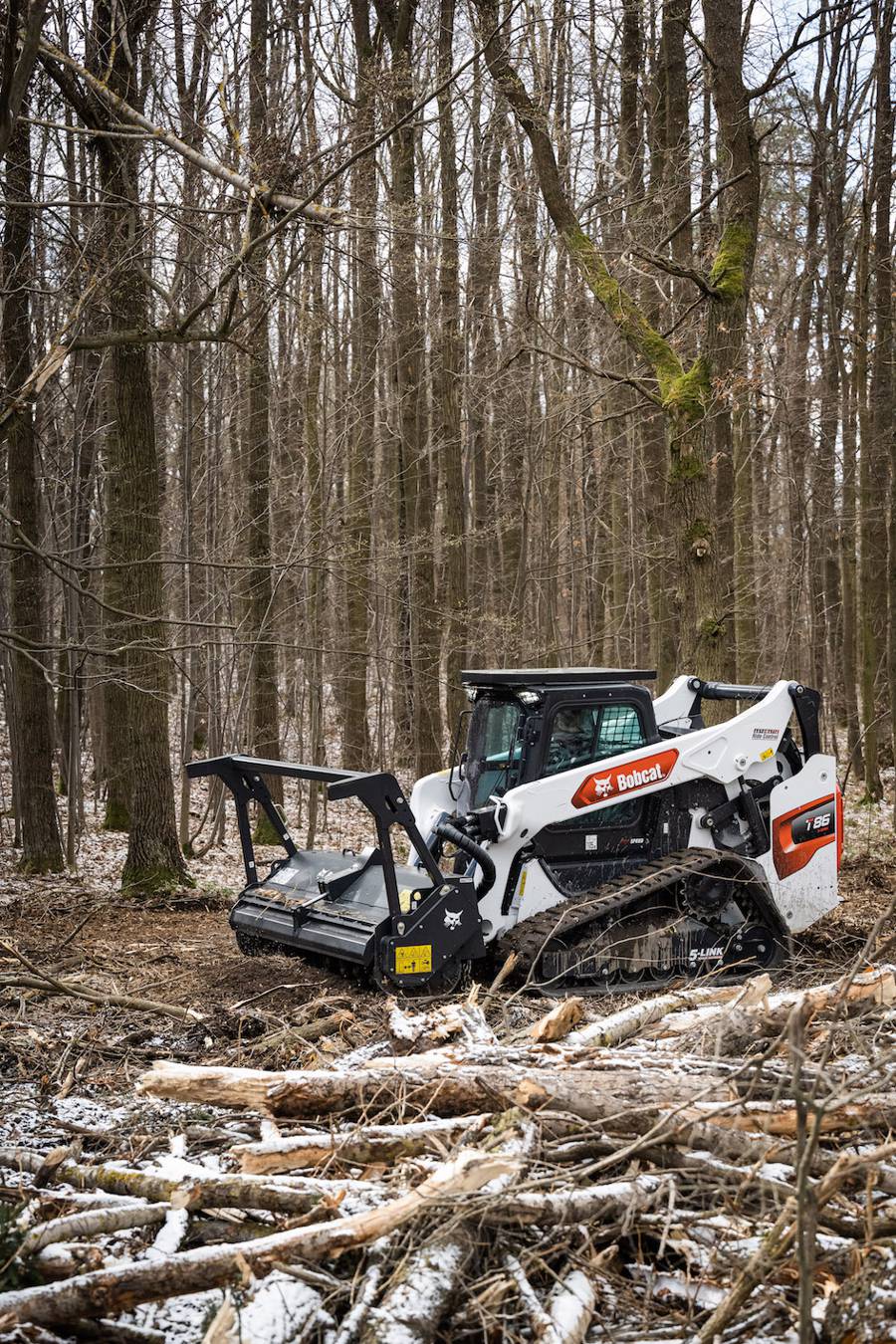
Forestry work carries a protection specification that has migrated from good practice into contractual prerequisite. Bobcat’s forestry applications kit is mandatory for operating the forestry cutter, and the attachment will not run without the exclusive forestry door fitted, a 19 mm laminated polycarbonate panel with an emergency exit provision. The package extends to Level II falling-object protection meeting ISO 3449, front and rear light guards, a hydraulic quick coupler guard that removes exposed fittings from the hose runs, safety chains that limit rearward debris throw, and a rotor brake that stops the drum from full speed within ten seconds once hydraulics are deactivated.
The reason this belongs in a commercial analysis rather than a specification sheet is that public tenders, insurers and principal contractors increasingly treat certified protection as a gate rather than a preference. A contractor bidding for regional fuel management work in Galicia, Extremadura or Castilla-La Mancha is bidding against firms whose equipment either carries the documented protection package or does not, and the difference decides prequalification before price is ever discussed. Machine specification has become a market access question, which changes how fleet managers should think about the cost of the kit.
There is a productivity dimension as well, and it tends to be underestimated. Operator confidence in dense standing timber directly affects cutting rate, and damage to glazing, lighting and hydraulic connections is one of the more common causes of unplanned downtime in forestry applications. Losing a carrier for two days during a six-week pre-season treatment window is disproportionately expensive, because the calendar for mechanical clearing is bounded by regional fire regulations at one end and by vegetation growth at the other.
Where the Commercial Value Is Concentrating
The attachment market is where competitive pressure is sharpest, and it remains notably fragmented in Europe. FAE Group, Seppi M., Prinoth and TMC Cancela hold strong positions in mulching heads and land-clearing tools, competing on rotor design, tooling life and carrier compatibility, while North American specialists including Fecon, Bandit, Denis Cimaf and Rayco dominate their domestic right-of-way and utility vegetation segments.
Full-line manufacturers such as Caterpillar, John Deere, Komatsu and Kubota approach the same demand from the carrier side. Bobcat’s structural argument sits between those camps, resting on a catalogue spanning more than 100 attachment categories and on attachments engineered to integrate with the carrier’s electronics, hydraulics and geometry rather than simply bolt to its coupler.
Integration is the commercially defensible position, because it converts an attachment purchase into a fleet decision. A contractor standardising on a single carrier family and a matched tool set gains predictable hydraulic performance, a single parts channel, one training programme and a resale profile that dealers can quote confidently. Campos’s emphasis on the quick-attach system reflects the same economics from the operator’s side, since the ability to move a carrier from mulching to grapple work to track grading within a shift is what lifts annual utilisation above the level at which specialist forestry machinery can be justified for smaller firms and municipalities.
Rental is the second channel worth watching, and it suits prevention work particularly well. Fuel management demand is seasonal, geographically dispersed and frequently tied to specific grant cycles, which makes ownership hard to justify for municipalities and smaller contractors. Skid-steer and compact track loader mounted mulching heads are the natural rental product in that environment, and post-fire rehabilitation work, including debris processing and soil stabilisation mulching, provides counter-cyclical utilisation that improves annual fleet returns for rental operators. Dealers with forestry-configured carriers and matched attachments available at short notice are positioned to capture demand that arrives with very little warning.
The group financials suggest the European demand recovery is real. Doosan Bobcat reported first-quarter 2026 revenue of USD 1.534 billion, up 6.2 per cent year on year, with operating profit of USD 141 million at a 9.2 per cent margin and net profit up 15 per cent to USD 90 million. EMEA led all regions with 18 per cent growth on recovering compact equipment demand, against full-year 2025 revenue of USD 6.182 billion and an operating margin of 7.8 per cent. Compact equipment revenue rose 7 per cent group-wide, supported by that European performance, which places southern European vegetation management among a set of drivers that includes urban infrastructure maintenance and rental fleet renewal.
Building the Prevention Programme Before the Next Season
The operational lesson from 2025 and 2026 is that mechanical clearing campaigns need to be planned and contracted well before the period of highest risk, and coordinated with the regional forestry authorities that set land-clearing rules in each territory. Spain’s decentralised model, in which autonomous communities carry primary responsibility for both prevention and emergency management, means specifications and permitted working windows differ across regional boundaries, and contractors operating across several communities need to build that variation into their fleet planning. Machines specified for the narrowest access corridor and the steepest permitted gradient will work everywhere; machines specified for the average will be idle somewhere.
The investment case for treating ground ahead of a fire season is increasingly well evidenced. Analysis cited by the World Economic Forum, drawing on National Institute of Building Sciences work, indicates that every dollar spent on wildfire mitigation avoids roughly four dollars in losses, and the same body of research has been used to structure insurance products that reward verified forest treatment with lower premiums.
As those instruments mature, the party carrying the risk gains a direct financial interest in funding mechanical clearing, which broadens the customer base for compact equipment beyond forestry authorities and municipalities into utilities, insurers, landowners and infrastructure operators protecting linear assets.
Infrastructure owners should read this alongside their own exposure. Roads, rail corridors, substations, telecommunications sites and water assets sit inside the same wildland-urban interface that the regulations now target, and the maintenance of vegetation setbacks around them is becoming an auditable obligation rather than a discretionary tidy-up.
The equipment that delivers it is already in most regional dealer networks, which is a considerable advantage for a market that has to scale quickly. Prevention has finally acquired the two things any industrial market requires, a defined specification and a funding route, and the compact equipment sector is the mechanism through which the policy will actually reach the ground.
Key Industry Questions
- Why does wildfire prevention favour compact equipment over larger forestry machines? The determining factor is regulated geometry rather than capability. Spanish civil protection guidance sets access roads at three metres for single-lane and five metres for two-lane routes, with a five-metre internal turning radius and gradients normally capped at 12 per cent, while perimeter fuel strips around buildings are measured in tens of metres rather than hundreds. Work of that shape happens between standing trees, along ditch lines and inside residential boundaries where collateral damage carries immediate cost. Compact carriers also move between dispersed rural sites on standard trailers without special transport arrangements, which matters when mobilisation time frequently exceeds actual cutting time on small, scattered parcels.
- What has actually changed in European policy to make prevention a funded market? The European Commission published its first Communication on integrated wildfire risk management on 25 March 2026, covering prevention, preparedness, response and recovery, and the Council adopted a supporting recommendation on 29 June 2026. The Communication explicitly identifies active and sustainable forest management as a cornerstone of resilience and confirms the Common Agricultural Policy as the primary EU funding vehicle for land-based prevention in the 2028 to 2034 programming period, covering thinning, pruning, species diversification and firebreaks. That combination gives prevention a defined policy framework and an identified financing route, which is the precondition for any sustained procurement pipeline.
- How large is the treatment gap that mechanical clearing needs to close in Spain? The Pau Costa Foundation’s 2023 declaration estimated that around 78,000 hectares of Spanish woodland, approximately 0.3 per cent of the total, were being actively managed each year, and recommended raising that to 1 per cent, or roughly 260,000 hectares, with annual forest management spending in the region of one billion euros. Closing a gap of that magnitude implies a multi-year mechanical treatment programme rather than a seasonal campaign. Spain also holds around 1.1 million hectares of wildland-urban interface, above 4 per cent of its forested land, which represents the most safety-critical portion of that workload.
- Why does hydraulic flow matter more than engine power when specifying a mulching carrier? Rotor speed and torque in a mulching head are functions of the hydraulic circuit feeding it. Bobcat’s loaders offer standard flow at around 23 gpm and 3,500 psi, high flow at roughly 36.6 gpm and 3,500 psi, and super flow at 42 gpm and 4,061 psi for the heaviest forestry drum mulching. Pairing a demanding attachment with an undersized circuit produces slower ground speed, coarser output and faster tooth wear, and those penalties compound across every hectare treated. Variable-displacement hydraulic motors, as used on Bobcat’s flail mulcher, partly mitigate the problem by allowing a single attachment to adapt across a wider range of carriers.
- What protection equipment is required for forestry attachment work, and why does it affect bidding? Bobcat’s forestry applications kit is a condition of operating the forestry cutter, and the attachment will not function without the laminated polycarbonate forestry door fitted. The package also includes Level II falling-object protection to ISO 3449, front and rear light guards, a hydraulic quick coupler guard, rearward safety chains and a rotor brake that halts the drum within ten seconds of hydraulic deactivation. Public tenders and insurers increasingly treat certified protection as a prequalification threshold rather than an optional extra, so specification decides eligibility to bid before commercial terms are considered.
- Where does rental fit into the wildfire prevention equipment market? Prevention demand is seasonal, geographically dispersed and often tied to grant cycles, which makes outright ownership difficult to justify for municipalities and smaller contractors. Skid-steer and compact track loader mounted mulching heads suit that pattern well, since a carrier can be hired for a defined treatment window and returned. Post-fire rehabilitation work, including debris processing and soil stabilisation mulching, adds counter-cyclical utilisation that improves annual returns on rental fleets. Dealers holding forestry-configured carriers with matched attachments are best placed to capture demand that frequently arrives with very little notice.
- How should infrastructure owners approach vegetation management around linear assets? Roads, rail corridors, substations, telecommunications sites and water assets sit inside the same wildland-urban interface that European and national regulation now targets, and maintaining vegetation setbacks around them is becoming an auditable obligation. Owners should map exposure against regional clearing requirements, establish treatment cycles that reflect vegetation regrowth rates rather than budget years, and specify contractor equipment for the narrowest access corridor and steepest gradient on the network. Excavator-mounted mulchers with auto-levelling are particularly relevant for ditch lines and embankments where wheeled or tracked loaders cannot work efficiently.
- What is the financial case for spending on prevention rather than response? Analysis cited by the World Economic Forum, drawing on National Institute of Building Sciences research, indicates that every dollar spent on wildfire mitigation avoids approximately four dollars in losses. Insurance products are beginning to reflect that arithmetic, with schemes rewarding verified forest treatment through reduced premiums. As risk carriers gain a direct financial interest in funded clearing, the customer base for compact equipment broadens beyond forestry authorities and municipalities to include utilities, insurers, large landowners and infrastructure operators, which is what converts prevention from a public expenditure line into a commercial market.
- How is the competitive landscape structured in mulching attachments? Europe remains fragmented, with FAE Group, Seppi M., Prinoth and TMC Cancela holding established positions in mulching heads and land-clearing tools, while North American specialists including Fecon, Bandit, Denis Cimaf and Rayco lead in domestic right-of-way and utility segments. Full-line manufacturers such as Caterpillar, John Deere, Komatsu and Kubota compete from the carrier side. Bobcat’s argument rests on breadth, with more than 100 attachment categories, and on engineering attachments to integrate with carrier electronics, hydraulics and geometry, which turns a tool purchase into a fleet standardisation decision with parts, training and residual value implications.
Strategic Takeaways
- European wildfire policy has acquired both a specification and a funding route, and that combination converts vegetation fuel management from a discretionary seasonal activity into a recurring, contractable workload that compact equipment fleets will deliver.
- Regulated dimensions, including 30-metre fuel strips and access roads of three to five metres with capped gradients, define the machine envelope more decisively than manufacturer capability, so fleets should be specified for the tightest corridor on the network rather than the average one.
- Hydraulic circuit selection is the single most consequential specification decision in mulching work, and pairing a demanding attachment with an undersized flow rating imposes a permanent productivity and tooling cost on every hectare treated.
- Certified operator protection has become a market access requirement in public prevention contracts, meaning protection packages should be evaluated as bidding infrastructure rather than as an optional equipment upgrade.
- As insurance products begin rewarding verified forest treatment, risk carriers gain a direct financial stake in funding mechanical clearing, broadening the buyer base for compact equipment to utilities, landowners and infrastructure operators alongside forestry authorities.