The Roundabout Paradox: The Safer Junction Millions of Drivers Still Resist
Every year, hundreds of thousands of crashes occur at road intersections in the United States, and a disproportionate share are the side-impact collisions, commonly called T-bone crashes, in which one vehicle strikes the flank of another at speed. Intersections account for more than two-fifths of all reported crashes in the country, and side-impact collisions of this kind are responsible for roughly a third of vehicle-occupant deaths.
Engineers have understood for decades that a single design change addresses the road safety problem more effectively than almost any other intersection countermeasure available, which is to replace the crossing junction with a modern roundabout. The evidence for that change is unusually consistent, and yet the United States continues to build comparatively few of them.
The gap between what the evidence supports and what actually gets built is the real subject here, and it carries a commercial lesson that reaches well beyond circular junctions. The roundabout is among the most cost-effective safety and efficiency investments a highway authority can make, delivering large reductions in fatal crashes alongside lower running costs and higher capacity, and its performance has been documented for years by the Federal Highway Administration, the Insurance Institute for Highway Safety and their equivalents across Europe and Australasia.
The binding constraint on wider adoption is not engineering, geometry or cost; it is public perception and the political process that responds to it. For the firms that design, model, finance and build road infrastructure, that distinction matters, because it locates the value not only in the concrete and the geometry but increasingly in the capacity to de-risk adoption, which is why simulation, visualisation and public engagement are becoming as commercially important as the junction itself.
Briefing
- Converting a conventional junction to a modern roundabout typically cuts fatal crashes by around ninety per cent and injury crashes by roughly seventy-five per cent, with the Highway Safety Manual citing average reductions in combined fatal and injury crashes of about eighty-two per cent.
- A standard four-way signalised junction presents 32 vehicle conflict points, whereas a single-lane roundabout reduces that to eight and removes the high-speed crossing movements that cause the deadliest side-impact collisions.
- Roundabouts also improve throughput and lifecycle economics, raising capacity by roughly thirty to fifty per cent, removing signal equipment and its maintenance, and offering service lives of around twenty-five years against roughly ten for signals.
- Adoption lags the evidence sharply, with the United States operating more than 11,000 roundabouts against nearly 43,000 in France and around 26,000 in the United Kingdom, a gap driven by unfamiliarity, status-quo bias and vocal local opposition rather than by any technical shortcoming.
- Connected and automated vehicles, digital-twin modelling and turbo-roundabout geometries are strengthening the case further, shifting the commercial opportunity towards the firms that can simulate, visualise and de-risk new junction designs.
The Geometry That Removes the Deadliest Crashes
The safety case begins with geometry rather than behaviour. A conventional four-way intersection contains 32 points at which vehicle paths conflict, made up of eight merging, eight diverging and sixteen crossing movements, and it is the crossing movements that produce the ninety-degree, high-speed impacts into a vehicle’s side. A single-lane roundabout reduces the total to eight conflict points, all of them merging or diverging in the same direction of travel, and it eliminates the crossing conflicts almost entirely.
The circulating design also forces vehicles to slow on entry and hold a lower, more uniform speed throughout, so the collisions that do still occur tend to be low-speed glancing contacts, rear-end shunts or minor scrapes rather than the T-bone strikes that kill.
That shift in the type of crash, rather than simply the number of crashes, is what makes the roundabout so effective, and it carries direct commercial consequences. Side-impact collisions are among the deadliest and most expensive events on the network, generating severe injuries, large liability claims and lengthy incident clearance, whereas the low-speed contacts typical of roundabouts are cheaper to settle and quicker to clear.
For highway authorities and their insurers, the design does not merely reduce how often crashes happen; it changes their severity profile, lowering the casualty and liability costs that dominate the whole-life economics of an intersection. The physics, in effect, does much of the work that enforcement and education struggle to achieve elsewhere on the network.
The Evidence Is Unusually Consistent
Few infrastructure interventions carry an evidence base as settled as the roundabout’s. Federal Highway Administration and Insurance Institute for Highway Safety research indicates that converting stop-controlled or signalised junctions to modern roundabouts reduces fatal crashes by around ninety per cent, injury crashes by roughly seventy-five per cent, and all crashes by something in the order of thirty-five to forty per cent.
The American Association of State Highway and Transportation Officials, through its Highway Safety Manual, puts the average reduction in combined fatal and injury crashes at about eighty-two per cent for conversions from two-way stop control and seventy-eight per cent from traffic signals. Those figures align closely with much larger datasets from the United Kingdom, France and Australia, which is precisely why the roundabout appears on the FHWA’s list of proven safety countermeasures.
The commercial case is reinforced by efficiency and cost. Roundabouts can carry roughly thirty to fifty per cent more traffic than a comparable signalised junction, and the Insurance Institute for Highway Safety has estimated that converting a tenth of America’s signalised intersections would have saved close to a billion hours of delay and more than six hundred million gallons of fuel in a single year.
On the balance sheet, a roundabout removes the signal heads, controllers and detection loops that draw power and require repair, saving an estimated few thousand dollars a year per junction in electricity and maintenance, and it typically offers a service life of around twenty-five years against roughly ten for signal equipment. Taken together, the safety, capacity and lifecycle numbers describe an investment with an unusually strong return, which makes the adoption gap all the more striking.
Why America Builds So Few
If the engineering and the economics point one way, the decision-making tends to point the other, and the reasons are behavioural rather than technical. Drivers unfamiliar with roundabouts often fear them, older motorists worry about the yield-on-entry rule and the speed of decision it demands, and hauliers raise concerns about large-vehicle movements that modern truck aprons and swept-path design largely resolve.
Layered on top is a powerful status-quo bias, because an existing junction that functions tolerably well feels good enough, and the disruption and unfamiliarity of change are weighted more heavily than the statistical promise of fewer deaths. The result is close to a textbook case of loss aversion, in which a certain and visible inconvenience outweighs a probabilistic and largely invisible benefit.
The political process then amplifies that instinct. Public consultation, by its nature, tends to surface and concentrate opposition, since those who object to a proposed roundabout are more motivated to attend meetings and write to their representatives than the larger number who are indifferent or quietly supportive.
Local politicians, responsive to vocal residents, often find it easier to defer than to champion a scheme whose benefits accrue quietly over years while its costs are felt immediately and locally. None of these obstacles is an engineering fault, and that is the essential point, because the roundabout does not fail on the merits, it fails on perception and process, which is a very different problem to solve and one that the industry has historically under-resourced.
Signals Instruct, Roundabouts Negotiate
There is a deeper reason behind the resistance, and it sits beneath the surface objections about unfamiliarity and large vehicles. A traffic signal issues an explicit instruction, since a green light means go and a red light means stop, and it externalises the decision so that the driver’s main task is to obey. A roundabout asks for something quite different, because it requires yielding, judging gaps in circulating traffic, reading the intentions of other drivers and, at busier junctions, a degree of eye contact and mutual accommodation.
Much American road design has historically been organised around signalised throughput and clearly assigned priority, which conditions drivers to expect an instruction rather than a negotiation, so the roundabout asks not merely for a new manoeuvre but for a different way of driving. Traffic signals, in that sense, optimise for control, whereas roundabouts optimise for cooperation, and cooperation is a more demanding thing to ask of drivers long conditioned to expect an instruction.
That distinction has a serious intellectual pedigree, seen most clearly in the shared-space work of the Dutch engineer Hans Monderman, whose redesigns in towns such as Drachten stripped out signals, signs and markings so that road users had to negotiate movement through informal social protocol. His schemes recorded measurable safety gains even as residents reported feeling less certain, and Monderman argued that ambiguity prompts drivers to seek eye contact, slow down and take greater care.
It would be a mistake to reduce this to a caricature of European against American temperament, because the same drivers adapt quickly once exposure makes the negotiated style familiar, as Carmel in Indiana has shown. For the industry the point sharpens the central argument, since the resistance is not only unfamiliarity with a manoeuvre but discomfort with a shift in the cognitive and social contract of driving, which helps explain why single leaflets and one-off instruction tend to underperform and why sustained exposure is what genuinely changes behaviour.
Europe Made the Roundabout Standard Practice
The contrast with much of Europe is stark and instructive. France operates close to 43,000 roundabouts, more than any other country and roughly four times the United States total despite a fraction of the land area and population, while the United Kingdom, which refined the modern give-way design, has around 26,000.
On a per-capita basis the gap is wider still, with France recording several hundred roundabouts per million people against only a few dozen per million in the United States. The Netherlands has among the highest densities in the world and has made the roundabout close to standard practice at appropriate junctions, and Australian networks embrace them so widely that many drivers actively prefer them to signals.
The lesson from these markets is that acceptance is cultural and institutional rather than a matter of driver capability, since the same human beings navigate roundabouts comfortably once exposure and expectation are established. The United States is not without its champions, and the city of Carmel in Indiana has replaced a large share of its junctions with roundabouts, with roughly one in every seventeen of its intersections now circular, and has recorded the safety and flow benefits to match.
Carmel’s experience demonstrates that the barrier is not American roads or American drivers but the absence, in most places, of the sustained political commitment and public familiarity that normalise the design. Where a jurisdiction commits and persists, adoption and acceptance tend to follow rather than lead.
Connected Vehicles Raise the Stakes
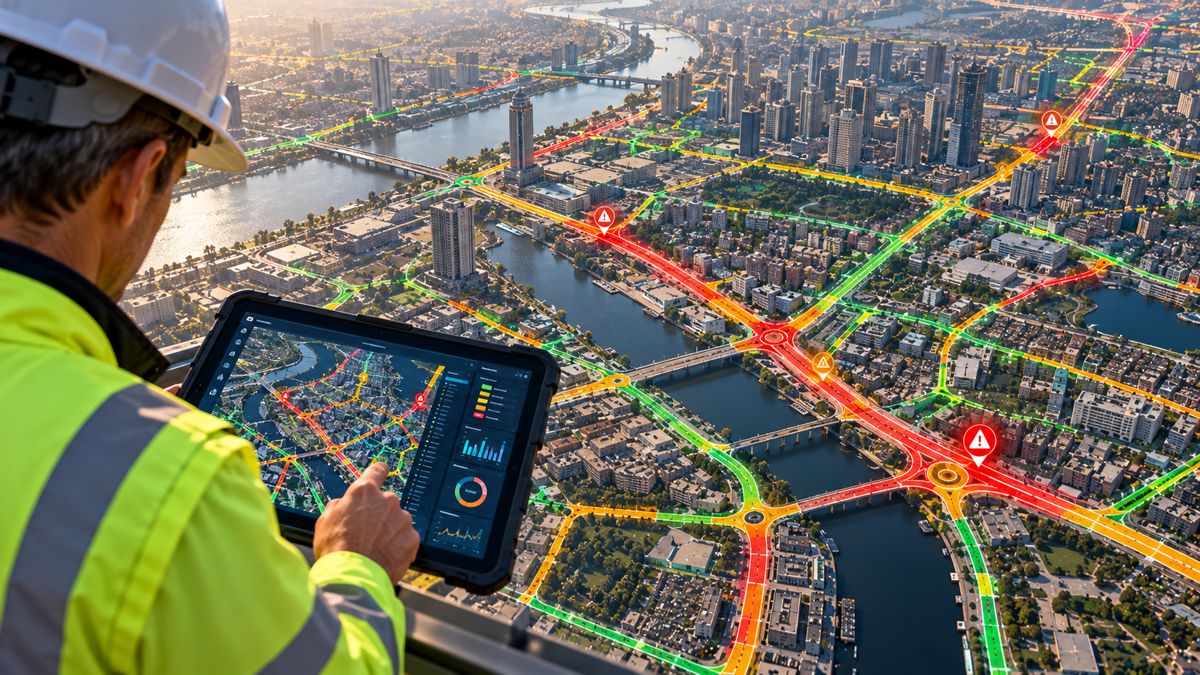
The technological direction of travel strengthens the roundabout’s position rather than undermining it. Junction design is increasingly carried out inside digital twins and microsimulation platforms such as SUMO, Vissim and Aimsun, which let engineers test geometry, capacity and safety against real traffic data before any ground is broken, and model turbo-roundabouts, spiral lane geometries, mini-roundabouts and signalised hybrids for specific sites.
Research using these tools has shown that geometric upgrades alone can struggle under peak demand unless they are paired with dynamic control, which is pushing designers towards adaptive, sensor-fed junctions rather than fixed layouts. For design consultancies and software vendors this is a growing commercial layer, because value is moving upstream into modelling, optimisation and the visualisation that helps the public and their representatives see how a scheme will actually behave.
Connected and automated vehicles add a further dimension. The roundabout’s low-speed, low-conflict, same-direction geometry is well suited to machine coordination, and studies applying reinforcement learning and vehicle-to-infrastructure communication have used central controllers to sequence connected vehicles through roundabouts, with digital-twin experiments reporting materially shorter waiting times even at partial automation rates.
Human-in-the-loop simulations, in which a real driver interacts with automated vehicles in a virtual roundabout, have found that people remain comfortable sharing the space, which matters as much for public acceptance as for engineering. As automation spreads, the intersection types that are simplest to model and safest by design will hold an advantage, and the roundabout sits squarely in that category, turning what began as a twentieth-century refinement into a natural fit for twenty-first-century mobility.
When the Barrier Is Perception, Not Engineering
The roundabout is, in the end, a case study in a much larger problem, which is that evidence alone rarely changes public policy or public behaviour. The modern roundabout has spent decades proving itself through data, and that data has not meaningfully wavered, yet perception continues to lag the engineering by a wide margin.
The lag is expensive, measured in avoidable fatalities, wasted fuel, unnecessary delay and higher whole-life costs, and it persists not because the case is weak but because the case has largely been made to the wrong audience. Engineers were convinced long ago, and the constituency that remains to be persuaded is the driving and voting public, yet persuasion is a discipline the infrastructure sector has too often treated as peripheral to the technical work.
For the industry, that reframing points to where value and differentiation now lie. The firms and agencies that treat public acceptance as an engineering problem in its own right, investing in simulation that can be shown to communities, in clear visualisation, in phased rollouts that build familiarity, and in driver education that removes the fear of the unfamiliar, will unlock schemes that others cannot.
The next generation of junctions will be designed in digital twins, optimised by algorithms and, increasingly, navigated by connected vehicles, but their arrival will still depend on winning an argument that is psychological as much as technical. The roundabout’s long and well-documented history suggests that the harder task was never convincing the engineers; it has always been convincing the drivers, and that is a problem the industry now has both the tools and the commercial incentive to solve.

Key Industry Questions
- Are roundabouts actually safer than traffic signals, or do they simply relocate crashes? The safety gain is real and reflected in severity, not just frequency. By removing high-speed crossing movements, roundabouts virtually eliminate the side-impact collisions that cause the most serious injuries and deaths. Federal Highway Administration and Insurance Institute for Highway Safety research shows conversions cutting fatal crashes by around ninety per cent and injury crashes by roughly seventy-five per cent, with the Highway Safety Manual citing average reductions in combined fatal and injury crashes of about eighty-two per cent. Crashes still happen, but they tend to be low-speed glancing contacts and rear-end shunts rather than T-bone strikes. The evidence is consistent across the United States, the United Kingdom, France and Australia, which is why the roundabout is classed as a proven safety countermeasure rather than a contested one.
- If roundabouts are so effective, why does the United States build so few? The obstacles are behavioural and political rather than technical. Many drivers are unfamiliar with roundabouts and fear them, older motorists worry about the yield-on-entry decision, and status-quo bias makes an existing junction feel good enough even when the data says otherwise. Public consultation tends to concentrate the minority who object rather than the majority who are indifferent or supportive, and local politicians often find deferral easier than advocacy for a scheme whose benefits accrue slowly while its disruption is immediate. The result resembles textbook loss aversion, where a visible short-term inconvenience outweighs a statistical long-term gain. None of these barriers reflects a fault in the engineering, which is why familiarity and sustained political commitment, rather than new technology, are what close the gap.
- Do roundabouts handle trucks, buses and emergency vehicles adequately? Yes, when they are designed for it, which modern practice routinely is. Truck aprons, the raised inner ring around the central island, allow the trailers of large articulated vehicles to track over additional space while keeping smaller vehicles on the main carriageway, and swept-path analysis during design ensures the largest expected vehicles can negotiate the junction. Roundabouts are also recognised for accommodating emergency and oversized vehicles, and their continuous flow can reduce delay for responders compared with queues at signals. Concerns about large vehicles are among the most common objections raised during consultation, yet they are largely addressed at the design stage. The persistence of the concern owes more to unfamiliarity than to any unresolved engineering limitation in contemporary roundabout geometry.
- Are roundabouts cheaper than signalised intersections over their lifetime? Generally yes, once whole-life costs are considered, even where initial construction is comparable or higher. A roundabout has no signal heads, controllers or detection loops to power, maintain or replace, saving an estimated few thousand dollars a year per junction in electricity and maintenance, and it typically offers a service life of around twenty-five years against roughly ten for signal equipment. Add the reduced casualty and liability costs that follow from eliminating high-speed side impacts, and the lifecycle economics usually favour the roundabout. Capacity gains of thirty to fifty per cent can also defer or avoid more expensive widening. The strength of the business case is one reason the adoption gap is best understood as a perception problem rather than a financial one.
- How do roundabouts perform for pedestrians and cyclists? Well-designed roundabouts improve pedestrian safety by cutting vehicle speeds and reducing conflict points, and the splitter islands between entry and exit lanes let pedestrians cross one direction of traffic at a time. The FHWA notes that a single-lane roundabout has around half as many pedestrian-vehicle conflict points as a comparable signal or stop-controlled junction. Multi-lane roundabouts require more careful treatment, as crossing distances and driver attention become more complex, and provision for cyclists needs deliberate design, whether through separate paths or clear on-carriageway arrangements. Vulnerable-user provision is an area where design quality matters most and where poor execution can undermine the safety case, so it warrants specific attention rather than assumption during scheme development and public consultation.
- Will connected and automated vehicles make roundabouts obsolete or more useful? More useful, on current evidence. The roundabout’s low-speed, same-direction, low-conflict geometry is comparatively easy for automated systems to model and negotiate, and research using reinforcement learning and vehicle-to-infrastructure communication has sequenced connected vehicles through roundabouts with digital-twin studies reporting shorter waiting times even when only a minority of vehicles are automated. Human-in-the-loop simulations suggest drivers remain comfortable sharing roundabouts with automated vehicles, which supports public acceptance during the long transition to mixed traffic. As automation matures, junction types that are simple to simulate and inherently forgiving will hold an advantage. Rather than being displaced, the roundabout is well positioned to become a preferred intersection form in a connected and automated network.
- What can highway authorities do to overcome public opposition to roundabouts? Treat acceptance as part of the engineering task rather than an afterthought. Effective approaches include high-quality simulation and visualisation that let communities see how a junction will operate, phased programmes that build familiarity across a network rather than dropping a single unfamiliar design into a resistant neighbourhood, and driver education that demystifies the yield-on-entry rule. Sharing local and comparable safety and flow data, as cities such as Carmel in Indiana have done, helps shift the conversation from fear to evidence. Engaging early, before positions harden, tends to work better than defending a finished design at a contentious hearing. The consistent lesson from high-adoption markets is that exposure and commitment, sustained over time, convert opposition into preference.
- How do turbo-roundabouts and other new geometries differ from standard roundabouts? They are refinements aimed at specific conditions rather than replacements for the classic design. Turbo-roundabouts use spiral lane markings and raised lane separators to guide drivers into the correct lane before entering, reducing lane-changing and weaving on multi-lane roundabouts and suiting locations with a dominant main-road flow. Mini-roundabouts serve constrained urban sites, while signalised roundabouts combine circulation with signal control at very high demand. Increasingly, these variants are tested in digital twins and microsimulation before construction, and research indicates that geometry alone may not cope with peak demand unless paired with adaptive control. The proliferation of forms reflects a maturing design toolkit, allowing engineers to match a specific geometry to a specific site rather than applying a single template everywhere.
Strategic Takeaways
- The roundabout demonstrates that the binding constraint on safer, cheaper infrastructure is frequently public perception and political process rather than engineering, a pattern that recurs across evidence-led infrastructure decisions.
- On whole-life costs, roundabouts usually outperform signals through lower maintenance, longer service life and, above all, the reduced casualty and liability costs that follow from eliminating high-speed side impacts, which strengthens the case for authorities under budget pressure.
- The adoption gap between the United States and high-roundabout markets such as France, the United Kingdom and the Netherlands is cultural and institutional, which means it can be closed through familiarity and commitment rather than requiring any technical breakthrough.
- Commercial value in junction design is moving upstream into simulation, digital twins and visualisation, rewarding firms that can both optimise geometry and help communities and politicians accept it.
- Connected and automated vehicles favour the roundabout’s forgiving, low-conflict geometry, so authorities planning for an automated future have an additional, forward-looking reason to prioritise circular junctions where they are appropriate.