Warm Mix Asphalt Could Reshape Road Building Across Southeast Asia
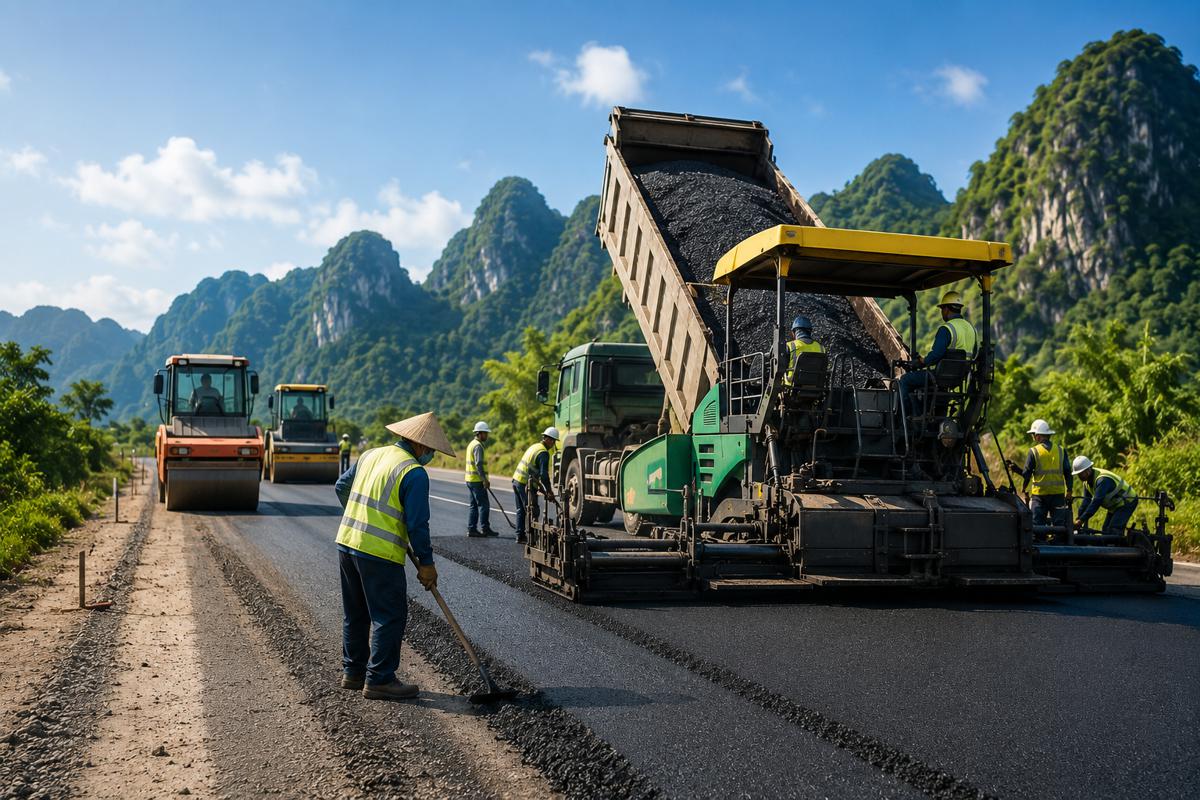
A 150-metre strip of National Highway 1 in central Viet Nam would not normally register as market intelligence. Yet the pilot documented in a recent Asian Development Bank Development Asia article, published on 15 July 2026 by Byung-Sik Ohm and Carlo Elipse of the Korea Institute of Civil Engineering and Building Technology (KICT), deserves attention well beyond its modest dimensions.
The test lays down two adjoining pavement sections, one built with conventional hot mix asphalt and one with warm mix asphalt (WMA) produced at temperatures 20°C to 30°C lower, then measures whether the lower-carbon option can survive Vietnamese traffic and climate without giving anything away on durability. The early laboratory numbers say it can, and that quietly changes the commercial conversation around how one of Asia’s fastest-growing road programmes will be built.
The significance is not the emissions saving on a single lane. It is that warm mix asphalt is maturing from an environmental nicety in developed markets into a practical procurement lever for the enormous paving pipeline now taking shape across Viet Nam and its neighbours. The country is committed to carbon neutrality by 2050, and it is simultaneously expanding its expressway and national highway network at pace, which places road construction at the awkward intersection of growth ambition and decarbonisation.
A technology that trims energy use and carbon output while holding, or improving, structural performance is precisely the kind of low-friction win that infrastructure owners can adopt without waiting for grid decarbonisation or fleet electrification to catch up. That is why a short test section is worth reading as a signal about where value, competition and specification-setting power are heading.
Briefing
- KICT, working with Yoonsung Industrial Development, the Government of Viet Nam and local contractors, has built a controlled pilot on National Highway 1 comparing conventional hot mix asphalt against warm mix asphalt produced 20°C to 30°C cooler.
- Laboratory testing on samples taken during construction showed the warm mix delivering roughly 10% greater resistance to cracking and 28% greater resistance to plastic deformation than the conventional control, alongside marginally better moisture resistance.
- The commercial prize lies less in the pavement than in the additive chemistry and the local specifications that will govern billions of dollars of future paving across Viet Nam’s expressway and highway build-out.
- Warm mix technology lets producers cut plant energy and carbon without changing aggregates or the fundamental paving process, making it one of the lowest-friction decarbonisation moves available to road owners today.
- A twelve-month field evaluation under live traffic will provide the durability evidence that infrastructure owners, financiers and specifiers need before wider rollout, with recycling and waste-material pavements as the logical next step.
The Real Prize Is Viet Nam’s Paving Pipeline, Not The Pilot
Reading this pilot in isolation understates it. The context that gives it weight is the scale of what Viet Nam intends to build. National Highway 1A, the corridor the test section sits on, is the spine of the national road system; the route runs the length of the country and, according to ADB project documentation, carries the lion’s share of freight and passenger transport along its 2,300 km length, contributing to about 75% of total freight and 95% of total passenger volumes carried by road transport in the entire country.
Above that legacy backbone sits an ambitious new-build programme. The Ministry of Construction is pushing to reach a target of 5,000km of expressway by 2030, and it has proposed widening fifteen sections of the eastern North-South Expressway with a total estimated investment of over 154,000 billion VND, aiming for completion by the end of 2030.
That pipeline is the reason a paving technology matters commercially. Every kilometre of expressway and every rehabilitated stretch of NH1 represents a specification decision, and specifications are sticky. Whatever material and process become normalised in Vietnamese road contracts over the next few years will shape procurement, plant investment and supplier positioning for a decade.
Warm mix asphalt is a strong candidate to become that norm because it slots into existing plant and paving workflows rather than replacing them. Road construction already dominates Vietnamese binder demand, with the country’s bitumen consumption weighted heavily toward road construction, which accounts for over 70% of total bitumen consumption, so any efficiency captured at the mixing plant scales directly across the busiest part of the market.
Performance First, Because Owners Will Not Trade Durability For Carbon
The pilot was engineered to answer the only question that ultimately governs adoption, which is whether the lower-carbon mix performs under load. The section was chosen precisely because it carries mixed medium and heavy vehicles and sits in a hot, humid environment, and it was split so that hot mix asphalt formed the control and warm mix formed the trial, with the warm mix built around a diamine-based wax additive combined with a polymer additive developed by Yoonsung Industrial Development. That design matters to specifiers because it isolates the variable rather than relying on optimistic manufacturer claims. Samples lifted during construction were taken back to the laboratory and tested for the distresses that actually retire pavements in service, namely cracking and permanent deformation.
The results give infrastructure owners a reason to take the technology seriously rather than tolerate it. The warm mix returned roughly 10% greater resistance to cracking and 28% greater resistance to plastic deformation than the conventional mixture, and under moisture testing both mixes cleared Viet Nam’s threshold requiring at least 80% retained strength, with the warm mix holding about 3% more.
Rutting resistance is the headline figure for a tropical highway carrying heavy freight, and a 28% improvement is the sort of margin that translates into longer maintenance intervals and lower whole-life cost. For a road owner, that reframes warm mix asphalt from a compliance cost into a lifecycle asset, since the carbon saving arrives alongside better performance rather than in place of it. The important caveat is that these are laboratory findings, and the twelve-month field evaluation under live traffic is what will convert promising numbers into bankable evidence.
Where The Value Concentrates: Additive Chemistry
The most commercially revealing detail in the pilot is easy to overlook, and it is the additive. Warm mix asphalt is not a single product but a family of technologies, and the temperature reduction depends on chemistry that lowers binder viscosity so aggregate can be coated at lower heat. The United States Federal Highway Administration describes the mechanism plainly, noting that the key is the addition of additives, whether water-based, organic, chemical or hybrid, that allow the asphalt binders and aggregates to be mixed at lower temperatures. That chemistry is where differentiation, margin and intellectual property sit, which is why the specific pairing of a diamine-based wax with a proprietary polymer in the Viet Nam pilot is more than a technical footnote.
The market is already pricing this in. The global warm mix additive segment is forecast to grow from USD 1.5 billion in 2026 to USD 2.6 billion by 2036, at a compound annual growth rate of 5.8%, with organic wax additives such as Fischer-Tropsch and bio-waxes holding the leading share, and it sits inside a much larger asphalt additives market valued at around USD 5.44 billion in 2026 and projected to roughly double by 2034.
The strategic reading for the industry is that the durable commercial position in lower-carbon paving belongs less to the contractor laying the mat than to whoever owns the additive formulation and can supply it into a growing pipeline of national road programmes. Yoonsung Industrial Development’s role in the Vietnamese pilot is therefore a bid for exactly that position, using a public-interest trial to establish performance credentials in a target export market.
Emissions Arithmetic That Actually Adds Up At The Plant
The environmental case for warm mix has been made many times, but the version that matters to construction economics is the one measured at the mixing plant. Most of the energy and carbon in conventional asphalt production is consumed heating raw materials before mixing, so lowering that temperature attacks the largest single cost and emissions line in the process.
The pilot cites a 2024 study in which reducing production and construction temperatures cut energy consumption by at least 15% and carbon dioxide emissions by at least 18%, figures that sit comfortably within the range reported internationally. The FHWA notes that depending on production temperature, reductions of 15 to 70 percent in carbon dioxide and other emissions during production have been reported, with fuel consumption typically falling by 20 to 35 percent.
Those savings compound in a way that suits Viet Nam’s decarbonisation timetable. The country’s transport emissions are on a steep upward curve as vehicle ownership rises, and modelling by BloombergNEF suggests that under a net-zero pathway Viet Nam’s transport emissions peak around 2029 before falling quickly, driven largely by road vehicle electrification.
Electrifying the fleet is the long game and depends on capital, grid capacity and consumer behaviour. Cutting the embodied carbon of the roads themselves is available now, requires no new plant in most cases, and aligns with the green transport action plan the government adopted under Decision 876/QD-TTg, part of the commitments made at COP26 to reach net-zero emissions by 2050. Warm mix asphalt is the rare decarbonisation option that a road agency can specify unilaterally and see reflected in the next paving season.
Local Validation And The Standards That Follow
Global experience with warm mix in Germany, the Republic of Korea and the United States gives the technology credibility, but credibility elsewhere does not write a Vietnamese specification. The pilot’s real function is to validate performance using local aggregates, local construction practice and genuine operating conditions, because that is the evidence base a national road authority needs before it will write warm mix into standard contracts. This is where the commercial and the technical converge. Whoever supplies the data that underpins a new specification gains influence over the shape of that specification, and specifications determine which products qualify for the pipeline that follows.
The prize is a Vietnamese warm mix standard tuned to tropical monsoon conditions and heavy freight, and the pilot is an early move toward defining it. If the twelve-month field results hold, the logic points toward local material specifications and construction standards that embed lower-carbon paving as routine rather than exceptional.
That in turn lowers the barrier for the next wave of sustainable pavement technologies, including reclaimed asphalt and the substitution of waste streams for virgin aggregate, both of which have been trialled on Vietnamese national roads and both of which benefit from warm mix chemistry that keeps binder workable at lower temperatures. The country that helps write the first standard is well placed to supply the second and third.
A Partnership Model Built For Technology Transfer
The structure of the pilot is as instructive as its results. KICT supplies the international research capability, Yoonsung Industrial Development supplies the additive technology and commercial ambition, the Government of Viet Nam supplies the live asset and regulatory context, and local contractors supply the construction knowledge that makes results transferable.
That configuration is a deliberate template for introducing a new material into public infrastructure, because it distributes both the risk and the learning. KICT has form here, having taken original Korean construction technology into other Asian markets; its wider portfolio includes field testing of modular water treatment systems in Malaysia and the Philippines under real coastal conditions, alongside earlier warm and cool mix asphalt work in Korea, Italy and Viet Nam.
For Korea, the model is also industrial strategy. Government-funded research institutes such as KICT function as a bridge between domestic suppliers and overseas demand, using demonstration projects to open export channels for Korean chemistry, engineering and standards. For Viet Nam, the same arrangement delivers de-risked access to proven technology plus the knowledge transfer that lets local firms adopt and eventually own the practice.
The broader lesson for infrastructure owners across Southeast Asia is that credible decarbonisation of construction rarely arrives as an off-the-shelf import; it arrives through partnerships that pair external research with local implementation and generate the field evidence that financiers and regulators require.
The Direction Of Travel For Greener Paving
Set against the wider market, the Vietnamese pilot is a small instance of a large shift. Asia-Pacific already leads global asphalt plant demand on the back of rapid urbanisation and infrastructure investment, and the sector is tilting toward energy-efficient production as environmental pressure builds, with warm mix asphalt and recycled asphalt pavement gaining traction because they cut energy consumption and carbon footprints during production. The technologies that win in this environment will be the ones that reduce carbon without asking road owners to accept higher lifecycle risk, and the early Vietnamese data suggests warm mix can meet that test under demanding conditions.
What industry leaders should take from a 150-metre strip of highway is a reading of where the market is heading rather than a single result. Lower-carbon road construction is becoming a procurement question in the fast-growing economies that are doing most of the world’s new paving, the commercial value is concentrating in additive chemistry and in the specifications that chemistry helps write, and the countries and companies positioning early stand to shape both.
Viet Nam’s field evaluation over the coming year will supply the durability evidence that turns a promising pilot into a mainstream option. If it delivers, the more consequential development will not be one greener lane on National Highway 1, but the specification, supply chain and partnership pattern that make the next several thousand kilometres greener by default.
Key Industry Questions
- What is warm mix asphalt and how does it differ from conventional hot mix? Warm mix asphalt is a family of technologies that let producers mix and lay asphalt at temperatures roughly 20°C to 30°C lower than conventional hot mix. The reduction is achieved with additives, which may be organic waxes, chemical surfactants, water-based foaming systems or hybrids, that lower binder viscosity so aggregate can be coated at less heat. The practical difference for a contractor is that the aggregates, the paver and the rollers remain broadly the same; only the plant temperature and the additive change. That continuity is what makes warm mix attractive, because it captures energy and emissions savings without forcing a wholesale change in equipment, workforce skills or paving method.
- Does lowering the temperature compromise pavement durability? The Vietnamese pilot was designed specifically to test this, and the early laboratory evidence points the other way. The warm mix returned around 10% greater resistance to cracking and 28% greater resistance to permanent deformation than the conventional control, and it slightly outperformed on moisture resistance, with both mixes clearing the national threshold of at least 80% retained strength. Rutting resistance is the critical measure for a hot-climate highway carrying heavy freight, so the deformation margin is commercially meaningful. The important qualification is that these are laboratory results from samples taken during construction, and the twelve-month evaluation under live traffic will determine whether the performance holds in service.
- How much carbon and energy does warm mix actually save? The pilot references a 2024 study showing energy consumption falling by at least 15% and carbon dioxide emissions by at least 18% when production and construction temperatures were reduced. International reporting places the range wider, with the US Federal Highway Administration citing carbon and other emissions reductions of 15 to 70 percent depending on temperature, and fuel savings typically of 20 to 35 percent. Because most of the energy in asphalt production goes into heating raw materials before mixing, the savings land on the largest cost and emissions line at the plant. That makes warm mix one of the few construction decarbonisation measures a road owner can act on immediately.
- Why does a 150-metre pilot matter to the wider market? Its value is as a signal, not a project. Viet Nam is building expressways at pace, targeting 5,000 km of expressway by 2030 and investing heavily in widening the North-South corridor, and National Highway 1 carries the great majority of the country’s road freight and passenger traffic. Whatever material and process become embedded in Vietnamese road specifications will govern procurement and supplier positioning across that pipeline for years. The pilot is an early move to establish warm mix performance credentials, and therefore an early move in the contest to shape the specifications that will decide which products qualify for future contracts.
- Where does the commercial value in warm mix concentrate? The margin and defensibility sit in the additive chemistry rather than in the paving itself. The temperature reduction depends on proprietary formulations, and the global warm mix additive market is forecast to grow from about USD 1.5 billion in 2026 to USD 2.6 billion by 2036. The Vietnamese pilot pairs a diamine-based wax with a polymer additive developed by Yoonsung Industrial Development, which is effectively a bid to establish that formulation in a target export market. Contractors capture value from efficiency and reputation, but the durable competitive position belongs to whoever owns the chemistry and can supply it into national road programmes at scale.
- What role do local specifications and standards play in adoption? They are decisive. Global experience in Germany, Korea and the United States provides confidence, but it does not substitute for validation under Vietnamese aggregates, practices and climate. National road authorities need locally generated evidence before they will write a new material into standard contracts, and the party that supplies that evidence gains influence over how the resulting specification is framed. A warm mix standard tuned to tropical conditions and heavy freight would embed lower-carbon paving as routine, and would lower the barrier for related technologies such as reclaimed asphalt and waste-material pavements that share the same low-temperature chemistry.
- How does this fit Viet Nam’s net-zero commitments? Viet Nam has pledged carbon neutrality by 2050 and has adopted a green transport action plan under Decision 876/QD-TTg. Fleet electrification is the long-term lever, and transport emissions are modelled to peak around 2029 before declining, but electrification depends on capital, grid capacity and consumer uptake. Cutting the embodied carbon of road construction is available now and requires little or no new plant, which makes warm mix a rare measure a road agency can specify unilaterally and see reflected in the next paving season. It complements rather than competes with vehicle decarbonisation, addressing the construction side of the transport carbon ledger.
- What should infrastructure owners and investors watch next? The twelve-month field evaluation is the immediate milestone, because it converts laboratory promise into service evidence that financiers and regulators can rely on. Beyond that, the signals to track are whether Viet Nam moves toward a formal warm mix specification, whether additive suppliers such as Yoonsung consolidate positions in the Southeast Asian pipeline, and whether the same partnership model extends into reclaimed asphalt and waste-aggregate pavements. For investors, the interesting exposure is the specialty additives and modified binder segment rather than commodity paving, since that is where growth and pricing power are concentrating as sustainable road construction scales across the region.
Strategic Takeaways
- Warm mix asphalt is shifting from an emissions-reduction option in mature markets into a practical procurement lever for the large road-building programmes now underway across Southeast Asia, giving owners a decarbonisation move they can specify without waiting for fleet electrification or grid change.
- The commercial value is concentrating in additive chemistry and in the local specifications that chemistry helps define, so the durable advantage belongs to formulation owners and standards-setters rather than to contractors laying the mat.
- Early Vietnamese laboratory data showing better cracking and rutting resistance reframes warm mix from a compliance cost into a lifecycle asset, because the carbon saving arrives alongside improved durability rather than in place of it.
- Locally generated field evidence is the gating factor for wider adoption, making the twelve-month evaluation under live traffic the milestone that turns a promising pilot into a bankable, specification-ready option.
- The KICT and Yoonsung partnership offers a repeatable template for technology transfer into emerging infrastructure markets, and its success would open the door to reclaimed asphalt and waste-material pavements built on the same low-temperature foundation.