Electrified Harbour Cranes are Reshaping Port Competitiveness at Gulfport
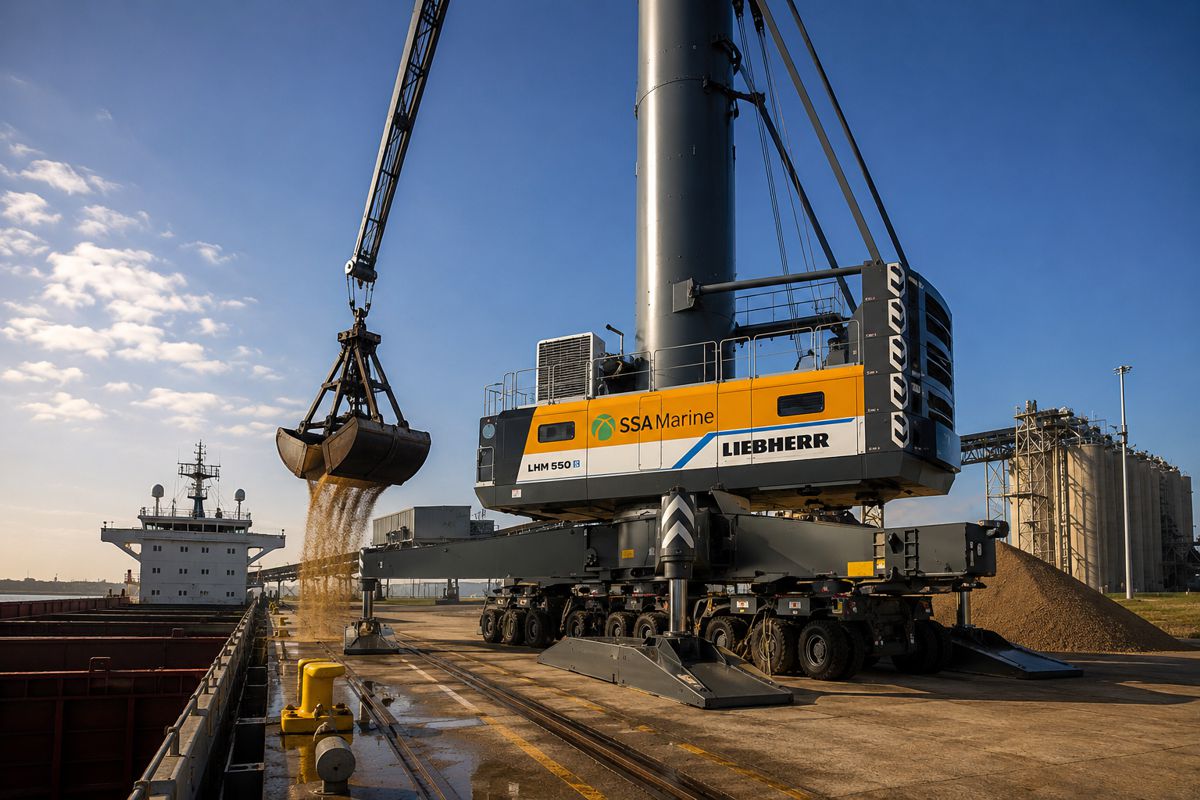
SSA Marine and the Mississippi State Port Authority at Gulfport have commissioned a second Liebherr LHM 550 hybrid mobile harbour crane, supported by a US$1.6 million state grant that will fund the electrical connection needed to run the machine on grid power. On the surface this reads as a routine equipment addition at a mid-sized Gulf Coast port.
The commercially interesting part sits underneath the announcement, in what the crane is actually for and in how it was paid for. A single 124-tonne grab crane now sits at the point where critical-materials supply reliability, the diesel-to-electric transition in cargo handling, and the blended public and private funding model that carries American port modernisation all meet.
That intersection, rather than the ribbon-cutting, is where the story matters to the wider industry. The crane’s primary job is moving ilmenite sand for The Chemours Company, the raw feedstock for white titanium dioxide pigment, into a manufacturing chain anchored by the firm’s DeLisle plant a short distance inland.
Chemours is the world’s largest titanium dioxide producer, DeLisle is one of its flagship chloride-process sites, and the plant is now expanding through a major on-site chlor-alkali facility. Read against that backdrop, a second identical crane is less about headline lifting capacity and more about guaranteeing throughput and uptime for a strategically important industrial customer, while quietly moving that operation a step closer to electric handling.
Briefing
- SSA Marine has commissioned its second Liebherr LHM 550 hybrid mobile harbour crane at the Port of Gulfport, rated at 124 tonnes, backed by a US$1.6 million grant from the Mississippi Department of Transportation’s Strategic Multi-Modal Investments Fund plus a partial SSA Marine match to fund the electrical connection.
- The crane’s principal role is bulk handling of ilmenite sand for The Chemours Company, feedstock for titanium dioxide pigment produced at the firm’s DeLisle facility, which has operated on the Mississippi Gulf Coast for more than four decades.
- Chemours is the global market leader in titanium dioxide, and its DeLisle site is being expanded through an on-site chlor-alkali plant planned by the PCC Group, with construction expected from early 2026 and operation targeted for 2028.
- The grant reflects a wider pattern: US ports face an estimated multi-billion-dollar cargo-handling equipment investment need over the next five years, and the majority are seeking public funding to help electrify diesel fleets.
- Gulfport has compounded a series of state and federal awards, including a 2024 Strategic Multi-Modal grant for rail and an US$11.25 million federal Port Infrastructure Development Program award in 2025, into a broader modernisation programme at a designated Strategic Seaport.
The Workhorse Crane and What a Second Unit Actually Buys
The LHM 550 is the most widely sold model in Liebherr’s mobile harbour crane portfolio, with more than 250 units delivered worldwide, and its appeal in a setting like Gulfport is easy to understand. It travels on rubber tyres with full 360-degree mobility, so it can be repositioned along the quay without fixed rail, and its hydrostatic drive and grab-handling controls are built for the repetitive, high-cycle work of moving bulk material into hoppers. For a terminal operator handling a dry mineral cargo such as ilmenite, that combination of mobility, precise grab control and rated capacity at the outreach the berth requires is worth more than any single peak-lift figure on a datasheet.
The decision to add a second matching unit is a reliability decision before it is a capacity decision. Running two identical LHM 550 cranes standardises spare parts, operator training and maintenance routines, and it gives SSA Marine redundancy against downtime on a cargo stream that feeds a continuous manufacturing process. When a terminal is effectively underwriting service-level commitments to a single demanding customer, the ability to keep berths working through maintenance windows and peak arrivals is the commercial product being sold.
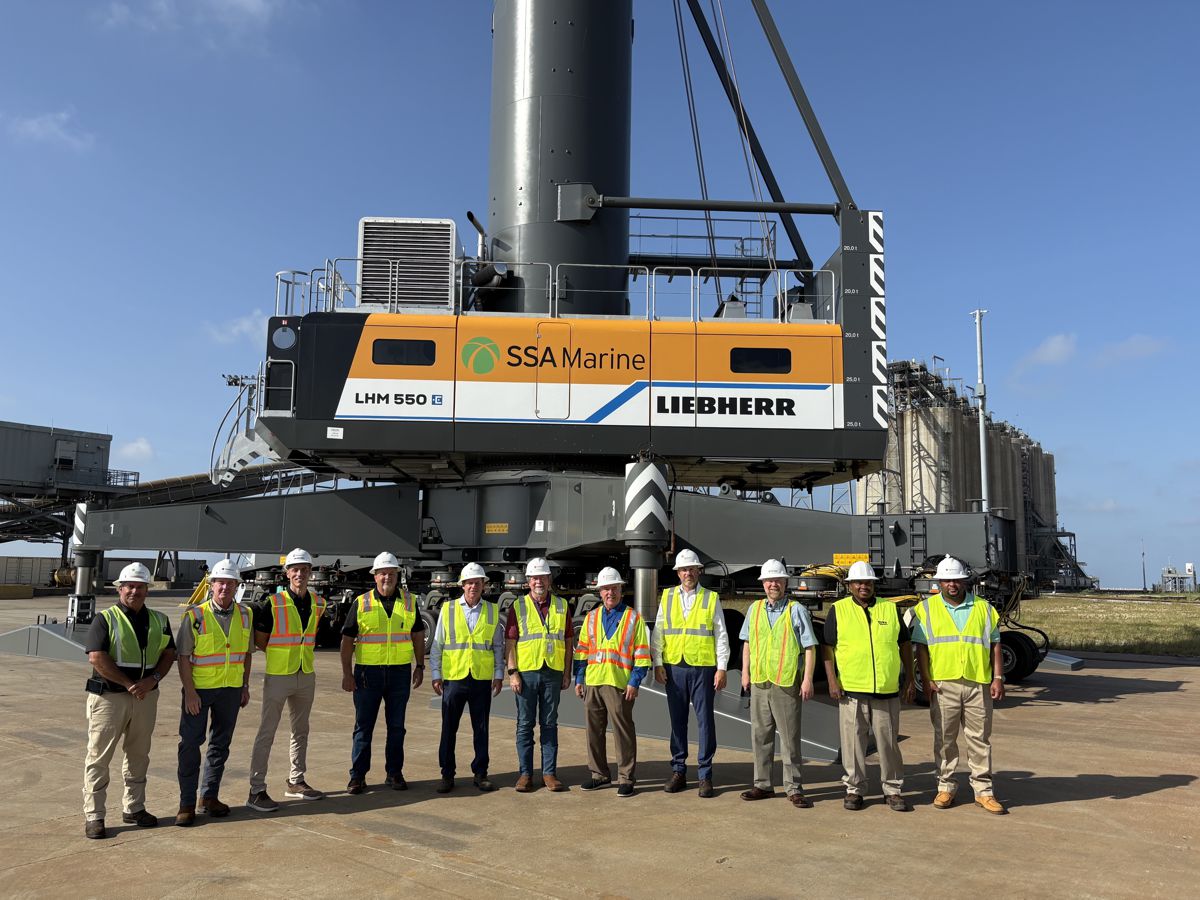
Greg Schruff, general manager of SSA Marine’s Port of Gulfport operations, framed the addition in exactly those terms, noting that “Adding a second LHM 550 at Gulfport expands our bulk handling capacity and allows us to continue delivering reliable, high-quality service to our customers,” and adding that the progress “comes from working closely with the Port, and it reflects our long-term commitment to the Mississippi Gulf Coast and SSA Marine’s broader sustainability goals.”
The Chemours Anchor and the Weight Behind It
The cargo the crane serves gives the investment its strategic heft. Ilmenite, a titanium-iron oxide mineral sand, is the primary feedstock for titanium dioxide, the pigment that supplies whiteness, opacity and durability to architectural and industrial coatings, plastics and paper. Chemours produces titanium dioxide through the chloride process under its Ti-Pure brand, and its DeLisle plant in Mississippi is one of the largest and most advanced chloride-process facilities in the world. In a global titanium dioxide market valued at roughly US$22 billion, Chemours holds the leading position, so the reliability of feedstock arriving across the Gulfport quay carries consequences well beyond one terminal’s throughput figures.
That anchor is becoming more valuable rather than less. The PCC Group plans to build and operate a chlor-alkali facility on the grounds of the DeLisle plant under a chlorine supply agreement with Chemours, with an annual nameplate capacity of 340,000 tonnes, construction expected to begin in early 2026 and operation targeted for 2028, alongside up to 1,200 temporary construction jobs. On-site chlorine supply strengthens the resilience of DeLisle’s pigment production at a time when ilmenite feedstock prices have shown pronounced volatility.
Duane Wilson, site engineering manager at the Chemours DeLisle facility, tied the crane directly to that reliability agenda, observing that “We are pleased that SSA Marine continues to invest in our partnership,” and that “The new crane will create improved efficiency in our manufacturing process and strengthen our ability to provide trusted supply reliability to our customers.” For infrastructure owners, the lesson is that dedicated anchor cargo, tied to a growing industrial cluster, is what turns port equipment spending into a low-risk proposition.
Grants, Matching and the Hybrid-to-Electric Path
The funding mechanism behind the crane is as significant as the crane itself. The machine already runs on a hybrid drive, and the US$1.6 million grant from the Strategic Multi-Modal Investments Fund, combined with a partial match from SSA Marine, pays for the electrical infrastructure that will let it operate on grid power rather than diesel. Electrifying a hybrid crane in this way delivers cleaner operation at the quay without discarding a serviceable asset, and it spreads the transition across two balance sheets instead of one. That structure matters because the economics of decarbonising cargo-handling equipment rarely close on a single operator’s numbers alone.
The scale of the wider challenge explains why the model is spreading. Industry surveys point to a cargo-handling equipment investment need running into billions of dollars across US ports over the next five years, covering ship-to-shore cranes, yard equipment and rail-mounted machinery, and a clear majority of ports report seeking government support to help fund electrification. Against that need, a grant that de-risks the electrical connection for one crane looks modest, yet it is precisely the kind of targeted, co-funded step that allows terminals outside the largest coastal gateways to modernise without waiting for a single transformative capital programme. Blended finance of this sort, rather than wholesale fleet replacement, is emerging as the realistic decarbonisation route for the bulk of the sector.
Gulfport’s Compounding Public-Private Playbook
Gulfport has become a case study in turning small, sequenced awards into meaningful modernisation. The Strategic Multi-Modal Investments Fund was created by the Mississippi Legislature in 2023 to lift freight capacity and economic activity at the state’s ports, airports and railroads, initially authorised at up to US$30 million and continued with a further US$18 million earmarked in the 2025 session. The port drew a US$2.6 million award from the fund in 2024 for rail expansion, then combined an US$11.25 million federal Port Infrastructure Development Program grant in 2025 with a private contribution from stevedore partner Ports America and additional state and port money into a project worth more than US$24.5 million. The latest US$1.6 million grant for crane electrification is the newest layer in that pattern.
What makes the approach effective is the leverage. Jon Nass, chief executive and executive director of the Port of Gulfport, described the crane project as evidence of “what can be achieved through strong public-private partnerships,” adding that the equipment “allows us to better support existing customers while providing flexibility to better attract future business,” and that the combined investments “strengthen our port, improve efficiency, and position Gulfport for continued growth.”
The port’s underlying profile supports that ambition, with on-dock Class I rail via CN and CPKC, a role as a designated Strategic Seaport with a direct rail connection to Camp Shelby and an active relationship with the locally based Naval Construction Battalion, and 1,400 refrigerated container plugs serving perishable trade. For other mid-tier ports, the takeaway is that a disciplined sequence of matched awards can compound into the kind of infrastructure that larger rivals fund in single blocks.
Where Port Electrification Value Is Moving
The Gulfport crane arrives as electrification shifts from a compliance obligation to a competitive lever across the American port system. The Port of San Diego brought the first all-electric mobile harbour cranes in North America into service, and all-electric bulk-handling cranes have since begun operating on the Lower Mississippi, signalling that the technology has moved from demonstration to working deployment in exactly the bulk and breakbulk niches Gulfport occupies.
California’s regulatory framework, from the Air Resources Board mandates to the San Pedro Bay zero-emission targets, has driven much of the early momentum, while federal policy under the 2025 executive order on restoring American maritime dominance has directed fresh investment toward port infrastructure. The direction of travel is consistent even where the drivers differ by region.
For a bulk terminal, the case for electrifying quayside cranes rests on more than emissions accounting. Electric drives cut local particulate and noise at the berth, which matters to the communities around working ports, and they typically carry lower maintenance demands and more predictable operating costs than diesel equivalents.
The presence of the International Longshoremen’s Association at the crane’s commissioning is a reminder that the workforce is part of this transition, and that credible electrification plans need to bring labour along rather than treat automation and clean power as the same conversation. As electrification becomes a factor in where cargo owners choose to route their business, ports that can offer cleaner, reliable handling gain an argument that goes beyond price.
What Gulfport Signals for the Next Wave of Port Investment
Stripped back, the Gulfport commissioning is a compact illustration of how competitive advantage is being built in the bulk and breakbulk segment. Secure a strategic anchor cargo tied to a growing industrial customer, match that cargo with standardised, reliable equipment, and use blended public and private finance to move the operation toward electric power one asset at a time.
None of those moves is dramatic in isolation, yet together they lower risk for the port, the terminal operator and the industrial customer simultaneously, which is why the model is likely to be copied along the Gulf Coast and beyond. The presence of a globally significant titanium dioxide supply chain behind the investment only sharpens the point.
For infrastructure owners and investors watching the sector, the practical signals are worth holding onto. Anchor cargo remains the surest way to de-risk terminal equipment spending, hybrid assets with an electric-ready path offer a hedge against both fuel costs and tightening emissions expectations, and state-level freight funds are becoming a decisive lever for ports that lack megaport balance sheets.
The next wave of port modernisation is unlikely to arrive as a handful of headline megaprojects. It is more likely to look like Gulfport, a sequence of matched, purposeful investments that quietly reposition a working port for the trade and the regulatory environment ahead.
Key Industry Questions
- Why does a single bulk crane matter to the titanium dioxide market? The crane handles ilmenite sand, the raw feedstock for titanium dioxide pigment produced at Chemours’ DeLisle plant, one of the world’s largest chloride-process facilities operated by the global market leader. Reliable feedstock delivery across the Gulfport quay underpins continuous pigment production for a plant that is being expanded through an on-site chlor-alkali facility. In a market valued at around US$22 billion, disruption to feedstock handling would ripple into coatings, plastics and paper supply chains. A dedicated, redundant crane setup reduces that risk. It is a small asset with outsized influence on a strategically important materials supply chain.
- What is the significance of the crane being hybrid with an electric connection? The crane already runs on a hybrid drive, and the grant funds the electrical infrastructure that will allow it to operate on grid power rather than diesel. This delivers cleaner, quieter operation at the berth without scrapping a serviceable machine, and it spreads the cost of transition across public and private funding. Electrifying an existing hybrid asset is far cheaper than full fleet replacement. It also positions the terminal for tightening emissions expectations and potential operating-cost savings, since electric drives generally require less maintenance and offer more predictable energy costs than diesel equivalents over an asset’s working life.
- How does the Strategic Multi-Modal Investments Fund work? The fund was created by the Mississippi Legislature in 2023 to increase freight capacity and economic activity at the state’s ports, airports and railroads. It was initially authorised at up to US$30 million, with a further US$18 million earmarked in the 2025 legislative session. State, county and municipal port authorities are eligible applicants for port projects, which are approved by the Mississippi Transportation Commission on the advice of a dedicated board. Awards typically require a matching contribution, as with the SSA Marine match on the crane electrification. The structure is designed to leverage limited public money into larger, co-funded infrastructure improvements.
- Why do ports rely so heavily on public grants for electrification? The capital cost of converting diesel cargo-handling fleets to electric power rarely closes on a single operator’s balance sheet, particularly outside the largest coastal gateways. Industry estimates put the US cargo-handling equipment investment need in the billions over the next five years, and a clear majority of ports report seeking government funding to help electrify. Grants de-risk individual steps such as electrical connections, charging infrastructure and equipment upgrades. This allows mid-tier ports to modernise incrementally rather than waiting for one transformative programme. Blended public and private finance has become the practical route to decarbonising the sector at realistic speed.
- What makes the Port of Gulfport strategically important? Gulfport is a designated Strategic Seaport with a direct rail connection to Camp Shelby and an active relationship with the locally stationed Naval Construction Battalion, giving it a defence role alongside commercial trade. It offers on-dock Class I rail service via CN and CPKC, supports north-south container and breakbulk trade, and maintains 1,400 refrigerated container plugs for perishable cargo. It also hosts research and manufacturing tied to Mississippi’s Blue Economy and uncrewed maritime systems. This mix of defence, intermodal, refrigerated and industrial cargo capability makes it more resilient than a single-purpose terminal.
- How does anchor cargo reduce investment risk for ports? Anchor cargo is a committed, recurring cargo stream tied to a specific customer, in this case ilmenite for Chemours. It gives a terminal operator predictable throughput against which to justify equipment spending, because the utilisation of the asset is largely known in advance. When that customer is part of a growing industrial cluster, the case strengthens further. This predictability lowers the financial risk of buying specialised handling equipment and supports service-level commitments. For infrastructure owners, securing anchor cargo is often the difference between a speculative investment and a bankable one.
- What are the labour implications of port electrification? Electrification and automation are distinct developments, though they are often conflated. Electrifying a crane changes its power source rather than removing the need for skilled operators and dockworkers, and the presence of the International Longshoremen’s Association at the Gulfport commissioning underlines that the workforce remains central. Credible electrification plans depend on bringing labour into the transition, protecting skilled roles and investing in training for new equipment. Ports that treat clean power and workforce planning as a single conversation are better placed to deliver change smoothly. Ignoring labour concerns risks slowing otherwise sound modernisation.
- Could the Gulfport model be replicated at other ports? The core elements are widely transferable: secure an anchor cargo, standardise on reliable equipment, and use blended public and private finance to electrify incrementally. Many mid-tier ports have access to state freight funds and federal programmes similar to those Gulfport has drawn on. What varies is the availability of a strong industrial anchor and the discipline to sequence multiple smaller awards into a coherent programme. Where those conditions exist, the approach offers a realistic alternative to single, large-scale capital projects. It is likely to be copied across the Gulf Coast and other regions with comparable industrial hinterlands.
Strategic Takeaways
- Anchor cargo tied to a growing industrial customer remains the most reliable way to de-risk terminal equipment investment, turning specialised handling capacity into a bankable proposition rather than a speculative one.
- Hybrid assets with an electric-ready path offer ports a practical hedge against both fuel-price exposure and tightening emissions expectations, without the capital burden of wholesale fleet replacement.
- State-level freight funds, matched with private contributions, are becoming a decisive lever for mid-tier ports, allowing them to compound modest awards into modernisation that larger rivals fund in single blocks.
- The reliability of a single bulk-handling operation can carry strategic weight far beyond one terminal when it feeds a globally significant supply chain such as titanium dioxide pigment production.
- Port electrification is shifting from a compliance obligation to a competitive differentiator, and terminals that pair cleaner handling with credible workforce planning will be best positioned as cargo owners factor emissions into routing decisions.