Utility Strike Prevention Goes Fleet-Wide as Network Plus Backs Live Dig Radar
Network Plus has committed to fitting RodRadar’s Live Dig Radar across more than 200 machines in its repair and maintenance fleet, a multi-year programme that moves underground strike avoidance out of the realm of procedure and toolbox talks and into the specification of the plant itself.
The contractor works for most of the country’s largest asset owners, including Severn Trent Water, Cadent Gas, National Grid and UK Power Networks, and it will also become the first operator to run RodRadar’s new 30cm Type 0 bucket, a version engineered for the tight, shallow, congested ground where the risk of hitting a live service is at its highest. Set against a national problem estimated at roughly 60,000 strikes and around £2.4 billion in economic cost every year, a single contractor putting live radar on its whole fleet is less a product story than a signal about where the industry is heading.
The wider significance lies in the timing and the ownership behind it. The rollout comes only weeks after Warburg Pincus agreed in late June to acquire Network Plus from OMERS Private Equity, a transaction that values the business squarely on its ability to deliver safe, reliable work at scale across water, gas and power networks. Read in that context, the decision reframes utility strike prevention as something closer to a balance-sheet discipline than a compliance obligation.
When a private equity owner underwrites operational-risk reduction across an entire fleet, detection technology has crossed the line from pilot and novelty into standard capital equipment, and the rest of the contracting market will feel the pull.
Briefing
- Network Plus is deploying RodRadar’s LDR Excavate technology across a repair and maintenance fleet of more than 200 machines over a multi-year programme, and is the first operator to adopt the new 30cm Type 0 digging bucket built for shallow, high-density urban utilities.
- The rollout lands within weeks of Warburg Pincus agreeing to acquire Network Plus from OMERS Private Equity, placing operational-risk reduction firmly on the value-creation agenda for a newly private-equity-backed contractor.
- University of Birmingham research and government data underpin an estimated 60,000 utility strikes a year in the UK at a cost of around £2.4 billion, with the true societal cost of an individual strike running at roughly 29 times its direct repair bill.
- Machinetech, RodRadar’s exclusive UK and Ireland distributor, sourced the opportunity and supported field trials; RodRadar’s backers include HOLT Ventures, Mayer Group, Brick & Mortar Ventures, Garney Construction and Dysruptek.
- Live Dig Radar is a job-aid system that alerts operators in real time as they dig; it complements safe-digging practice, HSG47 duties and the National Underground Asset Register rather than replacing any of them.
Strike Avoidance Becomes a Balance-Sheet Question
For most of the past decade, utility strikes have been filed under health and safety, managed through survey records, permits and careful hand-digging within proximity zones. The economics tell a harder story.
University of Birmingham research has long argued that the visible repair bill is only the surface of the cost, with the true societal impact of a strike, once delays, road closures, disrupted businesses and emergency response are counted, running at something close to 29 times the direct damage. For a contractor billing against tight margins, a single dig that goes wrong can turn a profitable job into a loss, and that arithmetic is now visible to the people signing the cheques rather than buried in an incident report.
That shift in visibility is precisely what makes the Warburg Pincus acquisition the relevant backdrop to this deal. Private equity ownership sharpens the focus on avoidable cost, insurance exposure and the reliability metrics that asset owners reward in framework renewals, and strike rate sits at the intersection of all three.
Dave Fleming, Head of Plant at Network Plus, framed the decision in operational terms, noting that “Utility strikes are a costly, high-risk disruption, and preventing them is a priority across our operations. RodRadar’s LDR technology is a complete game changer for risk management. By rolling this out across our fleet, we will not just protect our crews and assets, we will guarantee a best-in-class, uninterrupted service for our clients and the millions of UK citizens who rely on their infrastructure.” A fleet-wide capital commitment of this kind is the sort of measurable, repeatable risk reduction a new owner can put behind its growth case, which is why the deployment reads as a strategic decision rather than a procurement footnote.
Rising Excavation Volumes and the Gap the Data Cannot Close
The exposure is growing rather than shrinking, and the reason is the wall of investment now moving through UK infrastructure. The National Infrastructure Commission has pointed to a funding requirement well beyond £700 billion over the coming decade, and the water sector’s AMP8 cycle is already lifting enhancement and maintenance activity across the network operators.
Network Plus itself sits close to that surge, completing more than 60,000 developer-services jobs a year, installing hundreds of thousands of smart meters annually, and delivering, through its Envolve joint venture, as a strategic partner on South West Water’s multi-billion-pound AMP8 framework. More capital flowing into pipes and cables means more ground opened up, and every additional excavation is another opportunity for a strike.
Better subsurface data is part of the answer, but it does not close the loop. The National Underground Asset Register is bringing utility records together and its economic case points to billions in benefits over ten years, including a material annual saving from fewer strikes, with NUAR itself estimating that a hole is dug somewhere in the UK roughly once every seven seconds. Records, however accurate, describe the ground before the bucket goes in.
They cannot account for services that have shifted, were never mapped correctly, or were laid decades ago without reliable as-built information. Live Dig Radar addresses the moment the data cannot reach, the instant the teeth are in the soil, which is why the technology should be understood as complementary to NUAR rather than an alternative to it.
Engineering for the Densest and Shallowest Ground
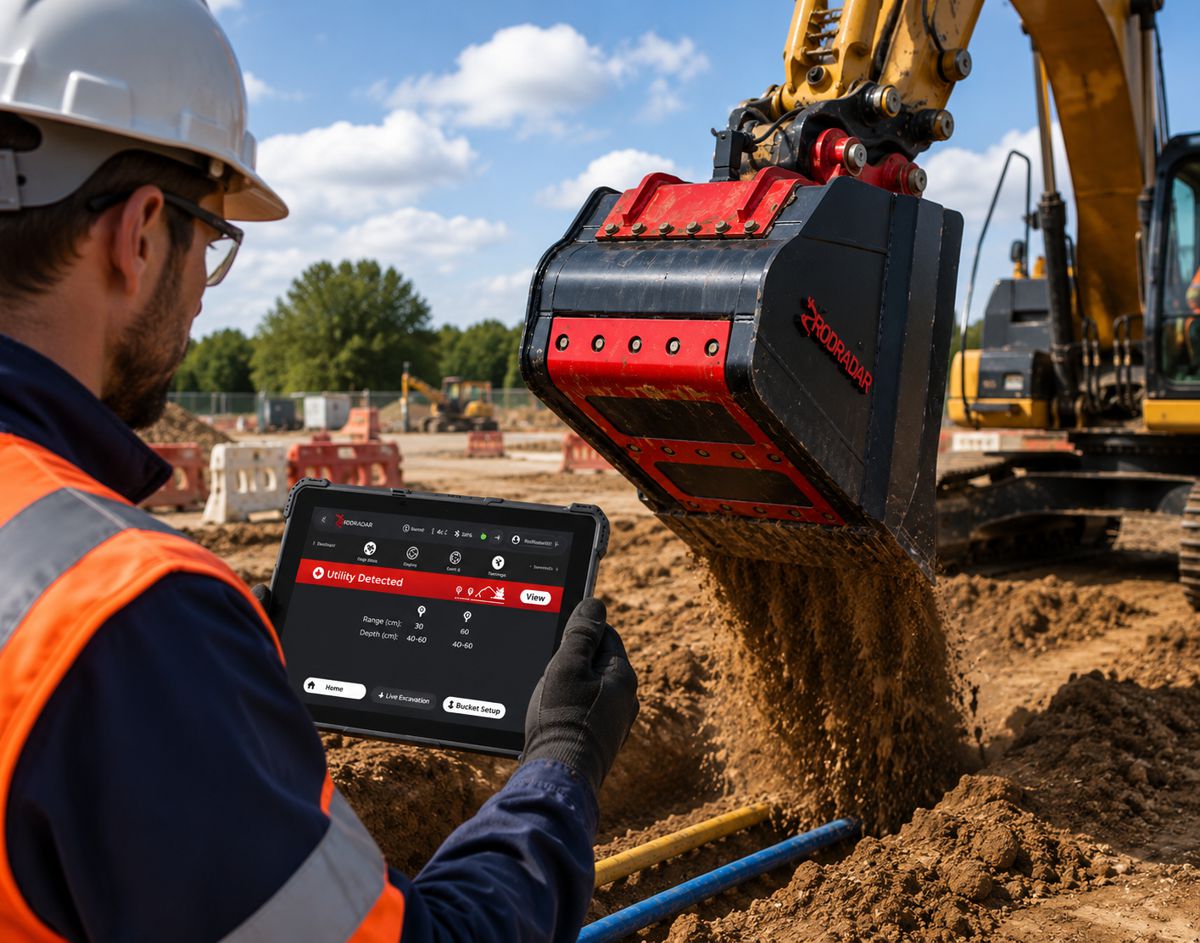
The technical heart of this announcement is the 30cm Type 0 bucket, and the engineering choice behind it reveals where the real difficulty lies. RodRadar’s LDR Excavate embeds ground-penetrating radar in the base of a digging bucket, generating a fresh scan with every pass and classifying what it detects so the operator receives an immediate visual and audible alert with an indication of depth. Until now the range ran towards heavier machines, with Type 4 and Type 5 buckets introduced in 2025 for excavators between 20 and 40 tonnes on major projects.
The gap sat at the opposite end, in the congested urban streetworks where shallow electricity, gas, water and telecoms cables crowd together and where a narrow bucket is the only practical tool. Scaling the technology down to 30cm puts live detection into exactly the environment that produces the greatest density of high-risk, near-surface services.
The commercial value of that narrowing is straightforward. Traditional ground-penetrating radar and electromagnetic locators are used before the dig and require interpretation, whereas an in-bucket system works during excavation without a specialist reading the trace.
Yuval Barnea, VP Sales and Marketing at RodRadar, described the deployment as evidence of momentum towards a wider goal, stating that “Network Plus operates at a scale that demands the absolute pinnacle of site safety and operational efficiency. We are incredibly proud they have chosen our field-proven Live Dig Radar to protect their workforce and their customers’ infrastructure. This massive nationwide deployment brings us a giant step closer to making ‘Zero Strikes’ the global industry standard.”
It is worth being precise about what the system is and is not, a point RodRadar makes itself. Live Dig Radar is positioned as a job-aid that enhances existing processes, not a substitute for safe-digging duties under HSG47 or for the survey and search steps that responsible contractors already follow, and that honest framing is part of what makes fleet adoption defensible.
The Market Forming Around Live Detection
A deal of this size also says something about the supply chain assembling behind in-bucket radar. The opportunity was identified and brought forward by Machinetech, RodRadar’s exclusive distributor for the UK and Ireland, which supported the field trials and will handle installation, training and ongoing support across the rollout.
Ash Mills, Managing Director and Co-Founder of Machinetech, tied the win to the firm’s purpose, saying that “Helping a contractor operating at this scale adopt real-time strike prevention is exactly the safety impact we set out to deliver for the UK market. As RodRadar’s exclusive Distributor, we are proud to bring Live Dig Radar to Network Plus, and are committed to providing comprehensive, on-the-ground support throughout this nationwide rollout.”
The presence of a dedicated distributor with an installation and training function matters commercially, because fleet-scale adoption depends less on the sensor and more on the service model that keeps 200 machines calibrated, supported and trusted by operators.
The investor base tells a parallel story about where industry capital sees value. Founded in Israel in 2013, RodRadar counts among its backers Brick & Mortar Ventures, HOLT Ventures, the venture arm of the major Caterpillar dealer HOLT CAT, Dysruptek, the ventures arm of US contractor Haskell, the Mayer Group, a Volvo Construction Equipment distributor in Israel, and Garney, a US contractor that has itself adopted the technology.
Several of those names are dealers and contractors rather than pure financial investors, which is telling; the earthmoving and dealer ecosystem is putting money into detection because it expects the capability to become embedded in mainstream plant. RodRadar has already integrated its buckets with Engcon tiltrotator and quick-coupler systems and worked with attachment manufacturers to widen availability, and the direction of travel points towards strike detection becoming a standard attachment category rather than a specialist add-on.
What Asset Owners and Frameworks Will Expect Next
The most consequential effect of a deployment at this scale is the pressure it places on the rest of the contracting market. Network Plus serves the water, gas and power networks that set the terms of the frameworks contractors compete for, and asset owners such as Severn Trent, Cadent, National Grid and UK Power Networks increasingly measure delivery partners on safety performance, service continuity and avoided disruption.
A contractor able to demonstrate a materially lower strike rate, backed by an auditable capability fitted across its fleet, carries a commercial advantage into every tender and every performance review. As one large operator moves, the reference point for what good looks like moves with it.
There is an insurance and liability dimension that reinforces the same trend. Strike costs land across repair, delay, third-party claims and reputational damage, and demonstrable risk controls influence how those exposures are priced and allocated between clients, contractors and their insurers. A fleet-wide detection programme gives a contractor something concrete to present in that conversation, and it gives asset owners a lever to specify in future work.
The combination of client expectation, insurer scrutiny and framework competition tends to convert a leading contractor’s discretionary investment into an emerging baseline, and that is the mechanism by which one rollout reshapes procurement norms across the sector.
Setting the Bar for the Next Investment Cycle
The phrase RodRadar keeps returning to is “Zero Strikes”, and while no single tool eliminates a problem rooted in ageing, poorly documented networks, the ambition is a useful marker of where the industry is aiming. The honest reading of this announcement is that the combination of live in-bucket detection, better pre-dig data through NUAR, and disciplined safe-digging practice is beginning to look less like a set of separate initiatives and more like an integrated system for taking strike rates down.
Network Plus has chosen to build the detection layer into its everyday plant rather than treat it as an exception, and it has done so at the start of a period defined by record infrastructure investment and heightened excavation volumes.
For industry leaders, the practical takeaway is about sequencing and positioning. The contractors and asset owners that embed strike avoidance now, while it is still a differentiator, will be the ones setting the standard when it becomes an expectation written into framework requirements. The AMP8 cycle and the broader infrastructure pipeline give the market a rare window to modernise the way digging is done before the next wave of spending compounds the risk.
Network Plus and RodRadar have not solved the £2.4 billion problem, but they have shown, at meaningful scale, what a credible response to it now looks like, and that is enough to move the reference point for everyone else.
Key Industry Questions
- What exactly is Live Dig Radar and how does it differ from a standard utility survey? Live Dig Radar is ground-penetrating radar built into the base of an excavator’s digging bucket. Rather than surveying a site before work begins, it scans continuously as the operator digs, generating a new reading with each pass and issuing an immediate visual and audible alert, along with a depth indication, the moment it detects a buried service. Conventional surveys and hand-held locators are pre-dig tools that require a specialist to interpret the results and cannot account for services that have moved or were never mapped. The in-bucket approach targets the live moment of excavation itself, acting as a last line of defence when the paperwork and the pre-dig search have taken the crew as far as records allow.
- Why does the 30cm Type 0 bucket matter more than the larger versions? The highest concentration of strike risk sits in congested urban streetworks, where shallow electricity, gas, water and telecoms services run close together and close to the surface. That environment calls for a narrow bucket, and until now RodRadar’s range favoured larger machines used on major projects. The 30cm Type 0 places live detection into the exact conditions that generate the most incidents, closing the gap at the small, high-density end of the market. For contractors whose work is dominated by repair and maintenance in urban ground, rather than open-site earthworks, the smaller unit is the version that fits the majority of daily tasks.
- Does Live Dig Radar remove the need for safe-digging procedures or NUAR data? No, and RodRadar is explicit on this point. The system is positioned as a job-aid that complements existing processes, not a replacement for them. Contractors still carry their duties under HSG47, still search records and use LineSearchBeforeUDig, and still apply safe-digging practice within proximity zones. The National Underground Asset Register improves the quality of information available before the ground is opened, while Live Dig Radar addresses the instant the bucket is in the soil, where records cannot help. The strongest results come from treating the three as layers of the same system rather than competing solutions, with detection catching what data and procedure inevitably miss.
- How significant is the Warburg Pincus acquisition to this story? Warburg Pincus agreed in late June 2026 to acquire Network Plus from OMERS Private Equity, in a deal subject to regulatory approval, with the existing leadership and branding expected to remain. The relevance is commercial rather than technical. Private equity ownership concentrates attention on avoidable cost, insurance exposure and the reliability metrics that win framework renewals, and utility strikes sit at the centre of all three. A fleet-wide detection programme gives a newly backed owner a concrete, measurable risk reduction to put behind its growth case, which helps explain why a capital commitment of this scale arrived when it did.
- What does the £2.4 billion figure actually represent? The figure is the estimated annual economic cost of utility strikes across the UK, drawn together in a 2022 government assessment and echoed by industry bodies including the Utility Strike Avoidance Group. It combines direct repair costs with project delays, traffic disruption, service interruptions and wider economic knock-on effects. University of Birmingham research reinforces why the total is so large, finding that the true cost of an individual strike runs at roughly 29 times its direct repair bill once indirect and societal impacts are counted. Against an estimated 60,000 strikes a year, and a country where a hole is dug roughly every seven seconds, that multiplier makes the headline figure credible and arguably conservative.
- Will other contractors be expected to follow? The pressure is likely to build. Network Plus works for the water, gas and power networks that define the frameworks contractors compete for, and those asset owners increasingly judge delivery partners on safety performance and service continuity. A contractor that can evidence a lower strike rate through a fitted, auditable capability carries an advantage into tenders and performance reviews. Insurers and clients apply further leverage through how they price and allocate strike-related liability. When a leading operator moves at fleet scale, the market’s reference point for acceptable practice moves too, and discretionary investment by the front-runners tends to become a baseline expectation for the rest.
- How mature is the technology, and who else uses it? RodRadar was founded in 2013 and its LDR Excavate buckets are in use with construction and utility firms across Europe, the United States and Australia. The range now spans several bucket sizes, from the new 30cm Type 0 to larger units for 40-tonne excavators, and the buckets have been integrated with Engcon tiltrotator and quick-coupler systems. The company’s backers include dealer and contractor ventures such as HOLT Ventures and Garney Construction, alongside construction-technology investor Brick & Mortar Ventures. That mix of financial and industry capital, combined with distributor networks in multiple markets, indicates a technology moving from early adoption towards mainstream availability rather than a first-of-its-kind trial.
- What is the realistic path to “Zero Strikes”? Zero Strikes is best read as a direction of travel rather than an imminent guarantee, given that the underlying problem stems from ageing and poorly documented networks laid over two centuries. The credible route combines three layers: better pre-dig data through NUAR, disciplined adherence to safe-digging duties, and live in-bucket detection to catch what the first two miss. Embedding detection across a whole fleet, as Network Plus has done, is what turns the concept from an aspiration into an operational practice. Progress will be measured in falling strike rates across the contractors and asset owners that adopt the full system, not in any single tool eliminating the risk on its own.
Strategic Takeaways
- Utility strike prevention has shifted from a health-and-safety line item to a balance-sheet discipline, and private-equity ownership of contractors such as Network Plus will accelerate that reframing across the sector.
- Rising excavation volumes driven by AMP8 and a £700 billion-plus infrastructure pipeline increase strike exposure faster than pre-dig data alone can contain it, strengthening the case for detection at the point of digging.
- The 30cm Type 0 bucket targets the shallow, congested urban ground where strike risk concentrates, making live detection viable for the everyday repair and maintenance work that dominates most fleets.
- Live Dig Radar is most defensible when treated as a complement to NUAR data and HSG47 safe-digging duties rather than a replacement, and contractors should position it as one layer of an integrated system.
- Fleet-scale adoption by a leading contractor tends to reset procurement norms; asset owners, insurers and framework competition are likely to convert today’s differentiator into tomorrow’s baseline requirement.