Dominican Republic Takes National Toll Network into its Next Digital Phase
The Dominican Republic is preparing to upgrade 20 toll plazas and 183 lanes under a new national deployment of Kapsch TrafficCom’s SmartToll technology, extending a programme that has already brought electronic payment, new toll infrastructure and digital monitoring to some of the country’s busiest roads.
The contract has been awarded by RD Vial, the state-owned road trust responsible for operating and developing the country’s principal road network. Kapsch TrafficCom will supply its SmartToll platform alongside maintenance and support services intended to keep the system operational and provide for subsequent platform upgrades.
The deployment comes at an active point in the development of the Dominican road network. RD Vial has been modernising toll stations, expanding its Paso Rápido electronic tolling service and investing toll revenues in highway construction and improvement programmes. The 183-lane project will become part of an increasingly connected national operation handling large volumes of traffic, payments and operational data.
Briefing
- Kapsch TrafficCom will modernise 20 toll plazas covering 183 lanes in the Dominican Republic.
- The project is being led by RD Vial and will use Kapsch TrafficCom’s SmartToll platform.
- Maintenance and support are included to provide operational continuity and accommodate future platform upgrades.
- RD Vial reported toll revenues of RD$12.368 billion in 2025, 36.8% above the RD$9.042 billion collected in 2024.
- Electronic Paso Rápido transactions accounted for 46.8% of toll revenues in 2024, according to RD Vial.
A Toll Network Already Changing
The new contract does not begin with an untouched network. RD Vial has spent several years replacing ageing toll technology and extending electronic collection across the country.
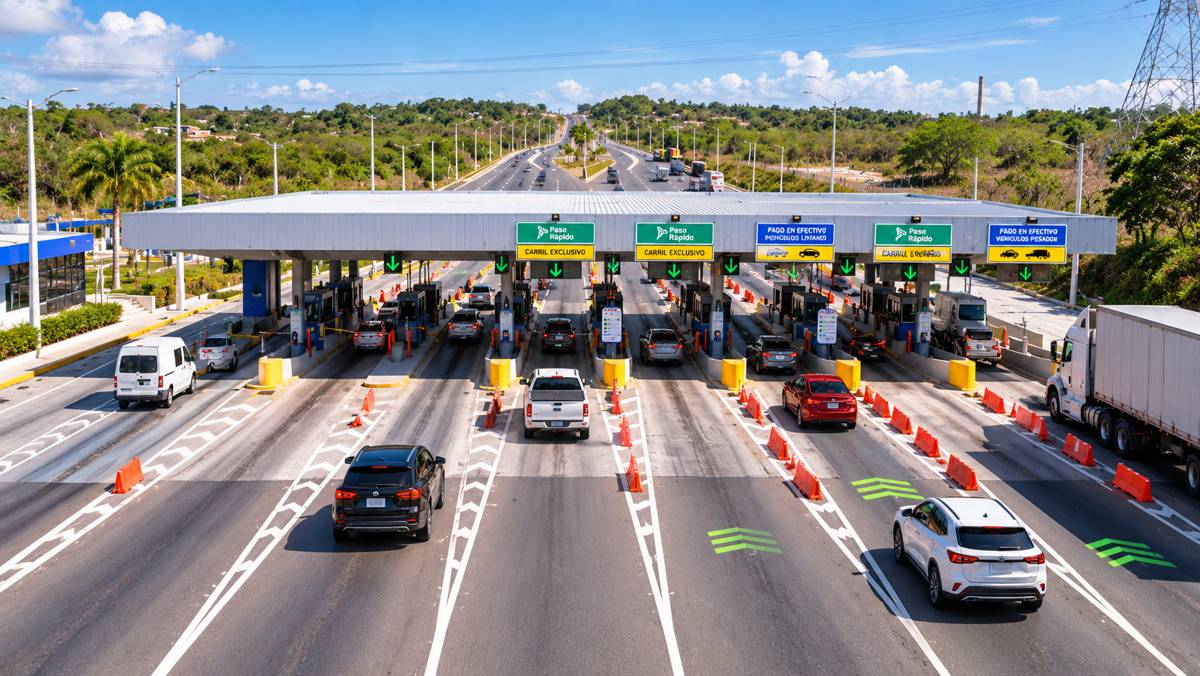
Paso Rápido uses an electronic device communicating with equipment installed at toll stations, allowing the system to identify the vehicle, check the account balance and process its passage. Vehicle category can be determined according to characteristics including axle configuration and height, allowing the same system to accommodate passenger cars and heavier commercial vehicles.
The underlying equipment has also been changing. During earlier upgrades on the Autovía del Nordeste, RD Vial described installing RFID readers, high-resolution cameras and faster data-processing systems alongside new toll-management software. The work brought data from individual plazas into a more adaptable platform capable of centralised supervision and control.
Some of that investment was driven by necessity rather than technological ambition. In 2023, RD Vial acknowledged that equipment at several stations had been operating for as long as ten years and that obsolete antennas and other components were affecting electronic toll performance. Subsequent maintenance and upgrades raised reported Paso Rápido effectiveness to between 93% and 99% at a number of stations.
The physical estate has been receiving attention as well. A national toll-station refurbishment programme announced in February 2025 covered canopies, islands, administrative buildings, structures and roadside protection at stations including Coral 1, Coral 2, La Romana, Catey 2, El Naranjal, Marbella, Guaraguao and Las Américas. SmartToll will therefore enter a network where hardware, buildings, payment systems and operating practices have already been moving through successive stages of renewal.
Electronic Tolling Gains Ground
RD Vial reported RD$12.368 billion in national toll revenues during 2025, up 36.8% from RD$9.042 billion in 2024. Part of that increase followed tariff adjustments introduced in January 2025, while the organisation also attributed the performance to sustained growth in vehicle movements.
Revenue has more than doubled since 2021, when collections stood at RD$5.637 billion. Tolling is now described by RD Vial as the principal financing mechanism for the road infrastructure under its administration.
Electronic collection is taking a substantial share of those transactions. Paso Rápido represented 46.8% of toll revenues in 2024, equivalent to RD$4.227 billion. With electronic transactions approaching half of revenue before the latest technology deployment, the reliability of the equipment and systems behind them carries considerable operational weight.
More recent figures show the volume continuing into 2026. RD Vial recorded more than 42.3 million vehicle movements through its toll stations during the first five months of the year, generating RD$5.778 billion in revenue.
The traffic handled by individual corridors can be substantial. When RD Vial opened its new toll station at kilometre 32 of the Duarte motorway in April 2025, it said the road was carrying more than 150,000 vehicles each day. The replacement station has 22 lanes, ten dedicated to Paso Rápido, although electronic readers were installed across all 22. RD Vial said at the time that approximately 90% of toll lanes nationally already had Paso Rápido readers. The site also incorporated a real-time monitoring room and provision for weighing heavy vehicles.
From Toll Booths to Network Operations
Modern tolling depends increasingly on what happens behind the barrier. Electronic vehicle identification, classification, account verification, transaction processing, lane equipment, cameras and central systems have to operate together while handling traffic continuously. Failures in software, communications or roadside hardware can quickly become physical queues when multiplied across busy lanes.
RD Vial’s earlier upgrades combined new software with RFID readers, cameras and processing hardware rather than treating electronic payment as an isolated component. Kapsch TrafficCom’s role will similarly extend beyond the initial SmartToll installation, with maintenance and support forming part of the contract across the 20 plazas.
“This project marks an important step in the modernization of tolling infrastructure in the Dominican Republic. It highlights the strength of our technology, our extensive international tolling expertise, and our strong presence across Latin America and the Caribbean. We are proud to support RD Vial in building a future-ready tolling ecosystem that will enhance efficiency and customer experience for road users,” said Ramiro Virreira, EVP Latin America at Kapsch TrafficCom.
The contract announcement does not disclose its financial value, implementation timetable or the precise equipment and software configuration planned for each plaza. Nor does it specify how the new platform will interact with every element of the existing Paso Rápido estate.
RD Vial’s technology ambitions extend further than conventional plaza operations. Procurement records published in January 2026 show an awarded process for a national toll-management system incorporating specialised back-office software for Multi Lane Free Flow operations. The available information does not establish whether that procurement forms part of the Kapsch SmartToll contract, so the two cannot be treated as the same project without further confirmation.
Toll Revenue and Road Investment
RD Vial is using toll income as part of the financing base for a sizeable road programme covering important passenger, freight and tourism corridors.
Projects cited by the organisation include work on the Barahona-Enriquillo and Enriquillo-Pedernales roads, bypasses at Azua, Baní and Navarrete, expansion of the Duarte motorway, reconstruction of the Las Américas motorway and development of sections of Avenida Ecológica.
The geography produces very different demands on the toll network. RD Vial reported more than RD$3.9 billion in 2025 toll revenue from the eastern corridor serving the tourism centres and Punta Cana, while the north-eastern corridor towards Samaná generated more than RD$4 billion. The northern route towards Santiago and the Cibao exceeded RD$2.093 billion.
RD Vial is simultaneously pushing digitalisation further into infrastructure management. In 2025 it sought technology capable of digitally surveying more than 3,000 km of the country’s principal RD-1 to RD-7 highways using visual inspection, georeferencing and 360-degree imagery. Requirements included remote inspection, automated maintenance orders and interoperability with existing GIS systems.
Tolling consequently sits within a wider digital road operation as well as the funding machinery for the network itself.
Building a National Platform
The Dominican deployment gives Kapsch TrafficCom a sizeable national project in Latin America and the Caribbean, but its performance will ultimately be measured at lane level: whether vehicles are recognised correctly, transactions are processed reliably, equipment remains available and queues continue moving.
RD Vial has already demonstrated that electronic tolling can achieve high recognition rates on parts of its network. It has also experienced the maintenance problems that emerge when equipment ages and different generations of technology accumulate across an operating system.
Modernising 20 plazas and 183 lanes offers an opportunity to reduce some of that fragmentation while placing maintenance, support and future platform development within the same contract. It is taking place as electronic collection accounts for an increasing share of toll transactions and toll revenues provide substantial funding for road investment.
The toll plaza is gradually becoming less of a collection point and more of a connected piece of national road infrastructure.
Key Industry Questions
- How many Dominican Republic toll plazas will Kapsch TrafficCom modernise? The contract covers 20 toll plazas and 183 lanes across the country.
- Who operates the Dominican Republic’s national toll network? The project is being led by RD Vial, the state-owned road trust responsible for the operation and development of the country’s principal road network.
- What technology will be deployed? Kapsch TrafficCom will use its SmartToll solution. The announcement does not provide a detailed equipment specification for individual plazas.
- What is Paso Rápido? Paso Rápido is the Dominican Republic’s electronic toll collection system. An electronic device in the vehicle communicates with equipment at the toll station so the vehicle can be identified and the transaction processed electronically.
- How widely is electronic tolling already used? RD Vial reported that Paso Rápido accounted for 46.8% of toll revenues during 2024. At the opening of the new Duarte motorway toll station in April 2025, it said around 90% of toll lanes nationally had Paso Rápido readers.
- How much revenue does the Dominican Republic collect from tolls? RD Vial reported RD$12.368 billion in toll revenues during 2025, compared with RD$9.042 billion in 2024. During the first five months of 2026, toll stations recorded more than 42.3 million vehicle movements and generated RD$5.778 billion.
- Will Kapsch TrafficCom maintain the system after installation? Yes. Maintenance and support services form part of the contract, with provision for operational continuity and future platform enhancements.
- Has a project completion date been announced? No implementation timetable was disclosed in the contract announcement.
Strategic Takeaways
- The 183-lane deployment builds on several years of electronic toll and physical plaza modernisation rather than introducing digital tolling to the Dominican Republic for the first time.
- Paso Rápido already handles a substantial proportion of toll revenue, increasing the operational importance of reliable electronic collection equipment.
- Maintenance and platform support are material parts of the contract because toll technology must operate continuously across geographically dispersed infrastructure.
- Toll modernisation is closely connected with road finance, with RD Vial describing toll collection as the principal funding mechanism for the infrastructure under its administration.
- RD Vial’s wider technology programme includes digital road inspection, GIS integration and preparations for Multi Lane Free Flow operations.