Africa EV Mobility Expo Arrives as Morocco Builds an Electric Vehicle Supply Chain
Morocco’s electric vehicle ambitions are beginning to extend well beyond assembling cars. Batteries, charging equipment, automotive components and increasingly sophisticated local supply chains are becoming part of an industrial strategy that already places the country among Africa’s most important vehicle manufacturing centres.
That changing industrial landscape will provide the backdrop to the second Africa EV Mobility Expo Morocco, taking place at the Office des Foires et Expositions de Casablanca from 27 to 29 October 2026. Organised by MIE Events, GEX and CCCME, the exhibition is expected to bring together more than 200 exhibitors, 500 products and solutions, and visitors from at least 15 countries.
Morocco is no longer positioning itself merely as a promising future location for electric mobility investment. Production capacity is being installed, international suppliers are arriving, and some of the infrastructure needed to support a broader EV manufacturing ecosystem is already taking shape.
Briefing
- Africa EV Mobility Expo Morocco returns to Casablanca from 27 to 29 October 2026 for its second edition.
- Organisers expect more than 200 exhibitors, 500 products and solutions, and over 15,000 visitors.
- Stellantis is expanding its Kénitra operation towards total capacity of 535,000 vehicles and micromobility units annually.
- Electric charging equipment is now being manufactured at the Kénitra plant, with installed capacity for 204,000 charging units.
- Morocco is attracting investment further upstream into EV batteries and battery materials, including the planned Gotion High-Tech gigafactory.
Morocco’s Automotive Base
Morocco already has something many countries pursuing an electric vehicle industry are still trying to create: an established automotive manufacturing base.
Renault and Stellantis have developed substantial operations in the country, supported by component suppliers, industrial zones, ports and transport infrastructure connecting Moroccan manufacturing with European and international markets. During the first four months of 2026, automotive exports generated 58.2 billion dirhams, an increase of 18.6% compared with the same period a year earlier, and remained the country’s largest export earner.
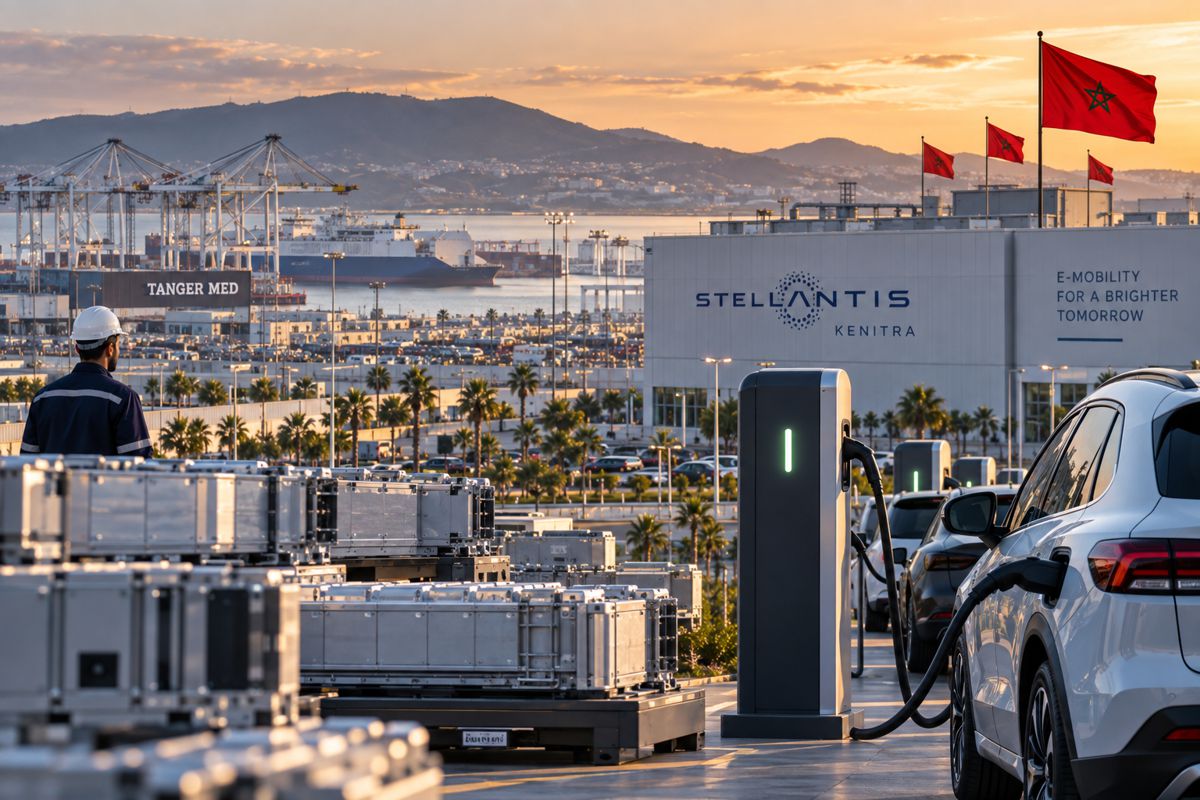
That base continues to expand. Stellantis announced a €1.2 billion expansion of its Kénitra operation in 2025, with total installed capacity planned to reach 535,000 vehicles and micromobility units a year. The development includes capacity for 400,000 vehicles on the company’s Smart Car platform and 135,000 electric micromobility units.
Production capacity for models including the Citroën Ami, Opel Rocks-e and Fiat Topolino has risen from 20,000 to 70,000 units annually, alongside capacity for 65,000 fully electric three-wheeled vehicles. Stellantis says the three-wheelers were developed through its Automotive Technical Center and a Moroccan engineering ecosystem involving more than 4,000 engineers and higher-level technicians.
The company is targeting local integration of 75% by 2030, with purchases from Morocco-based suppliers expected to exceed €6 billion annually by then. Its Kénitra operation has also started manufacturing electric charging stations, with capacity for 204,000 units.
Batteries Move Up the Agenda
Vehicle production represents only one part of the emerging EV supply chain. Morocco has been pursuing investment in battery materials and manufacturing for several years, helped by its proximity to European automotive markets and its existing industrial infrastructure. Projects involving Chinese battery and materials companies have progressively pushed the country further upstream.
One of the largest is the Gotion High-Tech battery gigafactory. In July 2026, the African Development Bank approved a €100 million loan towards the first phase of the project and said it would mobilise another €141 million from financing partners.
The initial investment is expected to be around $1.3 billion, with the plant producing lithium iron phosphate batteries as well as cathode and anode materials. Much of the production is intended for European markets.
Vehicle assembly, battery materials, cells, components and charging equipment increasingly sit within the same industrial proposition. Manufacturers have an established automotive customer base and export infrastructure nearby, while vehicle producers gain access to a growing network of local and international suppliers.
Suppliers Follow Production
That development can already be seen in the component industry. BENTELER opened a new automotive component plant at Kénitra in 2026, with production scheduled to begin during the summer. The facility is manufacturing components including bumpers, torsion beam axles, impact bars and suspension arms for an international vehicle manufacturer.
Its equipment includes a 3,200-tonne cold-forming press, robotic welding systems, cathodic dip coating and 3D laser technology. The company has described the operation as a digitally connected factory using Industry 4.0 systems, with more than 300 direct jobs associated with the project.
Morocco’s manufacturing geography also gives these investments access to an established export logistics system. Tangier Med has developed into one of the Mediterranean’s major port and industrial complexes, supporting automotive manufacturing and providing maritime connections to European and international markets. Together with the industrial clusters around Tangier and Kénitra, that infrastructure turns Morocco’s proximity to Europe into a practical manufacturing advantage.
None of this means Morocco’s transition to electric mobility is complete. Manufacturing EVs for export and creating a mature domestic electric mobility market are different challenges. Charging networks, electricity supply, vehicle affordability, fleet economics, maintenance capability and consumer demand will all influence the pace at which electric vehicles become commonplace on Moroccan and wider African roads.
Globally, charging infrastructure is expanding quickly. The International Energy Agency recorded more than seven million public charging points worldwide at the end of 2025 after almost 1.8 million were added during the year. Africa starts from a very different position from China, Europe or North America, however, with markets varying enormously in income, grid availability, vehicle age, urbanisation, fuel economics and transport patterns.
There is unlikely to be a single African model for electrification. Commercial vehicles, motorcycles, scooters, micromobility and charging infrastructure may therefore prove as important as passenger cars in determining how different markets develop.
More Than Passenger Cars
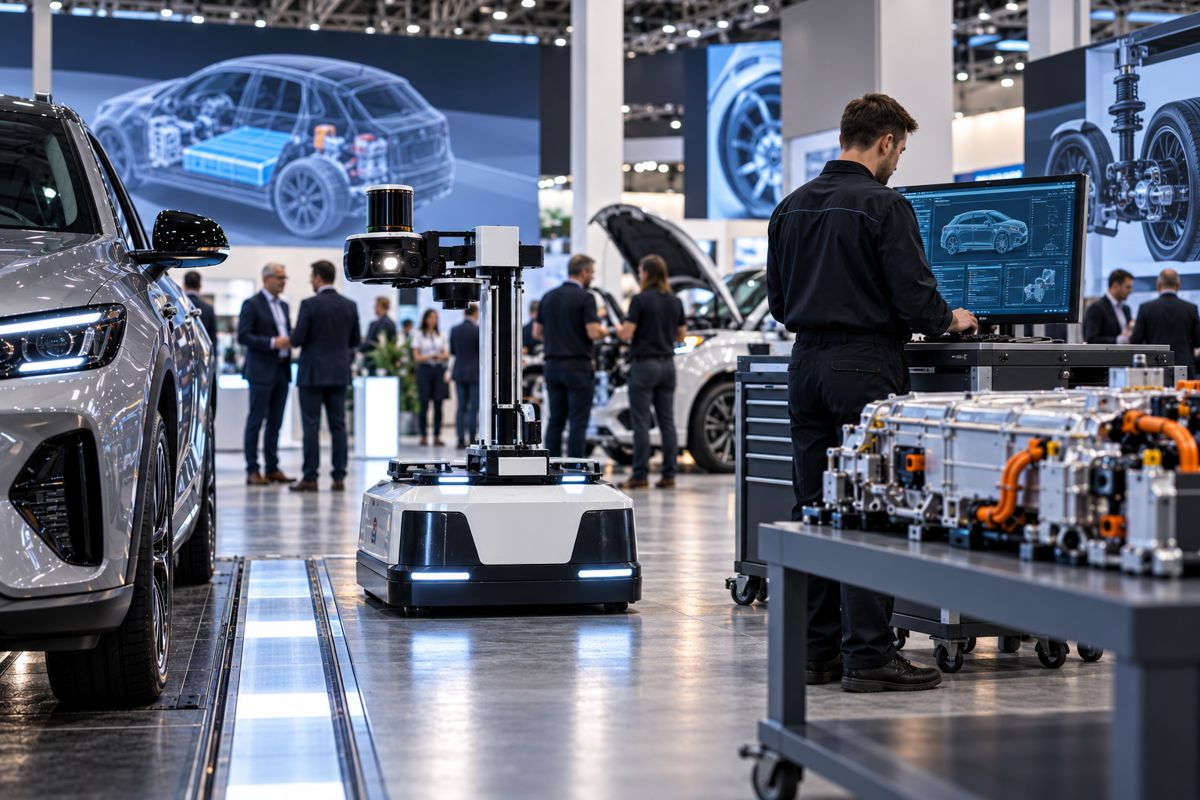
Africa EV Mobility Expo reflects that wider interpretation of electric mobility. Its exhibition programme is divided broadly across batteries, energy and infrastructure, powertrains and new-energy vehicles. Battery management systems, testing equipment, raw materials and energy storage sit alongside chargers, connectors, cables and energy management systems.
Electric motors, power electronics and control systems cover the propulsion side, while the vehicle categories stretch from passenger and commercial vehicles to motorcycles, scooters, bicycles, hybrids, fuel-cell vehicles, electric boats and eVTOL aircraft. Some of those markets are considerably closer to commercial maturity than others, but together they demonstrate how electrification increasingly crosses traditional boundaries between automotive manufacturing, energy, infrastructure and industrial technology.
The organisers expect more than 15,000 visitors during the three-day exhibition and are planning more than 1,000 B2B matchmaking meetings and at least ten seminars.
For international manufacturers, the attraction is partly Morocco itself and partly its position between major markets. Its automotive industry provides EV technology companies with an existing customer and supplier ecosystem, while established port and industrial infrastructure connects production with Europe and wider international markets.
The African dimension is more complicated but potentially larger over the long term. Electrification across the continent will develop according to local economics rather than simply copying European or Chinese adoption patterns. Commercial fleets, two- and three-wheelers, buses, urban delivery vehicles, distributed charging and specialised applications could produce very different markets from one country to another.
An Industrial Transition in Progress
The next stage of Morocco’s automotive development will depend increasingly on how much of the value surrounding vehicle production can remain within the country. Batteries, materials, power electronics, engineering, charging hardware, software and specialised components offer opportunities to deepen an industrial cluster that already exports vehicles at substantial scale.
There are competitive pressures as well. Electric vehicle manufacturing is becoming increasingly international as Chinese manufacturers and suppliers seek markets and production bases outside China, while European manufacturers reconsider costs, supply chains and manufacturing footprints. Morocco’s location, existing factories, supplier network and export infrastructure place it close to where those strategies intersect.
Africa EV Mobility Expo therefore arrives in Casablanca at an interesting point in the country’s industrial development. The exhibition floor will contain vehicles and chargers, batteries and powertrains, while outside the exhibition centre factories are expanding, suppliers are arriving and battery production is moving from proposal towards financed industrial capacity.
Morocco is beginning to assemble an electric mobility supply chain rather than simply electric vehicles.
Key Industry Questions
- When is Africa EV Mobility Expo Morocco 2026? The exhibition takes place from 27 to 29 October 2026 at the Office des Foires et Expositions de Casablanca in Casablanca.
- How large is the exhibition expected to be? Organisers expect more than 200 exhibitors, over 500 products and solutions, more than 15,000 visitors and participation from at least 15 countries.
- What sectors will the exhibition cover? The programme includes batteries, charging and energy infrastructure, electric powertrains, components, energy storage and new-energy vehicles ranging from passenger cars to commercial vehicles and micromobility.
- Does Morocco already manufacture electric vehicles? Yes. Stellantis manufactures electric micromobility vehicles including the Citroën Ami, Opel Rocks-e and Fiat Topolino at Kénitra, alongside other automotive production.
- Is Morocco developing an EV battery industry? Yes. Several battery-material and battery-manufacturing investments have been announced, including the Gotion High-Tech gigafactory project backed by financing from the African Development Bank and other partners.
- Why is Morocco attracting automotive investment? It combines an established automotive manufacturing base with component suppliers, industrial zones, export infrastructure and geographic proximity to Europe.
- Is charging equipment manufactured in Morocco? Stellantis has established production of electric charging stations at Kénitra with stated capacity for 204,000 units.
- Is Africa likely to follow Europe’s EV adoption model? Not necessarily. Vehicle economics, electricity infrastructure, transport patterns and incomes vary considerably between African markets, making commercial vehicles, buses, motorcycles, three-wheelers and other forms of electric mobility potentially important alongside passenger cars.
Strategic Takeaways
- Morocco’s advantage in electric mobility increasingly rests on the industrial ecosystem surrounding vehicle production rather than assembly capacity alone.
- Battery manufacturing and battery-material projects could capture substantially more of the EV value chain domestically.
- Growing local sourcing creates opportunities for component, machinery, automation, engineering and logistics suppliers as well as vehicle manufacturers.
- Charging equipment production at Kénitra demonstrates how automotive plants can expand into the infrastructure supporting electrification.
- Africa’s electric mobility market is likely to develop through several vehicle and infrastructure models rather than following a single passenger-car-led pathway.