Geo Week Expands Workforce Programme as Geospatial Skills Demand Grows
Geo Week is expanding its efforts to bring younger professionals into the geospatial sector, opening applications for its 2027 GEO Empower Event Scholarship alongside a broader workforce development programme connecting students, educators and industry employers.
Now entering its third year, the scholarship will bring three US university students to Geo Week 2027 in Salt Lake City, covering conference admission, accommodation and up to $1,000 towards travel. Recipients will also receive onsite mentoring and access to an event spanning surveying, mapping, GIS, lidar, reality capture, photogrammetry and increasingly AI-enabled spatial technologies.
Behind the scholarship sits a larger question for the sector. Geospatial technology is becoming embedded across infrastructure planning, construction, utilities, transport, environmental management and asset operations at the same time as employers need people capable of understanding both increasingly sophisticated technology and the physical environments being measured. Geo Week is consequently developing the scholarship into part of a wider workforce programme rather than treating it as a standalone annual initiative.
Briefing
- Applications for the 2027 GEO Empower Event Scholarship close on 30 October 2026.
- Three university students will receive full Geo Week conference passes, three nights’ hotel accommodation and travel reimbursement of up to $1,000.
- The programme includes onsite mentoring and networking with established geospatial professionals.
- Geo Week has established a Workforce Development Committee involving industry professionals, educators and advocates.
- Geo Week 2027 takes place from 23 to 25 February at the Salt Palace Convention Center in Salt Lake City, Utah.
Geospatial Employment and Skills
Geo Week describes the scholarship as part of an attempt to address the geospatial talent pipeline, with its newly established Workforce Development Committee intended to bring professional and educational perspectives into student engagement, career development and outreach.
There is a practical employment backdrop to that effort. US Bureau of Labor Statistics projections indicate that surveyor employment is expected to grow by 4% between 2024 and 2034, with approximately 3,900 openings each year. Many will arise from people leaving the profession or moving into other occupations rather than from employment growth alone.
The pattern extends into related occupations. Employment among surveying and mapping technicians is projected to increase by 5% over the decade, with around 7,600 openings annually, while cartographers and photogrammetrists are projected to record 6% growth and approximately 1,000 openings each year.
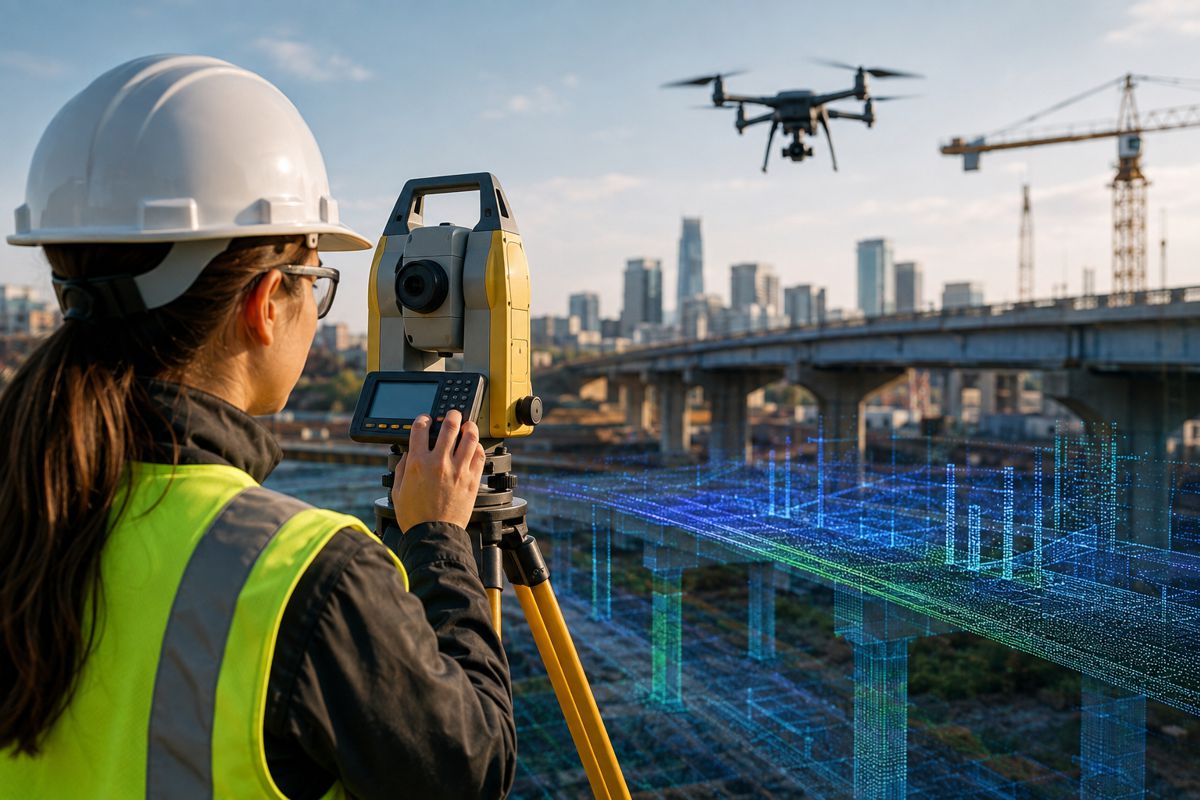
Technology is changing those occupations rather than simply removing the need for them. The BLS expects drones and other technologies to improve surveying productivity, while technicians will remain necessary to review and interpret the resulting information for accuracy and completeness.
Surveying and mapping increasingly sit within workflows involving unmanned aircraft, lidar, photogrammetry, GIS, reality capture, machine learning and large spatial datasets. Infrastructure owners and contractors may have access to considerably more information about their assets and projects, but extracting useful engineering or operational decisions from it still depends upon people who understand what the data represents.
From Scholarship to Workforce Programme
The GEO Empower initiative is aimed particularly at university students interested in applying geospatial, surveying, mapping, GIS and 3D technologies to social and environmental applications. Applicants must currently reside in the United States, and the programme is intended particularly for students early in their studies who would benefit substantially from attending an industry event for the first time.
Successful applicants receive access to conference sessions, keynotes and networking events, three nights’ accommodation and reimbursement for air and ground travel up to the programme’s $1,000 limit.
“The GEO Empower Scholarship has connected us with some of the most talented and passionate students in the geospatial field, and we are proud to grow this program as part of our workforce development initiatives,” said Lora Burns, Senior Marketing Manager at Geo Week. “Demand for geospatial talent is growing faster than qualified graduates entering the field and this scholarship is one of the most direct ways we can invest in closing that gap.”
Geo Week is also introducing a formal Workforce Development Committee comprising geospatial professionals, educators and advocates. Its remit covers conference content, career development opportunities and student outreach, giving employers and educators a more direct role in how the event engages with prospective entrants to the profession. A tiered sponsorship programme provides an industry funding route for the initiative and the GEO Empower scholarships.
The breadth of the geospatial sector means students studying one discipline may have relatively little exposure to commercial applications emerging elsewhere. A civil engineering student encountering terrestrial laser scanning, for example, may find the same underlying technology being used for construction verification, bridge inspection, digital twins or industrial asset management. Photogrammetry and aerial mapping similarly extend from traditional surveying into highways, mining, utilities, emergency response and environmental monitoring.
Geo Week’s conference reflects that convergence. Its programme covers lidar, laser scanning, photogrammetry, remote sensing, reality capture, machine learning and AI, with audiences ranging from land surveyors and GIS specialists to civil engineers, BIM and VDC managers, infrastructure agencies and data scientists. Academic programmes can teach the underlying science and engineering, while an exhibition and conference expose students to the equipment, software, workflows and organisations turning those disciplines into commercial operations.
“Students who attend Geo Week are exposed to one of the largest and most impactful geospatial conferences in the world, and we need the next generation to physically be there in-person to connect with opportunities, ideas, and hands-on product demos that will define their careers,” said Burns.
Geo Week Moves to Salt Lake City
The 2027 programme will coincide with Geo Week’s move from Denver to Salt Lake City, where the event will run from 23 to 25 February at the Salt Palace Convention Center. The conference brings together disciplines that were once more clearly separated, from conventional land surveying and aerial mapping to reality capture, BIM, digital construction and spatial data science.
That convergence is also changing what an entry-level geospatial career can look like. A student entering the sector in 2027 could eventually work with satellites, drones, mobile mapping systems, terrestrial scanners, construction machinery, digital twins or AI-assisted spatial analysis. The profession still requires the fundamental ability to measure and understand the physical world, but the tools available for doing so continue to multiply.
Applications for the 2027 GEO Empower Event Scholarship remain open until 30 October 2026.
Key Industry Questions
- What is the GEO Empower Event Scholarship? It is a Geo Week programme providing selected US university students with funded access to the annual geospatial conference and tradeshow, together with mentoring and networking opportunities.
- Who can apply for the 2027 scholarship? The programme is open to university students residing in the United States who demonstrate an interest in using geospatial technology for positive social or environmental impact.
- What does the scholarship cover? Recipients receive a full conference pass, three nights of hotel accommodation and reimbursement of up to $1,000 for airfare and ground transportation, together with onsite mentoring.
- How many scholarships are available? Three students will receive scholarships for the 2027 event.
- When do applications close? Applications close on 30 October 2026.
- When and where is Geo Week 2027? Geo Week takes place from 23 to 25 February 2027 at the Salt Palace Convention Center in Salt Lake City, Utah.
- Why is geospatial workforce development relevant to construction and infrastructure? Surveying, GIS, lidar, photogrammetry and reality capture increasingly feed into planning, design, construction, inspection and asset-management workflows. Employers therefore need people who can combine spatial-data skills with an understanding of physical assets and engineering applications.
- Are drones and automation reducing the need for survey professionals? They are changing productivity and working methods, but US employment projections still anticipate thousands of annual openings across surveying and mapping occupations. Human interpretation and verification of increasingly automated data collection remain important parts of the workflow.
Strategic Takeaways
- Workforce development is becoming intertwined with technology adoption as geospatial roles require familiarity with a wider range of sensors, software and data workflows.
- Replacement demand is an important part of the employment picture, creating recruitment needs even where overall occupational growth remains moderate.
- Automation is changing surveying and mapping work towards interpretation, verification and management of increasingly automated data collection.
- Bringing students into direct contact with equipment manufacturers, practitioners and infrastructure applications can expose them to career routes extending beyond conventional surveying.
- Geo Week’s committee and sponsorship structure turns its scholarship from an isolated student initiative into a potentially longer-term industry workforce programme.