Autonomous Rollers Move into Production on Puerto Rico Airport Project
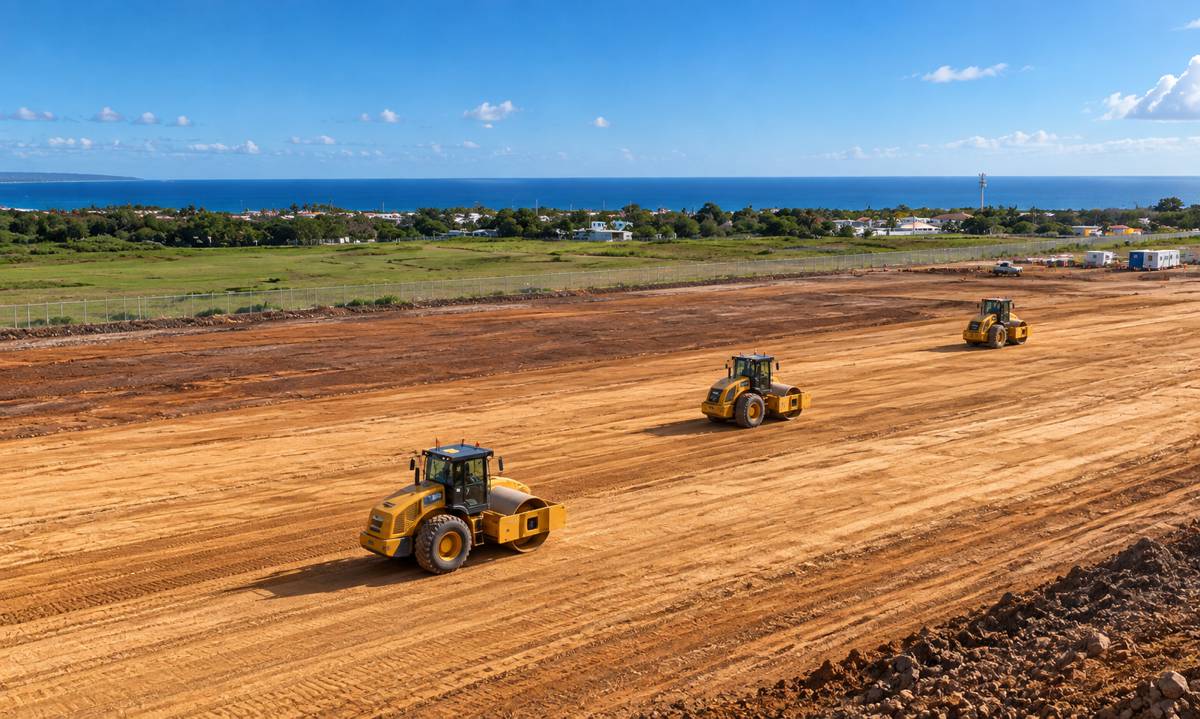
Three autonomous compaction rollers are working together on the construction of a new runway at Rafael Hernández International Airport in Aguadilla, Puerto Rico, with a single operator supervising all three machines.
Ferrovial has adapted the rollers to operate autonomously within predefined working areas, following planned trajectories and completing multiple passes without continuous manual control. They are being deployed on the $239 million runway project, where construction is taking place without interrupting airport operations.
At 3,350 metres long and 46 metres wide, the new runway provides the kind of repetitive, geometrically defined operation for which autonomous construction equipment is particularly well suited. Compaction depends upon repeated passes across prescribed areas, with coverage and consistency more important than the continual operator judgement required for excavation, loading or other work in changing site conditions.
Briefing
- Ferrovial has deployed three autonomous compaction rollers at Rafael Hernández International Airport in Puerto Rico.
- A single operator can supervise several rollers working simultaneously within predefined areas.
- The machines follow planned trajectories and make repeated compaction passes without continuous manual control.
- Ferrovial says AI-powered vision and obstacle detection can stop the machines when people or vehicles enter their operating area.
- The deployment forms part of a $239 million project to construct a 3,350-metre runway while airport operations continue.
Automating the Compaction Process
Much of a compaction operation can be planned before the roller starts moving. The required area can be mapped, routes established and passes programmed according to the compaction plan, allowing the machine to repeat a defined sequence across a comparatively predictable surface.
Ferrovial’s system allows the rollers to carry out multiple passes inside predetermined areas while maintaining their planned trajectories. Continuous control of the operation can also reduce some of the variability associated with manually driven compaction, particularly across large working areas where operators repeatedly cover the same ground.
The deployment does not remove the operator. It changes the operator’s role from directly driving one roller to supervising several machines carrying out predetermined tasks. Human supervision remains available for exceptions, site coordination and circumstances outside the machines’ programmed working envelope.
That changes the economics of autonomy considerably. The commercial proposition is no longer simply a roller capable of driving itself, but a small fleet in which one person can potentially oversee several productive machines.
Whether that translates into higher productivity will depend on performance in normal production: how many machines one operator can supervise effectively, how frequently human intervention is required and whether autonomous operation maintains the required compaction rate without slowing the wider construction programme.
Working Around an Active Airport
Rafael Hernández International Airport adds another constraint. The runway is being constructed while airport operations continue, making segregation, machine movement and control of the working area particularly important.
Ferrovial says the rollers incorporate AI-powered vision and obstacle detection systems capable of identifying people or vehicles and stopping the machinery automatically. Such systems provide an additional layer of machine control, although they do not eliminate the need for conventional site controls, exclusion zones and human supervision.
The large, defined pavement areas involved in runway construction provide predictable machine paths while strict construction specifications place a premium on repeatability. Once a working zone has been established and segregated from other activities, the rollers can repeat programmed movements without requiring an operator to reproduce the same route manually.
Federal Aviation Administration records show continuing investment in runway reconstruction at Rafael Hernández International Airport, while Puerto Rico Ports Authority records indicate wider runway, taxiway and terminal works around the airport. The autonomous rollers are therefore operating within an active aviation infrastructure programme rather than on an isolated demonstration site.
From Autonomous Machine to Supervised Fleet
Construction equipment manufacturers and contractors have spent years developing different levels of machine automation, ranging from guidance and automated blade control to remote operation and autonomous working cycles. The practical question is increasingly which construction processes can use that capability productively.
Compaction presents a relatively straightforward case. Rollers work at comparatively low speeds, follow repetitive paths and spend much of their operating cycle performing movements that can be planned in advance. Multiple machines can also work across the same large construction area, making supervision of several units more practical than it would be for machines carrying out unrelated tasks around a congested site.
Ferrovial’s three-roller deployment takes advantage of those characteristics. The important operating unit becomes the fleet rather than the individual autonomous roller: three machines carrying out the same repetitive construction process while one person oversees their operation.
For contractors, the eventual value of that model will depend less on whether a roller can move without somebody sitting in the cab than on what happens across an entire shift. Operator interventions, machine utilisation, achieved compaction, interaction with other site activities and the number of machines that can be supervised simultaneously will determine whether the technology changes production economics.
The Aguadilla project puts that operating model into real production rather than a demonstration environment. The useful evidence will come from the work itself: how frequently the rollers require intervention, whether one operator can consistently supervise all three, and how autonomous compaction performs against conventional operation over the course of the runway programme.
Key Industry Questions
- Why is compaction suitable for autonomous construction machinery? Compaction involves repeated passes over defined areas and can often be planned in advance. Those characteristics make machine trajectories easier to automate than operations involving continuously changing excavation, loading or interaction with other equipment.
- How many autonomous rollers is Ferrovial using in Puerto Rico? Three technologically adapted compaction rollers are operating autonomously under the supervision of a single operator.
- Are the rollers completely unsupervised? No. Ferrovial describes a supervised system in which one operator monitors several autonomous machines rather than directly driving each roller.
- How do the machines respond to people or vehicles? Ferrovial says the rollers use AI-powered vision and obstacle detection technology that can stop the machinery when people or vehicles are detected.
- Where are the autonomous rollers being used? They are being deployed during construction of a new runway at Rafael Hernández International Airport in Aguadilla, Puerto Rico.
- How large is the new runway? According to Ferrovial, the runway measures approximately 3,350 metres long and 46 metres wide.
- How much is the project worth? Ferrovial values the project at $239 million.
- Will autonomous rollers eliminate conventional site safety controls? No. Detection and automatic stopping systems provide another layer of machine control, but autonomous equipment still operates within a managed construction environment requiring appropriate segregation, supervision and site procedures.
- What changes when one operator supervises several machines? The operator moves from continuously controlling one roller to monitoring several machines carrying out predetermined tasks, intervening when operating conditions require it.
Strategic Takeaways
- Repetitive, geographically constrained construction tasks provide a practical environment for autonomous machinery.
- Supervising several machines from a single operator position changes the potential economics of autonomy more substantially than removing the driver from one machine.
- Autonomous equipment can be introduced for individual processes without requiring the entire construction site to operate autonomously.
- Runway construction combines large repetitive working areas with demanding pavement specifications, providing a useful environment for automated compaction.
- Intervention rates, machine utilisation and achieved compaction will provide better measures of commercial performance than autonomy alone.