Asphaltica 2026 Puts Road Maintenance Under the Microscope
Italy has almost 837,000 kilometres of roads, but maintaining them is becoming an increasingly complicated exercise in engineering, economics and public procurement. Asphalt costs remain under pressure, environmental criteria are changing specifications, digital monitoring is moving into routine asset management, and much of the network ultimately depends on local authorities working within constrained maintenance budgets.
That gives Asphaltica 2026 considerably more to discuss than asphalt production and paving machinery when the international road exhibition returns to BolognaFiere from 7 to 10 October.
Organised by BolognaFiere in collaboration with SITEB, the Italian Roads and Bitumen Association, the 2026 edition will bring together 140 exhibitors across 9,800 square metres of net exhibition space in the new Hall 37. More than 8,000 industry professionals are expected, supported by around 40 conferences and workshops covering road materials, machinery, recycling, digitalisation, safety, regulation and infrastructure management.
The exhibition has grown substantially since 2024. Exhibitor numbers are up by 18%, while net exhibition space has increased from 7,300 square metres to 9,800 square metres. Eighteen exhibitors will come from seven countries outside Italy, adding an international dimension to an event that remains closely tied to the particular challenges of the Italian road network.
“Asphaltica is the main national appointment and one of the most important in Europe for road transport operators. We are ready to launch a new edition that has all the prerequisites to reconfirm the exhibition’s leadership. During these four days, BolognaFiere will become the elected venue for manufacturers of machinery, plants, materials, and solutions to meet those who design, build, and manage infrastructure. It is a fundamental opportunity to discuss the evolution of the sector and the technologies that can make our roads more efficient, sustainable, and safe,” said Raul Barbieri, Director of Asphaltica.
Briefing
- Asphaltica 2026 takes place at BolognaFiere from 7 to 10 October in the new Hall 37.
- The exhibition will host 140 exhibitors across 9,800 square metres, with more than 8,000 industry visitors expected.
- Around 40 conferences and workshops will address materials, recycling, digitalisation, safety, regulation and road infrastructure management.
- A Sustainable Construction Site demonstration will recreate the road resurfacing cycle using machinery, high-RAP mixtures, low-emission technologies and mobile laboratories.
- Asphaltica will expand its format in 2027 with Asphaltica World in Rome before the main international exhibition returns to Bologna in 2028.
Road Maintenance in Italy
The machinery, materials and technology displayed in Bologna sit within a road maintenance market facing difficult economics. SITEB reported in June 2025 that Italian asphalt production had remained at 34.3 million tonnes during 2024, unchanged from the previous year. The association valued production and laying activity at approximately €3.6 billion and put employment across the sector at around 38,000 people.
More recent pressure has come from raw materials. SITEB said in August 2026 that bitumen prices had risen from an average of around €420 to more than €600 per tonne. For contractors working on projects tendered under substantially different cost conditions, rapid movements in a fundamental input can become particularly difficult where price revision mechanisms cannot respond at the same pace.
Those pressures are unevenly distributed across the road network. SITEB estimates that Italy has almost 837,000 kilometres of roads, of which approximately 7,000 kilometres are motorways and around 32,000 kilometres are managed by ANAS. More than 700,000 kilometres, including minor and unpaved roads, fall largely within provincial and municipal responsibilities.
Road maintenance is therefore as much an institutional problem as a technical one. Large national road authorities can build specialist asset-management teams, procure sophisticated survey systems and plan programmes across several years. A small municipality responsible for its own local network operates under very different financial and technical constraints.
The technologies appearing at Asphaltica increasingly extend beyond the asphalt plant, paver and roller. Condition monitoring, pavement data, artificial intelligence, connected road infrastructure and predictive maintenance are becoming part of the same conversation as aggregates, binders and compaction, allowing deterioration to be identified earlier while repairs remain manageable.
Recycling Moves Into the Mainstream
Reclaimed asphalt pavement has been used for years, but the combination of raw-material costs, circular-economy objectives and procurement requirements is pushing recycling further into mainstream pavement engineering. The technical challenge is no longer simply whether reclaimed material can be incorporated into asphalt, but how much can be used while maintaining predictable performance, durability and consistency.
Italy’s Minimum Environmental Criteria for roads, generally referred to as CAM Strade, add another layer. The requirements bring lifecycle assessment, recycled materials, pavement durability and environmental performance more directly into public procurement.
SITEB has supported the principle behind the regulations while also warning about the practical difficulties of implementation, particularly for smaller public authorities without specialist pavement engineering resources. Lifecycle assessment and pavement-condition methodologies can introduce considerable technical complexity into organisations historically focused on delivering routine local maintenance.
Asphaltica will address the subject directly on 10 October with an operational CAM Strade course intended to translate regulatory requirements into working practice. Lifecycle assessment will also feature earlier in the programme, including a session examining the applicability of LCA methodology to asphalt concrete.
The subject becomes particularly relevant when competing materials or pavement strategies make environmental claims based on different boundaries, assumptions, service lives and recycling scenarios.
A Roadworks Site Inside the Exhibition
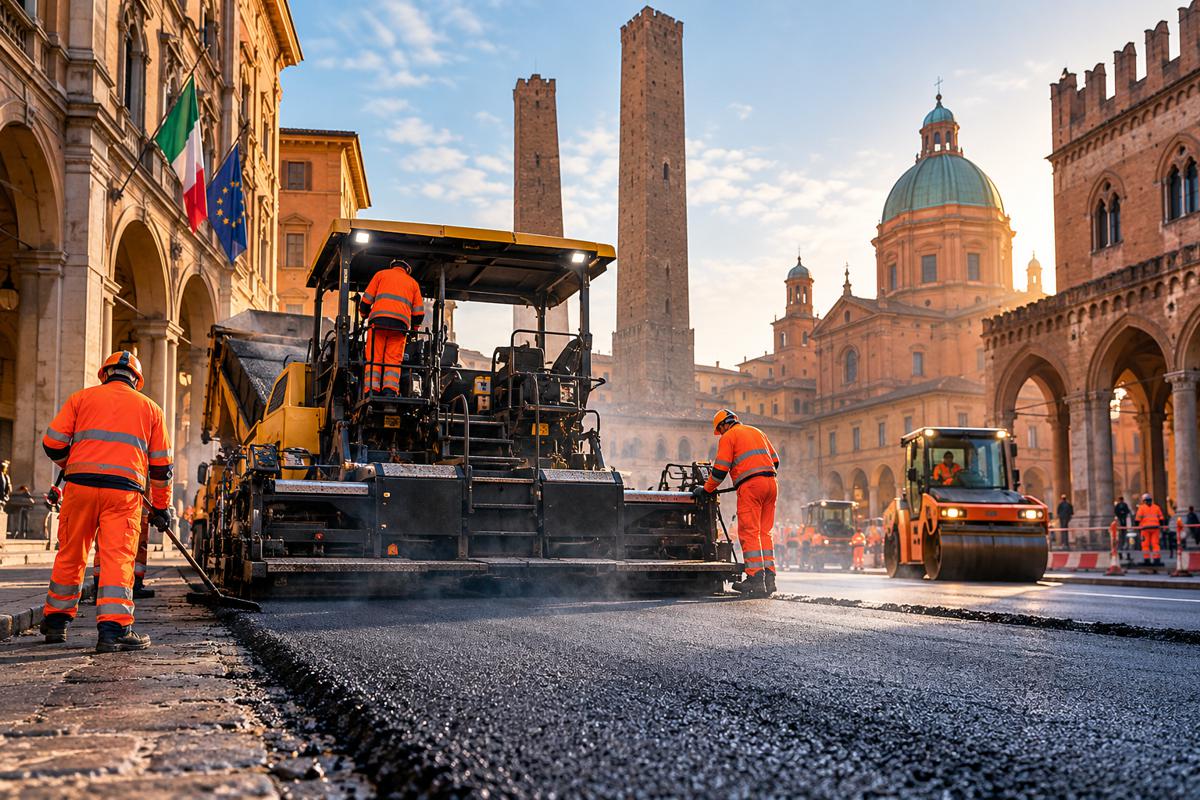
One of the more practical elements of Asphaltica 2026 will be the Cantiere Sostenibile, or Sustainable Construction Site, organised by InFrastrade. Rather than displaying individual technologies in isolation, the demonstration area is intended to show the complete resurfacing process, covering soil stabilisation, compaction, asphalt laying, high-RAP mixtures, low-emission technologies and mobile laboratory testing.
Pavement performance ultimately depends on that chain of operations, from material design and production through transport, laying, temperature management and compaction to quality control. A sophisticated asphalt mixture cannot compensate indefinitely for poor laying or inadequate compaction. Equally, increasingly capable paving and compaction equipment still depends upon suitable materials, correct process control and an appropriate pavement design.
Machinery, Materials and Monitoring
Road machinery manufacturers represented at the exhibition include Wirtgen Group, Ammann, Marini, Bomag, Dynapac, Caterpillar dealer CGT, CAMS and Bernardi Impianti. Energy and bitumen-related companies include ENI and Italiana Petroli, while Mapei and Iterchimica represent the additives and materials side of the industry.
Road safety, engineering, monitoring and infrastructure organisations will also be represented, alongside ANAS and the World Road Association, PIARC. Together, they cover much of the physical and increasingly digital road lifecycle: production, materials, recycling, paving, compaction, testing, monitoring, maintenance, signage, safety and rehabilitation.
Digitalisation is particularly relevant because road authorities are acquiring considerably more information about their assets than was possible when inspection largely depended upon periodic visual surveys. Mobile mapping, machine vision, connected sensors, ground-penetrating radar, pavement scanners and automated defect detection can create detailed pictures of road condition, although converting those datasets into maintenance decisions that fit engineering priorities and available budgets remains the harder problem.
Artificial intelligence can assist with classification, deterioration analysis and prioritisation, but the quality of the underlying inspection data and the engineering model remains fundamental. Roads still deteriorate through physical mechanisms: traffic loading, water ingress, temperature cycles, material ageing, inadequate drainage, weak foundations and construction defects. Digital systems may become better at finding those problems, but understanding their causes remains an engineering task.
Smart Roads Meet Conventional Engineering
The relationship between digital infrastructure and traditional road engineering will be explored in the SITEB Agorà programme, including an 8 October session titled “From Traditional Roads to Smart Roads”.
Smart-road development can encompass communications, traffic management, sensors, connected vehicles, roadside systems and infrastructure monitoring, but those capabilities still depend upon a functioning physical asset. A connected road with a deteriorating pavement remains a deteriorating road.
Better condition information can improve maintenance planning, while connected infrastructure can provide additional operational data about traffic, weather and incidents. Combining those sources can allow maintenance programmes to become more closely linked to the actual behaviour and condition of the asset rather than fixed inspection cycles alone.
Road safety forms part of the same programme. Asphaltica will include safety equipment, signalling and infrastructure specialists, while Assosegnaletica will preview a new Manual for Luminous Signals covering their selection, installation and maintenance. The Ragazzi On The Road initiative will provide a different perspective, placing young people alongside emergency and safety personnel to improve awareness of road safety and legal responsibility.
Eight Decades of ANAS
Alongside the emerging technology, Asphaltica will host a preview exhibition of vintage machinery and equipment ahead of the 80th anniversary of ANAS, founded in 1946 following the earlier AASS road organisation established in 1928.
The historic equipment provides a useful counterpoint to the sensor-equipped machinery and digital systems elsewhere in Hall 37. Road construction has been mechanised for generations, but the underlying operations remain recognisable: prepare the foundation, produce and place the material, compact it correctly, manage water, inspect the pavement and repair deterioration before it spreads.
What has changed dramatically is the information surrounding those operations. Modern contractors can measure temperatures, passes, compaction performance, machine position and production data almost continuously. Road owners can survey kilometres of pavement rapidly and combine condition information with geographic asset databases, while material producers can exercise tighter control over mixes and increasingly incorporate reclaimed material. The engineering principles have not disappeared; they are being measured more closely.
From Bologna to Rome
Asphaltica is also preparing to extend beyond its traditional Bologna format. Asphaltica World is scheduled for 20 and 21 October 2027 at the Salone delle Fontane in Rome, following an earlier format staged in Bari in 2025. The Rome event is intended to provide a conference and exhibition environment bringing industry representatives into closer contact with political and institutional decision-makers, before the full international exhibition returns to Bologna in 2028.
That institutional conversation sits alongside increasingly capable pavement technology, recycling systems, machinery and infrastructure monitoring. Their effectiveness still depends on road owners having stable programmes, suitable procurement mechanisms and enough certainty to intervene before deterioration turns routine maintenance into reconstruction.
“The road construction and maintenance supply chain is experiencing a phase of strong evolution: more sustainable materials and technologies, recycling, digitalization, waterproofing and consolidation systems, monitoring, new regulations, and innovative solutions are changing the way road infrastructures are designed and built. However, to accompany this transformation, stable planning of interventions, clear rules, and an increasingly close dialogue between institutions and operators are needed. Asphaltica offers a concrete opportunity to integrate these skills and give visibility to an industrial sector that plays a decisive role in the future development of our country,” said Stefano Ravaioli, General Manager of SITEB.
Asphaltica 2026 will provide plenty of machinery to examine in Bologna, but Hall 37 will also bring together the less visible parts of road maintenance: data, specifications, materials, procurement and the decisions that determine whether intervention comes early enough to prevent a larger repair.
Key Industry Questions
- When and where is Asphaltica 2026? Asphaltica 2026 takes place at the Bologna Exhibition Centre from 7 to 10 October 2026, with the exhibition located in Hall 37.
- How large is Asphaltica 2026? The organisers report 140 exhibitors occupying 9,800 square metres of net exhibition space, with more than 8,000 industry professionals expected.
- What industries does Asphaltica cover? The exhibition covers asphalt and bitumen, road construction machinery, paving and compaction, recycling, additives, monitoring, road safety, lighting, engineering, rental, training and infrastructure technology.
- What is reclaimed asphalt pavement? Reclaimed asphalt pavement, usually abbreviated to RAP, is material recovered when existing asphalt pavement is removed or milled. Properly processed RAP can be incorporated into new asphalt mixtures, recovering aggregates and part of the existing bituminous binder.
- What are CAM Strade? CAM Strade are Italy’s Minimum Environmental Criteria for road infrastructure procurement. They introduce environmental considerations including lifecycle assessment, materials, durability and circular-economy principles into public road projects.
- What is the Sustainable Construction Site at Asphaltica? The Cantiere Sostenibile is a live demonstration area intended to reproduce stages of road resurfacing, including stabilisation, compaction, paving, high-RAP asphalt, low-emission technologies and mobile laboratory activities.
- Why is digital monitoring becoming important for road maintenance? Digital surveys can collect detailed condition data across large road networks, helping authorities identify deterioration and prioritise interventions. Their usefulness depends on the quality of the data and how effectively it is incorporated into engineering and maintenance decisions.
- What is Asphaltica World? Asphaltica World is a conference-exhibition format scheduled to take place in Rome on 20 and 21 October 2027, with greater emphasis on dialogue between the road industry and institutional decision-makers.
Strategic Takeaways
- Road maintenance technology is increasingly being considered as a complete process linking materials, machinery, data, inspection and asset management.
- Higher bitumen costs strengthen the economic case for careful material management, recycling and longer pavement service life.
- RAP is moving further into conventional pavement production, but mixture design, quality control and performance remain more important than recycling percentages alone.
- Digital inspection can identify deterioration earlier, although useful maintenance decisions still depend on pavement engineering and realistic budgets.
- Environmental procurement requirements are increasing the technical demands placed on road authorities as well as contractors and material suppliers.