From Brazil to Bogotá: 10 Infrastructure Projects to Watch Across Latin America
Latin America’s geography has always imposed a price on movement.
The Andes divide the continent from north to south. The Amazon and other great river systems make conventional transport infrastructure difficult across enormous areas. Agricultural and mineral-producing regions can lie hundreds or thousands of kilometres from export ports, while some of the world’s largest cities have expanded faster than their transport networks can accommodate.
Infrastructure cannot shorten those physical distances. It can make them less expensive.
Across Brazil, new and upgraded freight railways are attempting to connect the productive interior more efficiently with ports. Mexico is rebuilding an interoceanic railway and port corridor across the Isthmus of Tehuantepec while adding freight infrastructure to the Tren Maya network. Argentina is constructing a pipeline and marine terminal to move oil from Vaca Muerta directly into international markets, while Paraguay and Brazil are completing a new international bridge as part of a road corridor extending towards Pacific ports in Chile.
The same calculation is taking place inside the region’s megacities. Bogotá is building its first metro. São Paulo is bringing another major underground railway into service, while Lima and Santiago are driving new tunnels beneath cities containing millions of people.
Briefing
- Brazil’s FICO-FIOL programme is gradually assembling an east-west freight railway between agricultural and mineral-producing regions, the North-South Railway and Atlantic export infrastructure.
- Mexico’s Interoceanic Corridor combines railways, ports and industrial infrastructure across the Isthmus of Tehuantepec, with construction continuing on the 447 km Line K towards Guatemala.
- Argentina’s Vaca Muerta Oil Sur programme is constructing a new pipeline, storage and Atlantic export terminal to create a high-capacity route from the Neuquén Basin to international oil markets.
- Bogotá Metro Line 1 was 82.33% complete at the end of August 2026, with 17 km of its 23.9 km elevated alignment already constructed.
- The Bioceanic Corridor through Paraguay is advancing through road construction and the completion of a new 1,294 m bridge across the Paraguay River to Brazil.
1. FICO-FIOL East-West Railway Corridor, Brazil
Brazil produces enormous quantities of grain and minerals deep inside a continent where the distance to the coast can determine whether an export is globally competitive.
The FICO-FIOL programme is gradually assembling a new railway axis between Brazil’s productive interior and Atlantic export infrastructure. Rather than one continuous construction contract, it comprises several railway sections at different stages of construction, concession and development.
FIOL 1 extends 537 km between Ilhéus and Caetité in Bahia. The section was subconcessioned to Bahia Mineração, or Bamin, for 35 years, with responsibility for completing and operating the railway. The concession envisages billions of reais of investment, with the railway ultimately feeding Porto Sul on the Atlantic coast.
A 127 km construction package on FIOL 1 was awarded to the TCR-10 consortium, formed by Brazilian contractor Tiisa and China’s CREC-10. The contract covers railway infrastructure and superstructure as Bamin works to complete a route whose earlier sections had been left at very different stages of construction.
FIOL 2 continues west from Caetité towards Barreiras and Correntina. Approximately 485 km of railway is involved, with construction divided into several lots under Infra S.A. FIOL 3, which would continue towards Mara Rosa in Goiás, remains at an earlier development stage.
At Mara Rosa, the corridor would meet FICO, the Central-West Integration Railway. Its first major section runs 383 km towards Água Boa in Mato Grosso and is being constructed by Vale as part of obligations associated with the renewal of its existing railway concessions.
The route ultimately points towards one of the world’s most productive agricultural regions. Mato Grosso alone produces huge volumes of soybeans and maize that currently travel long distances towards export terminals.
FICO-FIOL would give those flows another railway route towards the coast while connecting with Brazil’s existing North-South Railway. The individual sections may be progressing at different speeds, but together they show how Brazil is trying to turn separate freight lines into a more connected national railway system.
2. Interoceanic Corridor of the Isthmus of Tehuantepec, Mexico
At the narrowest point of southern Mexico, the distance between the Pacific Ocean and Gulf of Mexico has attracted infrastructure schemes for more than a century.
The modern Interoceanic Corridor of the Isthmus of Tehuantepec is turning that geography into a railway, port and industrial logistics system.
Its principal trans-isthmus railway, Line Z, connects the Pacific port of Salina Cruz with Coatzacoalcos on the Gulf. Mexico has rehabilitated and modernised the existing route with new track, structures, stations and operating systems.
The programme extends well beyond Line Z. The approximately 330 km FA Line connects Coatzacoalcos with Palenque, linking the corridor with southeastern Mexico and the Tren Maya network. Associated branch works totalling more than 110 km remained under construction during 2026.
Farther south, the approximately 447 km Line K is being rehabilitated towards Ciudad Hidalgo and the Guatemalan border. By the middle of 2026, that programme was around 90% complete.
Port investment is advancing alongside the railway at Salina Cruz and Coatzacoalcos, while industrial development zones are intended to attract manufacturing and logistics operations to the corridor.
Comparisons with the Panama Canal are inevitable but misleading. A railway across Mexico is not a substitute for moving a ship directly between two oceans. Containers have to be unloaded, transferred by rail and loaded again. Tehuantepec instead provides another connection between Mexico’s two coasts while linking ports, railways and industrial land in a region historically separated from the country’s largest economic centres.
The project is exploiting one of the relatively few places in Latin America where geography reduces rather than increases the distance between major maritime trade routes.
3. Vaca Muerta Oil Sur, Argentina
Argentina’s Vaca Muerta formation contains enormous oil and gas resources, but producing hydrocarbons in Patagonia is commercially useful only if they can reach customers.
Vaca Muerta Oil Sur is constructing a new crude-oil export corridor from the Neuquén Basin towards Punta Colorada on Argentina’s Atlantic coast. The programme combines a long-distance pipeline with pumping infrastructure, storage tanks and a new marine export terminal.
Construction accelerated through 2026, with the pipeline reported more than 60% complete by April.
At Punta Colorada, new storage tanks with capacities of approximately 120,000 cubic metres are under construction, with individual tanks around 82 metres in diameter. Offshore equipment has also begun arriving for the marine loading system that will transfer crude from the terminal to export tankers.
The programme is being developed by a consortium of major oil producers operating in Argentina, creating dedicated export capacity rather than relying entirely on existing pipeline and port infrastructure.
Phase 2 is intended to provide capacity of approximately 390,000 barrels per day by mid-2027, with later expansion capable of increasing throughput considerably beyond that level.
The completed system will give Vaca Muerta a direct high-capacity route to the Atlantic, combining pipeline transport, storage and marine loading within a single export chain.
4. Bogotá Metro Line 1, Colombia
Bogotá has spent decades discussing a metro. It is now watching one rise above its streets.
Line 1 will extend approximately 23.9 km from Bosa in the south-west to Calle 72, running predominantly on an elevated viaduct through one of Latin America’s largest urban areas.
By the end of August 2026, the project had reached 82.33% overall completion. Seventeen kilometres of viaduct had been constructed by that point, and the railway had moved sufficiently far into the systems phase for trains to begin running under test conditions.
Rather than tunnelling beneath Bogotá, contractors are constructing a continuous elevated railway through an already congested city. Piers, precast viaduct structures, stations, railway systems and public-realm works must all be delivered while traffic and daily life continue below.
Some locations require more specialised solutions. At Avenida Caracas and Calle 26, construction has included a 215 metre railway bridge using balanced-cantilever techniques to carry the metro across an existing grade-separated road intersection.
The completed railway will use automated trains. A journey between Bosa and Calle 72 that can currently take considerably more than an hour is expected to fall to around 27 minutes.
Testing will become increasingly important as civil construction gives way to systems integration, signalling, power, rolling stock and station commissioning. Comprehensive trial operation without passengers is scheduled to begin in September 2027.
After generations of proposals, abandoned plans and political argument, Bogotá’s first metro is no longer an ambition on a map. Much of it is already standing above the streets.
5. São Paulo Metro Line 6-Orange, Brazil
São Paulo is solving a similar mobility problem underground.
Line 6-Orange extends approximately 15.3 km through the Brazilian metropolis, connecting Brasilândia in the north-west with São Joaquim near the central area.
The programme includes 15 stations and 18 ventilation and emergency shafts, with tunnelling beneath some of the densest urban development in South America.
By early 2026, construction had exceeded three-quarters completion and excavation of the principal 15.3 km tunnel alignment had been completed. Much of the remaining workload consequently shifted towards stations, track, railway systems, architectural works and commissioning.
The transition into operation has already begun. In July 2026, the first six stations entered assisted operation, allowing the project to move progressively into service while work continues elsewhere on the line.
Once fully operational, Line 6 is expected to carry approximately 633,000 passengers each day. Journeys that can currently require around 90 minutes using existing public transport are expected to fall to approximately 23 minutes.
The project is being delivered through a public-private partnership, with ACCIONA playing a central role in construction and concession delivery. Line 6 adds capacity beneath districts where rebuilding the surface transport network at comparable scale would be extraordinarily difficult.
6. Lima Metro Line 2, Peru
Lima’s first underground metro is approaching the final stages of one of Peru’s most complex transport projects.
Line 2 runs east-west beneath Lima and Callao, creating a fully underground rapid-transit corridor through a metropolitan area containing more than ten million people.
By April 2026, the programme had passed 83% physical completion. An initial section is already carrying passengers, while tunnelling, station construction, railway systems and fit-out continue elsewhere along the alignment.
Stations and shafts have had to be constructed beneath heavily trafficked roads, with utilities relocated and traffic maintained around major work sites. Tunnel boring machines have advanced beneath developed areas where surface disruption has to be tightly controlled.
The wider programme also includes the branch towards Jorge Chávez International Airport, creating the prospect of a direct connection between the metro network and one of the country’s most important transport gateways.
Line 2 will give Lima its first high-capacity underground transport axis operating independently of the congestion on the streets above.
7. Santiago Metro Line 7, Chile
Santiago already has one of Latin America’s most developed metro systems, but the city continues to push new railway infrastructure beneath the surface.
Line 7 will create another east-west connection across the Chilean capital, linking Renca in the north-west with Vitacura in the north-east and providing interchange with the existing network.
By March 2026, the project had reached approximately 40% overall completion, with more than 16 km of tunnels excavated.
One of the important construction milestones came at Cal y Canto, where tunnelling fronts connected to create a continuous section approximately 1.7 km long. Station construction there had also progressed to around 60%.
The work involves extensive underground construction through a dense urban environment, together with shafts, stations, track, power, ventilation and railway systems.
Completion is currently targeted towards the end of 2028, adding another high-capacity corridor to a metro network already fundamental to movement across the Chilean capital.
8. Tren Maya Freight System, Mexico
The passenger railway attracted most of the attention when Tren Maya was built. The next stage is increasingly about freight.
Mexico is developing cargo facilities intended to turn the approximately 1,500 km passenger network into a mixed transport system capable of moving goods across the Yucatán Peninsula and southeastern states.
By June 2026, the freight programme had reached approximately 54% completion, with eight active construction fronts.
Four major cargo complexes are being developed at Palenque, Poxilá, Progreso and Cancún. Together, those facilities involve around 101 km of internal railway providing sidings, yards and logistics infrastructure for freight operations.
Additional works include approximately 48.7 km of new railway between Poxilá and Progreso, 18.9 km of rehabilitated railway towards Mérida and three freight branches totalling approximately 66.7 km.
The first 12 locomotives intended for freight operations have also arrived, with commercial cargo services targeted from 2027.
Freight operations require a different infrastructure layer from passenger services: yards, terminals, loading equipment, sidings and connections with industrial and maritime facilities. The connection towards Progreso is particularly important because it brings the railway more directly into the port logistics system.
The investment gives Tren Maya a freight role alongside its existing passenger function and creates another railway option for moving goods around southeastern Mexico.
9. Río Indio Reservoir and Panama Canal Water Programme, Panama
One of Latin America’s most important future transport projects is not a railway, road or port.
It is a reservoir.
The Panama Canal depends on freshwater to operate its locks. Each transit forms part of a much larger water-management system shared with the needs of Panama’s population.
Drought exposed the vulnerability of that arrangement when low water levels forced the Panama Canal Authority to restrict ship transits and vessel draughts.
The proposed Río Indio project is intended to strengthen the system. The Panama Canal Authority identifies the new reservoir as the most viable long-term solution for providing additional water for canal operations while helping secure supplies for more than half of Panama’s population.
The programme remains in development rather than heavy construction. Final design, land acquisition, environmental work, community engagement and procurement have been progressing ahead of a construction programme currently expected to begin in 2027 and continue towards 2031.
The Panama Canal shortens the maritime journey between the Atlantic and Pacific, but the locks that create that shortcut cannot operate indefinitely without sufficient freshwater.
Keeping ships moving between two oceans may ultimately depend on building a reservoir in the Panamanian interior.
10. Bioceanic Road Corridor, Paraguay and Brazil
Across the Paraguayan Chaco, another interoceanic route is taking physical shape.
The Bioceanic Road Corridor is intended to connect Brazil with Pacific ports in Chile through Paraguay and Argentina, creating a new overland freight route across the centre of South America.
Paraguay’s Route PY15 forms a critical part of that connection. Construction continued during 2026 on the section across the Chaco, including Lot 2 near Mariscal Estigarribia.
By April, eight construction fronts were active on that lot. Contractors had completed approximately 50 km of embankment, improved more than 44 km of subgrade with lime, placed around 33 km of soil-cement sub-base and completed 16 km of stabilised base, while asphalt surfacing had begun.
At the eastern end of the Paraguayan section, an even more visible piece of infrastructure is approaching completion.
The new Bioceanic Bridge spans the Paraguay River between Carmelo Peralta and Porto Murtinho in Brazil. The 1,294 metre cable-stayed structure is being built by the binational PYBRA consortium with investment of approximately G684.6 billion.
The bridge decks advancing from Paraguay and Brazil physically joined in July 2026, leaving finishing works, barriers, monitoring systems and associated infrastructure to be completed.
Road access is being built on both sides. Paraguay is constructing the connection between the bridge and PY15, while Brazil is developing a 13.1 km access on BR-267 incorporating six bridges and a viaduct.
The wider corridor continues through Argentina towards the Chilean ports of northern Chile. Once the remaining road, bridge, border and customs infrastructure is in place, freight from Brazil and Paraguay will have another route towards Pacific shipping without travelling to traditional Atlantic gateways.
Unlike many grand plans for a South American bioceanic connection, this corridor can already be measured in embankments, asphalt, bridge segments and kilometres of road under construction.
Shortening the Distance
Latin America’s infrastructure challenge begins with geography. The continent contains some of the world’s largest mountain ranges, forests and river systems, enormous agricultural and mineral-producing interiors, rapidly expanding cities and coastlines facing two oceans.
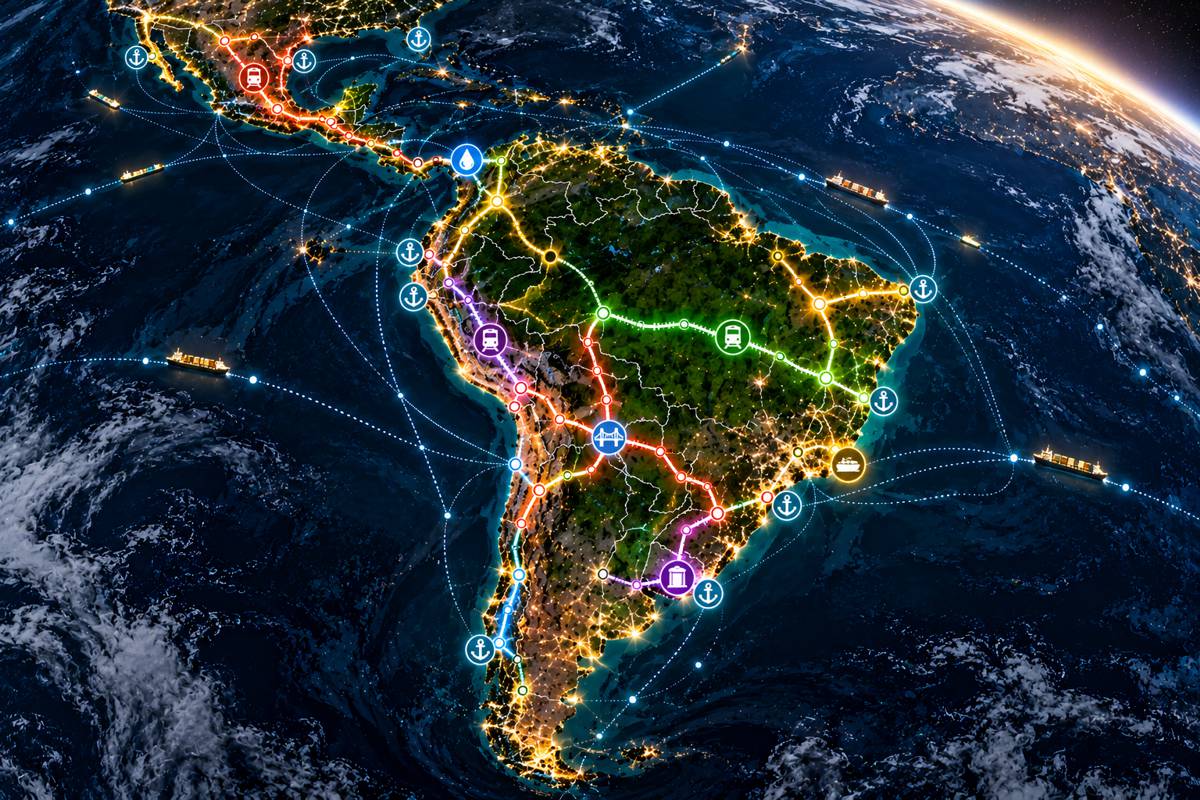
The projects now advancing across the region attack those distances at different scales. Brazil is assembling freight railways between its interior and the coast. Mexico is developing railway systems across an isthmus and around the Yucatán Peninsula. Argentina is constructing a direct export route from Vaca Muerta to the Atlantic, while the Bioceanic Corridor is creating another road connection towards the Pacific.
Bogotá, São Paulo, Lima and Santiago are doing something similar inside their metropolitan areas. Viaducts and tunnels cannot move neighbourhoods closer together, but they can turn journeys measured in hours into journeys measured in minutes. Chancay’s emergence as a major Pacific gateway in Peru adds another dimension as trade with Asian markets increases the value of efficient connections towards South America’s western coast.
None of these systems works in isolation. Railways require terminals and ports, pipelines require storage and marine loading facilities, highways crossing borders require customs infrastructure, and the Panama Canal depends on reservoirs feeding freshwater into its locks.
Latin America cannot change the mountains, forests, oceans or distances that have shaped its economic development.
Infrastructure can change how expensive those distances are.
Key Industry Questions
- What is the FICO-FIOL East-West Corridor? It is a developing Brazilian freight railway system combining sections of FICO and FIOL to improve connections between inland agricultural and mineral regions, the North-South Railway and Atlantic export infrastructure.
- Is Mexico’s Interoceanic Corridor intended to replace the Panama Canal? No. It provides a land-based connection between Pacific and Gulf ports, but cargo has to be transferred between ships and trains. Its wider purpose includes domestic logistics, port connectivity and industrial development.
- What is Vaca Muerta Oil Sur? VMOS is a new Argentine crude-oil export system combining a long-distance pipeline from the Vaca Muerta producing region with storage and marine terminal infrastructure at Punta Colorada.
- How advanced is Bogotá Metro Line 1? The project reached 82.33% overall completion at the end of August 2026. Seventeen kilometres of the 23.9 km viaduct had been constructed by that point.
- How large is São Paulo Metro Line 6? The line extends approximately 15.3 km and includes 15 stations and 18 ventilation and emergency shafts. Principal tunnel excavation has been completed and the first section entered assisted operation during 2026.
- How advanced is Lima Metro Line 2? The project had passed 83% physical completion by April 2026. An initial section is operating while construction and systems work continue elsewhere.
- What is being built for Tren Maya freight operations? The programme includes four major cargo complexes, around 101 km of internal track, a 48.7 km new connection towards Progreso, railway rehabilitation and several freight branches.
- Why does the Panama Canal need a new reservoir? Canal lock operations depend on freshwater. Río Indio is intended to strengthen long-term water availability for canal operations while also supporting drinking-water supplies.
- What is the Bioceanic Road Corridor? It is a developing highway corridor connecting Brazil with Pacific ports in Chile through Paraguay and Argentina. Major current works include Route PY15 across Paraguay, the new bridge between Carmelo Peralta and Porto Murtinho and associated access roads.
- Who is building the FICO-FIOL railway system? Different sections have different delivery structures. Bamin holds the FIOL 1 subconcession, Infra S.A. is responsible for works on FIOL 2, and Vale is constructing the first 383 km section of FICO between Mara Rosa and Água Boa.
Strategic Takeaways
- Latin America’s infrastructure investment is increasingly focused on reducing the economic penalty created by enormous distances, difficult terrain and congested cities.
- Freight rail, pipelines and international highways are creating additional routes between productive regions and maritime export gateways.
- Pacific trade is increasing the value of western gateways and transcontinental connections, while established Atlantic routes continue to handle enormous commodity flows.
- Bogotá, São Paulo, Lima and Santiago demonstrate that metropolitan mobility remains one of the region’s largest and most technically demanding infrastructure markets.
- The strongest projects increasingly depend on connected systems: railways need ports and terminals, pipelines need storage and marine facilities, international highways need border infrastructure, and shipping corridors can depend on water systems far from the coast.