Intel Targets AI Inference Economics with New GPU D-Series and Xeon Infrastructure
Intel has detailed a new AI accelerator design supporting up to 480 GB of memory, targeting one of the increasingly expensive challenges facing data centre operators: running large artificial intelligence models efficiently without allowing power consumption and infrastructure costs to escalate.
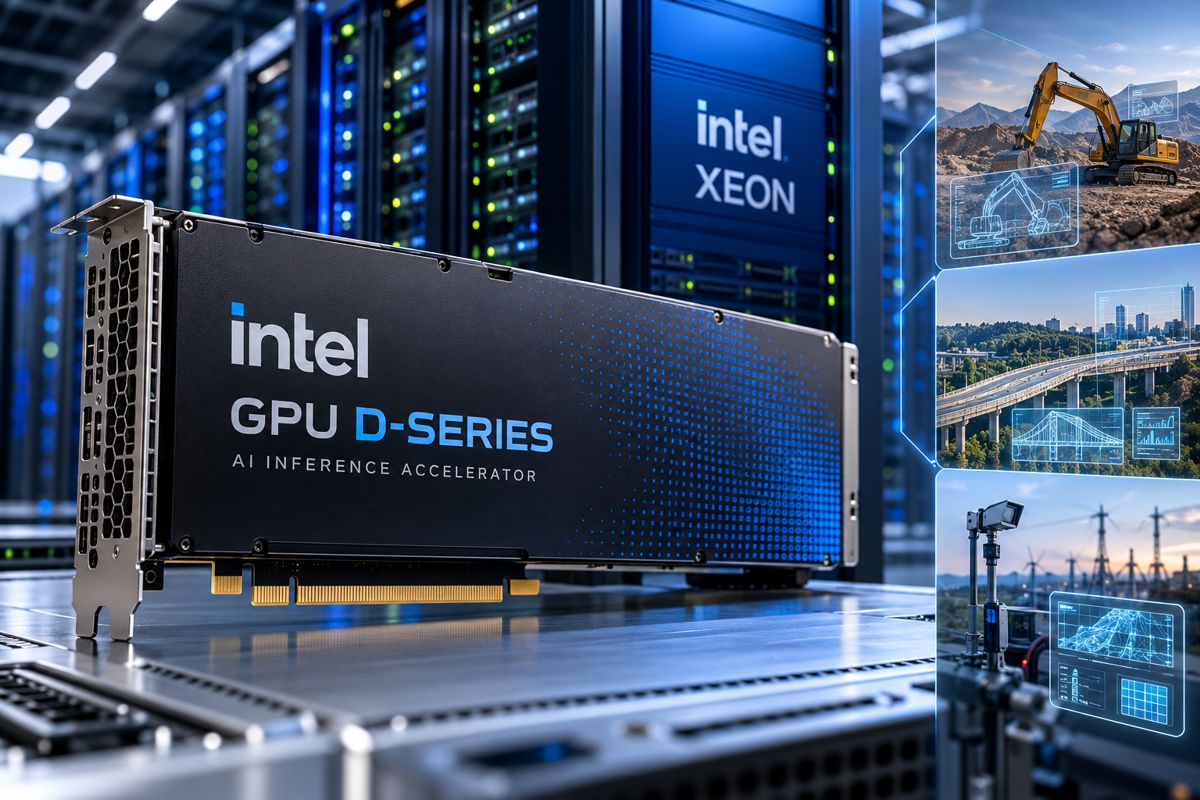
The new GPU D-series, formerly known as Crescent Island, combines Intel’s Xe3P architecture with LPDDR5X memory and a stated 350-watt power envelope. Unveiled at the Open Compute Project Global Summit 2026, the design is intended for sustained AI inference, where memory capacity and bandwidth can be as important as raw processing performance. Intel’s own PCIe card carries 160 GB of memory, while the architecture allows partners to develop configurations supporting up to 480 GB.
Alongside the GPU, Intel has introduced Xeon-based rack designs capable of accommodating more than 46,000 processor cores in selected configurations. Together, the developments form part of a broader effort to distribute AI workloads across CPUs, GPUs and specialised accelerators, allowing each component to handle the processing tasks for which it is best suited.
The approach is particularly relevant as AI applications move beyond individual prompts towards more complex operations involving multiple models, external software and extensive data processing. For organisations deploying these systems, the cost of computing increasingly depends on how efficiently the complete infrastructure operates rather than the theoretical performance of any single processor.
Briefing
- Intel has disclosed detailed specifications for its GPU D-series, previously code-named Crescent Island, based on the Xe3P architecture.
- Intel’s branded PCIe card provides 160 GB of LPDDR5X memory, with partner configurations supporting up to 480 GB.
- The GPU design offers a stated 1.5 TB/s memory bandwidth, 1.3 petaflops of FP8 compute and a 350 W power envelope.
- Selected Xeon 6+ rack configurations exceed 46,000 processor cores at a stated total rack power of 133.45 kW.
- Customer sampling is underway, supported by Intel’s work on open software frameworks and interoperable data centre infrastructure.
Memory Capacity and AI Inference
Training large AI models requires enormous quantities of computational processing, but running those models presents a different set of engineering constraints. Once trained, a model must be held in memory and accessed repeatedly as it processes requests, generates responses and works through increasingly long sequences of information.
Memory capacity and bandwidth become particularly important when models are large, requests involve extensive context or multiple applications share the same hardware. Even a powerful accelerator can spend time waiting for data if its memory system cannot keep pace with the processing units.
Intel’s D-series combines up to 480 GB of LPDDR5X memory in partner configurations with a stated bandwidth of 1.5 TB/s and 1.3 petaflops of FP8 compute performance. The company says the architecture can accommodate models containing up to 300 billion parameters on a single card, increasing to more than one trillion parameters in an eight-GPU system.
Those figures describe supported model capacities rather than guaranteed application performance. Actual requirements depend on factors including numerical precision, model architecture, context length and the memory needed to manage simultaneous inference requests. A model that fits within an accelerator’s available memory may still be constrained by processing speed, bandwidth or the demands of its operating environment.
The distinction between Intel’s own product and the wider design is also important. The company’s branded PCIe card contains 160 GB of LPDDR5X memory, while original design manufacturers can develop higher-capacity versions reaching 480 GB. Intel has stated a 350 W power envelope for the GPU D-series, although the supplied specifications do not establish identical operating characteristics for every possible partner configuration.
Intel has chosen a conventional PCIe format and air-cooled design, allowing the accelerator to be incorporated into server environments without necessarily requiring specialised liquid-cooling infrastructure. That could simplify deployment for operators expanding inference capacity within existing facilities, although electrical distribution, airflow and overall rack heat loads will still determine what modifications are necessary.
The commercial attraction of high-capacity memory is closely connected to utilisation. Keeping larger models resident in accelerator memory can reduce the need to distribute workloads across multiple devices, potentially simplifying system architecture and limiting some of the communication overhead associated with multi-GPU deployments.
Whether those advantages translate into lower operating costs will depend on the throughput achieved in production. Intel has disclosed hardware specifications and supported model capacities, but independently comparable inference benchmarks and complete system pricing will be needed to establish how the D-series performs against competing platforms.
Xeon Rack Architecture for Agentic AI
Intel’s latest Xeon rack designs address another part of the inference problem: the considerable general-purpose processing required to operate increasingly complex AI applications.
An agentic system may retrieve information from several sources, query databases, invoke external software, evaluate intermediate results and execute a sequence of tasks before producing an answer or completing an operation. The AI model performs the computationally intensive reasoning and generation, but much of the surrounding activity depends on conventional processors.
CPUs manage application execution, data movement, storage access, networking and interactions between different services. As the number of simultaneous AI agents increases, those supporting operations can become significant constraints on the performance of the complete system.
Intel has demonstrated new Xeon-based rack designs developed with ecosystem partners, many using the Open Compute Project’s Open Rack v3 standard. Selected Xeon 6+ configurations are specified at more than 46,000 processor cores per rack, with total rack power of 133.45 kW.
The figures demonstrate the processor density Intel is targeting, although they do not provide a direct measure of agentic AI performance. Core count alone cannot establish how many simultaneous tasks a rack can sustain, particularly when applications depend on external databases, network connections and accelerator availability.
Intel is increasingly framing system performance around completed work at a specified latency rather than individual processor benchmarks. In an agentic environment, an accelerator capable of generating responses quickly offers limited benefit if the surrounding infrastructure cannot retrieve information, execute tools or deliver data at a comparable rate.
This creates a substantial role for general-purpose computing alongside dedicated AI accelerators. Intel’s strategy builds on the established x86 ecosystem, using Xeon processors to manage workloads and coordinate resources while GPUs undertake the processing most suited to parallel acceleration.
The approach also allows infrastructure operators to vary the balance between CPU and GPU capacity according to their applications. A service handling extensive document retrieval and database operations may have different requirements from one concentrating on high-volume text generation, even when both use similar underlying AI models.
Open Software and Interoperable Infrastructure
Hardware capacity is only useful when developers can deploy applications without excessive software modification or dependence on a narrow selection of proprietary tools. Intel is therefore developing the D-series around its common Xe software foundation, with support for established AI frameworks, inference engines and deployment environments.
The company intends applications developed for existing Intel GPU platforms to remain portable across its newer hardware, reducing the work required to adopt additional accelerator generations. It is also contributing to upstream framework development so emerging open models can be supported as they become available.
Recent work includes early support for Meta’s Muse Glimmer, alongside software intended to accommodate a wider range of agentic applications. Intel’s AI for Enterprise Agent Toolkit already provides orchestration capabilities on Xeon processors, with a provider-based architecture designed to extend to Intel GPUs.
The software strategy is closely connected to Intel’s participation in the Open Compute Project, where the company says it has made 116 contributions since 2011.
One current initiative is the Open Adapter Card workgroup, which is developing a standardised sub-rack accelerator card form factor. The work addresses mechanical, electrical and management interoperability, with the intention of making it easier for equipment manufacturers and cloud operators to incorporate different accelerator technologies into compatible infrastructure designs.
Standardisation does not eliminate the practical differences between computing platforms. Software optimisation, driver support, memory management and application compatibility remain substantial considerations when moving workloads between processors from different manufacturers.
Nevertheless, a more consistent hardware and software environment could allow operators to introduce new processing technologies without replacing every element of their existing systems. For organisations making substantial investments in data centre infrastructure, the ability to extend the useful life of servers, racks and supporting equipment is an important part of long-term operating economics.
Industrial Applications and Connected Infrastructure
Although Intel’s announcement is primarily directed at data centre and enterprise computing markets, the underlying technology is relevant to the growing use of AI across engineering, industrial automation and infrastructure management.
Industrial AI operates across several distinct computing environments. Embedded processors handle functions directly within machinery, edge systems provide processing close to industrial operations, and centralised servers support applications requiring larger models, extensive datasets or shared computing resources.
The D-series is principally designed for the third category. Its power requirements and server-oriented architecture make it more suitable for data centres and substantial private computing installations than for direct integration into most mobile construction machines or compact industrial controllers.
Centralised inference can nevertheless support applications operating across connected equipment fleets and infrastructure networks. Machine telemetry, inspection imagery, maintenance records and engineering documentation can be processed together, allowing AI systems to assist with fault investigation, asset management and operational planning.
An infrastructure operator, for example, could use centrally hosted models to examine inspection records alongside technical documentation and historical maintenance information. Industrial organisations could similarly use AI agents to retrieve equipment data, interrogate software systems and prepare maintenance recommendations.
These are potential applications of the technology rather than deployments announced by Intel, and their practical value depends on the reliability of the data, the accuracy of the models and the software connecting them to operational systems.
The distinction between centralised intelligence and local machine control remains particularly important. Safety-critical functions in autonomous equipment and industrial machinery require suitable onboard control systems and predictable responses, regardless of the capabilities available from remote AI infrastructure.
For less time-sensitive operations, including engineering analysis, fleet diagnostics and document-intensive workflows, centralised inference allows multiple facilities or equipment fleets to access substantial computing resources without duplicating that hardware at every location.
The economics become more attractive where computing capacity can be shared across applications, although network availability, data protection and service costs must be considered alongside processor performance.
Commercial Deployment and Competition
Intel’s new accelerator enters a market where established software ecosystems and production experience carry considerable weight. NVIDIA has built a substantial position around its CUDA environment, while AMD and other semiconductor developers are pursuing competing AI accelerator architectures.
Intel is approaching the market with a combination of high memory capacity, conventional server compatibility and an established position in general-purpose data centre processing. Its Xeon processors are already widely used across enterprise infrastructure, giving the company an existing hardware and software environment around which to develop its inference offering.
The D-series was first introduced under the Crescent Island code name in October 2025, when Intel outlined plans for an inference-focused accelerator using Xe3P architecture and LPDDR5X memory. The latest announcement provides more detailed specifications and confirms that customer sampling is underway.
Intel is working with original equipment manufacturers, original design manufacturers, cloud infrastructure providers, independent software vendors and specialist AI companies to develop systems suitable for commercial deployment.
Three questions remain central to assessing the hardware’s competitive position: how it performs under sustained production workloads, what complete systems will cost and when customers will be able to purchase them at scale.
Memory capacity alone does not establish the economics of inference. A system’s ability to handle simultaneous requests, maintain acceptable latency and achieve high utilisation can be just as influential as the amount of model data held on an individual accelerator. Software maturity and the availability of optimised inference frameworks will also affect how much of the hardware’s theoretical performance can be realised.
The Xeon rack designs introduce similar considerations. More than 46,000 processor cores in a rack represents considerable density, but operators must assess the actual workloads supported, the associated power consumption and the capacity of networking and storage systems to keep those processors productive.
Intel has provided the memory specifications, power envelope and system architecture behind its latest inference strategy. What remains is the evidence from production systems: how many simultaneous workloads the hardware can sustain, how efficiently it handles large models and what those capabilities cost when deployed at scale.
Key Industry Questions
- What is the Intel GPU D-series? The Intel GPU D-series is a family of data centre accelerators designed for AI inference, using Intel’s Xe3P architecture and LPDDR5X memory.
- How much memory does the Intel GPU D-series support? Intel’s branded PCIe card contains 160 GB of LPDDR5X memory. Partner-manufactured configurations can support up to 480 GB.
- What are the GPU D-series performance specifications? Intel states up to 1.5 TB/s of memory bandwidth, 1.3 petaflops of FP8 compute performance and a 350 W power envelope. Actual application performance will depend on the hardware configuration and workload.
- Can the D-series run large AI models? Intel says a single card can accommodate models with up to 300 billion parameters, while an eight-GPU system can support models exceeding one trillion parameters. Capacity depends on model precision, memory allocation and runtime requirements.
- Why does memory capacity matter for AI inference? Large AI models require substantial memory to store their parameters and manage processing operations. Greater memory capacity can reduce the need to distribute models across multiple accelerators, while bandwidth affects how quickly data reaches processing units.
- What role do Xeon processors play in agentic AI? Xeon processors handle general-purpose computing tasks such as application execution, data processing, networking and software orchestration. These functions support the specialised processing performed by GPUs and other accelerators.
- Can Intel’s new GPU be installed in construction machinery? The D-series is designed primarily for server infrastructure rather than onboard machine control. It could support centrally hosted AI applications used for fleet diagnostics, engineering analysis and infrastructure management.
- Does the GPU D-series require liquid cooling? Intel describes an air-cooled PCIe design intended for conventional server environments. Complete systems must still provide sufficient electrical and cooling capacity for their installed hardware.
- When will the Intel GPU D-series be available? Customer sampling is underway, but the supplied announcement does not establish a general commercial availability date or published pricing.
Strategic Takeaways
- Memory capacity is becoming a major factor in inference system design. Intel’s architecture targets workloads where large models and concurrent requests place substantial demands on accelerator memory.
- Conventional server compatibility could simplify deployment. PCIe connectivity and air cooling may allow operators to introduce additional inference capacity without adopting entirely new hardware platforms.
- Agentic AI creates additional demand for general-purpose processing. Database access, tool execution and application orchestration can place considerable workloads on CPUs alongside dedicated AI accelerators.
- Open software may reduce migration barriers. Intel’s support for established frameworks and interoperable infrastructure could make its hardware easier to integrate, although application performance will remain decisive.
- Industrial adoption is likely to emerge through computing services. Construction and engineering organisations may encounter the D-series through cloud platforms, enterprise software and centrally hosted AI applications rather than direct accelerator purchases.