NVIDIA and Stellantis Advance Robotaxi Plans Across Europe and Central Asia
Three autonomous mobility partnerships announced in October 2026 have brought together vehicle manufacturers, artificial intelligence developers, ride-hailing platforms and public authorities in France and Kazakhstan. The agreements involve NVIDIA, Stellantis, Wayve, Pony.ai, Bolt and inDrive, with proposed deployments ranging from winter testing in Astana to an urban mobility programme covering Greater Paris.
The partnerships divide responsibilities between vehicle manufacturers, autonomous driving developers and established ride-hailing operators. Stellantis will provide vehicle platforms, companies including Wayve and Pony.ai will develop the driving systems, and mobility operators will manage passenger services. Governments and transport authorities will determine where and under what conditions those services can operate.
Briefing
- inDrive, Pony.ai and NVIDIA have signed an agreement to explore Level 4 autonomous ride-hailing in Kazakhstan.
- Astana is the proposed first deployment location, using Pony.ai’s seventh-generation robotaxis.
- Wayve, Stellantis and NVIDIA are collaborating with the French government to develop autonomous vehicle capabilities in France.
- Bolt, Stellantis and Métropole du Grand Paris propose initial autonomous mobility trials from 2028, with potential commercial operations by 2030.
- NVIDIA Hyperion and Halos feature in all three announcements, although the proposed vehicle technologies and operating arrangements differ.
Kazakhstan Prepares for Autonomous Ride-Hailing
Kazakhstan has been selected as the first test market for a proposed autonomous ride-hailing service involving inDrive, Pony.ai and NVIDIA.
Under a memorandum of understanding, the companies will examine the technical, regulatory, operational and commercial requirements for introducing Level 4 autonomous vehicles through the inDrive platform.
Pony.ai would supply its seventh-generation robotaxis, while inDrive would manage the passenger-facing platform and service operations. NVIDIA would support the project through its AI infrastructure, including the Hyperion autonomous vehicle reference architecture and Halos safety technologies.
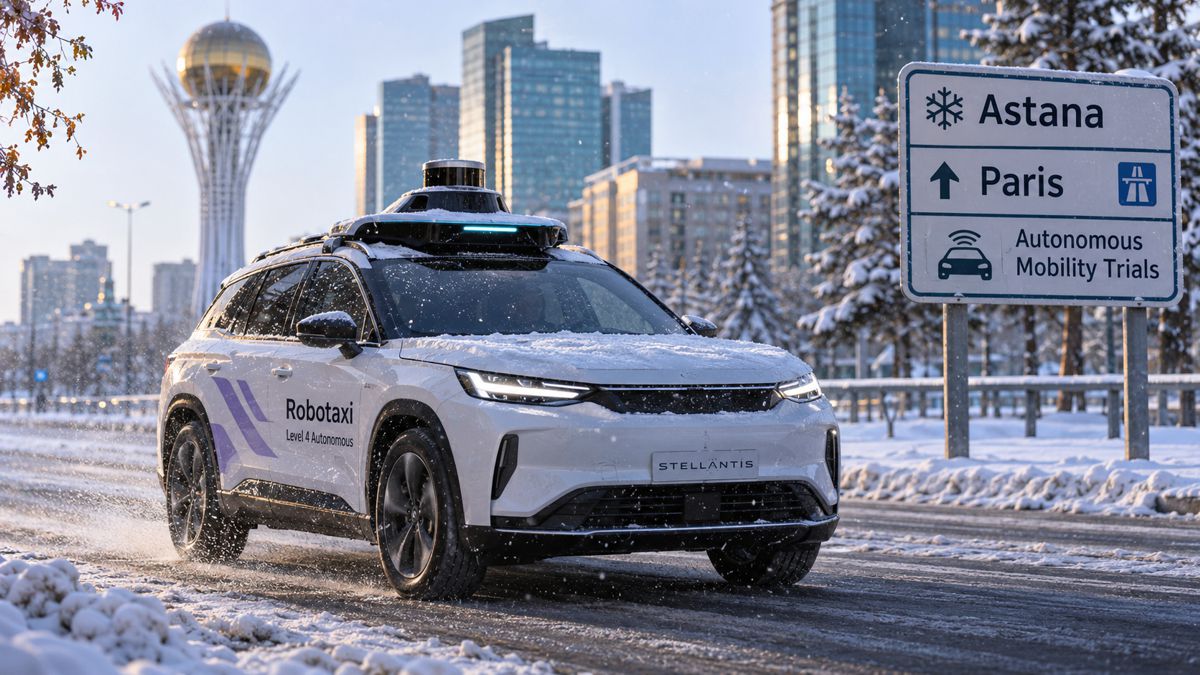
The partners intend to begin in Astana, subject to agreement with the Kazakh government. The city presents an unusually demanding environment for autonomous driving systems, particularly during its prolonged winters.
Snow and ice affect tyre adhesion, braking performance and vehicle control. Snow-covered road markings, obscured kerbs and changing road surfaces also complicate the interpretation of information collected by cameras and other sensors. Maintaining reliable autonomous operation under these conditions requires more than demonstrating competent driving on clear urban roads.
Pony.ai’s Gen-7 platform incorporates multiple sensor technologies, redundant systems and fail-operational capabilities intended to maintain safe operation when individual components encounter faults.
Arsen Tomsky, founder and CEO of inDrive, described the climatic challenge as a valuable part of the proposed deployment:
“Launching here will provide an important opportunity to evaluate autonomous driving technology in challenging winter conditions. Success in Astana could offer valuable insights for expanding autonomous mobility to other locations facing similar challenges.”
The project also builds on inDrive’s established presence in Kazakhstan. Rather than developing a passenger network from scratch, the proposed service could use an existing ride-hailing application and customer base.
The initial deployment arrangements, including the timetable, safety supervision and conditions for fully driverless operation, remain subject to further agreement and assessment.
France Builds an Autonomous Vehicle Ecosystem
In France, Wayve, Stellantis and NVIDIA have announced a collaboration supported by the French government to advance the development and deployment of autonomous vehicles.
The agreement was presented at the Assises du Véhicule Autonome on 23 October, where government representatives, manufacturers, technology developers and transport organisations discussed the requirements for bringing autonomous driving into commercial operation.
The proposed technical arrangement combines Stellantis’ Level 4-ready vehicle platforms with the Wayve AI Driver, integrating NVIDIA Halos OS on the NVIDIA Hyperion computing and sensor architecture.
Wayve specialises in an AI-based approach to automated driving that learns driving behaviour from data. Stellantis contributes vehicle engineering, manufacturing capabilities and the integration of autonomous systems into automotive platforms.
The collaboration brings autonomous driving software development together with established automotive engineering and manufacturing capacity. However, it does not establish a production volume, commercial service launch date or confirmed operating fleet.
The French government is also developing the regulatory framework needed for deployment, with an emphasis on vehicle safety, authorisation procedures and data sovereignty. France has already accumulated experience through automated mobility experiments, although moving from controlled trials to commercial passenger services requires additional operational and regulatory arrangements.
Transport Minister Philippe Tabarot emphasised the need for cooperation between technology developers, public authorities and transport organisations:
“France is committed to adapting its regulatory framework to accelerate the development of autonomous vehicles while maintaining strict safety and data sovereignty requirements.”
The collaboration will also involve engagement with trade unions, city authorities and local mobility stakeholders. France is seeking to develop autonomous driving capabilities alongside its existing automotive manufacturing and engineering industries, rather than relying entirely on imported vehicles and operating systems.
Greater Paris Plans Autonomous Mobility Trials from 2028
A separate agreement between Métropole du Grand Paris, Bolt and Stellantis provides a more defined timetable for testing autonomous transport services.
Although Stellantis and NVIDIA are involved in both French initiatives, the Greater Paris proposal has a different operating structure. Pony.ai has been identified as a potential autonomous driving technology supplier, while Bolt would manage service integration and deployment planning.
The partners have submitted the Greater Paris Autonomous Driving Living Lab to the European Commission’s Autonomous Drive Ambition Cities initiative, known as ADACities.
Initial deployments are proposed from 2028 across up to five municipalities in north-west Greater Paris. Subject to the results of those trials and regulatory approvals, the partners aim to expand towards approximately 30 municipalities and potential commercial operations by 2030.
The project will investigate whether autonomous vehicles can address gaps in the existing transport network, particularly first- and last-mile journeys, access to employment areas and services outside conventional operating peaks.
Greater Paris has approximately 7.2 million inhabitants and an extensive public transport system. The ongoing Grand Paris Express expansion is improving metropolitan connectivity, but connecting residential districts, workplaces and major transport interchanges remains a practical challenge.
Under the proposed division of responsibilities, Métropole du Grand Paris will coordinate local authorities and oversee the public-interest evaluation. Bolt will lead service integration and deployment planning, while Stellantis will supply vehicles based on its Level 4-ready platforms.
Pony.ai has been identified as a potential autonomous driving technology provider, with NVIDIA Hyperion and Halos expected to support the proposed system. Its participation in that role has not been presented as a finalised supplier appointment.
The pilot will be independently evaluated against operational safety, passenger acceptance, public transport integration, environmental effects and the economic conditions required for further deployment. Participating municipalities and relevant authorities will also need to identify suitable routes and secure the necessary approvals.
NVIDIA’s Position Across the Partnerships
NVIDIA appears in all three announcements, providing a common technology foundation for otherwise distinct commercial arrangements.
Its Hyperion platform provides a reference architecture for the sensors and computing systems used in highly automated vehicles. Halos encompasses safety-related technologies and processes intended to support the development and validation of autonomous driving systems.
The driving intelligence itself may come from different suppliers. Pony.ai provides its Virtual Driver technology, while Wayve develops its own AI Driver.
The resulting supply structure separates computing infrastructure, autonomous driving software, vehicle engineering and transport operations into distinct commercial activities. Companies can collaborate across these areas without necessarily developing every component themselves.
Responsibility for safety assurance, remote assistance, vehicle maintenance, operational interruptions and incident management must nevertheless be established before a driverless service can operate reliably.
An autonomous vehicle capable of completing a journey without human intervention is only one component of a functioning transport business.
Commercial Operations and the Economics of Robotaxis
The proposed services will ultimately face many of the same economic questions as conventional ride-hailing, with additional costs associated with autonomous vehicle technology.
Removing the driver changes the operating cost structure, but does not eliminate expenditure on fleet management, insurance, servicing, cleaning, charging or refuelling, communications and customer support.
Autonomous systems may also require remote operational assistance, specialised maintenance and additional procedures for dealing with vehicles that cannot complete journeys independently.
The operational design domain will directly affect fleet economics. Restrictions on weather, road conditions or geographical coverage can reduce the hours during which vehicles generate revenue. In Astana, prolonged winter conditions could make that relationship particularly important, while the Greater Paris trials will examine how autonomous vehicles perform within an established metropolitan transport network.
Fleet utilisation will also depend on passenger demand, vehicle availability and the ability to provide reliable service across different operating periods. A robotaxi fleet restricted to particular districts or weather conditions may struggle to achieve the utilisation needed to offset its technology and operating costs.
The proposed partnerships offer different environments in which to examine those questions. Astana provides an opportunity to evaluate autonomous performance in severe winter conditions while using an established ride-hailing platform. France is concentrating on industrial and regulatory development, while Greater Paris is proposing a structured assessment of how robotaxis could complement conventional urban transport.
The Next Phase of Autonomous Transport Deployment
The announcements arrive as European authorities examine how automated mobility services can move beyond isolated demonstrations and into regulated passenger operations.
The Greater Paris programme provides a proposed route towards commercial services by 2030, while Kazakhstan could offer earlier evidence of how autonomous vehicles perform under demanding winter conditions.
The next stage will be measured through authorised passenger operations, service reliability and the costs of maintaining autonomous fleets. Kazakhstan could provide evidence from difficult climatic conditions, while the Greater Paris programme is designed to examine how driverless vehicles fit into an established metropolitan transport network.
For now, the agreements establish partnerships and proposed operating models rather than completed commercial services. Their commercial value will depend on what happens when vehicles begin carrying paying passengers.
Key Industry Questions
- What is Level 4 autonomous driving? Level 4 automation allows a vehicle to perform the driving task without human intervention within a defined operational design domain. That domain may restrict the locations, weather conditions, road types or other circumstances in which the system operates.
- When will robotaxis begin operating in Kazakhstan? inDrive, Pony.ai and NVIDIA are exploring an initial deployment in Astana, subject to agreement with the Kazakh government. A confirmed commercial launch date has not been established in the supplied announcement.
- Which companies are involved in the Greater Paris project? The principal partners are Métropole du Grand Paris, Bolt and Stellantis. Pony.ai is a potential autonomous driving technology supplier, with NVIDIA technology supporting the proposed architecture.
- Will autonomous taxis replace public transport in Paris? The proposed programme is designed to examine complementary services, including connections to existing transport networks and journeys that are poorly served by conventional options. It is not presented as a replacement for mass transit.
- What does NVIDIA Hyperion provide? Hyperion is a reference architecture combining computing and sensor technologies for automated vehicles. Autonomous driving developers can use it as part of their vehicle system designs.
- Why is Astana an interesting location for autonomous vehicle testing? Its severe winters provide challenging conditions for perception, vehicle control and operational reliability, particularly when snow and ice affect road surfaces and visible infrastructure.
- What is the planned timetable for Greater Paris? Initial experimentation is proposed from 2028, with the ambition of expanding towards approximately 30 municipalities and potential commercial operations by 2030, subject to approvals.
- What are the main barriers to commercial robotaxi deployment? Safety validation, regulatory authorisation, reliable operation within defined conditions, fleet management and sustainable operating costs remain central requirements.
Strategic Takeaways
- Existing ride-hailing platforms provide autonomous vehicle developers with established customer access and operational infrastructure.
- Level 4-ready vehicle platforms allow manufacturers to collaborate with different autonomous driving software suppliers.
- Restrictions on weather, operating areas and road conditions can directly affect robotaxi fleet utilisation and commercial viability.
- Greater Paris is treating autonomous mobility as a transport service requiring public-interest evaluation, rather than solely a vehicle technology demonstration.
- Safety responsibilities, fleet management and operating economics will determine whether autonomous mobility can expand beyond experimental deployments.