Lunar Landing Pads Bring Civil Engineering to the Moon
Building a landing pad on the Moon presents an unusual civil engineering problem. The structure must withstand rocket exhaust, protect surrounding equipment from high-velocity debris and operate without the water-based cooling systems used at terrestrial launch facilities. Researchers at the University of Alabama in Huntsville (UAH) have now tested a modular design that redirects exhaust through channels built into the landing surface itself.
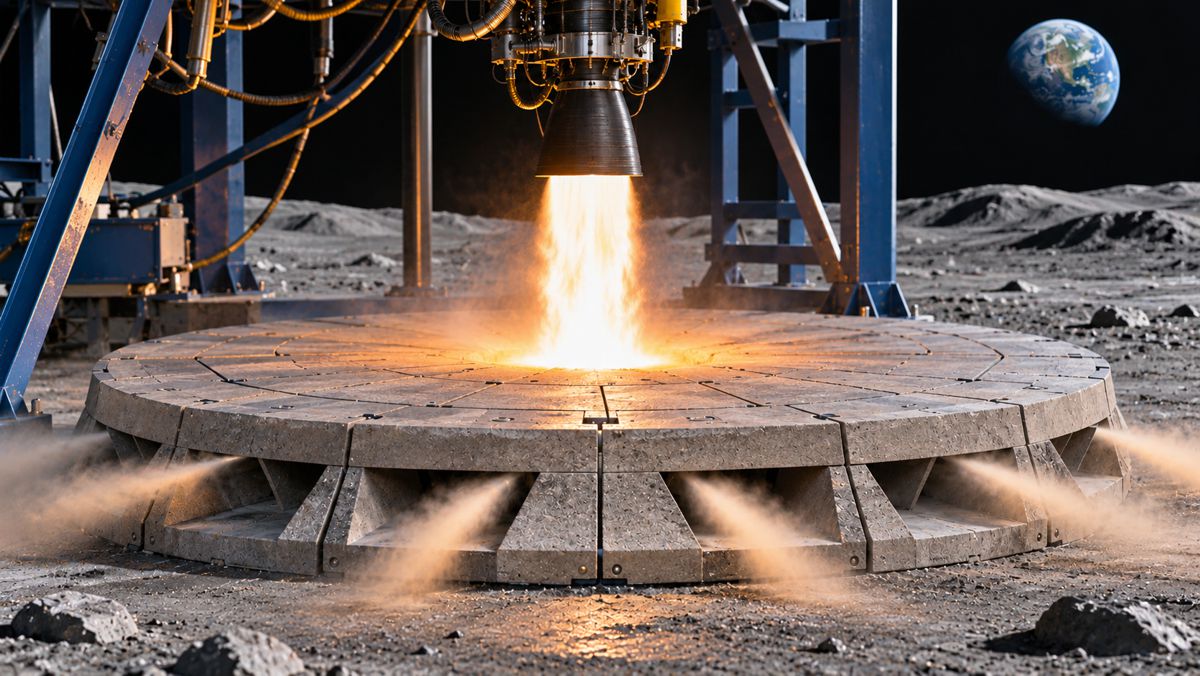
Three rocket-motor firings were conducted on a 12-foot-wide prototype at the university’s Propulsion Research Center during summer 2026. The interlocking concrete structure incorporated internal vents to direct exhaust away from the landing area, with embedded sensors recording flow through the system. Researchers reported that the tests demonstrated successful plume redirection while preventing the concentrated thermal damage that could occur with a solid pad.
The project is being developed through a multiyear partnership between UAH and Linc Research Inc., supported by NASA’s Small Business Technology Transfer programme. Its longer-term objective is a landing surface that could be assembled from modular components manufactured using materials available on the Moon.
Briefing
- Researchers at the University of Alabama in Huntsville completed three rocket-motor firing tests on a prototype lunar landing pad.
- The 12-foot-wide structure uses interlocking concrete components and internal vents to redirect rocket exhaust.
- The design is intended to reduce thermal damage and protect spacecraft, equipment and nearby lunar infrastructure.
- Future versions could use construction materials produced from lunar regolith rather than materials transported from Earth.
- The next planned prototype will measure 20 feet in diameter and is intended for further evaluation at NASA’s Marshall Space Flight Center.
Rocket Plumes and Lunar Surface Damage
Rocket exhaust presents a particular challenge on the Moon. With virtually no atmosphere to constrain the expanding plume, exhaust from a descending spacecraft can interact directly with the surface, disturbing loose regolith and accelerating particles away from the landing site.
Lunar dust is a serious engineering concern. Fine, abrasive particles can interfere with mechanical equipment, contaminate exposed surfaces and threaten sensitive instruments. Larger debris accelerated by engine exhaust introduces additional hazards for nearby structures and vehicles. These effects become more consequential when a landing site is used repeatedly, particularly where spacecraft must operate near habitats, power systems and other equipment.
Conventional terrestrial launch facilities use substantial infrastructure to manage rocket exhaust, including flame trenches, deflectors and water-based cooling or sound-suppression systems. Such arrangements are difficult to reproduce on the Moon, where water is a valuable resource and every kilogram of equipment transported from Earth carries a substantial logistical burden.
“On Earth, we use water-cooled flame buckets to redirect rocket exhaust,” explained Dr Judy Schneider, professor in UAH’s Department of Mechanical and Aerospace Engineering. “But we won’t have those resources on the lunar surface, where water will be in limited supply. Our goal is to redirect the rocket plume so it doesn’t damage the landing vehicle or any surrounding structures.”
The Huntsville approach places exhaust management within the landing surface itself. Instead of depending entirely on a solid pad to resist concentrated thermal and mechanical loads, the structure incorporates vents intended to capture and channel the exhaust away from the immediate landing area.
The direction in which that exhaust is discharged will be an important consideration as the design develops. Redirecting a rocket plume away from the landing surface does not eliminate its energy, and the outlet arrangement must avoid exposing nearby equipment or surrounding terrain to damaging exhaust flows. The university’s initial announcement does not provide sufficient detail to establish how the vent geometry would perform under full-scale lunar landing conditions.
Testing an Internally Vented Structure
The initial prototype was assembled from individual concrete components into a structure measuring approximately 3.66 metres across. Its interlocking arrangement provides a practical way to investigate how separate manufactured elements might form a continuous landing surface while accommodating internal exhaust channels.
During the three hot-fire tests, a rocket motor was fired against the prototype, allowing researchers to examine how the plume travelled through the vents. Instrumentation within the structure recorded flow behaviour and provided data for evaluating the design.
“The hot-fire tests demonstrated that we could redirect the rocket plume,” Schneider said. “By using an internally vented structure, we were able to prevent the heat from damaging the pad as it could in a solid structure.”
The tests establish that the venting concept can redirect exhaust under the conditions examined. The university has not published sufficient performance data in the supplied announcement to establish how the structure would respond to the thrust, temperatures and pressure distribution associated with a full-scale lunar landing.
The experiments were also conducted on Earth, where atmospheric pressure, gravity and surrounding environmental conditions differ considerably from those on the lunar surface. Additional evaluation will be necessary before the performance of the vented system can be extrapolated to an operational lunar landing site.
There are structural questions to resolve as well. A modular surface must accommodate loads from landing gear, thermal cycling, repeated engine firings and potential movement at the joints between components. The internal vents must remain effective without creating weak points in the surface or transferring damaging heat into supporting material.
Manufacturing Landing Pads From Lunar Materials
The concrete used in the Huntsville prototype is an experimental substitute for construction materials that could eventually be manufactured using lunar resources. Transporting a large landing pad from Earth would be expensive and would compete for payload capacity with scientific equipment, life-support systems and other essential hardware.
Lunar regolith offers a potential alternative. The loose material covering much of the Moon’s surface contains mineral constituents that could be processed into solid construction products, although their properties vary with location and manufacturing method.
Researchers are investigating processes including sintering, in which particles are bonded using heat, and melting, which can produce more consolidated materials. Both approaches offer potential routes to making blocks, slabs or other construction components without importing all the raw material from Earth.
Manufacturing a solid paving block from processed regolith is one challenge. Producing an interlocking structural component with accurately formed internal exhaust channels is considerably more demanding. The material must retain sufficient strength around the passages, while adjoining modules must align closely enough to maintain the intended flow path.
Manufacturing the components locally would still require equipment, energy and reliable quality control. The resulting material would need to withstand the thermal and mechanical conditions of repeated landing operations, while the modular joints would have to accommodate expansion, contraction and loading without compromising the structure.
Modularity could provide useful operational flexibility. Individual elements might be manufactured, transported across the lunar surface and installed using robotic handling equipment. Damaged sections could potentially be replaced without reconstructing the entire pad, provided the components and connections are designed for maintenance.
Such capabilities remain development objectives rather than demonstrated features of the current prototype.
Scaling the Design for NASA Evaluation
The next planned stage is a landing pad measuring 20 feet, or approximately 6.1 metres, in diameter. The university intends to deliver this larger structure to NASA’s Marshall Space Flight Center in Huntsville for additional testing and evaluation.
Increasing the diameter from 12 to 20 feet would expand the surface area by approximately 2.8 times, assuming comparable circular geometry. That introduces a larger network of components, joints and exhaust passages, with corresponding demands on assembly accuracy and the distribution of loads through the structure.
The larger prototype will provide an opportunity to examine whether the venting arrangement remains effective as the landing surface grows. Repeated firing tests, thermal measurements and structural inspections could help establish how the design performs over successive operating cycles, although the precise scope of NASA’s planned evaluation has not been specified in the university’s announcement.
The research is being led by Schneider with a student team including mechanical engineering master’s student Cadis Ammons, mechanical engineering undergraduates Isaac Menzel and Matthew Allmon, and civil engineering undergraduate Andrew Angelucci.
Their work combines aerospace propulsion testing with materials and structural engineering, providing practical experience in developing infrastructure for an environment where conventional construction methods cannot be applied without substantial adaptation.
Building Infrastructure for Repeated Landings
A lunar landing pad is a relatively modest structure compared with the spacecraft it supports, but its performance could influence the layout and operation of an entire lunar base.
Landing areas must be positioned to reduce risks to inhabited facilities, while still allowing equipment and cargo to be transferred efficiently. Greater separation can improve protection from exhaust and debris, but increases the distance over which supplies, machinery and personnel must travel.
A properly engineered landing surface could help manage some of those competing requirements. It would not eliminate every hazard associated with rocket plumes, and exhaust discharged through vents would still require careful control of its direction and interaction with surrounding terrain.
The Huntsville tests represent an early demonstration of one possible approach. The researchers have shown that an internally vented modular structure can redirect rocket exhaust during terrestrial testing, with further work required on scaling, materials, structural durability and lunar operating conditions.
Future lunar bases will require more than spacecraft and scientific equipment. Landing areas, access roads, foundations, protective barriers and maintenance facilities will all have to be constructed and maintained in an environment where conventional building methods cannot simply be transplanted from Earth. The Huntsville research is still at prototype stage, but it brings a recognisable civil engineering discipline to a problem that has largely belonged to aerospace engineering.
Key Industry Questions
- How does the lunar landing pad redirect rocket exhaust? The design uses internal vents within an interlocking structure to channel exhaust away from the landing area, reducing concentrated heat exposure.
- Why are conventional rocket landing facilities unsuitable for the Moon? Terrestrial facilities can use large structures and substantial water supplies for cooling. Lunar facilities must contend with limited local resources, transport constraints and near-vacuum conditions.
- Could the landing pad be manufactured on the Moon? Potentially. Researchers envisage using processed lunar regolith to manufacture modular components, although the necessary production and assembly methods have not yet been demonstrated for this design.
- What construction materials are being considered? The current prototype uses concrete. Future components could use regolith-derived materials manufactured through processes including sintering or melting.
- What has been demonstrated so far? Three Earth-based rocket-motor tests demonstrated exhaust redirection through a 12-foot-wide prototype. Full-scale lunar performance has not been established.
- How will the design be tested further? A larger, approximately 6.1-metre-diameter prototype is planned for evaluation at NASA’s Marshall Space Flight Center. Further testing will be needed to assess thermal behaviour, structural durability and performance under conditions representative of lunar operations.
- Why use modular components rather than a single solid pad? Modular construction could simplify manufacturing, transport, assembly and maintenance. Individual components might also be replaced if damaged, although these advantages remain to be demonstrated in lunar conditions.
- What are the main engineering challenges? Controlling exhaust discharge, maintaining structural strength around internal vents, producing accurately fitting components and ensuring durability under repeated thermal and mechanical loading.
- Could similar systems be used on Mars? The underlying approach may be relevant, but Martian atmospheric conditions, soil properties and operating requirements would demand separate engineering evaluation.
Strategic Takeaways
- Lunar landing infrastructure will need to accommodate repeated rocket exhaust exposure as well as conventional structural loads.
- Internally vented designs offer an alternative to relying exclusively on the thermal resistance of a solid landing surface, although exhaust discharge remains an engineering challenge.
- Manufacturing interlocking components with internal flow channels from lunar regolith presents more demanding requirements than producing conventional construction blocks.
- Modular construction could simplify lunar assembly, maintenance and replacement of damaged components, provided joints and connections can withstand repeated operating cycles.
- Terrestrial hot-fire testing establishes an initial proof of concept, but vacuum conditions, structural durability and full-scale plume behaviour remain essential areas for further evaluation.