Wastewater DNA Offers New Way to Predict Sewer Pipe Corrosion
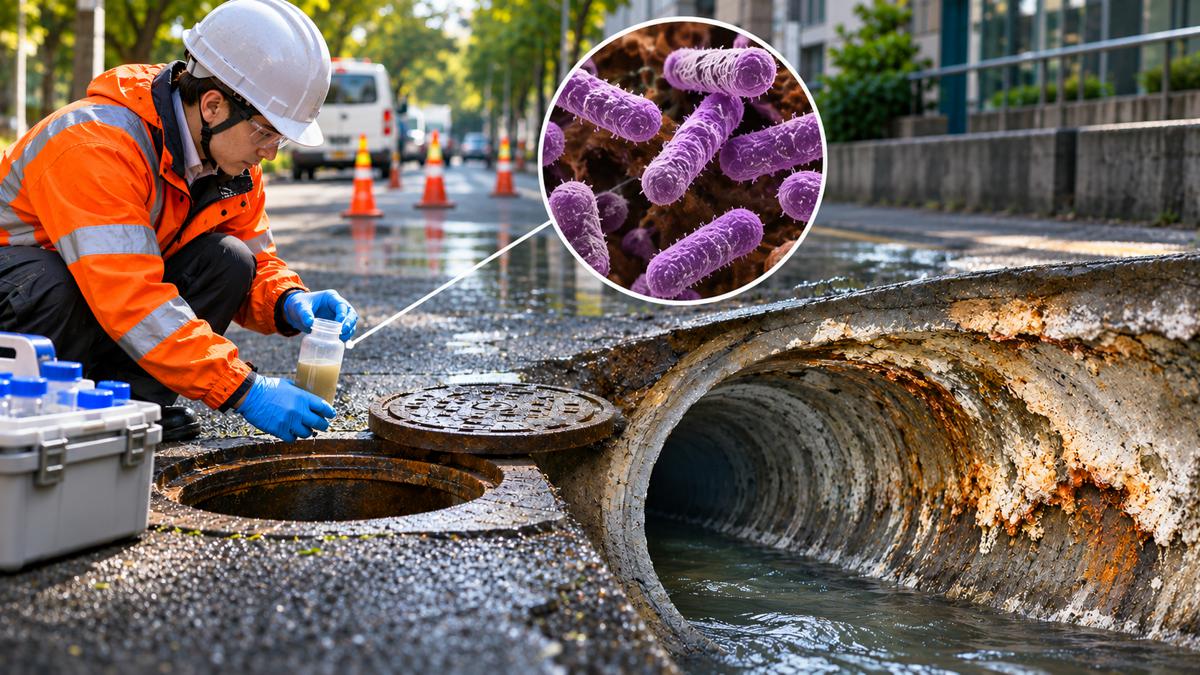
Wastewater samples collected from 40 manholes have helped researchers in Japan assess corrosion risk across a sewer network containing thousands of pipe sections. By measuring bacterial DNA and combining the results with ecological modelling and machine learning, the team at Tohoku University has demonstrated a potential new way to identify underground infrastructure requiring closer inspection.
The research, led by Professor Daisuke Sano at Tohoku University, examines whether microorganisms associated with corrosive conditions can provide useful information about the deterioration of sewer pipes. The resulting model combines microbial indicators with conventional engineering data, offering municipalities another means of identifying sections at greater risk of severe corrosion and directing inspection resources towards vulnerable parts of their networks.
Briefing
- Researchers at Tohoku University have developed a method for predicting severe sewer pipe corrosion using bacterial DNA collected from wastewater.
- The study analysed wastewater samples from 40 manholes across a residential sewer network.
- The bacterium Desulfobulbus emerged as the strongest biological predictor of severe corrosion, ranking second only to pipe age among the factors examined.
- Ecological modelling and a Random Forest machine-learning model were evaluated against inspection records covering 3,498 pipe sections.
- Including microbial information improved the model’s ability to identify severely corroded pipes, potentially supporting more targeted inspection programmes.
The Hidden Challenge of Sewer Corrosion
Underground sewer networks present a difficult asset management problem. Pipes must operate continuously in environments where wastewater chemistry, microbial activity and physical conditions can contribute to deterioration, yet much of the infrastructure is inaccessible without specialist inspection equipment. Closed-circuit television surveys remain an established method of examining pipe interiors, allowing operators to identify cracking, corrosion, deformation and other defects, but inspecting extensive networks requires considerable time, equipment and personnel.
Corrosion presents a particular concern because deterioration can progress without producing obvious symptoms at street level. Damage to concrete sewer pipes can eventually compromise their structural integrity, increasing the likelihood of leakage, collapse and disruption to surrounding infrastructure. Wastewater escaping from damaged pipes can contaminate surrounding soil and water, while severe structural failures can undermine roads and other assets above the network.
Age and physical characteristics provide useful indicators of deterioration, but they do not fully describe the biological and chemical environment inside a sewer. Even where municipalities maintain regular inspection programmes, determining which sections deserve immediate attention can be difficult, particularly when networks contain pipes of different ages, materials and operating conditions.
Understanding the Biological Processes Behind Corrosion
The Tohoku University study examined sulfate-reducing bacteria, microorganisms associated with the production of sulfide under oxygen-depleted conditions. These bacteria form part of the biological processes involved in sewer corrosion, although the damage itself results from a sequence of interacting chemical and microbial reactions.
In suitable conditions, sulfate reduction can produce dissolved sulfide, which may subsequently be released as hydrogen sulfide gas. When hydrogen sulfide reaches moist surfaces exposed to oxygen, sulfur-oxidising microorganisms can convert it into sulfuric acid, contributing to the deterioration of concrete. The process is influenced by wastewater conditions, microbial communities and the physical characteristics of the sewer network, meaning pipes of similar age may experience substantially different corrosion environments.
The researchers investigated whether measuring the DNA of sulfate-reducing bacteria in wastewater could provide useful information about where severe corrosion was more likely to occur. Among the organisms examined, Desulfobulbus, a genus of sulfate-reducing bacteria, showed the strongest relationship with recorded pipe deterioration.
Professor Daisuke Sano explained: “We were surprised by how useful Desulfobulbus, a type of sulfate-reducing bacteria, was for predicting pipe corrosion. Among all the biological factors we tested, it was the strongest predictor, second only to pipe age.”
The composition of microbial communities in wastewater may therefore contain information about corrosion risk that conventional asset records cannot capture on their own. The predictive relationship does not establish that Desulfobulbus is directly responsible for the deterioration observed, but its presence offers a potentially useful indicator of conditions associated with severe corrosion.
From Manhole Samples to Underground Risk Maps
The researchers collected wastewater samples from 40 manholes within a residential sewer network, measuring DNA associated with sulfate-reducing bacteria. Although the samples provided biological information at individual locations, the objective was to estimate conditions throughout the connected pipe network. To achieve this, the team applied ecological modelling using pipe slope and upstream building area to estimate where corrosion-associated bacteria were more likely to occur.
These geographical estimates were incorporated into a Random Forest machine-learning model alongside conventional pipe information, including age, diameter and slope. The technique combines multiple decision trees to identify patterns in datasets, allowing the researchers to examine relationships between physical pipe characteristics, estimated microbial conditions and recorded corrosion severity.
The model was evaluated against existing inspection records covering 3,498 pipe sections. Including microbial information improved its ability to identify severely corroded pipes, indicating that biological indicators could add predictive value to conventional infrastructure data.
Sano described the geographical modelling approach: “By combining wastewater DNA with ecological modeling, we converted invisible biological signals into clear geographic maps. This can help municipalities prioritize inspections more efficiently and identify high-risk areas before costly failures occur.”
Rather than directly measuring the remaining structural capacity of individual pipes, the model produces a risk assessment that could help determine where further investigation is warranted. This would allow biological information collected at selected locations to contribute to a wider understanding of conditions across the network, without requiring wastewater samples from every pipe section.
Combining Biological and Engineering Data
Conventional sewer asset records describe the physical network, with information such as pipe age, diameter and gradient used to inform maintenance planning. Microbial measurements offer a different perspective, providing evidence about biological conditions associated with corrosion processes. Combining the two allows the prediction model to consider characteristics of the infrastructure alongside aspects of the environment in which it operates.
The identification of Desulfobulbus as a particularly strong predictor is noteworthy because the analysis distinguished between different biological signals rather than treating all microbial measurements as equally informative. Pipe age remained the strongest predictor reported in the supplied research summary, but the additional microbial information improved the model’s ability to identify severe deterioration.
There are limits to what such measurements can establish. The presence of corrosion-associated bacteria does not confirm that a particular pipe has already suffered structural damage, and the relationship between microbial activity and deterioration depends on interacting biological, chemical and physical processes. A model identifying elevated risk could justify bringing forward a CCTV inspection or another condition assessment, but decisions about rehabilitation or replacement would still require evidence of the pipe’s actual condition.
Targeting Sewer Inspections More Effectively
Municipalities managing extensive underground sewer networks must balance inspection expenditure against the likelihood and consequences of unexpected failure. Risk-based maintenance programmes help direct limited resources towards vulnerable assets, and wastewater DNA analysis could provide additional evidence for those decisions.
Samples collected at selected manholes could potentially support risk mapping across larger connected areas, reducing the need to obtain biological measurements from every individual pipe section. The resulting assessments could then be compared with asset records and existing inspection programmes to identify locations where additional surveys might be justified, particularly where previous inspections are incomplete or outdated.
Such decisions would still require an understanding of failure consequences. A pipe beneath a heavily trafficked road or close to sensitive infrastructure may warrant particular attention even where predicted corrosion risk is moderate. Equally, a section identified as having elevated microbial risk would not necessarily require immediate intervention if subsequent inspection found little evidence of structural deterioration.
Practical questions remain before the approach can become a routine municipal tool. Wastewater composition and microbial populations can vary with operating conditions, while the relationship between bacterial indicators and corrosion may differ between networks. The reported findings demonstrate improved prediction within the network studied, but they do not establish that the same model will perform equally well across other sewer systems.
Further evaluation would need to examine how reliably the method transfers between locations, how frequently wastewater should be sampled and whether the additional information produces measurable savings in inspection expenditure. The supplied research summary does not quantify those potential savings or establish a recommended sampling frequency, leaving the economics of operational deployment open to further investigation.
Towards Earlier Detection of Underground Deterioration
Physical inspections provide essential evidence about sewer condition, but they are necessarily intermittent, leaving periods during which deterioration may progress unnoticed. Wastewater DNA analysis offers another way of examining the conditions associated with that deterioration, with the Tohoku University research demonstrating improved identification of severely corroded sewer sections when microbial information is combined with conventional engineering data.
The study, published in Communications Materials, provides a basis for further investigation into how microbial risk mapping might be incorporated into sewer asset management. Whether the technique becomes practical for routine use will depend on its reliability across different networks and the balance between sampling costs and improvements in inspection efficiency.
For municipalities responsible for extensive underground infrastructure, the prospect of using biological information already present in wastewater to guide more targeted investigations offers an interesting addition to established maintenance methods. The approach remains a predictive tool rather than a substitute for physical inspection, but it could help engineers decide where those inspections are most urgently needed.
Key Industry Questions
- How can wastewater DNA help predict sewer corrosion? DNA analysis can identify bacteria associated with corrosion-related processes. Researchers can combine these measurements with pipe characteristics and predictive models to estimate where severe deterioration is more likely.
- Which bacteria were most closely associated with severe corrosion? The Tohoku University study identified Desulfobulbus, a genus of sulfate-reducing bacteria, as the strongest biological predictor among those examined.
- How many sewer pipes were included in the research? The model was evaluated against inspection records covering 3,498 pipe sections, using biological measurements obtained from wastewater samples collected at 40 manholes.
- What is the role of machine learning in the method? A Random Forest model combines estimated microbial habitat conditions with pipe age, diameter and slope to identify patterns associated with severe corrosion.
- Can wastewater DNA testing replace CCTV sewer inspections? No. The method estimates corrosion risk rather than directly measuring structural condition. Physical inspections remain necessary to confirm damage and determine appropriate maintenance.
- Why are sulfate-reducing bacteria associated with sewer corrosion? These bacteria can produce sulfide under oxygen-depleted conditions. Subsequent biological and chemical processes can generate sulfuric acid that attacks concrete sewer surfaces.
- Could the technique reduce sewer maintenance costs? More accurate risk assessments could help target inspections and potentially reduce unnecessary surveys. The supplied research does not establish the financial savings achievable in operational use.
- Can the model be used in other cities? The approach may be transferable, but its predictive performance would need to be validated against local wastewater conditions, network characteristics and inspection records.
Strategic Takeaways
- Biological monitoring could strengthen condition assessment. Wastewater DNA offers information about corrosion-associated conditions that conventional pipe records do not directly capture.
- Sampling does not necessarily require access to every pipe. Ecological modelling can extend observations from selected manholes into network-wide risk estimates, subject to model reliability.
- Predictive models can complement physical inspections. Identifying higher-risk sections provides a basis for prioritising surveys without treating model outputs as confirmed structural defects.
- Local validation remains essential. Differences in wastewater composition, network design and operating conditions could influence how well microbial indicators predict corrosion elsewhere.
- Inspection economics will determine practical adoption. The value of microbial risk mapping will depend on whether improved targeting justifies the costs of sampling, laboratory analysis and model maintenance.