Why Some Buildings Survive Earthquakes While Their Neighbours Collapse
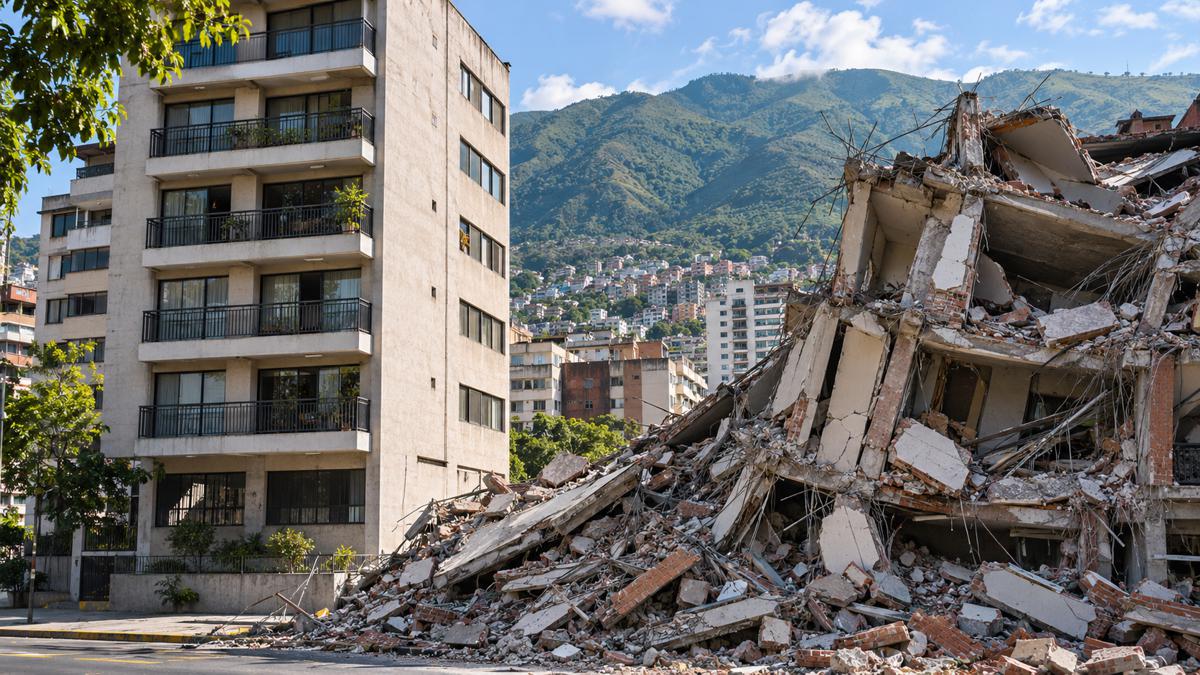
Two powerful earthquakes struck northern Venezuela on 24 June 2026, damaging buildings and infrastructure across the region. In affected areas, the destruction was uneven, with some structures collapsing while others nearby remained standing.
The magnitude 7.2 foreshock was followed approximately 32 seconds later by a magnitude 7.5 mainshock, according to the US Geological Survey. The sequence affected northern Venezuela, including the wider Caracas region, and raised familiar questions about why structures exposed to the same earthquake can experience such different outcomes.
Part of the answer lies beneath their foundations. The composition and depth of the ground, the way seismic waves travel through it, and the structural characteristics of individual buildings all influence the forces experienced during an earthquake.
For geotechnical engineers, these relationships are well established, although determining why a particular building failed requires detailed investigation. Brian Carlton, lead engineer and earthquake expert at the Norwegian Geotechnical Institute (NGI), and Jörgen Johansson, principal engineer in geohazards and dynamics at NGI, explain how ground conditions can amplify seismic shaking, undermine foundations and expose weaknesses in structural design.
Carlton’s research also extends to improving the prediction of earthquake-induced ground failure. In a peer-reviewed study published in Earthquake Spectra, co-authored with Mertcan Geyin and Harun Kursat Engin, the researchers investigated how artificial intelligence techniques could use historical earthquake data to predict where liquefaction is likely to manifest at the surface. Their findings demonstrated the potential of case-based reasoning to improve existing prediction methods, although further development is needed before practical application.
Briefing
- Two earthquakes measuring magnitude 7.2 and 7.5 struck northern Venezuela on 24 June 2026, causing structural and infrastructure damage.
- Soft sedimentary deposits can amplify earthquake shaking, with the severity of the effect varying considerably across an urban area.
- Resonance between the vibration characteristics of the ground and a building can increase structural movement and damage.
- Liquefaction can cause loose, saturated soils to lose strength, threatening foundations, roads, bridges and buried utilities.
- Geotechnical investigation, appropriate seismic design and effective building-code enforcement remain fundamental to reducing earthquake losses.
When the Ground Amplifies an Earthquake
The ground beneath Caracas is far from uniform. In some districts, deep deposits of sediment overlie harder rock, creating conditions in which seismic waves can be amplified before reaching a building’s foundations. Elsewhere, shallower deposits and firmer ground produce a different response to the same earthquake.
“Caracas sits in a deep basin filled with soft sediments, and when seismic waves pass from hard rock into that soft ground, the soil can amplify the shaking, in places by several times,” Carlton explains.
These local site effects help explain why earthquake damage can vary so sharply across a city. The thickness and stiffness of soil deposits influence the frequency and amplitude of ground movement, while the geometry of the underlying rock can affect how seismic energy is transmitted and concentrated.
“It is the combination of how hard the ground shakes, what that ground is made of, and how well the structure was built for it,” Carlton says.
A tall building generally sways more slowly than a short, rigid structure. The soil beneath it also has natural vibration characteristics, determined partly by the depth and stiffness of the deposits. When earthquake shaking excites the ground and structure at frequencies close to their natural periods, the resulting movement can become substantially amplified.
“A tall building has a longer natural period than a short one. When the period of the soil matches the period of the building, the two reinforce each other and the shaking multiplies,” Carlton says.
Johansson offers a familiar comparison. “Think of pushing a child on a swing. If you push in time with the swing’s own rhythm, each small push builds on the last and the child soars higher and higher. Push at random, and nothing much happens,” he explains.
The interaction is more complicated than a simple match between two frequencies. The duration and frequency content of the earthquake, the damping characteristics of the structure and the behaviour of the supporting ground all influence the response. Nevertheless, resonance remains an important consideration when designing buildings on deep sedimentary deposits.
Caracas provided an early demonstration of these effects during the 1967 earthquake, when several multi-storey apartment buildings collapsed despite the epicentre being some distance from the capital. Subsequent engineering investigations identified relationships between building height, soil depth and the distribution of severe damage.
“In Caracas in 1967, buildings of a certain height on a certain thickness of soft soil failed far more than others,” Carlton explains.
The 1985 Mexico City earthquake produced an even more striking example. Although the earthquake originated hundreds of kilometres away, seismic waves were amplified and prolonged by the soft sediments of the former lake basin. Buildings with particular vibration characteristics suffered disproportionate damage, while other structures nearby remained standing.
The two disasters helped establish the importance of understanding the dynamic relationship between local geology and structural design. The consequences were not confined to the strength of individual buildings. The ground itself was changing the demands placed upon them.
Investigating Seismic Conditions Before Construction
Boreholes, geophysical surveys, laboratory testing and in-situ measurements can reveal the soil conditions that made these earlier earthquakes so destructive. They also provide the information needed to assess seismic hazards before construction begins.
Engineers investigate the geological profile beneath a proposed development, including soil stiffness, sediment thickness, groundwater conditions and the potential for ground instability. Depending on the project and the seismic hazard, this information may be used to develop site-specific ground response models and evaluate how different earthquake motions could affect the structure.
“A site investigation reveals the thickness of the soil and its natural period, so engineers can deliberately give a new building a different period from the ground beneath it and/or improve the ground to make it stiffer and stronger. Where resonance cannot be avoided, the building must be built stronger to absorb the heavier vibration,” Johansson says.
Structural design must accommodate a range of possible earthquake motions rather than a single vibration frequency. Engineers use design response spectra and, for more demanding projects, detailed dynamic analysis to evaluate how the structure and its foundations are likely to behave.
The European Eurocode framework addresses seismic resistance through EN 1998, including provisions for structural design, geotechnical considerations and foundation performance. More detailed site-specific assessments may be appropriate for major bridges, hospitals, industrial facilities and other infrastructure where the consequences of failure are particularly severe.
Caracas has also been the subject of extensive seismic microzonation research, combining geological, geophysical and geotechnical information to identify areas with similar ground response characteristics. Studies of the city’s sedimentary basin have examined relationships between soil thickness, vibration periods and the damage recorded during the 1967 earthquake.
Such work allows engineers and planning authorities to distinguish between locations where conventional design assumptions may be sufficient and those requiring more detailed investigation. It can also help identify existing buildings that warrant further assessment, particularly where older structural systems coincide with potentially unfavourable ground conditions.
When Firm Ground Loses Its Strength
Some earthquake failures occur because the ground supporting a structure can no longer carry its load.
Liquefaction is particularly associated with loose, saturated sandy soils. During strong cyclic shaking, water pressure can build between soil particles, reducing the effective stress that normally enables the material to support foundations and resist deformation.
The consequences can be dramatic. “In loose, sandy, water-saturated ground, violent shaking raises the water pressure between the sand grains until the sand loses its strength entirely. The sand behaves like a very dense liquid. Buildings on top can settle, tilt, or collapse, and on sloping or waterfront ground, the liquefied layer can slide sideways, tearing foundations and buried pipes apart, and manholes may pop out of the ground,” Carlton explains.
Liquefaction can affect entire infrastructure corridors. Road embankments may settle, bridge approaches can deform and underground pipelines may be displaced or damaged by lateral ground movement. Waterfront structures are particularly exposed where liquefied soils move towards an unsupported edge.
A bridge may emerge from an earthquake with its main structure intact but remain unusable because its approaches have settled or shifted. Similarly, a port terminal can suffer extensive operational disruption through ground deformation even where individual buildings have avoided collapse.
The likelihood of liquefaction depends on soil type, density, groundwater conditions and the intensity and duration of shaking. Geotechnical investigations can identify susceptible deposits, allowing engineers to consider measures such as soil densification, drainage, ground replacement or foundations designed to accommodate anticipated movement.
The appropriate solution depends on the site and the performance required. A ground improvement technique suitable for a road embankment may not be appropriate for a heavily loaded bridge foundation or an industrial installation containing sensitive equipment.
Building Across Active Faults
Earthquake shaking is not the only geological hazard that structures must withstand. Where a fault ruptures through to the surface, permanent displacement can impose forces and movements far beyond those associated with ordinary ground vibration.
A structure spanning an active fault may experience substantial horizontal or vertical displacement as the ground moves in different directions. Conventional seismic strengthening cannot necessarily prevent damage under those conditions, making avoidance of known fault traces the preferred approach wherever practical.
Existing developments do not always have that option. California Memorial Stadium at the University of California, Berkeley, occupies the trace of the Hayward Fault, one of the major active faults in the San Francisco Bay Area. Its seismic retrofit required engineers to address the possibility of permanent ground displacement beneath the structure.
“California Memorial Stadium at Berkeley was built right across a known fault whose seismic hazard was not understood at the time. During a later retrofit, it was rebuilt as separate sections that can slide past each other without tearing apart,” Carlton says.
The project incorporated structural arrangements intended to accommodate differential movement across the fault, illustrating the distinction between designing a building to resist shaking and allowing parts of it to move relative to one another when the ground itself is displaced.
Similar challenges arise along highways, railways, pipelines and transmission corridors. These networks can extend across hundreds of kilometres and may have limited opportunities to avoid active geological structures. Fault crossings require careful assessment of expected displacement, the vulnerability of the asset and the practicality of repair following an earthquake.
Building Codes and Construction Quality
Modern engineering can design structures to withstand substantial earthquake shaking, allowing buildings to deform, dissipate energy and avoid sudden collapse. Yet buildings continue to fail from weaknesses that engineers have understood for decades.
“Most building damage is manmade. We have known how to design for earthquake shaking for a long time,” Johansson says.
Seismic regulations have developed over more than a century, frequently in response to disasters that exposed deficiencies in construction practices. Italy introduced early seismic design regulations following the 1908 Messina earthquake, while Japan adopted national seismic requirements after the 1923 Great Kantō earthquake.
Contemporary building codes establish minimum requirements for structural resistance, detailing and performance under specified seismic demands. Their effectiveness depends on competent engineering, appropriate materials and construction that follows the approved design.
“Almost every country has an adequate building code. The problem is that often, it isn’t followed either during design or construction,” Carlton says.
Older buildings may predate current requirements, while inadequate inspection, poor workmanship, unauthorised alterations and inconsistent enforcement can undermine otherwise sound engineering. These vulnerabilities become particularly difficult to address in rapidly expanding cities, where large numbers of buildings may have been constructed without comprehensive seismic assessment.
The 2010 Haiti earthquake demonstrated the consequences. Widespread structural collapse exposed serious weaknesses in the design and construction of buildings that lacked effective seismic detailing and oversight.
Individual failures, however, require careful investigation. A collapsed building may have suffered from inadequate reinforcement, poor connections, foundation movement, unexpected ground response or several interacting deficiencies. The NGI specialists emphasise that the mechanisms discussed here cannot establish why particular buildings failed during the June 2026 Venezuelan earthquakes without examining the sites and structures involved.
Structural Survival and Infrastructure Resilience
Earthquake-resistant design does not necessarily mean that a building will emerge from a major earthquake undamaged.
For many ordinary buildings, the primary objective under severe design-level shaking is to prevent collapse and protect life. Cracking, deformation and damage to non-structural components may occur while the main structural system continues to perform its intended function.
Japan’s experience during the magnitude 9.0 Tohoku earthquake in 2011 provides an example of how engineered structures can accommodate prolonged movement. High-rise buildings in Tokyo swayed for several minutes, with many avoiding major structural damage despite the duration of the shaking experienced in the city.
“It may be a horrible experience for the people inside, because it will vibrate or swing a lot, but the building will at least not fall on them,” Johansson says.
Protecting occupants also requires attention to furniture, suspended equipment, glazing and building services that can become dangerous during strong movement.
Critical infrastructure presents additional demands. A hospital that remains standing but loses its power, water or essential medical equipment may still be unusable when it is needed most. Bridges, emergency facilities, communications networks and transport corridors can require higher performance standards or additional measures to support continued operation and rapid recovery.
These requirements influence foundation design, structural detailing, equipment restraint and the resilience of supporting services. They also complicate the assessment of older infrastructure, where engineers must work with existing structural systems, foundations and alterations made over decades.
Retrofitting can improve seismic performance through additional bracing, shear walls, foundation strengthening, seismic isolation or other measures suited to the building. The choice depends on the existing structure, the expected earthquake demands and the performance required after an event.
For public authorities responsible for extensive portfolios of schools, hospitals, bridges and transport assets, identifying the most vulnerable structures is often as important as selecting the appropriate strengthening technique.
Understanding the Shaking That Reaches a Building
The magnitude of an earthquake describes the size of the seismic event, but not the shaking experienced at an individual site.
“The magnitude is like the size of a bomb, but the bomb could be one kilometre away or a thousand kilometres away,” Johansson observes.
Distance from the rupture and earthquake depth influence the energy reaching the surface. Local geology can then amplify or modify that motion, while the structure’s own characteristics determine how it responds.
A moderate earthquake close beneath a densely populated city can therefore cause more severe damage than a substantially larger event occurring farther away. Engineers assess the resulting hazard using measures such as ground acceleration, velocity, displacement, shaking duration and the response of structures with different natural periods.
The principles are well established, although each major earthquake provides new evidence about how buildings and infrastructure perform under real conditions. Detailed investigations of the Venezuelan earthquakes will be needed to establish the combination of geological, structural and construction factors responsible for individual failures.
The relationship between ground conditions and earthquake damage was recognised long before modern geotechnical testing, computer modelling or seismic design standards became available.
“There was an earthquake in India in the 1800s, and the houses built on rock survived while the ones on soft ground collapsed. Even 200 years ago, people understood how important the soil is,” Carlton concludes.
Key Industry Questions
- Why do buildings close together experience different earthquake damage? Local soil conditions, foundation systems, structural design, building height and construction quality can produce different responses to the same earthquake. Shaking intensity may also vary considerably across short distances.
- What is seismic resonance in buildings? Resonance occurs when earthquake shaking excites a structure near one of its natural vibration frequencies. Depending on the ground motion and structural characteristics, this can amplify movement and increase seismic demands.
- When is a site-specific seismic assessment necessary? Requirements depend on national regulations, local geology, structural characteristics and project importance. Detailed assessments are particularly relevant for critical infrastructure, complex ground conditions and sites where conventional seismic classifications may not adequately describe the hazard.
- How do engineers evaluate liquefaction susceptibility? Engineers use geological information, groundwater measurements, in-situ testing and laboratory investigations to assess whether soils are likely to lose strength under anticipated earthquake loading.
- Can ground improvement prevent earthquake damage? Ground improvement can reduce specific hazards, including liquefaction and excessive settlement, but it cannot eliminate all seismic risks. The structure must still be designed for the expected ground motions.
- What is seismic microzonation? Seismic microzonation divides an area into zones according to local geological conditions, expected ground response and related hazards. It can inform planning, structural design and retrofit priorities.
- Can older buildings be strengthened against earthquakes? Many existing structures can be improved through additional bracing, shear walls, foundation strengthening, seismic isolation or other measures. The appropriate approach depends on the original construction and identified vulnerabilities.
- Why can a bridge become unusable without collapsing? Foundation settlement, lateral ground movement, damaged bearings or deformation of approach embankments can interrupt traffic even when the main bridge structure remains standing.
- Do earthquake-resistant buildings always remain operational? No. Many seismic design approaches prioritise life safety and collapse prevention. Continued operation requires additional consideration of structural damage, equipment, utilities and essential services.
Strategic Takeaways
- Seismic design begins with the ground. Soil depth, stiffness and geological conditions can substantially change the shaking transmitted to a structure.
- Structural and geotechnical engineering must work together. Resonance and soil-structure interaction can increase seismic demands even where the individual structural and foundation components appear adequate.
- Ground failure can disable infrastructure without structural collapse. Liquefaction and lateral spreading can damage bridge approaches, buried utilities, ports and transport corridors.
- Older assets require targeted investigation. Buildings constructed before modern seismic requirements may contain vulnerabilities that are not apparent during normal operation.
- Life safety and continued operation are different design objectives. Critical infrastructure may require higher performance standards and protection of supporting systems to remain functional after a major earthquake.