From Flying Traffic Cones to Roadside Robots: Rethinking How We Protect Road Workers
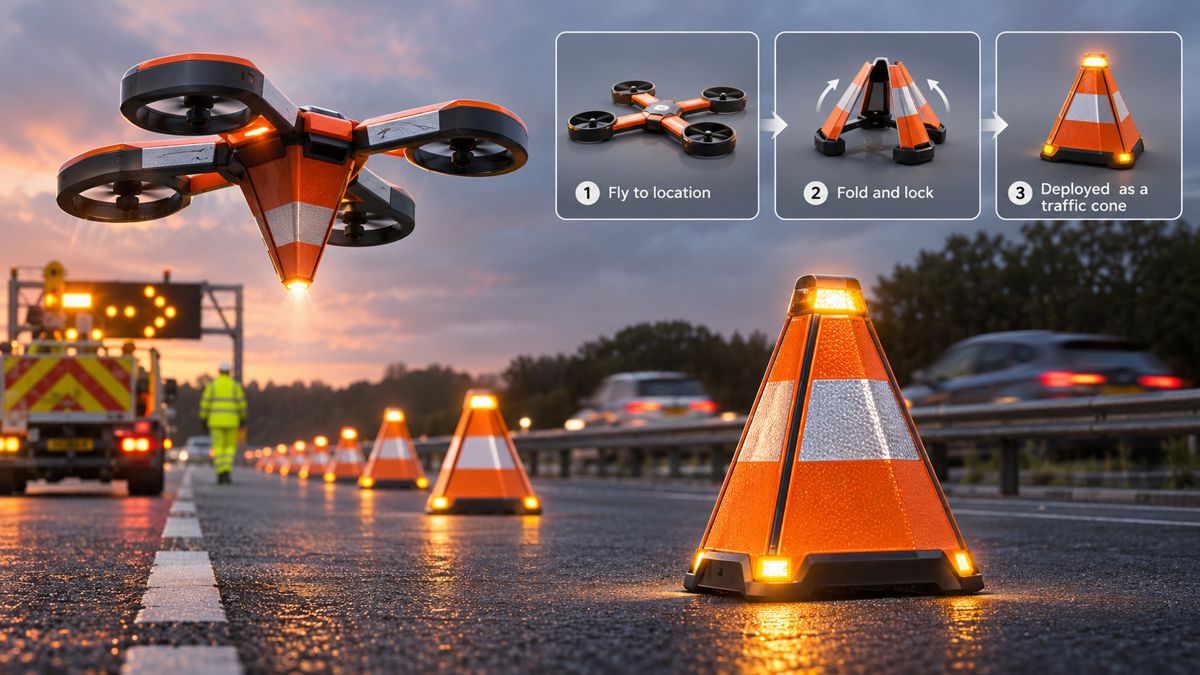
A team of students in China has designed a traffic cone that can fly to a roadworks site, land in position and transform itself into a conventional-looking safety marker. Equipped with four ducted propellers, folding arms and magnetic locking points, the SkyCone concept offers an unusual approach to a familiar highway maintenance problem: how to establish a safe working area without first sending people into live traffic.
Developed at the Beijing Institute of Technology, SkyCone has received recognition at the 2026 European Product Design Award. It remains a design concept rather than a commercially tested system, but the thinking behind it is already finding practical expression in the highway industry. Automated cone-laying vehicles are operating on British roads, while robotic handling equipment and automatic lane-closure systems are reducing the need for workers to install traffic management measures by hand.
Briefing
- SkyCone is a flying traffic cone concept developed by students at the Beijing Institute of Technology.
- Four ducted propellers allow the proposed device to fly into position before folding into a reflective roadside marker.
- The design received recognition in the conceptual category of the 2026 European Product Design Award.
- Automated cone-laying vehicles are already being used on British highways, including the M25.
- Stability, fleet coordination, recovery logistics and operating costs remain significant challenges for airborne traffic management.
Rethinking the Traffic Cone
Traffic cones are among the simplest and most recognisable pieces of road safety equipment. Their familiar shape has changed relatively little because it performs its intended purpose effectively. They are portable, highly visible, inexpensive and relatively easy to replace when damaged.
The process of putting them in position is considerably less straightforward. On busy roads, traffic management teams must establish temporary lane closures in darkness, poor weather and confined working areas, often with vehicles passing only a short distance away. Deploying and recovering hundreds of cones can involve several hours of repetitive manual handling.
In January 2020, Highways England, now National Highways, described the physical demands involved in conventional cone-laying operations. A typical four-kilometre closure required approximately 260 to 300 cones, with individual workers potentially handling between five and six tonnes of cones during a shift. Including signs, lamps, sandbags and other equipment, the combined handling burden could reach eight to ten tonnes per person.
Workers carrying out these operations must also remain alert to passing traffic, particularly during the installation and removal of temporary lane closures. Even with established safety procedures, the working environment leaves little room for mistakes by approaching drivers.
The designers behind SkyCone have approached that problem from the equipment itself, asking whether a traffic cone could reach its working position independently.
How SkyCone Works
The SkyCone concept was developed by Xinhao Guo, Songyan Pan, Zixu Zhang and Wanzheng Liu at the Beijing Institute of Technology.
In flight, the device takes the form of an X-shaped quadcopter, with four triangular arms extending from a central hub. Each arm contains a ducted propeller, allowing the unit to travel to a predetermined location without being carried by a worker or road maintenance vehicle.
After landing, the arms would rotate upwards and connect through magnetic locking points, forming a four-sided pyramid with reflective orange and white surfaces. Integrated warning lights would provide additional visibility, while a downward-facing camera and non-slip base form part of the proposed design.
The concept envisages multiple units operating together to establish temporary safety boundaries around road incidents, maintenance operations and other hazardous locations. Rather than transporting a stack of cones on a conventional vehicle, a coordinated fleet could theoretically distribute itself along a designated route or perimeter.
The designers have also proposed applications around rockfalls, hazardous industrial sites and difficult terrain where sending personnel to position warning equipment may be particularly dangerous.
An important question is what happens when the cones are no longer required. A practical system would need to reverse the folding mechanism, confirm that each device was safe to launch and return the units to a collection or charging point. Recovery could be especially complicated on an active road, where debris, damaged equipment or passing vehicles might obstruct individual markers.
SkyCone received its award in a conceptual design category, which recognises the proposed design rather than demonstrating operational performance. There is no established evidence of highway trials, regulatory approval or reliable autonomous deployment under live traffic conditions.
Nevertheless, the design brings a different mechanical approach to a problem that highway authorities and traffic management contractors have already been addressing through more conventional automation.
Automated Cone Laying on British Highways
The mechanisation of temporary traffic management has progressed considerably beyond experimental prototypes.
In Britain, National Highways has supported the development of automated cone-laying machines intended to eliminate the need for personnel to work from exposed rear platforms on slow-moving traffic management vehicles.
One example is the Falcon 100 Automated Cone Laying Machine, developed by Highway Care and its engineering partners. The system received National Highways approval for use on the strategic road network in February 2021 following technical development, safety assessments and road trials.
Operated from inside the vehicle cab, the Falcon 100 uses a mechanical handling system to deploy and retrieve conventional traffic cones without requiring workers to stand on the rear of the vehicle. According to Highway Care, it can deploy seven cones per minute and retrieve six.
In July 2022, Balfour Beatty announced the rollout of Falcon automated cone-laying machines across its highways operations, including through Connect Plus Services, the consortium responsible for maintaining and operating the M25 and its associated routes.
The technology has a practical advantage over more experimental approaches. It works with established traffic management equipment, allowing contractors to change the deployment process without fundamentally altering the roadside markers that drivers encounter.
Highway Care has subsequently introduced the Falcon 75, a smaller automated system intended for roads using 750 mm traffic cones, including local authority networks where narrow carriageways and restricted access can make larger specialist vehicles less practical.
Other manufacturers are pursuing similar developments. King’s King Cone automated conelayer is designed to transport and handle up to 400 cones on an 18-tonne vehicle platform that also incorporates impact protection equipment. The manufacturer describes the system as undergoing testing for National Highways approval.
These machines retain the familiar arrangement of a traffic management vehicle travelling along the carriageway, but remove much of the repetitive manual handling and exposure associated with placing and recovering cones.
Automating the Lane Closure
Automation is also being applied to the wider process of establishing temporary traffic restrictions.
One example is SwiftGate, an automated lane-closure system developed for locations where traffic management must be installed frequently.
In January 2022, National Highways announced trials of the system at the A3 Hindhead Tunnel in Surrey. Rather than requiring workers to manually establish the initial taper of cones, SwiftGate uses automatically operated barriers to close traffic lanes and direct approaching vehicles away from restricted areas.
National Highways reported that the automatic taper movement could take approximately 50 seconds, with the wider deployment process taking around five minutes, compared with approximately 25 minutes for a conventional manual operation.
The system does not necessarily eliminate the need for cones along the remainder of a closure. Its purpose is to establish the initial lane restriction more quickly and with less direct worker exposure.
Automated gates are particularly suited to fixed locations where closures occur repeatedly, while vehicle-mounted cone-laying machinery offers greater flexibility across changing worksites.
SkyCone introduces a further possibility: temporary warning equipment that can travel independently to a location, potentially without requiring a ground vehicle to approach the area first.
A landslide, damaged bridge approach or unstable embankment may need an exclusion zone before workers can safely inspect the site. Autonomous markers could eventually help establish that boundary, although their usefulness would depend on dependable navigation, deployment and recovery.
The Engineering Challenges
Turning an imaginative design into dependable roadside equipment would require considerably more than demonstrating that a quadcopter can fold into a pyramid.
A conventional traffic cone is an effective piece of engineering partly because it achieves its purpose with very few components. It requires no power supply, software, communications network or specialist maintenance. It can be stored in large quantities, handled in poor weather and replaced relatively cheaply.
A flying equivalent would introduce batteries, electric motors, flight controllers, sensors, communication systems and moving structural components. Each would need to withstand repeated deployment in a harsh roadside environment where dust, rain, road salt and accidental impacts are commonplace.
Stability presents a particular challenge. Temporary traffic markers must remain visible and correctly positioned despite wind, vehicle turbulence and occasional contact. Adding ballast to a flying cone could improve stability after landing, but the additional weight would increase the energy needed for flight.
The number of units required would create further complications. A motorway closure may involve hundreds of cones distributed over several kilometres, requiring coordinated navigation, charging infrastructure, collision avoidance and reliable communications between devices.
Positioning accuracy would be critical near live traffic, where a misplaced marker could itself create a hazard. An autonomous system would need to identify safe landing locations and react appropriately when a planned position was obstructed by a stationary vehicle, debris or uneven ground.
Recovery would present its own difficulties. A damaged drone might be unable to take off, while a depleted battery could leave equipment stranded on the carriageway. Any commercial system would need a safe means of collecting failed units without recreating the very worker exposure that automation was intended to reduce.
There is also the question of airspace regulation. In Britain, the Civil Aviation Authority imposes requirements according to the nature of drone operations, including aircraft characteristics, proximity to people and the risks involved. Complex autonomous flights around busy highways would require an appropriate regulatory and operational safety framework.
The cost of managing these systems would need to be considered alongside their technical performance. Purchase prices, battery replacement, maintenance, charging facilities, software support and damaged equipment would all contribute to the total cost of ownership.
For routine highway maintenance, established automated cone-laying vehicles currently offer a simpler approach. Their mechanical systems can be integrated into existing fleets while continuing to use familiar traffic cones and established operational procedures.
Where Autonomous Markers Could Be Useful
The economics may look different in locations where conventional access is dangerous, difficult or slow to establish.
A remote landslide, unstable quarry face or damaged structure might require temporary warning markers before personnel can safely enter the area. In these circumstances, the additional cost and complexity of autonomous equipment could be easier to justify than on a routine motorway maintenance shift.
Other potential applications include emergency incident management, industrial exclusion zones and temporary restrictions around infrastructure inspections. The common requirement is to establish a visible boundary while limiting the need for people to approach the hazard directly.
There may also be opportunities for less elaborate equipment. Ground-based autonomous markers, self-positioning warning lights and robotic traffic management devices could provide some of the same advantages without requiring each unit to become an aircraft.
Different environments are likely to favour different technologies. A busy motorway closure, a confined urban street and an unstable mountain road present very different requirements for deployment speed, visibility, equipment stability and recovery.
The practical case for any system will depend on how reliably it performs those tasks and whether the reduction in worker exposure justifies the additional operating costs.
From Design Concept to Practical Safety Equipment
SkyCone remains an imaginative design proposal, with substantial engineering, regulatory and commercial questions still to be resolved. Its four folding propeller arms may never become a common sight on public highways, but the underlying problem is already driving investment in automated traffic management equipment.
Vehicle-mounted cone layers and automatic lane-closure systems are demonstrating that established traffic management methods can be redesigned around safer deployment procedures. Their development has concentrated on removing people from exposed positions while retaining the equipment and operating practices that highway authorities already understand.
The Beijing students have approached the same problem from another direction, reconsidering the traffic cone itself rather than the vehicle or person responsible for placing it.
Roadworkers will continue to need temporary protection from moving traffic. The engineering challenge is to establish that protection without requiring them to enter the danger zone first.
Key Industry Questions
- What is SkyCone? SkyCone is a conceptual autonomous flying traffic cone developed by students at the Beijing Institute of Technology. It is designed to fly to a designated location before folding into a recognisable roadside safety marker.
- Has SkyCone been tested on public highways? No verified public-road testing has been established from the available information. Its 2026 European Product Design Award was granted in a conceptual design category rather than as certification of an operational highway safety product.
- Are automated traffic cone deployment systems already available? Yes. Vehicle-mounted automated cone-laying machines, including Highway Care’s Falcon systems, have been developed and introduced for use on British highways.
- How do automated cone-laying vehicles improve worker safety? They allow operators to deploy and retrieve traffic cones from inside a vehicle cab, reducing manual handling and the need for personnel to work on exposed rear platforms beside moving traffic.
- Could flying traffic cones replace conventional equipment? Potentially in specialised environments, although stability, battery capacity, positioning accuracy, maintenance, regulatory approval and recovery procedures would need to be addressed before commercial deployment.
- How does SwiftGate differ from automated cone-laying machinery? SwiftGate uses automatically operated barriers to establish the initial taper of a lane closure at a fixed location. Automated cone-laying vehicles travel along the carriageway placing or collecting conventional cones.
- Where might autonomous traffic markers be most useful? Possible applications include landslide zones, unstable embankments, damaged infrastructure, hazardous industrial areas and remote emergency incidents where conventional access is unsafe or difficult.
Strategic Takeaways
- Reducing worker exposure is the principal objective. Automated traffic management equipment can reduce manual handling and the time personnel spend close to live traffic.
- Compatibility supports adoption. Vehicle-mounted cone-laying systems retain established equipment and operating practices, reducing the practical barriers to implementation.
- Specialist environments may provide the strongest early applications. Remote or hazardous locations could justify more complex autonomous systems where conventional deployment is difficult.
- Recovery is as important as deployment. Autonomous markers must be collected safely, including when batteries fail or equipment is damaged.
- Operational economics will determine commercial viability. Deployment speed, reliability, maintenance costs and measurable safety improvements will shape which technologies progress from prototypes into everyday highway operations.