AI and the New Gatekeepers of Global Construction Procurement
A highway safety barrier manufacturer in Vietnam might have the production capacity, technical expertise and competitive pricing to supply an Australian infrastructure project, yet remain entirely unknown to the contractor responsible for buying the equipment. Without an established distributor, a personal introduction or a place on an existing supplier network, getting considered can be almost as difficult as winning the contract.
Artificial intelligence could change the first part of that equation. A procurement manager can now investigate overseas manufacturers, compare published technical documentation and assemble an initial list of potential suppliers without relying entirely on familiar commercial contacts. Whether any of those companies can satisfy the project’s engineering and regulatory requirements is another matter.
For decades, approved supplier lists and established commercial relationships have shaped the construction supply chain. They provide reassurance in an industry where failures can be expensive, disruptive and potentially dangerous. They can also make it difficult for unfamiliar manufacturers to compete, even where their products are technically suitable.
AI-assisted research offers another way into these established markets. Combined with more accessible procurement information and emerging digital product documentation, it could allow buyers to investigate manufacturers that would previously have escaped their attention. The potential is considerable, although greater visibility does not necessarily lead to more open competition.
Briefing
- AI-assisted research could expand construction supplier discovery beyond established commercial relationships and approved supplier networks.
- International manufacturers may gain access to new markets, although technical compliance and formal qualification remain essential.
- RICS research found that 45% of construction organisations surveyed had no AI implementation, while fewer than 1% reported fully embedded use.
- UK procurement reforms and the EU’s developing digital product passport framework are improving the foundations for structured supplier and product information.
- AI recommendations introduce new risks around technical accuracy, commercial visibility and the transparency of supplier selection.
The Commercial Value of an Approved Supplier
Construction procurement has traditionally relied on relatively concentrated networks of manufacturers, subcontractors and specialist service providers. Major contractors maintain relationships with organisations whose capabilities have been demonstrated through previous projects, formal qualification procedures or years of successful delivery.
There are sound operational reasons for this approach. A supplier of structural steel, bridge bearings or specialist concrete components may be responsible for materials that must perform reliably for decades. Procurement teams need confidence in manufacturing quality, certification, delivery arrangements and the supplier’s ability to resolve problems once a project is underway.
These relationships often extend into the specification process. Products incorporated into standard designs, engineering schedules and framework agreements may continue to be specified across successive projects. Changing supplier can require further design checks, additional testing or revised contractual arrangements, particularly where proprietary systems are involved.
For manufacturers seeking entry into an unfamiliar market, the difficulties extend well beyond meeting the technical specification. They must establish credibility with consultants and procurement managers who may already have suitable suppliers, while demonstrating that the commercial benefits of introducing an alternative justify the additional assessment.
An established supplier can therefore enjoy a significant advantage before a tender is issued.
AI-assisted research offers procurement teams a way to investigate that wider market with comparatively little initial effort. A search for manufacturers of bridge expansion joints can be refined according to product type, movement capacity, applicable standards and previous project experience. Similar enquiries can explore suppliers of geosynthetics, specialist paving materials, tunnelling equipment or highway safety systems.
The results will depend on the information available and the capabilities of the particular AI system. Nevertheless, buyers can investigate manufacturers without knowing their names in advance, potentially bringing new companies into consideration much earlier in the procurement process.
Opening International Supply Chains
For manufacturers in emerging and established industrial economies alike, international market access remains one of the most persistent commercial challenges.
Vietnam, India, Turkey, South Korea and other manufacturing centres have businesses capable of producing sophisticated engineering components and construction products. Some maintain substantial international distribution networks, while others remain concentrated in regional markets despite having the capacity to serve overseas customers.
Traditional supplier discovery can involve exhibitions, commercial introductions, trade directories and specialist sourcing agents. Establishing whether a manufacturer is suitable may require considerable correspondence, translation of technical documents and discussions about applicable regulations.
AI can reduce some of the initial research involved, particularly where companies have published detailed product information but have limited international marketing resources.
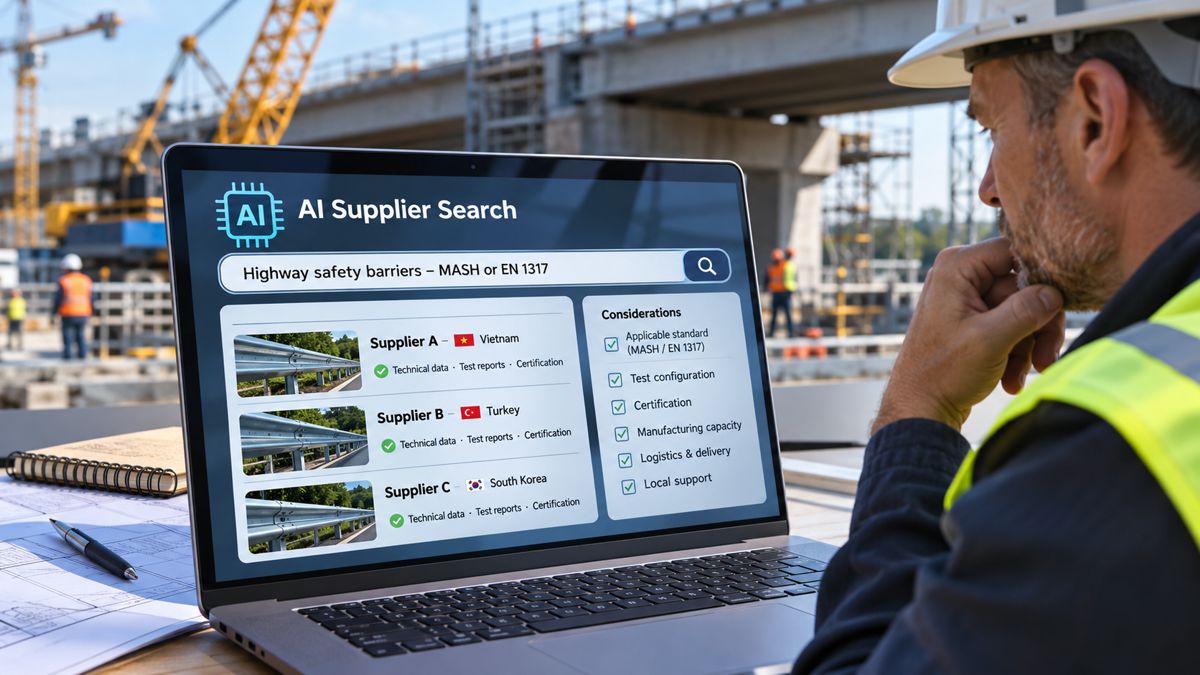
Highway safety barriers provide a useful example. A contractor seeking an alternative supplier may need to investigate manufacturers across several countries while considering product configuration, crash-testing evidence, installation requirements and local acceptance procedures.
The relevant standards are not necessarily interchangeable. The American Manual for Assessing Safety Hardware (MASH), for example, establishes crash-testing criteria used in the evaluation of roadside safety hardware, while Europe’s EN 1317 series provides a different framework for assessing road restraint systems.
A manufacturer’s claim of compliance with one regime does not automatically establish acceptance under another. Test results may relate to specific configurations of posts, rails, connections and installation conditions, and those details can be decisive when considering whether a system is suitable for a particular project.
An AI-assisted search may help identify manufacturers and locate relevant testing documentation. Engineers and procurement specialists must still determine whether the available evidence applies to the proposed installation and satisfies the requirements of the responsible road authority.
The commercial process can be equally demanding. A competitive factory price may lose its advantage once freight, import duties, insurance, local certification, installation support and delivery times are considered. Some manufacturers may also need local representation to satisfy contractual requirements or provide technical assistance.
International sourcing intermediaries retain a role here, particularly where they provide manufacturer verification, factory inspections, logistical coordination and commercial negotiation. AI may make manufacturers easier to find without making them any easier to qualify or contract.
There is also a less obvious consequence for suppliers. Easier discovery could generate more speculative enquiries from buyers compiling extensive lists of potential manufacturers. Separating genuine purchasing opportunities from preliminary market research may become an increasingly important part of international sales.
The Difference Between Discovery and Approval
The construction industry’s formal prequalification systems remain an important safeguard against unsuitable suppliers entering projects.
In the UK, the Common Assessment Standard, developed by Build UK, provides an industry-agreed approach to assessing the organisational capabilities of construction suppliers. It reduces duplication by allowing recognised assessments to be used across participating contractors and clients.
Version 6, published on 1 November 2026, introduced further changes reflecting regulatory developments and industry requirements. These included clarification of the Building Safety section, particularly the treatment of scaffolding and temporary works that do not form part of a completed building structure.
More than 26,000 companies are certified to the Common Assessment Standard, according to industry information accompanying the latest revision. Its continued development demonstrates that formal qualification remains a central part of construction procurement, even as the methods used to identify potential suppliers evolve.
Such assessments address organisational competence, but individual products may still require separate technical approval. A manufacturer can meet relevant business prequalification requirements without every product in its catalogue being suitable for a particular design or jurisdiction.
For safety-critical products, verification may involve reviewing original test reports, checking certification with issuing bodies and confirming that the proposed configuration matches the tested system. Financial standing, production capacity, insurance and previous performance can be equally relevant to the final purchasing decision.
AI has potential applications within this administrative work, particularly for document classification, identifying missing information and comparing submitted evidence against defined requirements. Those applications would need appropriate controls, particularly where commercially sensitive information or consequential technical decisions are involved.
The distinction between supplier discovery and qualification is likely to become more visible as research tools improve. A manufacturer may appear on an initial shortlist through automated research, but entry into an approved supplier network still requires the evidence demanded by the buyer.
Digital Procurement and Product Information
AI-assisted research is developing alongside a broader effort to make procurement information more accessible and consistent.
The UK’s Procurement Act 2023, which came into force in February 2025, introduced reforms to public procurement procedures and transparency requirements.
The enhanced Find a Tender service, launched on 24 February 2025, now operates as the central digital platform for covered public procurement activity. Suppliers can register and maintain core business information, while procurement opportunities and relevant notices are made available through a common service.
This reduces some of the administrative work involved in identifying opportunities and submitting information across multiple procurements. It also creates more consistent public records, although the platform does not replace project-specific qualification or provide unrestricted access to confidential supplier assessments.
A related development is taking place within European construction product regulation.
Regulation (EU) 2024/3110, the revised Construction Products Regulation, provides for a construction digital product passport system intended to improve access to product information, including declarations of performance and conformity, technical documentation and relevant safety information.
The requirements are being introduced progressively. The European Commission’s indicative timetable anticipates further measures relating to construction product passports in 2027, with practical implementation depending on subsequent regulatory provisions and applicable product categories.
These developments could eventually make it easier to compare technical information supplied by manufacturers across different European markets.
A procurement system able to access verified, structured product records would have a stronger basis for checking declared characteristics than one relying on general web searches and marketing literature. AI tools could assist with interrogating those records, provided the source information, its current status and the limits of the automated assessment remain clear.
There are practical advantages for manufacturers as well. A properly maintained product record identifying the relevant standard, certificate, tested configuration and supporting documentation can reduce repeated technical enquiries and make information easier to retrieve across different purchasing systems.
That is a considerably more substantial development than simply ensuring a manufacturer’s website appears in an AI-generated search result.
The Risk of New Gatekeepers
Greater access to information does not necessarily produce a fairer market.
AI systems can use different combinations of training data, indexed web material, search retrieval and specialist databases. Their recommendations may vary according to the wording of an enquiry, the sources available and how the system selects or summarises information.
A manufacturer with extensive English-language technical documentation and a strong digital presence may be easier to identify than a competitor whose information is confined to local-language catalogues or scanned documents.
There is no assurance that the companies appearing in an AI-generated shortlist represent the best products, the most competitive manufacturers or even the complete range of suitable suppliers.
A procurement manager asking for five manufacturers may receive five plausible recommendations, accompanied by convincing descriptions and references. The system may offer little explanation of why those companies were selected or which other businesses were excluded.
This introduces a different kind of commercial gatekeeping. Established supplier relationships can favour familiar companies, while automated discovery may favour organisations whose information is more accessible to the systems conducting the search.
Smaller manufacturers with limited marketing resources could find themselves disadvantaged despite possessing suitable products, substantial production capacity and extensive engineering experience.
The accuracy of the recommendations presents a separate concern.
The US National Institute of Standards and Technology identifies the generation of confident but false information as a risk associated with generative AI. Such errors can include inaccurate descriptions, unsupported claims and references to evidence that does not exist.
In construction procurement, a mistaken statement about a certification, performance classification or applicable standard could influence an initial technical assessment. The risk becomes more serious if information is transferred into purchasing systems or specifications without independent verification.
Manufacturers also face the possibility that outdated or incorrect third-party information will influence how their capabilities are represented. A discontinued product, expired certificate or obsolete manufacturing arrangement may remain visible in material used by AI search systems.
Accurate documentation and traceable sources are therefore essential. A clearly identified test certificate with its issuing body, scope and applicable product configuration offers substantially more value than a general statement of compliance.
Independent technical publications and industry bodies can provide useful context, although media coverage does not constitute product certification or guarantee inclusion in any AI recommendation.
The emerging challenge is to ensure that automated discovery expands the range of credible suppliers rather than creating another opaque barrier between manufacturers and buyers.
Construction’s Adoption Gap
The construction industry’s current use of AI provides some perspective on how quickly these developments might influence procurement.
The RICS Artificial Intelligence in Construction Report 2025, based on responses from more than 2,200 professionals worldwide, found that approximately 45% reported no AI implementation within their organisations. Another 34% were in the early stages of experimentation.
Just under 12% reported regular AI use in specific processes, while fewer than 1% described fully embedded, organisation-wide deployment.
The study examined AI adoption across construction rather than measuring supplier discovery specifically. It cannot establish how frequently procurement professionals are already using AI-generated recommendations, or whether those recommendations are influencing contract awards.
It does, however, demonstrate the distance between widespread interest in the technology and its integration into established construction operations.
Respondents identified shortages of skilled personnel, difficulties integrating new tools with existing systems and poor data availability among the principal obstacles. Supply chain management was recognised as an area of potential benefit, although expectations were stronger for project scheduling, design optimisation and other activities.
Procurement presents additional complications because supplier information is often dispersed across purchasing platforms, enterprise systems, project records and individual commercial teams. Technical documentation may be inconsistent, while qualification requirements can differ between business units and geographical markets.
Reliable automation requires an understanding of which information is authoritative, how it should be updated and who is responsible for reviewing the result.
There may also be a gap between official corporate adoption and everyday use. A quantity surveyor employing a general-purpose AI assistant to investigate manufacturers is not necessarily participating in a formal AI procurement programme.
That activity may be difficult to capture in surveys measuring the implementation of organisational technology systems, leaving the true extent of AI-assisted supplier discovery uncertain.
Competition Beyond Existing Relationships
The commercial effects of AI-assisted procurement are unlikely to be evenly distributed across construction markets.
Manufacturers of relatively standardised components may face greater competition if buyers can identify and compare alternative suppliers more easily. In product categories where technical characteristics are clearly defined and evidence of conformity is readily available, the cost of investigating additional manufacturers could fall.
Established distributors may also face pressure where their principal commercial advantage has been access to overseas manufacturers that buyers previously struggled to locate.
More complex engineering markets are different. A supplier of tunnelling equipment, specialist bridge components or a proprietary construction system may provide design assistance, installation supervision, maintenance and long-term technical support. Those services form a substantial part of the purchasing decision and cannot be assessed through a simple comparison of catalogue specifications.
In such markets, unfamiliar manufacturers would still need to demonstrate that they could deliver the complete technical and commercial package.
For procurement teams, broader market access may bring additional work. Investigating suppliers across several jurisdictions introduces questions about applicable standards, contractual enforcement, logistics, currency exposure and local support arrangements. More potential suppliers do not necessarily produce a faster purchasing decision.
Manufacturers could face changing commercial expectations as well. Detailed technical information, properly maintained certification records and accessible project references may increasingly influence whether potential customers discover their products.
There are limits to what better documentation can achieve. A manufacturer without the necessary testing, delivery infrastructure or financial resources cannot overcome those shortcomings simply by making its information easier to find.
Nor is there yet sufficient public evidence to conclude that AI-generated recommendations are materially changing the allocation of construction contracts. The technology offers a potentially valuable research capability, but its measurable influence on supplier approval and purchasing decisions remains to be established.
Established supplier networks will continue to have a place in construction, particularly where safety, technical complexity and long-term performance make procurement decisions difficult to reverse. Buyers still need reliable manufacturers, verified products and companies capable of supporting projects long after delivery.
AI-assisted research may give unfamiliar suppliers an opportunity to demonstrate those credentials. Whether that produces more open competition or another system favouring the most visible manufacturers will depend on how procurement organisations use the technology.
The approved supplier list is unlikely to disappear. The route onto it may become considerably less predictable.
Key Industry Questions
- Can AI approve a construction supplier? AI can assist with research, documentation and preliminary assessment, but formal approval depends on the buyer’s technical, commercial and regulatory requirements. Accountability remains with the responsible procurement organisation.
- Will approved supplier lists become obsolete? There is no convincing evidence that formal supplier lists are disappearing. AI may change how potential suppliers are identified, while established qualification processes continue to determine which companies are approved.
- Can smaller international manufacturers benefit from AI procurement tools? Potentially. AI may make unfamiliar manufacturers easier to discover, particularly in international markets. Commercial success will still depend on product suitability, verified credentials, production capacity and delivery arrangements.
- How should buyers verify AI-recommended suppliers? Original certification, test reports and technical documentation should be checked against project requirements. Relevant issuing bodies, manufacturing capabilities, financial standing and previous performance may also require independent assessment.
- Are MASH and EN 1317 highway barrier approvals interchangeable? No. They use different testing and performance assessment frameworks. Acceptance of a barrier system depends on the applicable jurisdiction, relevant product configuration and requirements of the responsible authority.
- What is the Common Assessment Standard? It is a UK construction industry framework for supplier prequalification developed by Build UK. It allows recognised assessments of organisational capability to be used across participating contractors and clients, reducing duplicated administrative work.
- How will digital product passports affect construction procurement? They are intended to make prescribed product information more accessible and consistent. As the EU framework develops, structured digital records could assist technical comparisons, compliance checks and product traceability.
- Could AI reduce the need for international sourcing agents? AI may reduce the research involved in locating manufacturers, but sourcing agents can still provide verification, factory inspections, local representation, negotiation, logistics and other commercial services.
- Is AI already influencing construction contract awards? AI is being explored across construction, but robust public evidence directly linking AI-generated supplier recommendations to contract awards remains limited. Supplier discovery is easier to demonstrate than its influence on final procurement decisions.
Strategic Takeaways
- International supplier discovery could become more competitive. Manufacturers previously excluded by limited commercial networks may gain opportunities to demonstrate their capabilities.
- Formal qualification remains essential. AI-generated recommendations cannot replace technical compliance, product testing, financial assessment or contractual due diligence.
- Digital accessibility may become a commercial differentiator. Manufacturers with clear, verifiable technical information will be easier to investigate through both conventional and AI-assisted research.
- Structured procurement and product data offer more durable benefits than search visibility alone. Consistent records can improve technical assessment, traceability and administrative efficiency.
- Automated shortlists require scrutiny. Procurement teams must guard against inaccurate claims, incomplete recommendations and selection methods that favour digital visibility over engineering capability.