Linarc Launches Lia AI Assistant for Construction Document Management
A drawing revision that changes a structural dimension without being recorded in the revision notes can create problems long before anyone notices the discrepancy on site. Construction teams face similar difficulties with contractual obligations scattered across lengthy agreements and submittal requirements buried within hundreds of pages of technical specifications. Finding, checking and organising that information remains a substantial administrative task, particularly during the early stages of a project.
Construction software developer Linarc has introduced Lia, an artificial intelligence assistant designed to handle much of that document processing within its existing project management platform. Now described by the company as operating in production, the system extracts information from construction drawings, specifications and contracts, converting it into structured project records that teams can review and use within their established workflows.
The software brings together drawing indexing, revision comparisons, specification analysis and contract information extraction. Its emphasis is on creating usable project records, including submittal registers and information that can support requests for information (RFIs) and change orders, rather than simply providing a conversational interface for searching uploaded documents.
Briefing
- Linarc has introduced Lia, an AI-powered assistant for processing construction drawings, specifications and contracts.
- Visual language models index drawing packages and identify changes between revisions, including alterations not formally highlighted.
- Specification analysis generates submittal registers, while contract processing extracts milestones, payment terms and other obligations.
- AI-generated records include confidence indicators and source references, with human review required before approval.
- Specification-driven procurement workflows are undergoing quality assurance, while further AI-assisted scheduling functionality is in development.
Drawing Indexing and Classification
One of Lia’s principal functions is the automated processing of construction drawing packages. Using visual language models, the software examines individual sheets and extracts identifying information, including drawing titles, sheet codes, revision details, dimensions and scales. It can also recognise multiple drawings appearing on a single sheet and organise the resulting information into a structured drawing index.
Construction projects frequently receive drawing packages containing hundreds or thousands of sheets, issued by different consultants and revised throughout delivery. Document controllers and project engineers must maintain registers establishing which drawings are current, which have been superseded and which require attention. The process can become particularly demanding when architectural, structural and building services documentation arrives in different formats or follows inconsistent naming conventions.
Lia is designed to undertake the initial classification and indexing work, allowing project teams to examine the extracted records before accepting them into the management system. Its effectiveness will depend partly on the quality and consistency of the source documents, especially where drawings contain unusual layouts, incomplete title blocks or conflicting revision information.
Drawing Revision Detection
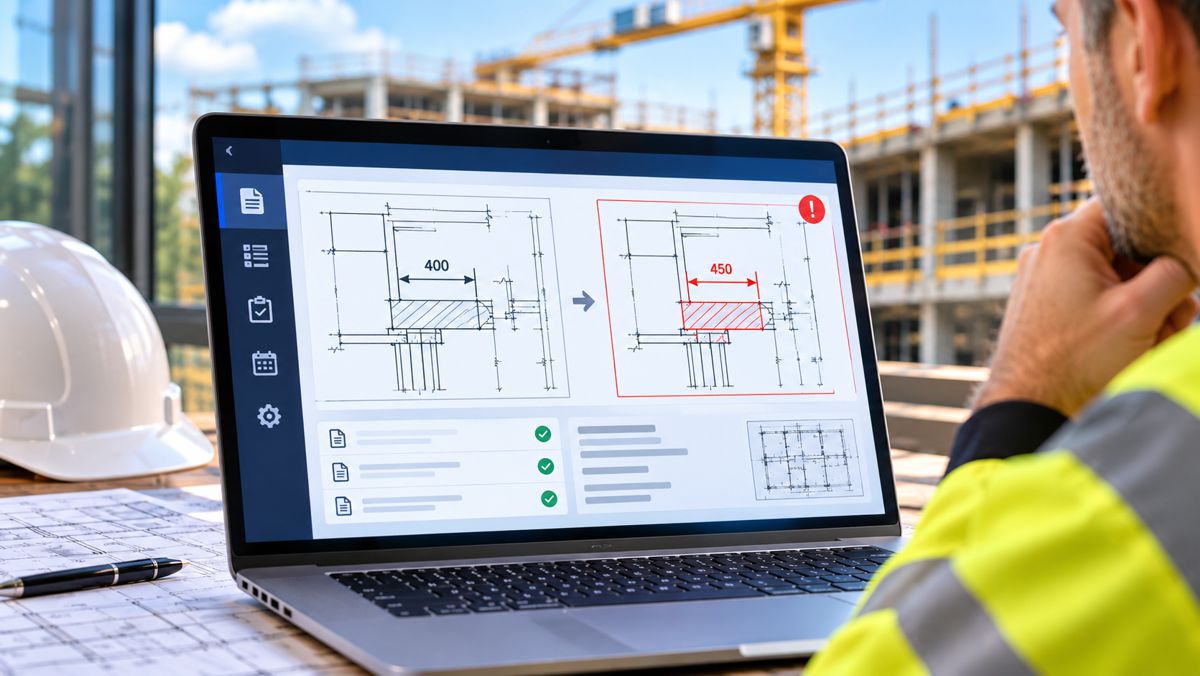
Architects and engineers commonly identify changes using revision clouds, updated annotations and revision schedules. In practice, alterations are not always consistently documented, particularly when drawings undergo repeated revisions or relatively small adjustments are made during design coordination.
Lia compares successive drawing versions to identify additions, removals, annotation changes and modifications to title blocks. According to Linarc, the software can detect differences even when designers have not highlighted them using conventional revision markings.
Consider a revised structural drawing that alters the dimensions of a reinforced concrete element. The change might affect formwork quantities, reinforcement schedules, material procurement or construction sequencing. If it goes unnoticed, the discrepancy may only emerge after work has been planned or materials have been ordered, potentially requiring further design clarification and adjustments to the programme.
Linarc allows identified differences to be associated with existing RFIs or used to initiate new RFIs and change orders, with marked-up drawing comparisons attached to the relevant records. Project teams can therefore investigate changes within the same environment used to administer them, although determining whether an alteration constitutes a contractual variation remains a matter for the responsible professionals and the project’s agreed procedures.
Automated Submittal Management
Construction specifications contain extensive requirements for material approvals, product data, fabrication drawings, testing certificates and other documentation that contractors must submit before or during construction.
Preparing a comprehensive submittal register traditionally involves reviewing specification sections individually, identifying the relevant requirements and transferring them into a tracking system. The work becomes more complicated when submission obligations appear outside sections explicitly dedicated to submittals, or when technical requirements are distributed across several parts of the specification.
Lia analyses those documents to generate proposed submittal registers and individual submittal records. Linarc says the system searches throughout the specification rather than restricting its analysis to headings labelled Submittals, helping capture requirements that might otherwise be missed during a manual review.
Each extracted requirement retains a reference to its original specification section, allowing project engineers and subcontractors to verify the information before approval. The resulting register can then support the coordination of technical submissions with procurement, fabrication and installation activities, where outstanding approvals can delay the availability of materials and equipment.
Contract Intelligence and Commercial Administration
Alongside technical documents, Lia processes construction contracts to identify information needed by project managers, quantity surveyors and commercial teams throughout delivery.
The software extracts provisions relating to milestones, liquidated damages, payment terms, retainage, contractual notices and schedules of values. These details influence project administration, financial reporting and the handling of delays or variations, yet may be distributed across the main agreement, schedules and supplementary conditions.
Contractual notice provisions deserve particular attention. Depending on the agreement and governing law, contractors may be required to notify the client or contract administrator of particular circumstances within a specified period. Missing a required notice can complicate entitlement to additional time or payment, while overlooked retainage provisions and payment conditions can affect cash flow. Similarly, liquidated damages clauses establish potential financial exposure associated with delayed completion.
Presenting these obligations within a project management system can make them easier to locate and administer without repeatedly searching lengthy agreements. However, identifying contractual language is different from interpreting its legal effect, particularly where amendments and incorporated documents modify the underlying terms. Lia’s source references allow the extracted information to be checked against the original agreement before it becomes part of the project record.
Human Verification and Accountability
Linarc has incorporated a review stage into Lia’s document-processing functions. According to the company, every AI-generated item carries a confidence level and a citation identifying the source document from which the information was extracted. Project teams must review and approve the proposed records before they are shared within the project environment.
The arrangement allows the software to prepare administrative information while retaining human control over its acceptance and subsequent use. A drawing dimension, contractual notice period or specification requirement can be checked directly against the underlying document, rather than being accepted solely on the basis of an AI-generated response.
Shanthi Rajan, Founder and CEO of Linarc, explained the company’s approach: “Lia is designed to do more than answer questions or summarize documents. Lia takes on the time-consuming work of turning project information into something construction teams can actually use,” said Rajan.
“From the first day of a project, Lia helps teams identify requirements, uncover changes and move work forward, while keeping contractors in control of every decision. And we’re just getting started.”
Confidence indicators may help users prioritise records that require closer examination, although they are not independent confirmation of accuracy. The review process will be particularly important where extracted information feeds contractual, financial or procurement activities and errors could become embedded in the project’s administrative records.
AI Competition in Construction Software
Linarc is entering a construction technology market in which established software providers are already incorporating AI into project administration.
Autodesk’s AutoSpecs uses AI to analyse construction specifications, generate proposed submittal logs and identify potentially missing requirements. Its version comparison functionality also helps teams recognise changes between successive specification documents.
Procore has taken a broader approach through AI agents operating within its construction management environment. Following the introduction of its expanded AI platform in May 2026, the company announced additional agents in July covering activities such as submittal review, RFI preparation, contract analysis, scheduling and change assessment.
These developments place Lia within a competitive market where AI is being applied to established construction workflows rather than confined to document searches and general-purpose chat interfaces.
Linarc’s offering concentrates several related functions within its own project management platform, allowing extracted information to be associated with the documents, registers and administrative records that construction teams already maintain. Its commercial appeal will depend on the quality of those connections, the effort required to verify results and how well the software fits existing project procedures.
Interoperability is another consideration, particularly where consultants, specialist subcontractors and clients work with different document management systems. The announcement does not establish the full extent of Lia’s compatibility with external platforms or the document formats supported across every function.
Procurement and Scheduling Development
Linarc plans to extend Lia beyond its initial document-processing capabilities. Specification-driven procurement workflows are undergoing quality assurance testing, while additional AI-assisted scheduling functions remain in development. The company’s broader ambition encompasses procurement, programme management, financial controls and field operations within its unified software environment.
The existing capabilities already connect several activities that influence one another throughout construction. Drawing revisions can affect material specifications and procurement requirements, while contractual milestones establish the commercial framework within which those activities must be delivered. Linking the underlying information could reduce repeated data entry and improve consistency between project records, provided changes are reviewed and properly controlled.
Lia’s initial release concentrates on work that project engineers, document controllers and commercial teams already undertake, often manually, during mobilisation and throughout delivery. Its ability to identify undocumented drawing changes, extract contractual obligations and prepare submittal registers brings several established administrative processes into a single AI-assisted workflow.
Linarc has confirmed production availability but has not published independently verified extraction accuracy, time savings or deployment results. For contractors, the practical test will be whether Lia produces records that are sufficiently complete, reliable and straightforward to verify that it reduces the overall workload of managing construction information.
Key Industry Questions
- What is Linarc Lia? Lia is an AI-powered construction assistant integrated into Linarc’s project management platform. It analyses drawings, specifications and contracts to generate structured records that project teams can review and approve.
- Is Lia available for construction projects? Linarc describes its initial document-processing functions as live in production. Contractors should confirm deployment arrangements, licensing and available functionality directly with the company.
- Can Lia detect drawing changes that designers have not highlighted? According to Linarc, Lia compares drawing versions and identifies added, removed or modified elements, including changes that have not been marked using revision clouds or revision notes.
- Does Lia automatically generate construction submittal registers? Yes. The software analyses technical specifications to identify submission requirements and generate proposed registers and submittal records, with references to the relevant specification sections.
- Can Lia extract contractual notice periods and payment conditions? Lia can identify and organise contractual obligations, including notice provisions, payment terms, retainage, milestones and liquidated damages. Extracted information remains subject to human verification.
- Can Lia create RFIs and change orders? The system can support the initiation of RFIs and change orders from identified drawing differences, with marked-up comparisons attached. Formal review and approval remain subject to project procedures.
- How does Lia compare with Autodesk and Procore? All three providers offer AI-assisted construction document or project administration functions. Lia combines drawing indexing, revision detection, specification extraction and contract intelligence within Linarc’s platform, while Autodesk and Procore offer their own capabilities and integrations.
- What should contractors examine before adopting AI document management software? Important considerations include extraction accuracy, revision tracking, source traceability, verification workload, data security, compatibility with existing systems and the handling of contractual information.
Strategic Takeaways
- Drawing revision control: Automated comparisons could help identify design alterations that have not been formally highlighted, improving the completeness of technical reviews.
- Administrative efficiency: Drawing indexing and submittal generation offer opportunities to reduce repetitive work, provided the verification process does not offset the savings.
- Commercial oversight: Extracting contractual obligations into accessible project records can support administration, although interpretation and compliance remain professional responsibilities.
- Software competition: Linarc faces established providers already applying AI to construction workflows, making reliability, integration and usability important competitive considerations.
- Practical performance: Document extraction accuracy, traceable source material and measurable reductions in administrative effort will be more meaningful than the number of AI functions advertised.