






Tanzania Secures $1.2 Billion Railway Financing to Extend Africa’s Central Corridor
Tanzania has secured a US$1.2 billion commercial financing facility for the Tabora–Kigoma section of its Standard Gauge Railway, bringing together nine international and African banks under an arrangement supported by the African Development Bank (AfDB).
The agreement supports a 411-kilometre electrified railway extending west from Tabora towards Kigoma on Lake Tanganyika, where the route will connect Tanzania’s modern railway network with trade routes serving the Democratic Republic of Congo (DRC). The investment forms part of a wider programme to develop the Central Corridor as a regional freight route linking East Africa’s interior with the Indian Ocean.
At the centre of the transaction is an US$800 million partial credit guarantee arranged by the AfDB, the largest in the institution’s history. The arrangement combines commercial lending, development finance guarantees and international credit insurance, allowing participating institutions to share the financial exposure associated with one of Tanzania’s major infrastructure investments.
Briefing
- Tanzania has signed a US$1.2 billion commercial financing facility for Standard Gauge Railway Lot 6, connecting Tabora and Kigoma.
- The African Development Bank has arranged an US$800 million partial credit guarantee, its largest to date.
- Nine banks are participating, with Deutsche Bank and Société Générale co-arranging the commercial facility.
- The railway comprises 411 km of electrified main line and approximately 95 km of additional sidings and loops.
- The commercial facility forms part of a wider US$2.3 billion financing package intended to improve western Tanzania’s transport connections and regional trade.
Combining Commercial Lending with Development Finance
Major railway projects present financing challenges that conventional commercial lenders cannot always accommodate. Construction takes years, capital expenditure is concentrated early in development, and financial returns depend on long-term freight demand, operational performance and the reliability of connecting infrastructure.
For sovereign borrowers, these considerations become more complicated when international lenders must assess public debt exposure, borrowing costs and political or economic uncertainty. Tanzania’s Standard Gauge Railway programme requires substantial capital across several construction sections, making the availability and terms of international financing central to its delivery.
The AfDB was mandated by Tanzania to structure and mobilise up to US$3.2 billion for the country’s regional railway development programme. Its role in the Tabora–Kigoma transaction combines infrastructure financing expertise with guarantees designed to attract commercial lenders that might otherwise be reluctant to assume the full credit exposure.
Deutsche Bank and Société Générale co-arranged the US$1.2 billion commercial facility, alongside HSBC, Commerzbank, Nedbank, Stanbic Bank Tanzania, First Abu Dhabi Bank, FirstBank UK and Bank of Africa United Kingdom.
The nine-bank syndicate has committed US$720 million in guaranteed lending and a further US$480 million advanced against Tanzania’s sovereign credit risk without the same guarantee protection. The AfDB’s partial credit guarantee, valued at up to US$800 million, covers the principal of the protected tranche together with two years of interest, subject to the agreed guarantee terms.
The structure accommodates lenders with differing appetites for sovereign exposure within a single financing arrangement. It also allows Tanzania to draw on commercial banking capacity while using the development bank’s financial standing to support a substantial portion of the borrowing.
Sharing Risk with International Insurers
The transaction includes a private credit insurance arrangement organised by specialist broker Texel, which distributes US$405.5 million of exposure to a panel of international insurers, including Lloyd’s syndicates.
The AfDB remains the Guarantor of Record, while the insurance provides a further layer of risk distribution behind the guarantee. This enables private insurers to participate in the transaction’s credit exposure without becoming direct lenders to the railway programme.
The US$800 million guarantee supports the commercial borrowing rather than representing an additional cash contribution to the project. Similarly, the US$405.5 million insurance arrangement distributes existing financial exposure and should not be counted as separate project funding.
The signed US$1.2 billion commercial facility sits within a wider US$2.3 billion financing package. The remaining components include an export credit agency tranche and another tranche intended to be mobilised alongside a co-guarantor, although the AfDB’s announcement does not establish that every element of the wider package has been signed or disbursed.
Max Ndiaye, Senior Director at the African Development Bank Group, said: “By combining development finance, commercial lending and insurance capacity, we have successfully unlocked the scale of financing required to deliver this type of transformational regional infrastructure. It reflects the vision behind the New African Financial Architecture for Development (NAFAD), focusing on private capital mobilization and partnerships in risk sharing to mobilise resources at scale,”
The arrangement sits within the AfDB’s wider efforts to attract institutional and commercial capital into African infrastructure. Its financial performance will depend on the borrowing terms, repayment obligations and the ability of the participating institutions to manage their respective exposures throughout the life of the facility.
Building the Tabora–Kigoma Railway
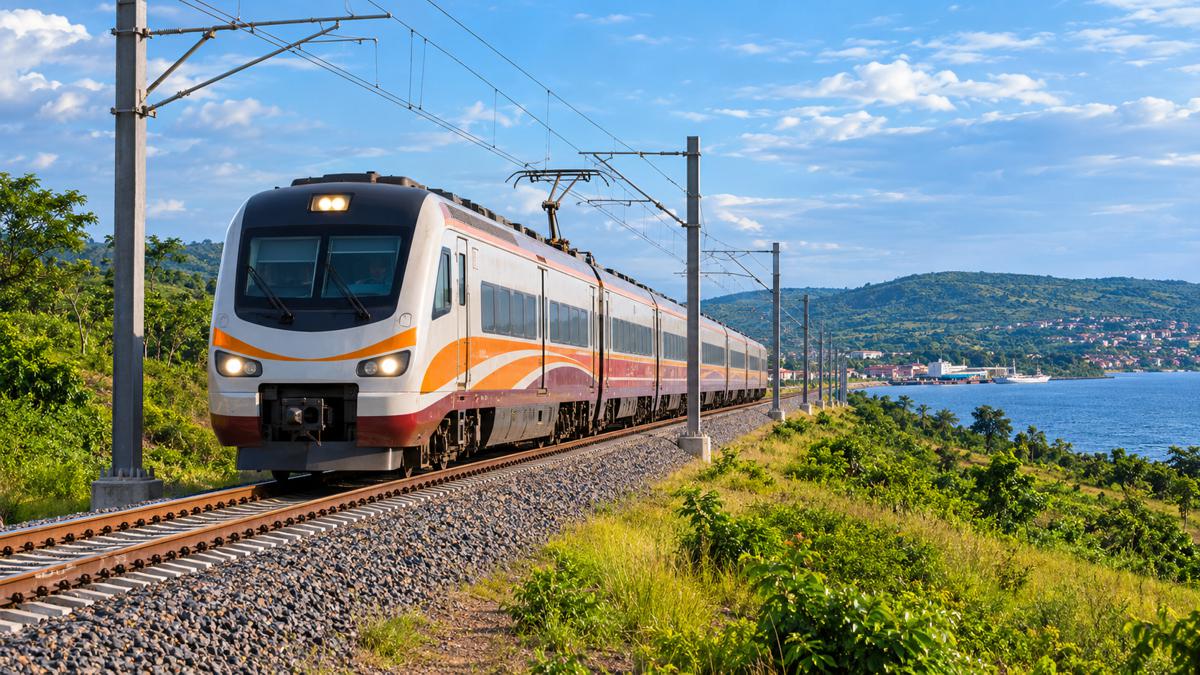
Standard Gauge Railway Lot 6 extends Tanzania’s modern railway network westwards from Tabora to Kigoma, establishing an electrified transport route through areas with substantial agricultural production, mineral resources and long-standing logistics constraints.
The project comprises 411 km of main line and approximately 95 km of sidings and passing loops, giving a total track length of 506 km. Engineering consultancy TYPSA, which participates in the construction supervision consortium, identifies the route as a mixed-traffic railway designed to accommodate both passenger and freight services.
According to TYPSA’s project documentation, the line is designed for maximum passenger speeds of 160 km/h and freight speeds of 120 km/h, with an alignment broadly following the existing metre-gauge railway corridor. The infrastructure includes one main station, six smaller stations, three medium-sized stations and a sorting station, alongside electrification, signalling and telecommunications systems.
The project is being delivered through a design-and-build arrangement awarded to a consortium of Chinese companies. TYPSA’s involvement includes detailed design review, environmental safeguard verification, supervision of civil works and railway systems, and construction contract management.
The alignment passes through the Tabora and Kigoma regions, where railway development involves land acquisition, environmental management and the coordination of works across several districts. Tanzania Railways Corporation has published environmental and social impact assessment documentation and resettlement plans covering sections of the route, identifying the potential effects of construction on local communities, agricultural land and the surrounding environment.
These requirements form part of a substantial civil engineering programme involving earthworks, drainage, bridges, stations and railway systems. Construction progress must also be coordinated with the wider network so that completed sections can eventually operate as part of a continuous freight and passenger corridor.
Connecting Western Tanzania with Regional Markets
Kigoma occupies an important position on the eastern shore of Lake Tanganyika, providing access to inland waterway routes serving the DRC and neighbouring countries. The new railway will strengthen its connection with Tanzania’s standard gauge network and, through the Central Corridor, the Port of Dar es Salaam.
Freight moving between the Indian Ocean and western Tanzania could consequently travel a greater proportion of its journey by modern rail, reducing dependence on long-distance road transport and older railway infrastructure. Agricultural commodities, minerals, construction materials and general merchandise are among the cargo categories that could benefit from improved capacity and more predictable journey times.
Across Lake Tanganyika, the route between Kigoma and Kalemie provides a connection towards the eastern DRC. The commercial potential of this link depends on the efficiency of port operations, lake transport services and onward road and rail connections within the Congolese transport network.
The wider regional railway programme also includes connections towards Burundi, extending the geographical reach of Tanzania’s Central Corridor. These projects are intended to improve access to maritime trade routes for landlocked economies while supporting industrial and agricultural activity along the railway network.
Improved railway capacity alone will not guarantee lower logistics costs. Freight operators require reliable train services, competitive tariffs, sufficient terminal capacity and efficient cargo transfers between rail, road, ports and lake transport. The performance of the completed corridor will depend on how effectively these elements work together, particularly where international shipments involve several transport operators and customs authorities.
For western Tanzania, the investment offers the prospect of improved market access in regions where transport distances and operating costs have historically constrained commercial activity. Construction will generate demand for labour, equipment and materials, while the longer-term opportunities include more efficient agricultural distribution, mineral movements and industrial supply chains.
Mike Salawou, Director of the AfDB’s Infrastructure and Urban Development Department, said: “The strategic value of this railway lies in the productive investment it can unlock along the Central Corridor. By connecting agricultural and mineral production areas, industrial centres and markets, the investment can strengthen regional value chains and expand opportunities for businesses and communities. Our ambition is to translate this landmark financing into a corridor that supports competitive industries, creates jobs and deepens regional integration,”
The financing also aligns with the AfDB’s Ten-Year Strategy 2024–2033, which places infrastructure development, regional integration and private capital mobilisation among its priorities.
With the commercial facility now signed, Tanzania has secured a substantial part of the financing needed for its western railway extension. Further funding arrangements, construction delivery and the integration of supporting transport infrastructure will determine when the new line can begin carrying sustained passenger and freight traffic.
At Kigoma, the railway will reach the eastern shore of Lake Tanganyika, where cargo can continue towards the DRC through established lake transport routes. The development of those connections, together with reliable services to Dar es Salaam, will determine how much additional trade the completed Central Corridor can accommodate.
Key Industry Questions
- How much financing has Tanzania secured for the Tabora–Kigoma railway? Tanzania has signed a US$1.2 billion commercial financing facility forming part of a wider US$2.3 billion financing package. The remaining tranches should not be treated as already disbursed.
- What is the African Development Bank’s role? The AfDB acted as initial mandated lead arranger and structured an US$800 million partial credit guarantee supporting commercial lending for Standard Gauge Railway Lot 6.
- How does the partial credit guarantee work? The guarantee provides protection for the covered commercial lending tranche, including principal and two years of interest, according to the agreed terms. It helps lenders manage credit exposure without adding a separate US$800 million cash contribution.
- Which banks are financing the railway? The syndicate comprises Deutsche Bank, Société Générale, HSBC, Commerzbank, Nedbank, Stanbic Bank Tanzania, First Abu Dhabi Bank, FirstBank UK and Bank of Africa United Kingdom.
- Why are both 411 km and 506 km quoted for Lot 6? The railway includes approximately 411 km of main line and 95 km of sidings and passing loops, producing a total track length of around 506 km.
- Who is constructing the Tabora–Kigoma railway? A consortium of Chinese companies holds the design-and-build contract, while an international supervision consortium that includes TYPSA provides engineering review and construction oversight.
- How will the railway connect Tanzania with the DRC? The route will extend to Kigoma on Lake Tanganyika, where inland waterway services connect with Kalemie in the DRC. The effectiveness of the freight connection will depend on port handling, lake transport and onward logistics infrastructure.
- What other financing is planned? The wider US$2.3 billion package includes an export credit agency tranche and another tranche to be arranged with a co-guarantor. The AfDB’s broader railway financing mobilisation mandate extends to US$3.2 billion.
Strategic Takeaways
- Sovereign credit exposure: The transaction combines guaranteed and unguaranteed lending, allowing commercial banks to participate according to their respective risk appetites.
- Insurance-backed risk distribution: The US$405.5 million insurance arrangement extends risk participation beyond the lending syndicate without increasing the nominal amount of commercial borrowing.
- Phased project financing: The signed commercial tranche is a substantial commitment, although the remaining elements of the wider financing package still need to be distinguished from funding already secured.
- Intermodal transport requirements: The railway’s commercial performance will depend on terminal capacity, port operations and connections with road and lake transport services.
- Future infrastructure financing: The combination of development bank guarantees, commercial lending and private insurance provides a potential model for other capital-intensive transport projects facing sovereign credit constraints.