






SpaceX Starmind and the Rise of Computing Infrastructure in Space
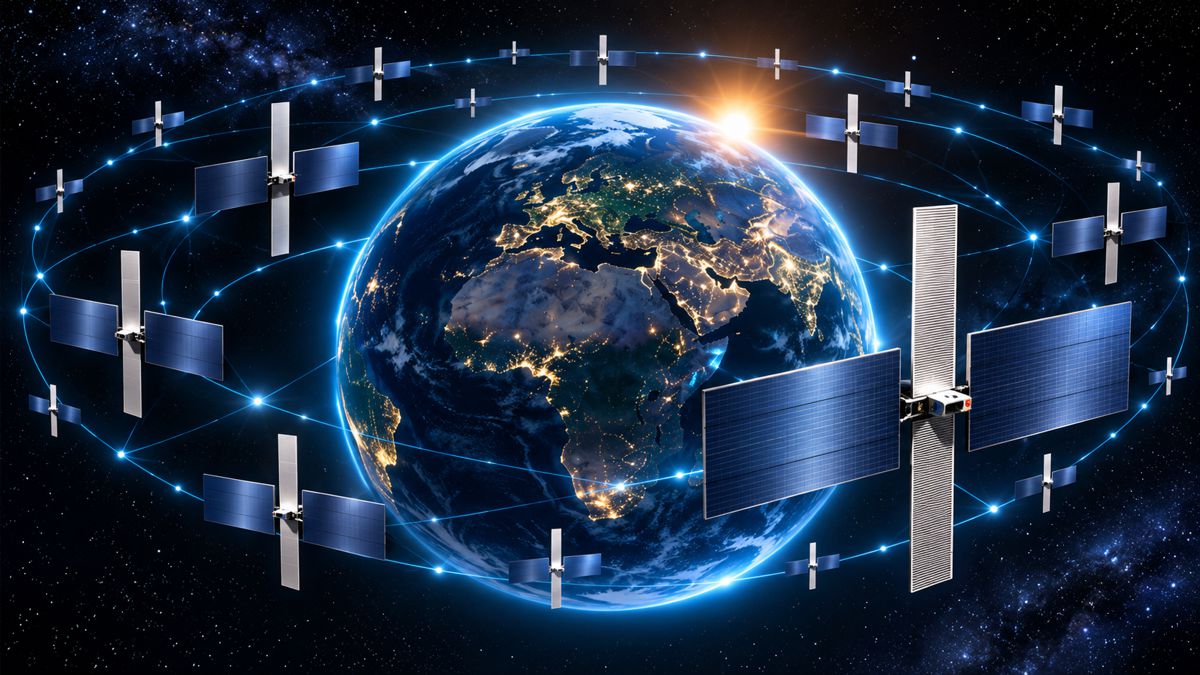
SpaceX is developing a generation of computing satellites with solar arrays spanning approximately 75 metres and AI processing systems derived from some of the world’s most advanced terrestrial data centres. Through its Starmind programme, the company intends to extend the technologies that made Starlink a commercially established global broadband service into an entirely new category of digital infrastructure.
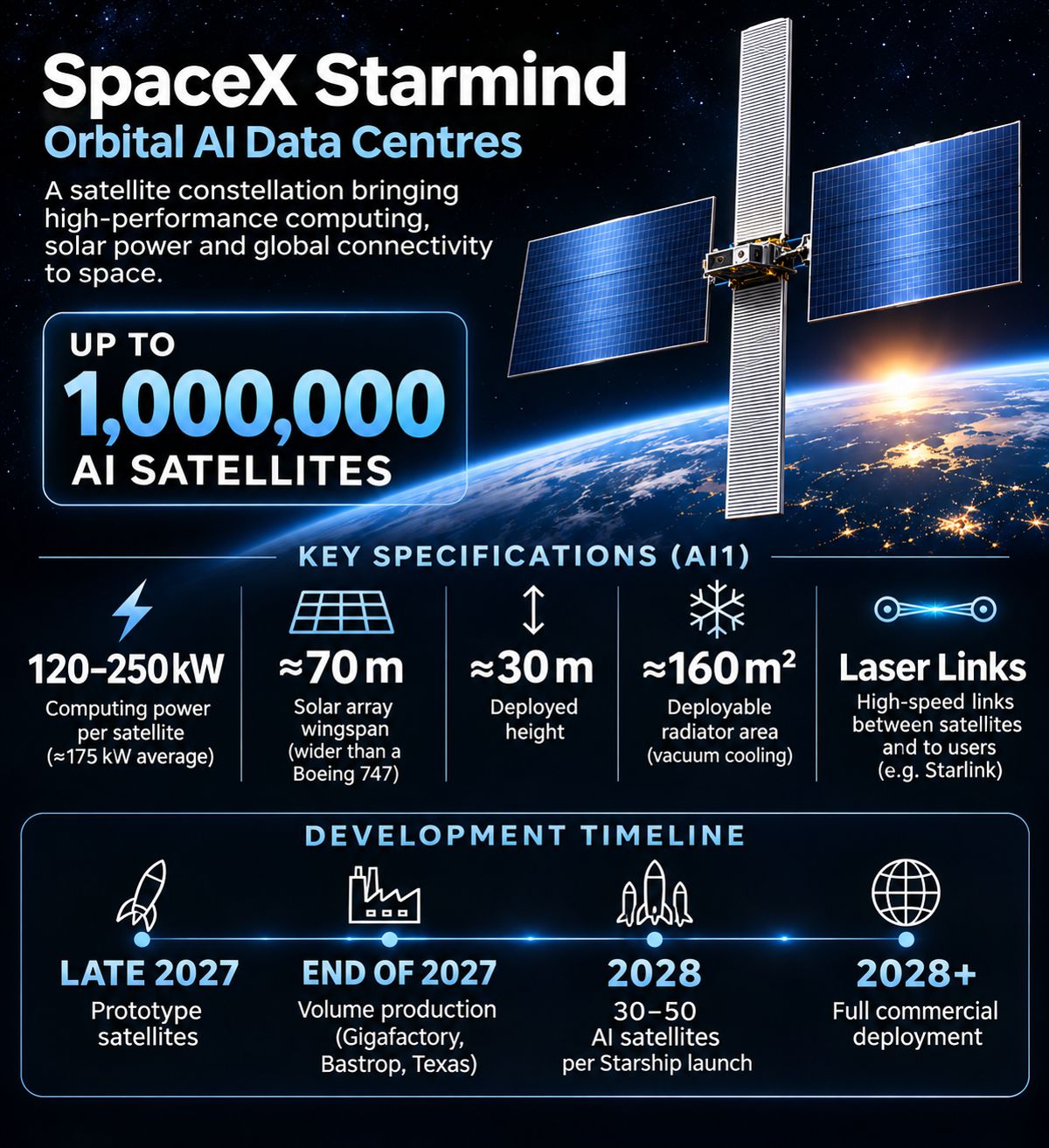
On 30 January 2026, SpaceX submitted an application to the US Federal Communications Commission seeking authorisation to operate up to one million satellites as part of an orbital data centre network. Although the proposed constellation remains subject to regulatory approval and extensive engineering development, SpaceX already possesses many of the industrial capabilities needed to begin building it.
Competition is also developing rapidly. Google has successfully demonstrated AI processing hardware in orbit and announced a heavy-lift launch partnership with Blue Origin on 19 November 2026. Starcloud has deployed high-performance NVIDIA computing hardware aboard a satellite, while Chinese developers are establishing distributed computing capabilities across interconnected spacecraft.
Access to abundant solar energy is a compelling incentive for moving computing infrastructure beyond the Earth’s surface, particularly as terrestrial data centre development places increasing demands on electricity networks. Over the longer term, however, the opportunity extends considerably further. Establishing dependable computing, power generation, communications and maintenance services in orbit could provide the foundations for a permanent industrial economy in space.
Briefing
- SpaceX is seeking regulatory authorisation for an orbital data centre constellation comprising up to one million satellites.
- Its proposed Starmind AI1 spacecraft incorporates advanced NVIDIA computing architecture, extensive solar arrays and deployable liquid cooling radiators.
- Google and Blue Origin are targeting the first quarter of 2029 for a heavy-lift mission carrying rack-scale computing satellites.
- Experimental AI computing hardware is already operating in orbit through programmes developed by Google, Starcloud and Chinese technology organisations.
- Advances in radiation protection, thermal management, optical communications and robotic servicing could support the development of long-lived orbital industrial infrastructure.
From Starlink Broadband to Starmind
Starlink has already changed expectations of what satellite infrastructure can deliver. High-speed broadband connections capable of supporting demanding professional applications are available in locations where installing conventional telecommunications infrastructure would be prohibitively expensive. Remote construction sites, mining operations, offshore installations, maritime vessels and isolated communities can access services delivered through a network whose principal communications infrastructure is continually moving hundreds of kilometres above the Earth’s surface.
A decade ago, relying on satellite broadband for everyday professional activities, video conferencing, cloud applications and substantial data transfers would have seemed impractical to many businesses. The combination of low Earth orbit, electronically steered antennas, high-capacity satellite communications and increasingly sophisticated network management has overcome many of the limitations historically associated with satellite internet.
The Starlink network also incorporates optical inter-satellite communications, allowing information to travel between spacecraft before returning to Earth. These laser connections provide additional routing flexibility, particularly across oceans and remote regions where terrestrial communications infrastructure is limited.
Starmind extends that architecture by introducing computing capacity into the orbital network itself. Selected workloads could be processed in space rather than routed through satellites to terrestrial data centres, with the results delivered through the communications network. For SpaceX, established satellite manufacturing facilities, reusable launch vehicles and extensive experience operating large constellations provide a considerable industrial advantage.
Conventional broadband and distributed AI computing have different communications requirements, particularly when numerous processors need to exchange information continuously during model training. Nevertheless, Starlink provides a compelling demonstration of how quickly orbital infrastructure can become an ordinary and commercially useful part of daily life.
Engineering the Starmind AI1 Satellite
SpaceX’s published Starmind spacecraft design envisages a substantial solar-powered computing platform incorporating advanced processors, optical communications and liquid-based thermal management. Design specifications have evolved during 2026, with later published figures describing a significantly larger spacecraft than the concept presented earlier in the year.
The proposed AI1 configuration includes:
- Computing payload electrical demand of up to 250 kW at peak operation.
- Average computing payload electrical demand of approximately 175 kW.
- A deployed wingspan of approximately 75 metres.
- A deployed height of approximately 30 metres.
- Approximately 160 square metres of deployable liquid radiator area.
- Solar generation and high-capacity optical inter-satellite communications.
These remain development specifications rather than demonstrated operational performance. With a deployed wingspan comparable to that of an Airbus A380, however, AI1 represents a substantial piece of industrial equipment. Manufacturing thousands of spacecraft on this scale would create demand for automated production systems, lightweight structures, precision deployment mechanisms, large photovoltaic arrays and standardised computing assemblies.
In August 2026, NVIDIA confirmed its involvement in the programme, with the first-generation Starmind satellite intended to incorporate an adapted version of its Vera Rubin NVL72 rack-scale computing system. The underlying architecture is also being developed for advanced terrestrial AI facilities, providing a direct technological connection between conventional data centre investment and future orbital computing infrastructure.
SpaceX is targeting initial computing satellite launches from late 2027, with larger deployments potentially following in 2028. Progress will depend on hardware qualification, launch capacity, regulatory approval and the successful demonstration of the spacecraft’s integrated computing, power and thermal management systems.
Harnessing the Sun Beyond the Atmosphere
Electricity availability has become one of the principal constraints on terrestrial data centre development. Large facilities require substantial grid connections, dedicated substations and reliable generating capacity, often competing with expanding industrial electrification and residential electricity demand.
Orbital computing offers access to solar energy without the limitations imposed by cloud cover, atmospheric attenuation or conventional terrestrial grid infrastructure. Carefully selected sun-synchronous orbits can provide exceptionally long periods of sunlight, while dawn-dusk orbital configurations can position spacecraft close to the boundary between the Earth’s illuminated and dark hemispheres, reducing the time spent in shadow.
Near-continuous solar generation could substantially reduce energy storage requirements, although orbital geometry, seasonal variations and operational contingencies must still be accommodated. The solar arrays themselves represent a considerable engineering investment, requiring lightweight structures that can be folded for launch, deployed reliably and maintained in appropriate orientations throughout their operational lives.
Exposure to energetic particles, ultraviolet radiation and the wider space environment gradually reduces photovoltaic performance. Designing generating capacity around expected degradation, alongside appropriate energy storage and redundant electrical distribution, will be essential for infrastructure expected to operate continuously for several years.
The potential scale of SpaceX’s proposal is extraordinary. If one million spacecraft were each equipped with computing payloads consuming an average of 175 kW, their combined computing demand would reach 175 GW, excluding propulsion, communications and other supporting systems. This is an illustrative calculation rather than an announced deployment capacity, and any eventual constellation would almost certainly incorporate several generations of spacecraft with different performance characteristics.
Even a comparatively modest proportion of that hypothetical capacity would represent a significant addition to global computing infrastructure, powered by electricity generated directly alongside the equipment consuming it.
Cooling Data Centres in a Vacuum
The availability of solar energy in orbit comes with an equally demanding thermal management challenge. Although space is commonly described as extremely cold, the absence of an atmosphere prevents equipment from transferring heat into its surroundings through conventional air cooling. Almost all the electrical energy consumed by computing processors eventually becomes heat, which must ultimately be rejected through thermal radiation.
An orbital data centre requires an integrated system capable of collecting heat from processors, memory and power electronics before transferring it through conductive materials or circulating liquids to external radiator panels. Heat rejection depends on radiator temperature, surface emissivity, exposure to sunlight and the thermal influence of the Earth.
The relationship between temperature and radiated energy is particularly important. Under idealised conditions, thermal radiation increases with the fourth power of absolute temperature, meaning that relatively modest increases in radiator operating temperature can considerably improve heat rejection. Higher-temperature liquid cooling systems could therefore reduce radiator area and spacecraft mass, provided the processors, coolant, pumps and associated equipment can operate reliably within the required temperature range.
SpaceX’s proposed combination of a 175 kW average computing payload and approximately 160 square metres of deployable radiator area illustrates the engineering demands involved. Assessing the system’s actual performance will require further information about radiator operating temperatures, effective emitting surface area, cooling circuit efficiency and heat generated by supporting equipment.
Large radiator assemblies must also withstand the effects of micrometeoroids and orbital debris. A damaged cooling pipe in a terrestrial data centre can often be repaired by maintenance engineers, whereas a coolant leak in an unattended spacecraft could disable a substantial investment. Independently isolatable cooling circuits, redundant pumps, autonomous fault detection and protective radiator designs offer potential ways of limiting the consequences of individual failures.
The US Government Accountability Office’s assessment of space-based data centres, published in April 2026, identifies thermal management among the principal technical challenges facing the sector. Aerospace engineers already possess extensive experience designing spacecraft cooling systems, and adapting those capabilities to high-density AI computing could accelerate the development of lighter structures, more efficient heat exchangers and advanced liquid cooling technologies.
Orbital installations would avoid the direct water consumption associated with evaporative cooling systems on Earth, although their closed-loop cooling circuits may still contain water or other working fluids. The absence of conventional cooling towers and large air-handling systems creates a fundamentally different approach to managing industrial waste heat.
Protecting Computing Hardware from Space Radiation
High-performance processors designed for terrestrial data centres operate beneath the protection of the Earth’s atmosphere and magnetic field. Moving them into orbit exposes electronic systems to energetic particles trapped within the Earth’s magnetic environment, particles emitted during solar events and galactic cosmic rays originating beyond the Solar System.
Low Earth orbit retains considerable geomagnetic protection, although exposure varies with altitude, orbital inclination and geographic location. Satellites passing through the South Atlantic Anomaly encounter elevated levels of trapped radiation, while high-inclination orbits can expose spacecraft to different conditions around the polar regions.
Radiation can affect computing hardware through several mechanisms. An energetic particle striking a semiconductor may change a stored bit, interrupt a calculation or cause an electronic system to reset. More severe interactions can trigger electrical faults that permanently disable components, while accumulated exposure gradually degrades semiconductor materials, memory systems and power electronics.
Spacecraft engineers already account for cumulative ionising radiation, single-event effects and displacement damage when qualifying electronic equipment. Orbital AI computing introduces the additional challenge of achieving very high processing performance at commercially competitive costs, potentially using adaptations of hardware originally designed for terrestrial applications.
Some encouraging evidence has emerged from Google’s Project Suncatcher engineering research. Researchers exposed a Trillium Tensor Processing Unit to a 67 MeV proton beam, investigating its response to accumulated radiation and individual energetic particle interactions. The high-bandwidth memory proved particularly sensitive, with irregularities beginning at approximately 2 krad(Si), compared with an estimated shielded five-year mission exposure of 750 rad(Si).
The tested chip experienced no permanent failures attributable to accumulated ionising radiation up to the maximum test dose of 15 krad(Si). Although testing an individual device cannot establish the reliability of a complete orbital computing system, the results provide encouraging evidence that some commercially developed processors may be suitable for space applications with appropriate protection.
The integrity of the computation is as important as the survival of the processor. An electronic system can remain operational while producing incorrect results because radiation has corrupted data held in memory or altered an intermediate calculation. Undetected errors could compromise scientific analysis, engineering simulations or the training of an AI model.
Potential protection measures include:
- Targeted radiation shielding around sensitive processors and electrical equipment.
- Error-correcting memory and continuous data integrity monitoring.
- Redundant computing, communications and power systems.
- Computational verification and selective repetition of affected calculations.
- Checkpointing to preserve progress during lengthy computing workloads.
- Automatic isolation, restart and recovery of malfunctioning equipment.
Large terrestrial computing clusters already incorporate sophisticated fault management because operating thousands of processors inevitably introduces equipment failures and interruptions. Extending these techniques into orbit could allow an individual accelerator to be isolated, its workload transferred elsewhere and affected calculations repeated without interrupting the wider service.
Physical shielding will remain important, but combining appropriate protection with resilient computing architectures may prove more economical than attempting to eliminate every possible radiation-induced error through hardware design alone.
Designing for Solar Storms
Solar flares, solar energetic particle events and geomagnetic storms present different, sometimes overlapping, hazards to spacecraft. Intense electromagnetic radiation from solar flares can disrupt radio communications, while energetic particles can affect electronics and accelerate degradation of solar arrays. Geomagnetic disturbances can increase spacecraft charging risks and heat the Earth’s upper atmosphere, causing it to expand and increasing atmospheric drag at lower orbital altitudes.
SpaceX has already experienced the operational consequences of disturbed space weather. In February 2022, 38 of 49 recently launched Starlink satellites re-entered the atmosphere after geomagnetic activity increased atmospheric density at their initial deployment altitude. The additional drag prevented the affected spacecraft from establishing their intended operational orbits, an incident subsequently examined in a peer-reviewed study published in Space Weather.
Future computing satellites equipped with extensive solar arrays and radiator assemblies will have substantial deployed surface areas, making atmospheric drag an important consideration when selecting operational altitudes and designing propulsion systems. Higher orbits can reduce this drag, although they introduce different radiation exposure, communications and end-of-life disposal requirements.
Severe space weather also introduces the possibility of correlated failures across an entire computing network. A distributed architecture provides protection against individual equipment faults, but a sufficiently extensive solar particle event could affect numerous satellites within a relatively short period.
The NOAA Space Weather Prediction Center already monitors solar activity and provides warnings of conditions that can affect spacecraft, communications and terrestrial electricity infrastructure. Future orbital computing networks could incorporate these forecasts into autonomous operating systems, allowing spacecraft to save computational progress, suspend sensitive operations, protect critical data and transfer workloads before hazardous conditions develop.
Reducing computational activity or switching equipment off does not eliminate radiation exposure, and some space weather events provide little useful warning. Physical protection, radiation-tolerant control systems and resilient spacecraft architecture will remain necessary, alongside operational procedures that reduce the consequences of foreseeable disturbances.
Severe solar storms can also affect electricity networks and communications systems on Earth. Maintaining computing resources across terrestrial and orbital facilities could eventually improve overall resilience, provided operators account for their different vulnerabilities and avoid concentrating critical workloads within infrastructure exposed to the same failure mechanisms.
Google and Blue Origin Advance Project Suncatcher
Google is investigating a different approach to orbital computing through Project Suncatcher, a research programme examining whether interconnected solar-powered satellites equipped with its Tensor Processing Units can collectively support scalable machine learning infrastructure.
The company launched its first prototype spacecraft in October 2026 in partnership with Earth observation specialist Planet, subsequently reporting that its orbital hardware had generated an AI response using Google’s Gemma 4 model. The experiment provided an early operational demonstration of data centre-class AI hardware in space, complementing the company’s ground-based radiation and optical networking research.
On 19 November 2026, Google announced a launch services agreement with Blue Origin for a dedicated New Glenn heavy-lift mission targeting the first quarter of 2029. The spacecraft will be designed to provide computing capacities broadly comparable to individual terrestrial data centre racks and will operate in a sun-synchronous orbital environment.
Google’s research envisages computing satellites flying in closely coordinated formations, allowing individual spacecraft to exchange information over relatively short optical links. One illustrative configuration incorporates 81 satellites orbiting at approximately 650 kilometres above the Earth, with neighbouring spacecraft separated by roughly 100 to 200 metres.
Laboratory testing has demonstrated optical communications of 800 Gbps in each direction between a single transceiver pair. Achieving similarly dependable performance across an operational satellite formation will require precision navigation, reliable optical alignment, coordinated propulsion and sophisticated network management.
Rather than distributing computing resources independently across thousands of kilometres, such formations could function collectively as orbital data centres. The spacecraft would remain physically separate, but their computing hardware could cooperate through dedicated high-capacity communications links.
Blue Origin is also pursuing its own orbital computing ambitions through Project Sunrise, which seeks authorisation for a constellation comprising up to 51,600 computing satellites. The company’s New Glenn launch capability and its separate Project Suncatcher partnership position it within both the supporting launch infrastructure and the wider computing market.
Starcloud Demonstrates High-Performance Computing in Orbit
American technology company Starcloud has already deployed an NVIDIA H100 GPU aboard a spacecraft, providing practical experience of operating commercially developed high-performance computing equipment in orbit.
Launched in November 2025, Starcloud-1 carried its computing payload aboard a satellite weighing approximately 60 kilograms. The company subsequently demonstrated AI inference and model training in space, providing an early technical foundation for larger computing spacecraft and future commercial services.
Starcloud’s development programme envisages increasingly powerful platforms incorporating multiple processors, persistent data storage and cloud computing capabilities. In August 2026, the company announced a US$250 million extension to its existing financing round, supporting further spacecraft development and manufacturing expansion.
Specialist infrastructure developers such as Starcloud could help establish an independent commercial market for orbital computing. Customers may eventually be able to purchase processing capacity without developing their own spacecraft or launch programmes, following the service-based model that has become established across the terrestrial cloud computing industry.
China Develops Distributed Space Computing
China is also establishing practical orbital computing capabilities, with particular emphasis on processing information generated by satellites themselves. In May 2025, twelve spacecraft forming the initial group of the Three-Body Computing Constellation were launched from the Jiuquan Satellite Launch Center. The programme involves Zhejiang Lab and commercial aerospace developers investigating distributed AI processing across interconnected spacecraft.
Processing satellite observations directly in orbit offers an immediate practical application for the technology. Earth observation spacecraft generate substantial quantities of imagery, sensor measurements and other information that traditionally needs to be transmitted to terrestrial facilities before analysis.
Onboard computing enables spacecraft to identify relevant features, detect anomalies, compress information and discard unnecessary data before transmission. Applications involving flood monitoring, wildfire detection, geological assessment, infrastructure inspection and disaster response could benefit from shorter intervals between observation and operational decisions.
These services provide a potential source of early commercial demand for orbital computing, particularly where transmitting large volumes of unprocessed data to Earth creates communications bottlenecks. Developing computing resources around existing space-based activities could establish commercially sustainable applications before more ambitious general-purpose AI facilities become economically practical.
Developing a Space Computing Supply Chain
The emergence of multiple orbital computing programmes is encouraging semiconductor manufacturers and engineering suppliers to develop products specifically intended for the space environment. In March 2026, NVIDIA introduced its space computing platform, including the Space-1 Vera Rubin module for advanced orbital AI applications.
The company is working with aerospace organisations including Axiom Space, Kepler Communications, Planet, Sophia Space and Starcloud, whose activities extend across commercial space facilities, optical networking, geospatial intelligence and autonomous spacecraft operations.
Standardised computing hardware could allow satellite manufacturers to concentrate on power generation, thermal management, structural design and mission requirements without developing proprietary processor architectures for every application. Radiation-tolerant memory, high-capacity optical communications, qualified power electronics and modular computing assemblies could all become significant specialist markets.
The wider engineering opportunities extend to deployable structures, lightweight manufacturing, precision mechanisms, photovoltaic production and automated assembly. Companies experienced in industrial robotics, advanced cooling systems and remote asset maintenance may find applications for their technologies in this developing supply chain, subject to the extensive qualification requirements associated with launch and space operations.
Connecting Orbital Computing Directly to Users
A construction site, offshore platform or autonomous mining operation connected through satellite broadband could theoretically access computing resources located within an orbital network. Selected AI inference applications, geospatial analysis, engineering simulations and cloud computing workloads could be allocated according to available processing capacity, communications performance and operational requirements.
Light travels faster through a vacuum than through conventional optical fibre, offering potential advantages for certain long-distance communications routes. Actual end-to-end performance will depend on routing, satellite positions, network congestion, communications equipment and the location of the computing resources.
The success of satellite broadband does not automatically resolve the networking challenges associated with distributed AI training. Accelerators working collaboratively on the same large model may need to exchange enormous volumes of information with exceptionally low latency, making the performance of inter-satellite communications a central consideration.
Early commercial orbital computing networks may therefore concentrate on independently executable workloads, onboard satellite data processing and applications that can be divided into relatively self-contained tasks. As optical communications and distributed computing architectures develop, more demanding applications could follow.
Terrestrial data centres will continue to offer substantial advantages for workloads involving closely integrated processors, large local datasets and readily accessible maintenance. A hybrid computing architecture would allow orbital and terrestrial facilities to complement one another, allocating workloads according to the advantages of each operating environment.
From Computing Satellites to Permanent Orbital Infrastructure
The first generations of orbital data centres are likely to incorporate power generation, processors, communications and cooling equipment within individual spacecraft, providing a practical route to incremental deployment through standardised satellite manufacturing. Over longer periods, however, the economics of hardware replacement may encourage a different approach.
AI processors evolve rapidly, while solar arrays, structural systems, radiators and other spacecraft components may remain operational well beyond the commercial life of the computing equipment they support. Replacing an entire spacecraft whenever its processors become obsolete would discard valuable infrastructure that has already been manufactured, launched and established in orbit.
Conventional data centres rarely require complete reconstruction when new generations of processors become available. Buildings, substations, electrical distribution systems and mechanical services can often remain in operation while computing equipment is replaced. Applying the same principle in orbit could create a compelling model for long-lived industrial infrastructure.
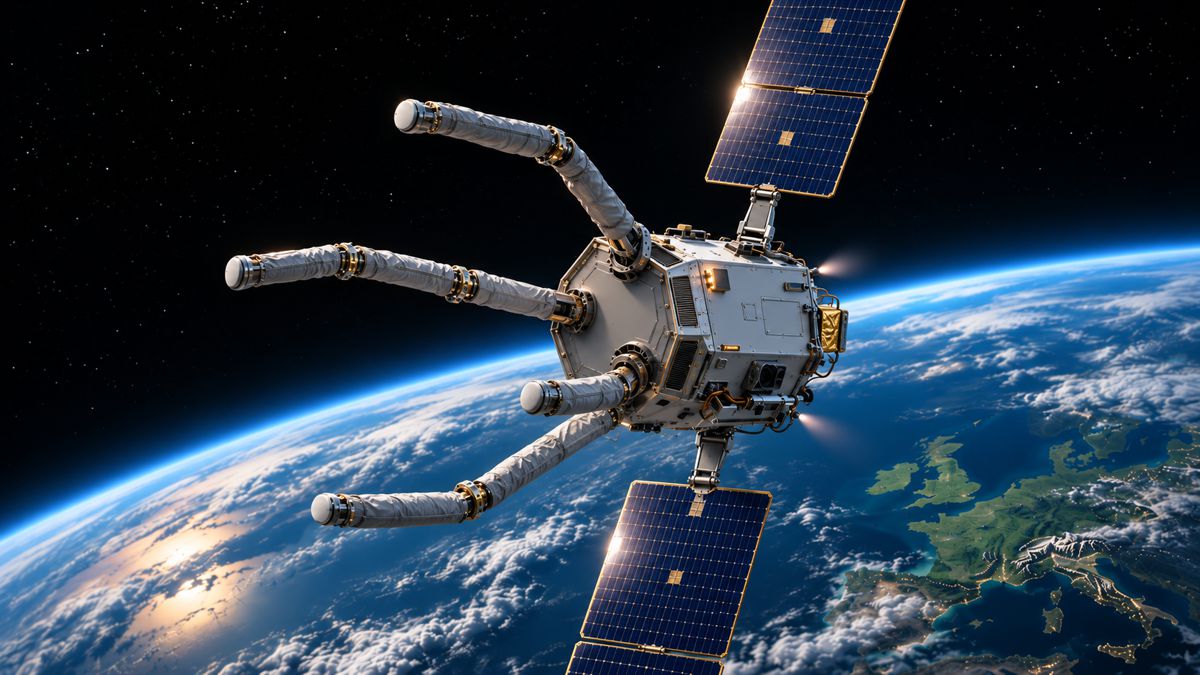
Permanent orbital computing platforms might eventually incorporate extensive shared solar arrays, electrical distribution systems, common communications equipment and large radiator assemblies supporting multiple replaceable computing modules. Robotic servicing vehicles could deliver new hardware, exchange malfunctioning components and retrieve redundant equipment for disposal or eventual recycling.
Such facilities would benefit from standardised mechanical, electrical, communications and thermal interfaces, allowing computing modules from different manufacturers to connect to established infrastructure. Automated storage facilities could hold replacement equipment in orbit, reducing the need to arrange an individual launch whenever a component fails.
Shared infrastructure would also introduce concentrated operational risks. Damage to a common electrical distribution system or cooling network could affect numerous computing modules, making independent protection, redundant services and isolatable infrastructure sections essential design considerations.
The spacecraft recovery technologies currently under development for active debris removal missions provide an early foundation for some of these capabilities. Autonomous rendezvous, robotic capture, precision manoeuvring and remote inspection could eventually support routine maintenance and equipment replacement across increasingly sophisticated orbital installations.
These proposed architectures are considerably more ambitious than the individual computing spacecraft currently being developed, but they address a fundamental lifecycle challenge. Industrial infrastructure becomes more valuable when it can be maintained, adapted and upgraded without repeatedly replacing the entire facility.
The Economics of Building Data Centres in Space
Terrestrial data centre development involves substantial expenditure on land, buildings, grid connections, substations, backup generation, mechanical services, physical security and planning approvals. Orbital facilities have a different cost structure, dominated by spacecraft manufacturing, launch services, optical communications, thermal management and equipment replacement.
Reusable launch vehicles have already changed the economics of satellite deployment, and SpaceX’s Starship programme is intended to extend those improvements through considerably greater payload capacity and launch frequency. The eventual commercial performance of heavy-lift launch services will be central to the viability of large-scale orbital computing.
Google’s Project Suncatcher economic modelling suggests that launch prices below US$200 per kilogram could bring certain annualised launch costs per unit of computing power into a range comparable with terrestrial electricity expenditure. Its analysis anticipates that such prices might become achievable during the mid-2030s if historical launch cost reductions continue.
The comparison addresses only part of the overall economics. Orbital facilities must also account for spacecraft manufacturing, financing, insurance, communications, hardware degradation, equipment replacement and disposal, while terrestrial facilities benefit from established supply chains and comparatively straightforward access for maintenance engineers.
Nevertheless, avoiding conventional electricity grid connections, extensive development sites and evaporative cooling offers attractive potential advantages. Standardised spacecraft manufacturing, commercially available computing modules and increasingly competitive launch services could gradually reduce costs across several elements of the orbital infrastructure supply chain.
Long-lived facilities that allow computing hardware to be replaced independently of their supporting structures may offer further economic improvements. Every functioning solar array, radiator and electrical system retained in orbit would represent infrastructure that does not need to be manufactured and launched again.
Commercial opportunities may initially concentrate on applications where computing in space delivers a specific operational advantage, including satellite imagery analysis, autonomous spacecraft operations and scientific research. As the cost and reliability of orbital computing improve, the market could expand to encompass workloads currently hosted entirely within terrestrial facilities.
Managing an Expanding Orbital Industrial Environment
Deploying large numbers of computing spacecraft will create responsibilities extending beyond their electrical and computational performance. Space traffic coordination, collision avoidance, environmental monitoring and dependable end-of-life disposal will become integral components of the infrastructure.
Large solar arrays and radiator assemblies increase spacecraft dimensions and can complicate navigation and manoeuvring. Operators will need reliable tracking, autonomous collision avoidance capabilities and procedures for coordinating operations with other satellite networks, particularly where computing platforms occupy closely organised formations.
Extensive satellite constellations also have consequences for astronomical observations. The American Astronomical Society has raised concerns during the regulatory proceedings associated with SpaceX’s application, including the potential effects of large numbers of spacecraft on ground-based astronomy. Controlling reflected sunlight and coordinating orbital operations will form part of the industry’s wider environmental responsibilities.
Reducing terrestrial water consumption and pressure on electricity networks offers potential environmental benefits, although spacecraft manufacturing, rocket launches and atmospheric re-entry introduce different impacts. Assessments will increasingly need to examine the complete lifecycle of orbital computing equipment rather than considering energy generation in isolation.
Designing spacecraft around repairability, recoverability and dependable disposal could reduce some of these pressures. Longer-lived platforms with replaceable equipment may eventually allow computing capacity to expand without a corresponding increase in the number of disposable spacecraft.
Investment in orbital computing could consequently accelerate the development of supporting industries encompassing robotic servicing, spacecraft inspection, orbital logistics, construction and industrial waste recovery. These services have potential commercial value independently of the computing facilities they support.
Building the Industrial Infrastructure of Space
The first generation of orbital data centres may consist largely of individual satellites carrying their own processors, solar arrays and cooling equipment. As demand develops, the economics of maintaining and upgrading these systems could encourage the construction of larger, longer-lived industrial platforms supported by robotic maintenance services and an increasingly sophisticated orbital supply chain.
Such infrastructure would have applications extending well beyond artificial intelligence. Dependable computing, electrical generation, thermal management and communications services could support scientific research, automated manufacturing, autonomous spacecraft operations and future construction projects. Even the development of infrastructure around the Moon could benefit from increasingly capable computing resources beyond the Earth’s surface.
Radiation, solar storms, thermal management and orbital congestion remain substantial engineering challenges, but decades of aerospace development have already established a foundation for addressing them. Applying those capabilities to the scale and economics of commercial computing will stimulate innovation across semiconductor design, industrial robotics, materials science and spacecraft manufacturing.
Starlink has demonstrated that infrastructure in space can become an ordinary part of daily life. Starmind, Project Suncatcher and the competing programmes now under development are exploring how much further that principle can be taken, with the prospect of establishing an enduring industrial economy beyond the Earth’s surface.
Key Industry Questions
- What is SpaceX Starmind? Starmind is SpaceX’s proposed orbital AI computing programme, combining solar-powered spacecraft, high-performance processors, thermal management systems and optical communications infrastructure.
- Will SpaceX launch one million computing satellites? SpaceX has applied for authorisation to operate up to one million satellites. The figure represents a proposed regulatory upper limit rather than an approved or guaranteed deployment programme.
- How will orbital data centres generate electricity? Photovoltaic arrays will convert sunlight into electricity. Carefully selected orbital configurations can provide near-continuous solar exposure, potentially reducing energy storage requirements.
- How are data centres cooled in space? Heat is transferred from processors and supporting electronics to external radiators through conductive materials and cooling circuits. The radiators emit the heat as infrared radiation.
- Can commercial AI processors survive space radiation? Early demonstrations and radiation tests suggest that selected commercial processors can operate in space with appropriate protection. Shielding, error correction, computational verification and fault-tolerant architectures remain essential.
- Could solar storms disable orbital data centres? Severe space weather can affect electronics, solar arrays, communications and spacecraft trajectories. Radiation protection, space weather forecasting, autonomous protective procedures and distributed computing systems could reduce operational risks.
- Will orbital data centres replace terrestrial computing facilities? Orbital computing is more likely to complement terrestrial infrastructure initially. Different workloads can benefit from different combinations of energy availability, communications performance, processing architecture and maintenance accessibility.
- Which companies are developing orbital data centres? Participants include SpaceX, Google, Blue Origin and Starcloud, alongside Chinese developers such as Zhejiang Lab and its industrial partners. NVIDIA and other technology suppliers are supporting the wider space computing supply chain.
- Could orbital data centres eventually be repaired and upgraded? Future platforms could incorporate replaceable computing modules, shared power and cooling infrastructure, and standardised servicing connections. Robotic maintenance vehicles could upgrade equipment without replacing entire spacecraft.
- What opportunities does orbital computing create for engineering companies? Potential markets include deployable structures, solar arrays, advanced liquid cooling, radiation shielding, autonomous robotics, optical communications, precision manufacturing, orbital logistics and modular industrial construction.
Strategic Takeaways
- Starlink’s commercially established communications network, manufacturing capabilities and launch infrastructure provide SpaceX with a substantial foundation for developing orbital computing services.
- Radiation protection must address both hardware survival and the integrity of computations, creating demand for resilient semiconductor architectures and autonomous fault management.
- Long-lived orbital platforms with replaceable computing modules could improve lifecycle economics while reducing the need to dispose of complete spacecraft.
- Competitive heavy-lift launch services, standardised computing hardware and specialised engineering supply chains could broaden participation in orbital infrastructure development.
- The power generation, communications, cooling and maintenance facilities developed for orbital data centres could support a considerably wider industrial economy in space.