Perception Moves to the Machine as Edge AI Reshapes Off-Highway Autonomy
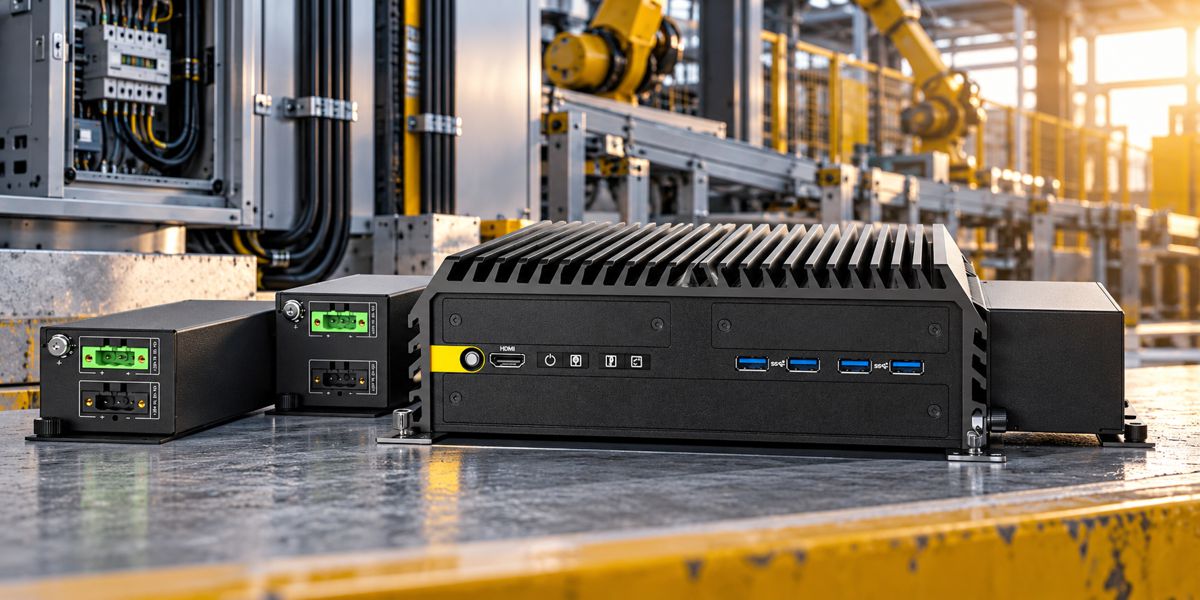
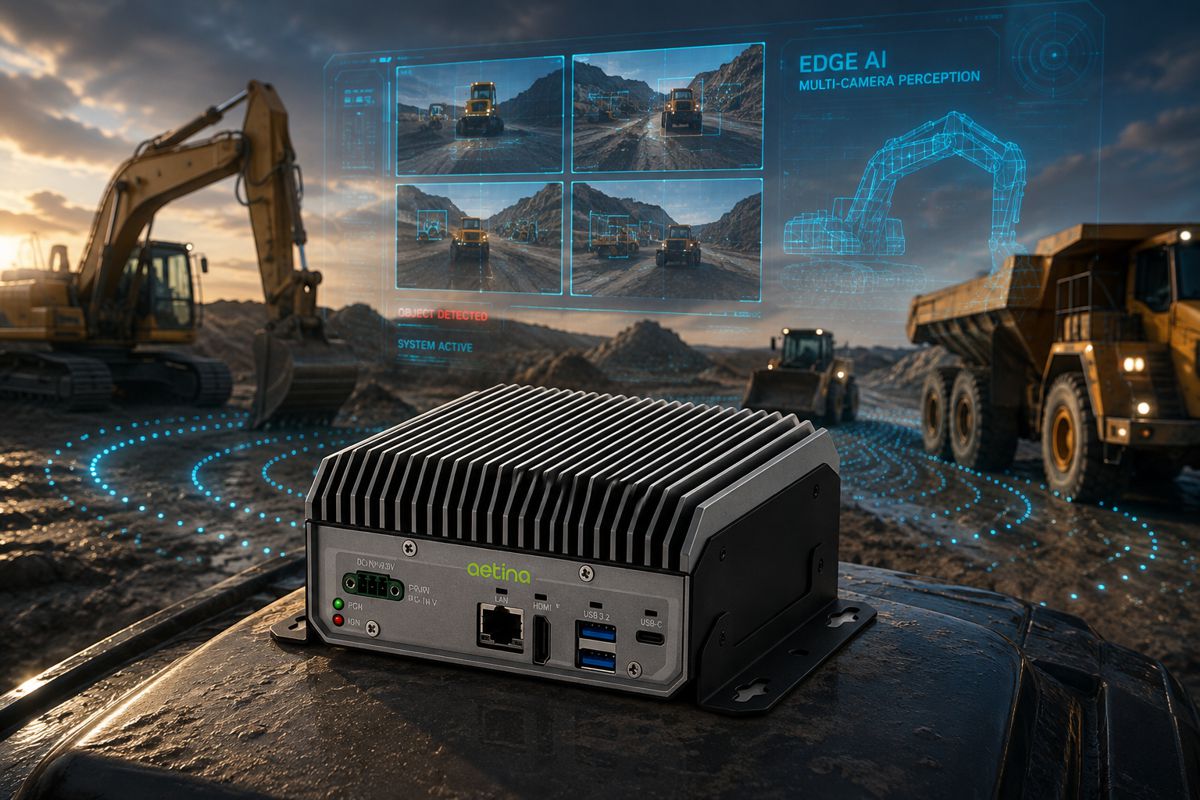
The most consequential shift in artificial intelligence is no longer happening in the data centre. It is happening on the machine itself, where cameras, sensors and inference chips are being asked to see, interpret and act in real time without waiting on a connection to the cloud. Aetina’s launch of its first palm-sized in-vehicle edge AI systems, the DeviceEdge AIE-VN34/44 and AIE-VO24/34, is a modest-looking announcement that speaks to a much larger movement.
The industrialisation of on-machine perception is turning what used to be a bespoke engineering project into an off-the-shelf building block, and that has direct consequences for how construction plant, commercial fleets and autonomous mobile robots will be specified, procured and deployed over the next decade.
For infrastructure operators, the significance sits less in the specifications and more in what those specifications remove. Multi-camera vision has always been technically possible on a moving machine, but making it rugged enough to survive a jobsite, certified enough to pass into a vehicle programme, and cheap enough to deploy at fleet scale has been the persistent obstacle.
Aetina, a subsidiary of the Innodisk Group and an NVIDIA Elite Partner, is addressing exactly that gap, and it is doing so at the accessible tier of the market rather than the flagship. The commercial story here is the descent of autonomy hardware down the cost and size curve, and the quiet migration of purchasing power from vertically integrated original equipment manufacturers toward an ecosystem of certified modular suppliers.
Briefing
- Aetina has launched two palm-sized, fanless in-vehicle edge AI systems built on NVIDIA Jetson Orin NX and Orin Nano modules, delivering up to 100 TOPS and 67 TOPS of AI performance respectively for multi-camera vision at the machine.
- Each unit carries four GMSL2 camera connections capable of low-latency streaming over cables up to 15 metres, enabling 360-degree surround-view, blind-spot detection and situational awareness on vehicles and robots.
- Both systems pass MIL-STD-810H shock and vibration testing and hold E-Mark (E24) automotive certification, removing two of the slowest steps in bringing vision hardware into a vehicle programme.
- The launch lands as off-highway leaders including Caterpillar and John Deere commit to the same NVIDIA Jetson software stack, signalling a durable architectural choice across the construction and agricultural equipment sectors.
- Value is concentrating in a modular supply chain of validated compute, camera adapters and long-term software support, compressing development cycles and shifting competitive advantage away from in-house integration.
The Sensing Layer Is Moving Onto the Machine
The economic logic of edge inference is straightforward once the cloud round-trip is removed from the equation. A construction vehicle or autonomous mobile robot generating several high-resolution camera streams cannot afford to send that data to a remote server, wait for a decision and receive it back before acting.
Latency, connectivity gaps and bandwidth cost all conspire against that model, and for any safety-relevant function such as obstacle avoidance or blind-spot detection, the delay is unacceptable. Processing the vision workload locally, on compute that sits inside the machine, resolves the problem at source and turns raw camera data into actionable intelligence within milliseconds.
This is the design intent behind the two new Aetina systems. The AIE-VN34/44 is built on the NVIDIA Jetson Orin NX in 8GB and 16GB variants, reaching up to 100 TOPS of AI performance, while the AIE-VO24/34 uses the Jetson Orin Nano with Super Mode in 4GB and 8GB configurations for up to 67 TOPS. Both are packed into a chassis measuring roughly 136 by 132 by 63 millimetres, small enough to be mounted almost anywhere on a vehicle or robot.
The choice of the Orin tier rather than the newer, more powerful Jetson Thor platform is telling, because it places these systems firmly in the high-volume, cost-sensitive segment where the bulk of real deployment will occur. Not every autonomous function requires server-class reasoning at the edge, and the commercial opportunity in perception is enormous precisely because so much of it can run on affordable, power-efficient silicon.
Certification and Ruggedisation Decide What Actually Ships
Engineers who have tried to move a vision prototype into a fielded product know that the compute performance is rarely the deciding factor. The barriers are environmental and regulatory, and they are where projects stall for months. Aetina has engineered both systems for continuous operation in conditions that defeat consumer-grade hardware, with a fanless architecture that runs without throttling from minus 25 to plus 55 degrees Celsius, a 9 to 36 volt wide-voltage input, and integrated Ignition Power Control to manage safe startup and shutdown against the voltage fluctuations typical of a working vehicle.
Isolated CAN FD and GPIO or RS-232 interfaces connect the compute to vehicle signals, controllers and industrial peripherals, alongside Gigabit Ethernet, USB 3.2, HDMI and M.2 expansion for storage and wireless.
The certification credentials matter just as much as the connectors. Both systems pass MIL-STD-810H shock and vibration testing and carry E-Mark (E24) approval for automotive electronic equipment, which streamlines their entry into global vehicle markets and spares integrators the expensive, time-consuming process of qualifying an uncertified board. The four GMSL2 ports, using Fakra-Z connectors, deploy the Gigabit Multimedia Serial Link technology originated by Maxim Integrated and now part of Analog Devices, carrying video, control data and power over a single cable at up to six gigabits per second across distances of 15 metres.
That reach is the practical enabler of surround-view on a large machine, where cameras must sit far from the central compute and survive the electromagnetic noise and mechanical stress of the operating environment. Validated GMSL2 adapter boards and driver-ready camera modules complete the bundle, and the compression of integration and validation time this offers is the real commercial proposition.
The Off-Highway Sector Has Already Chosen the Architecture
The clearest evidence that this is more than a niche product launch lies in the company that has committed to the underlying platform. When NVIDIA brought its Blackwell-powered Jetson Thor to general availability in August 2025, its named early adopters included Caterpillar and Amazon Robotics, with John Deere among the companies evaluating the platform to advance their physical AI capabilities.
Those are not experimental start-ups. They are the dominant forces in construction and agricultural equipment, and their alignment with the Jetson software stack, spanning Isaac for robotics and Metropolis for vision analytics, points to a settled architectural direction for off-highway autonomy rather than a passing experiment.
For an infrastructure audience, that matters because it de-risks the supply chain. Once the largest equipment makers standardise on a common compute and software foundation, the surrounding ecosystem of camera vendors, adapter suppliers and system integrators aligns behind it, and the smaller players building fleets, retrofits and specialist machines inherit a mature, well-supported platform.
Aetina sits precisely in that ecosystem, one of a group of Jetson partners that also includes Advantech, ADLINK and Connect Tech, supplying the ready-made compute layer that lets a machine builder concentrate on the application rather than the plumbing. The strategic consequence is that autonomy capability becomes something a mid-sized manufacturer can buy and integrate, not something only a global OEM can afford to build.
Multi-Camera Vision Becomes Situational Intelligence
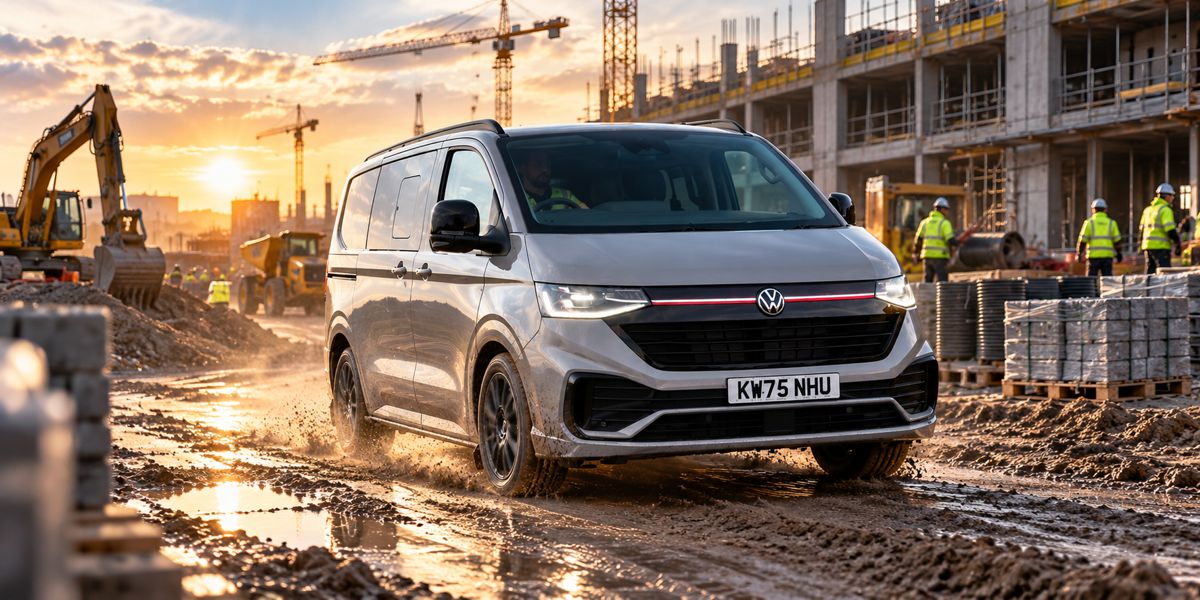
The applications Aetina identifies map cleanly onto the operational realities of construction and logistics. Surround-view monitoring and blind-spot detection address one of the most stubborn safety problems in the sector, the limited visibility from the cab of a large machine and the risk that poses to workers on foot.
Obstacle avoidance and path planning give autonomous mobile robots the perception they need to navigate warehouses, yards and increasingly the jobsite itself, while real-time defect inspection brings machine vision to production lines and prefabrication facilities where quality control has traditionally relied on human eyes. People tracking and security monitoring extend the same sensing capability into building and site management.
What unifies these use cases is the conversion of visual data into decisions, and this is where the technology earns its commercial keep.
James Ho, Manager of Edge Computing Product Division at Aetina, framed the shift in terms of the perception layer itself, stating: “As real-time, multi-camera perception becomes the sensing layer for AI agents operating in vehicles, AMRs, and industrial equipment, customers need edge compute that is rugged enough for the field and ready for mass production from day one, Aetina’s palm-sized in-vehicle edge AI systems bring four-camera GMSL2 support, automotive-grade certification, and NVIDIA Elite Partner-backed BSP support together in one rugged multi-vision platform, helping customers simplify integration and accelerate the deployment of intelligent vision at the edge.”
The point worth drawing out for infrastructure operators is that the productivity and safety gains from surround perception do not depend on full autonomy. A machine that simply sees more, and warns or intervenes accordingly, delivers measurable value long before it drives itself, and that lowers the threshold for adoption considerably.
Where Commercial Value Is Concentrating
The competitive dynamic underneath this launch is a commoditisation of the perception building block, and it favours suppliers who can bundle certified compute, camera sensing and long-term software support into a single validated package. Aetina’s board support package is built on NVIDIA JetPack 6.2, with JetPack 7.2 support to follow, and that ongoing software commitment is a genuine differentiator in a market where a fielded fleet may run for a decade.
NVIDIA has extended the production lifecycle of the Jetson Orin family through 2032, giving equipment makers the supply assurance they need to design these modules into long-lived platforms without fear of premature obsolescence. Predictable availability and a maintained software stack are not glamorous features, but they are decisive in procurement decisions for capital equipment.
The wider market context sharpens the case for the accessible Orin tier that these systems occupy. Memory prices have climbed sharply through 2025 and into 2026, and NVIDIA itself has positioned parts of its newer robotics line-up around mitigating that cost pressure, which makes efficient, right-sized compute more attractive than raw performance for volume deployment.
Aetina’s parent, Innodisk, brings industrial memory, storage and camera module expertise to the group, and that vertical breadth lets the company assemble complete sensing solutions rather than selling compute in isolation. For infrastructure buyers, the practical takeaway is that the value in autonomy is migrating from proprietary, in-house perception systems toward a modular supply chain where sensing, transmission and inference arrive pre-integrated, validated and ready for mass production. Competitive advantage increasingly rests on how quickly a machine builder can deploy that capability, not on whether it can engineer it from scratch.
What Infrastructure Leaders Should Take From This
The strategic signal in this launch is that the perception layer for physical AI is becoming a purchasable commodity, and the implications ripple well beyond a single product family. Fleet operators, plant hire businesses and equipment manufacturers should be assessing where surround-view perception and edge inference can be retrofitted or designed in to improve safety and reduce operational risk, because the hardware barriers that once made such projects prohibitive are falling away.
The convergence of V2X connectivity and local edge computing continues to drive demand for compact, rugged compute that processes vision data on the machine, and the organisations that move early will be buying into a maturing ecosystem rather than pioneering an unproven one.
The longer view is that autonomy in construction and infrastructure will arrive incrementally, sensor by sensor and function by function, rather than as a single leap to driverless machines. Each certified, mass-producible perception module lowers the cost of the next increment, and the standardisation now visible across the Jetson ecosystem means that investment in this architecture compounds rather than strands.
For those specifying equipment, negotiating supply agreements or planning capital renewal, the sensible posture is to treat on-machine perception as a fast-commoditising capability, to favour suppliers with proven certification and long software lifecycles, and to recognise that the competitive frontier is shifting from who can build intelligent vision to who can deploy it fastest and most reliably in the field.
Key Industry Questions
- Why does processing vision data on the machine matter more than raw AI performance for construction fleets? Local processing removes the delay, connectivity dependence and bandwidth cost of sending camera data to a remote server and waiting for a decision. For safety-relevant functions such as blind-spot detection or obstacle avoidance on a moving machine, that round-trip latency is unacceptable, so inference has to happen on the vehicle itself. The Aetina systems are engineered for exactly this, turning multiple camera feeds into decisions within milliseconds. For fleet operators, reliability and real-time response in poor-connectivity environments often matter more than peak compute figures, which is why a right-sized module frequently beats a more powerful but costlier one.
- What do the MIL-STD-810H and E-Mark certifications actually change for an equipment buyer? These certifications remove two of the slowest and most expensive steps in bringing vision hardware into a fielded product. MIL-STD-810H shock and vibration testing confirms the units can survive the mechanical stress of a working machine, while E-Mark (E24) approval clears them for use in automotive electronic systems across global markets. Without pre-certified hardware, an integrator must qualify an uncertified board itself, a process that can add months and considerable cost to a project. Buying compute that already carries these credentials compresses the timeline from prototype to deployment and reduces the technical risk of a programme.
- Why did Aetina build these systems on Jetson Orin rather than the newer Jetson Thor? The Orin tier sits in the high-volume, cost-sensitive segment where most real-world deployment will occur, whereas Jetson Thor targets server-class reasoning for demanding humanoid and multi-model robotics. Many perception functions, including surround-view and blind-spot monitoring, do not require flagship compute, so an efficient Orin-based system delivers the capability at a far more deployable price and power envelope. With memory costs having risen sharply, right-sized compute has become more commercially attractive than raw performance for fleet-scale rollout. The choice reflects where the volume opportunity in machine perception genuinely lies.
- What is GMSL2, and why does the 15-metre cable reach matter on large machines? GMSL2, or Gigabit Multimedia Serial Link, is a serialiser-deserialiser technology originated by Maxim Integrated and now owned by Analog Devices, carrying video, control data and power over a single cable at up to six gigabits per second. Its 15-metre reach is the practical enabler of surround-view on large plant, where cameras must be mounted far from the central compute and still deliver low-latency, high-resolution streams. The interface is highly resistant to the electromagnetic noise and vibration of harsh environments, which is why it has spread from automotive ADAS into robotics and industrial vehicles. Four GMSL2 ports allow a single unit to build a complete 360-degree perception system.
- How does the involvement of Caterpillar and John Deere affect the wider market? When the dominant construction and agricultural equipment makers commit to a common compute and software platform, they de-risk it for everyone else. Both companies have aligned with NVIDIA’s Jetson stack, with Caterpillar among the early Jetson Thor adopters and John Deere evaluating the platform, which signals a settled architectural direction for off-highway autonomy. That alignment pulls the surrounding ecosystem of camera vendors, adapter suppliers and integrators into the same standard, giving smaller machine builders access to a mature, well-supported foundation. The result is that autonomy capability becomes something a mid-sized manufacturer can buy and integrate rather than something only a global OEM can build.
- Does adopting this technology require committing to full machine autonomy? No, and that is central to its commercial appeal. A machine that simply sees more of its surroundings and warns operators or intervenes to prevent an incident delivers measurable safety and productivity value long before it drives itself. Surround-view and blind-spot systems address a well-known hazard, the limited visibility from the cab of a large machine, without any requirement for autonomous operation. Adoption can therefore be incremental, function by function, which lowers the threshold for investment considerably. This staged path lets operators capture near-term benefit while building toward greater autonomy as the technology and the business case mature.
- What supply and lifecycle assurances matter when designing these modules into long-lived equipment? Capital equipment often runs for a decade or more, so predictable component availability and a maintained software stack are decisive. NVIDIA has extended the production lifecycle of the Jetson Orin family through 2032, giving manufacturers the confidence to design these modules in without risking premature obsolescence. Aetina’s board support package, currently built on NVIDIA JetPack 6.2 with JetPack 7.2 support to follow, provides the ongoing software commitment that a fielded fleet depends on. Buyers should weigh these lifecycle guarantees as heavily as headline performance, because a perception platform that loses support or supply mid-life becomes an expensive liability.
Strategic Takeaways
- On-machine perception is becoming a purchasable commodity rather than a bespoke engineering project, and the competitive frontier is shifting from who can build intelligent vision to who can deploy it fastest and most reliably in the field.
- Certification and ruggedisation, not raw compute, are the real gatekeepers to deployment, so equipment buyers should prioritise pre-qualified hardware that removes months of validation from a project timeline.
- The alignment of Caterpillar, John Deere and the wider Jetson ecosystem around a common software stack de-risks off-highway autonomy investment and points to a durable architectural standard worth designing toward.
- Surround-view and edge inference deliver safety and productivity gains without requiring full autonomy, giving operators an incremental, lower-risk adoption path that captures value now while building toward more capable systems.
- With memory costs elevated and Jetson Orin availability guaranteed to 2032, right-sized, long-supported compute is a stronger commercial bet than flagship performance for fleet-scale perception, and value is concentrating in suppliers who bundle certified compute, camera sensing and sustained software support.