You Don’t Need to Market Like a Multinational Anymore
Editorial disclosure: This article forms part of Highways.Today’s Construction Marketing Month. Highways.Today provides the Expert Article Writing and Publishing service mentioned in this feature.
A specialist construction technology company considering Australia once faced a fairly substantial decision before it had learnt very much at all. Someone had to commission market research, find an adviser, buy reports, speak to distributors or attend an exhibition. Investigating the opportunity could become an investment before management had established whether there was an opportunity worth investigating.
Similar barriers appeared closer to home. Exploring a new application for an existing product consumed engineering and commercial time. Understanding an unfamiliar sector required outside knowledge. Competitive research took hours. Even discovering that an idea was bad could be surprisingly expensive.
Artificial intelligence is beginning to alter those economics. Its most useful contribution to an ambitious mid-sized construction company may have relatively little to do with producing more content. AI gives a capable person access to a powerful research and analytical environment in which markets can be investigated, documents interrogated, competitors mapped, technical subjects explored, datasets examined and assumptions challenged at a speed that was difficult to achieve with a small team only a few years ago.
Those systems can also be confidently wrong, which makes judgement and verification part of the capability rather than optional safeguards. Used critically, however, they allow a manufacturer, specialist contractor, materials producer, engineering business or construction technology company to consider a very different marketing operation.
Instead of attempting to reproduce the departments, agency networks and campaign structures of much larger competitors, a mid-sized company can build around qualities it already possesses: specialist knowledge, proximity to customers, shorter decision chains and the ability to change direction quickly.
The multinational still has scale. The specialist may have something harder to purchase: agility.
Briefing
- OECD research found generative AI was already in use among 31% of SMEs surveyed across seven countries.
- Eurostat recorded AI use among 55.0% of large EU enterprises in 2025, compared with 30.4% of medium-sized enterprises and 17.0% of small enterprises.
- LinkedIn’s 2025 B2B Marketing Benchmark found 95% of surveyed B2B marketers used AI at least weekly and 65% daily or more, while only 32% rated their expertise as “extremely good”.
- McKinsey’s August 2026 “decision dividend” research argues that some of AI’s largest economic gains can come from faster decisions, better use of existing assets and opportunities that would otherwise be missed.
- The 2025 6sense Buyer Experience Report found that the winning supplier was already on the buyer’s Day One shortlist 95% of the time.

A Different Marketing Operation
Growing companies have traditionally borrowed their organisational ambitions from larger ones. Success brings another marketing employee, another agency, more exhibitions, more advertising, regional campaigns, additional software platforms and eventually perhaps separate teams for digital, communications, content, brand and market development.
There is nothing inherently wrong with that structure. A multinational equipment manufacturer operating across dozens of countries needs regional coordination, brand controls, dealer communications, legal oversight and enough capacity to support many products and markets simultaneously.
A company with 200 or 500 employees has a different problem. Trying to reproduce the multinational model with a fraction of the resources can leave it permanently underpowered. The department is smaller, the research budget thinner, advertising less frequent and international coverage more limited. It plays the same game as its largest competitors while accepting a structural disadvantage in almost every category.
Modern AI tools create the possibility of designing something else.
OECD research published in November 2025, based on more than 5,000 SMEs across Austria, Canada, Germany, Ireland, Japan, Korea and the United Kingdom, found generative AI in use among 31% of the businesses surveyed. The organisation concluded that lower costs and data requirements had widened access to capabilities previously concentrated more heavily among larger organisations, although significant differences in digital maturity remained.
Eurostat’s 2025 figures offer a useful counterweight to any suggestion that the playing field has suddenly become level. AI technologies were being used by 55.0% of large EU enterprises, compared with 30.4% of medium-sized businesses and 17.0% of small enterprises.
Large companies therefore remain more likely to have adopted AI and may have data scientists, specialist teams, enterprise platforms and substantial technology budgets behind it. But a mid-sized company no longer needs an enterprise transformation programme before its marketing manager can analyse a spreadsheet, interrogate a 200-page infrastructure plan, examine five competitors or conduct a preliminary investigation into another market.
The more interesting opportunity lies in what that additional intelligence allows the company to do.

Put Intelligence Close to the Business
A good marketing manager in a specialist construction company occupies an unusual position. Marketing touches customers, competitors, products, sales, technology, pricing, geography and strategy. The person doing the job hears what sales teams are encountering, understands what engineers are developing, knows what customers ask at exhibitions and gradually builds a picture of how the company is perceived from outside.
Too often that role becomes predominantly administrative: manage LinkedIn, update the website, brief the SEO agency, order the exhibition stand, commission a brochure and send out press releases. AI creates room to move the job upwards.
A capable marketing leader can now investigate a new market before a management meeting, compare the public positioning of competitors, explore an unfamiliar engineering subject, analyse customer information, interrogate an infrastructure investment programme and examine alternative applications for an existing technology. One commercially curious person can cover far more ground than before.
LinkedIn’s 2025 B2B Marketing Benchmark, based on research conducted by Ipsos among 1,500 B2B marketing leaders across six countries, found 95% using AI at least weekly and 65% daily or more. Yet only 32% rated their AI expertise as “extremely good”.
Once broadly similar tools are available to everybody, possession of the software provides little lasting advantage. The differentiator becomes the person using it: their judgement, curiosity, commercial understanding, industry knowledge and ability to frame useful questions.
The World Economic Forum’s Future of Jobs Report 2025 points in the same direction. Analytical thinking remained employers’ most sought-after core skill, regarded as essential by seven in ten surveyed companies. Resilience, flexibility and agility, along with leadership and social influence, also ranked highly, while AI and big data headed the fastest-growing skills.
For a specialist construction company, that combination argues for putting a very good marketing person close to management, engineering, sales, product development and customers. They need to understand what the business is trying to become, where its technical strengths lie and what the market is asking for.
It also raises a more fundamental question about how much market understanding companies should routinely outsource.
An SEO agency may know what customers are searching for. A PR agency may recommend subjects to discuss. A consultant investigates competitors. An export adviser examines another country. Useful knowledge arrives in reports and presentations, often interpreted by people who understand their discipline better than they understand the company itself.
External expertise can be extremely valuable. The risk comes when the resulting knowledge lives mainly outside the business.
A specialist manufacturer should understand how customers describe the engineering problem it solves. A contractor should know which infrastructure programmes could create demand for its capabilities. A technology company should continuously examine competing approaches. A materials producer considering another country should begin developing its own institutional understanding of standards, climate, procurement, distribution and competing products, even when local advisers will eventually be needed.
McKinsey’s August 2026 research describes a “decision dividend” from AI, arguing that some of the largest economic gains can come from faster decisions, better use of existing assets and opportunities that would otherwise be missed.
That is a useful way to think about AI inside marketing. Saving three hours producing a brochure has value. Discovering three months earlier that an adjacent export market has a developing requirement for the company’s technology may have far more.
The company should aim to own the intelligence, allowing its understanding of customers, markets, competitors and opportunities to accumulate internally while buying outside expertise where it adds something different.

Experiment Before You Invest
One of the quiet constraints on mid-sized companies is the cost of finding out that an idea will not work.
Consider a manufacturer of specialist road maintenance machinery that suspects its equipment might have an application in mining. Even an initial investigation could once require internal research, consultant time, industry reports and conversations with people in an unfamiliar sector.
Today, a commercially curious marketing manager can begin much further upstream. They can investigate how mines currently perform the relevant task, identify terminology, map major operators, examine equipment already in use, locate specialist publications and exhibitions, study supplier claims and compile the questions that need answering by engineers or people with mining experience.
None of that proves there is a market. It helps the company decide whether the idea deserves more money.
The same process can be applied to an asphalt technology developed in Europe that might suit warmer climates, a machine-control company exploring another equipment category, a geotechnical specialist considering a neighbouring country or a materials producer wondering whether a successful domestic application has relevance overseas.
Ten possibilities can be investigated relatively cheaply. Eight may lead nowhere and two may justify proper research. Failure becomes much cheaper when it occurs before serious commitment.
That suits mid-sized businesses because experimentation can often travel through the organisation quickly. A marketing manager can raise an idea with the commercial director, talk to an engineer, check assumptions with sales and conduct enough preliminary research to bring something tangible back to management within days.
A multinational can do all of this too, often with better data and greater specialist resources. It also has regional responsibilities, global brand rules, annual plans, approval structures and many competing priorities. Those controls exist for good reasons, particularly where technical claims, regulation and corporate reputation are concerned, but scale inevitably requires coordination.
A specialist company may be able to investigate something on Monday and begin testing it by Friday. That ability to change its mind quickly deserves to be treated as an asset rather than a symptom of being smaller.
Think Globally Earlier
International expansion used to force expensive choices comparatively early. Should the company exhibit in Dubai? Appoint a distributor in Australia? Commission research into India? Visit CONEXPO? Translate its material into another language? Hire somebody in Singapore?
Each step carries cost, and companies can know remarkably little about a market when they first have to decide whether to spend money on it.
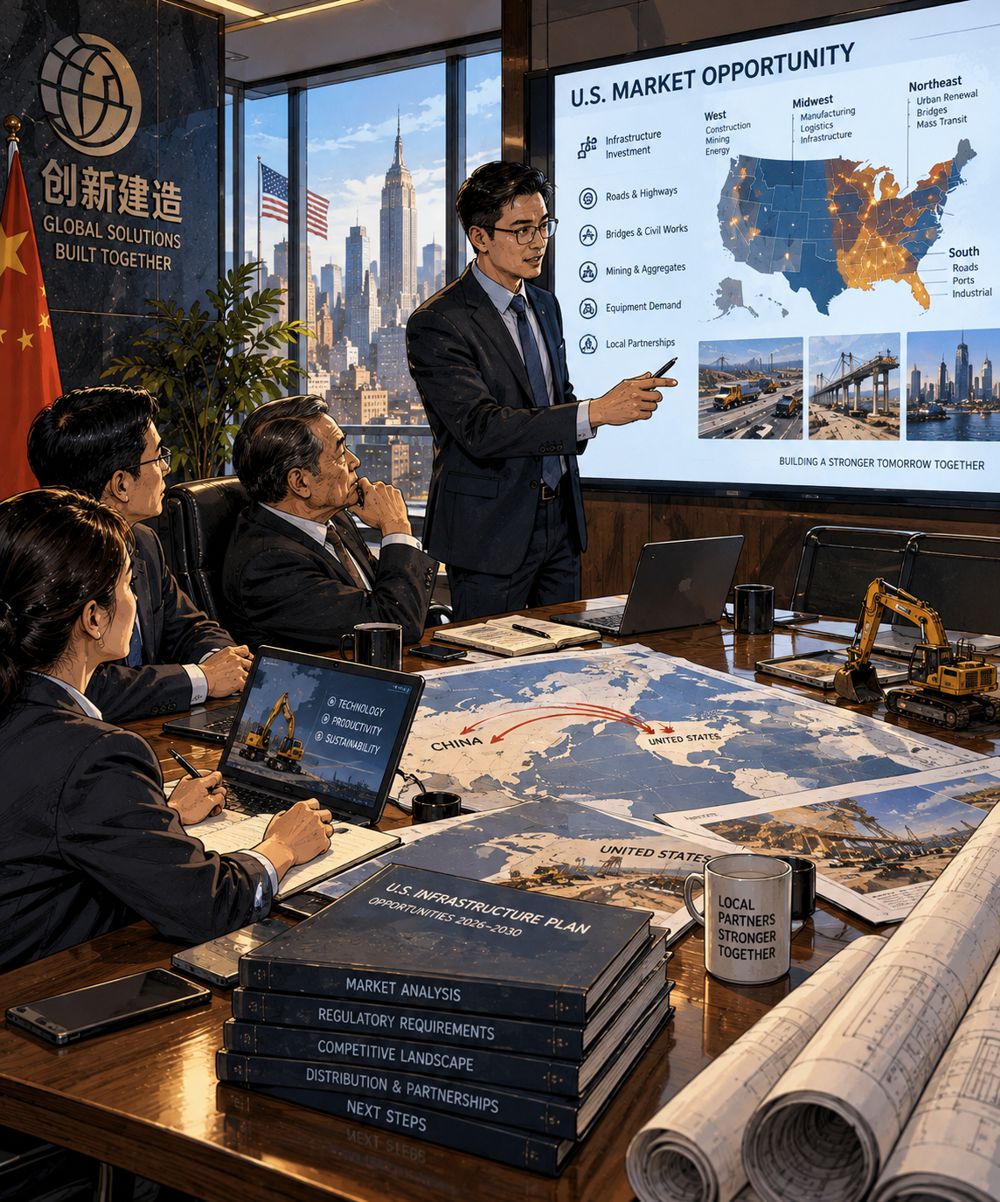
AI cannot make the decision for them, but it can help them reach the point where much better questions can be asked. A European equipment manufacturer can begin investigating Australian road programmes, procurement structures, local terminology, standards and competitors without leaving its existing market. An Indian construction technology company can compare infrastructure priorities across several African countries. A South Korean specialist can begin exploring Gulf construction markets long before it is ready to appoint a local partner.
These are research exercises rather than market-entry strategies. Information concerning regulations, standards, tariffs, technical compliance, procurement law and market size must still be checked against authoritative sources and competent local advice. Language models are particularly dangerous when plausible wording is mistaken for verified knowledge.
Used properly, however, they reduce the friction involved in becoming curious about somewhere else. A company no longer has to wait until management is sufficiently convinced about a country to justify substantial research. It can investigate first, discard weak possibilities, identify the questions it cannot answer internally and spend money where local expertise becomes valuable.
The cost of asking whether another market might be interesting has fallen. For specialist construction companies whose expertise travels more easily than their reputation, that allows international thinking to begin much earlier.

Own the Strategy, Buy What Is Scarce
If internal marketing teams become more capable, agencies, consultants, publishers and other specialists do not suddenly become unnecessary. The reason for employing them simply becomes clearer.
There is less sense in paying an external organisation merely because it possesses tools the company can now operate competently itself. Preliminary research, routine competitor analysis, summarisation, early campaign development and basic content production are increasingly accessible to an internal team.
Scarce capabilities remain scarce.
A company entering a regulated market may need an experienced local adviser. A major brand project may require exceptional design talent. International media relations depend partly on relationships and knowledge developed over many years. Professional research, photography, film, technical writing and specialist creative work continue to reward expertise.
Independent authority belongs in the same category. A company can publish almost unlimited material on its own website, and AI has made producing that material easier than ever. What it cannot do is manufacture an independent reputation simply by increasing the volume.
That becomes particularly relevant in B2B markets where substantial research occurs before suppliers hear from potential customers. The 2025 6sense Buyer Experience Report, based on nearly 4,000 buyer responses across North America, APAC and EMEA, found that the winning vendor was already on the buyer’s Day One shortlist 95% of the time. It also found that 94% of buying groups had put their shortlist in order of preference before engaging with sellers.
That gives pre-sales visibility considerable weight. If a supplier is largely absent from the buyer’s research environment, the formal sales conversation may begin after much of the competitive landscape has already been formed.
Construction procurement adds complications to that picture. Approved supplier lists, dealer relationships, previous project experience, demonstrations, engineering approvals, local service capability and procurement rules can all shape buying decisions in ways that generic B2B research does not fully capture.
The broader direction is nevertheless familiar. A supplier increasingly benefits from being understood, credible and discoverable before direct engagement begins.
Corporate publishing can contribute to that. Independent industry publishing adds something different.
From Keywords to Subjects
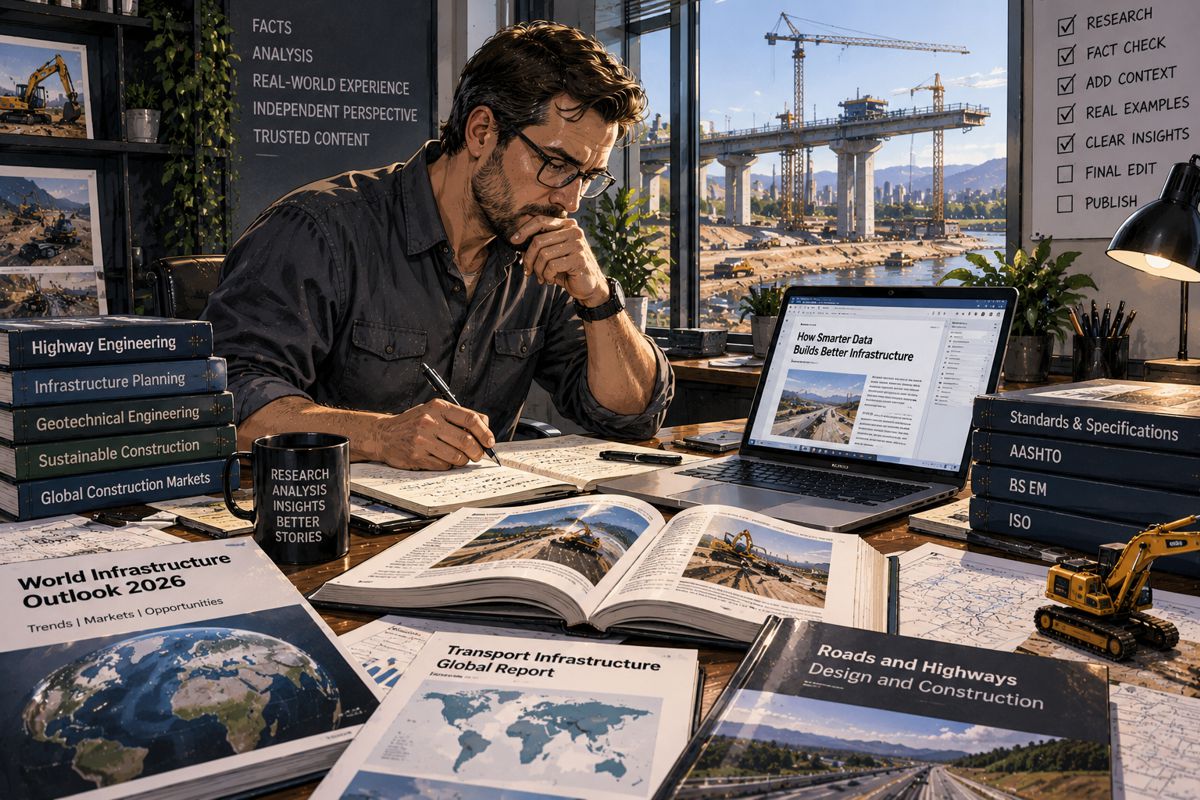
For years, companies have been encouraged to ask which keywords they want to rank for. Understanding search demand remains useful, and conventional search still plays an important role in how companies and technologies are discovered.
An ambitious specialist business can nevertheless ask a more valuable question: What does it want to be known for?
Perhaps it possesses exceptional knowledge of reclaimed asphalt. Its engineers may understand drainage failures better than almost anybody in its market. It may have spent twenty years developing specialist expertise in machine control, ground improvement, bridge inspection, geosynthetics, quarry processing, road markings, autonomous machinery, digital twins or low-carbon concrete.
That knowledge frequently exists in places marketing does not reach. It sits with the engineer who has solved the same problem on 40 projects, the product manager who understands why installations fail, the managing director who has watched a market evolve for 25 years and the service technician who understands how equipment behaves after thousands of hours in service.
A corporate website can state that the company is a leader. An advertisement can call its technology innovative. A brochure can describe decades of experience. Those are perfectly legitimate marketing tools, but they remain claims made by the company about itself.
Authority grows when the market can see the knowledge behind them.
For a business seeking recognition in asphalt recycling, the stronger long-term objective is therefore not merely to rank for the phrase “asphalt recycling”. It is to become one of the companies repeatedly associated with useful, credible knowledge about the subject: its engineering, economics, materials, equipment, specifications, practical difficulties and successful applications.
One article does not create an industry leader, and no credible publisher should promise that it will. A sustained body of informed work does create evidence. Engineers can encounter it, customers can share it, search engines can index it and journalists can find it. Buyers and prospective distributors researching an unfamiliar company can see that there is substance behind the corporate description.
Over time, the company begins to own a subject rather than merely pursue a keyword.
Authority Beyond the Corporate Website
Once a company has identified the subjects it understands deeply, the next challenge is carrying that expertise beyond its own corporate channels.
A manufacturer’s website should explain its technologies, products and capabilities. Independent industry publishing performs another job. It can place the engineering problem, the market, the technology and the company’s knowledge within a broader professional context, exposing that expertise to people who may never visit the corporate website in the first place.
This is the role Highways.Today’s Expert Article Writing and Publishing service is intended to fill.
The company retains its strategy and market intelligence. Its engineers, directors, technicians and product specialists provide the expertise. Highways.Today researches the wider subject, identifies the strongest editorial story, develops the industry context and turns that knowledge into substantial construction and infrastructure journalism for publication through an established international platform.
The starting point might be a technology deserving wider explanation, a difficult engineering problem the business has learnt how to solve, experience accumulated across projects, research requiring a broader audience or a specialist subject around which the company wants to build recognition.
The difference is partly one of audience and partly one of context. A manufacturer explaining its own product on its own website is performing an essential marketing function. Independent industry editorial examining the underlying engineering problem, researching the wider subject and incorporating the company’s expertise into a serious article creates a different kind of public record.
Neither replaces the other. Together they allow a company to explain what it sells while demonstrating what it knows.
That distinction may become more valuable as AI makes generic corporate content almost limitless. The ability to produce words is rapidly becoming abundant. Specialist knowledge, editorial judgement, independent credibility and an established industry audience remain much harder to reproduce.
The Advantage of Being Close
The mid-sized construction company has an advantage that rarely appears on a marketing budget.
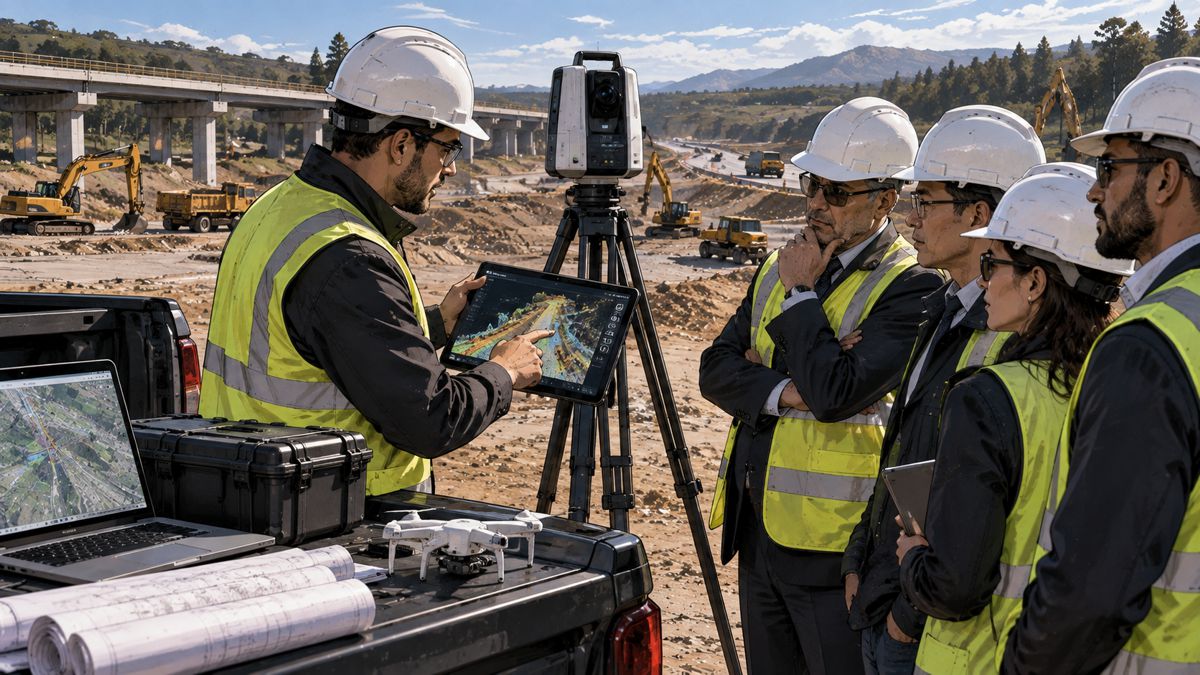
The managing director may still know the customers. The engineer who designed the product may be down the corridor. The service technician knows what happens after thousands of hours in dust, heat and vibration. A commercial question can reach somebody capable of answering it without travelling through six departments.
AI makes that proximity more powerful. It gives a curious company more places to look, more questions to ask and a much cheaper way of discovering which ideas deserve attention. What it does not provide is the experience sitting inside the business.
That may prove to be the more durable advantage. The next generation of successful specialist construction brands does not have to look like smaller versions of today’s multinational companies. Some will build their reputations precisely because they remain close enough to their engineering, customers and markets to move quickly when they see something worth pursuing.
The challenge is making sure the wider industry knows what they know.

Key Industry Questions
- How can mid-sized construction companies use AI in marketing? AI can support market research, competitor analysis, data analysis, technical investigation, campaign development and preliminary exploration of international opportunities.
- Should construction companies bring all marketing in-house? No. Strategy, market intelligence and institutional knowledge are particularly valuable when retained internally, while outside specialists remain useful where they provide expertise, relationships, independent authority or creative capability that the company cannot efficiently reproduce.
- Does AI give SMEs the same capabilities as multinational companies? No. Large companies retain significant advantages in budgets, data, specialist teams, brand recognition and market presence. AI does lower the cost of accessing some research, analytical and creative capabilities.
- Can AI be used to research international construction markets? Yes, particularly for preliminary investigation and comparison. Regulations, standards, procurement requirements, market statistics and technical rules should be checked against authoritative sources and local expertise before decisions are made.
- What are the limitations of using AI for construction market research? AI systems can return outdated, incomplete or incorrect information and may present uncertain answers confidently. Technical requirements, regulations, procurement rules, market figures and other decision-critical information require verification from reliable primary sources.
- Can AI reduce marketing costs for a mid-sized construction company? It can reduce the time and cost of research, analysis, early campaign development and routine production work. It does not remove the need for skilled people, reliable data, specialist expertise or independent verification where commercial decisions depend on accuracy.
- Why is experimentation valuable to mid-sized companies? Smaller businesses can often investigate and test ideas through fewer organisational layers. AI can reduce the time and cost involved in determining whether an idea deserves further investment.
- What should a construction company want to be known for? The strongest answer usually comes from technical or operational expertise. Building sustained recognition around a specialist subject can create a stronger long-term position than pursuing isolated search terms without a wider authority strategy.
- Why does independent editorial still matter when companies can create their own content with AI? Corporate publishing remains first-party communication. Independent industry editorial can provide external context, editorial judgement, an established audience and credibility outside the company’s own channels.
- What does Highways.Today’s Expert Article Writing and Publishing service provide? It combines a company’s expertise with independent research, editorial development, construction-sector knowledge, professional writing, publication and international distribution through Highways.Today.
Strategic Takeaways
- AI’s strongest marketing value may lie in expanding research, analysis and decision-making capacity rather than simply increasing content production.
- Mid-sized construction companies can compete around speed, expertise and experimentation instead of reproducing multinational marketing structures with smaller budgets.
- Market intelligence becomes more valuable when it accumulates inside the company and remains close to management, sales, engineering and customers.
- Cheaper preliminary research allows companies to investigate new applications and international markets before committing substantial resources.
- As corporate content becomes easier to produce, specialist knowledge, independent editorial authority and established industry audiences become more distinctive assets.