AI Powered Geoscience Accelerates Development at Konkola Copper Mines
The global race for copper has intensified. From electrified transport and grid expansion to data centres and renewable power, copper sits at the heart of the energy transition. According to the International Energy Agency, demand for copper in clean energy technologies alone is expected to more than double by 2040 under stated policy scenarios. Against that backdrop, the ability to discover, define and responsibly develop high-grade copper deposits is no longer just a mining story. It is an infrastructure story, a technology story and, increasingly, a geopolitical one.
Now, CopperTech Metals Inc. has announced a strategic partnership with Axiom Group, VBKOM and Fleet Space Technologies to deploy next-generation geoscience technologies at the Konkola Copper Mines in Zambia. Operated by Konkola Copper Mines Plc, a subsidiary of CopperTech, the asset is widely recognised as one of the world’s highest-grade copper deposits. The collaboration is designed to sharpen subsurface insight, accelerate decision-making and reinforce CopperTech’s vertically integrated approach from exploration through to metal production.
Copper’s Strategic Importance in a Digitised Infrastructure Economy
Copper’s relevance to infrastructure has broadened well beyond traditional construction and power distribution. Electric vehicles use significantly more copper than internal combustion models. Offshore wind turbines require tonnes of copper cabling. Data centres, fibre networks and 5G systems all rely heavily on copper conductors. In short, the world’s digital and decarbonised ambitions are physically wired in copper.
At the same time, supply growth has struggled to keep pace. Ageing mines, declining grades and rising technical complexity have placed pressure on producers. The World Bank has repeatedly warned that critical mineral supply chains must expand rapidly to meet climate targets. For investors and policymakers, that translates into one clear priority: bring high-quality resources into production faster, with greater geological certainty and lower environmental risk.
Konkola Copper Mines, located in Zambia’s Copperbelt Province, occupies a strategic position in this equation. Zambia remains one of Africa’s most important copper producers, and the Copperbelt has historically delivered high-grade ore bodies. By combining established processing infrastructure with advanced exploration technologies, CopperTech is positioning the operation as a technology-led supplier of critical minerals to global markets, including the United States.
A New Model for Data Rich Exploration
Exploration has always been a high-risk, high-reward exercise. Traditional drilling campaigns can be expensive, time-consuming and, in complex geological settings, uncertain. The integration of high-resolution seismic imaging, AI analytics and space-enabled data systems marks a shift in how mining companies reduce that uncertainty.
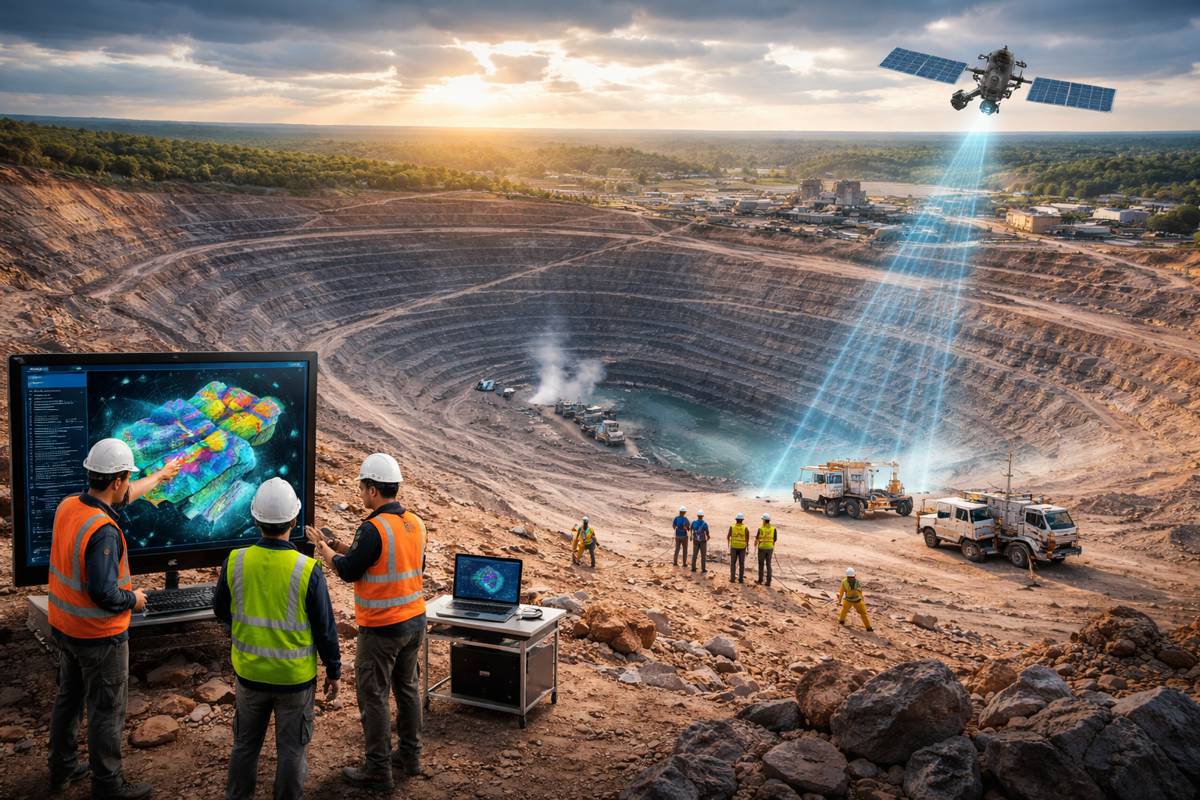
Through the new partnership, Axiom will embed Fleet Space’s ExoSphere platform and conduct a high-resolution 3D seismic survey across the orebody and proximal zones at Konkola. The objective is to generate advanced 3D Ore Body Knowledge models and AI-driven drill targeting insights that can guide more precise campaign design.
Deshnee Naidoo, CEO of CopperTech Metals, framed the initiative as part of a broader operational transformation: “CopperTech is deploying innovative technologies at KCM to strengthen our vertically integrated mining operations from exploration to metal production,” she said. “This strategic partnership with Axiom, VBKOM and Fleet brings together world-class partners to integrate advanced geoscience technology and earth-based applications to enhance exploration accuracy, target definition, and resource confidence.”
The emphasis here is not merely on speed. It is on confidence. In large underground systems such as Konkola, even small improvements in geological understanding can translate into major gains in capital allocation efficiency, mine planning accuracy and safety.
Space Enabled Analytics Meets On The Ground Mining Expertise
Fleet Space Technologies has built its reputation around satellite-enabled connectivity and real-time geophysical data integration. Its ExoSphere platform combines field-based sensors, AI analytics and space infrastructure to provide near real-time subsurface intelligence. While space technology in mining may once have sounded futuristic, it is rapidly becoming a practical tool for operational optimisation.
Flavia Tata Nardini, Co-Founder and CEO of Fleet Space Technologies, highlighted the broader significance of the deployment: “For producers like CopperTech, accelerating its responsible development requires a more deeply integrated approach to exploration,” she said. “By bringing Agile Geoscience to KCM, we’re not only helping to unlock critical resources faster and more efficiently, but also introducing next-gen exploration technologies and skills to the Zambian mining sector.”
The partnership extends beyond technology provision. Axiom contributes deep geoscience capability, while VBKOM adds mining systems expertise. Doug Engdahl, CEO & President of Axion Group, described the collaboration as a structural shift in innovation deployment: “Our work with CopperTech, VBKOM and Fleet Space represents a new model for how mining companies deploy innovation, not just to accelerate geological understanding and drill confidence, but to build long-term capability and competitiveness. By combining our global technical experience and leadership with Fleet’s real-time data systems, we are driving a change in speed, precision, and confidence in exploration decision-making.”
Taken together, the arrangement suggests a move away from siloed service contracts towards integrated technology ecosystems embedded within mining operations.
Accelerating Learning Cycles in Complex Geology
Konkola’s geology is both an asset and a challenge. High grades are attractive, but structural complexity demands precise targeting. In such environments, drilling without advanced subsurface modelling can lead to suboptimal resource delineation and unnecessary expenditure.
High-resolution 3D seismic surveys, when combined with AI-enhanced interpretation, allow for more accurate visualisation of ore continuity, structural features and fault networks. By building detailed 3D OBK models, CopperTech aims to compress the feedback loop between data acquisition and operational decision.
In practical terms, that means fewer blind drill holes, more targeted campaigns and improved conversion of inferred resources into measured and indicated categories. For investors, that translates into stronger resource confidence. For mine planners, it provides a more reliable foundation for scheduling and capital planning. And for regulators and communities, better geological knowledge can support safer and more predictable development pathways.
Implications for Responsible Development and Energy Security
CopperTech, established by Vedanta Resources Limited and domiciled in the United States, has positioned itself as a technology-driven producer aligned with energy security objectives. In an era where critical mineral supply chains are increasingly scrutinised, transparency and data integrity matter.
By integrating AI and advanced geoscience into exploration, the company signals an intent to minimise waste, optimise extraction and strengthen environmental stewardship. Responsible development today is inseparable from digital capability. Data-rich exploration reduces unnecessary disturbance, focuses capital where it delivers value and supports more accurate life-of-mine planning.
For the global construction and infrastructure ecosystem, the significance is clear. Reliable copper supply underpins grid upgrades, renewable energy roll-outs, electric transport networks and digital infrastructure expansion. If advanced exploration technologies can accelerate resource definition at high-grade assets like Konkola, the ripple effects will extend far beyond the mine gate.
Technology Led Mining in the Copperbelt
Zambia’s Copperbelt has long been synonymous with mineral wealth, yet the sector faces modernisation pressures. Introducing next-generation geoscience tools can contribute to skills transfer, data literacy and operational resilience within the region.
Fleet’s reference to introducing new technologies and skills into the Zambian mining sector hints at a broader developmental impact. As digital systems become embedded in exploration workflows, local engineers and geoscientists gain exposure to AI-enabled modelling and real-time analytics. Over time, that can strengthen domestic technical capacity and position the Copperbelt as a hub for innovation, not merely extraction.
Meanwhile, the integration of earth-based seismic surveys with space-enabled analytics reflects a wider industrial convergence. Mining is no longer isolated from aerospace, software engineering or advanced data science. Instead, it sits at the intersection of these disciplines, drawing on each to improve productivity and sustainability.
A Strategic Signal to Investors and Policymakers
Announcements of technology partnerships are commonplace in the mining sector. What distinguishes this collaboration is its explicit alignment with vertical integration, AI deployment and strategic mineral supply objectives. CopperTech is not simply adding another exploration contractor. It is embedding a digital exploration architecture designed to improve decision velocity and long-term competitiveness.
For investors, faster and more accurate resource definition can shorten development timelines and reduce capital risk. For policymakers concerned with energy transition supply chains, enhanced production capacity at high-grade deposits strengthens diversification away from more volatile jurisdictions.
Ultimately, the Konkola initiative illustrates a broader shift in how critical mineral assets are developed. Advanced seismic imaging, AI-driven targeting and space-enabled connectivity are no longer peripheral tools. They are becoming core infrastructure in their own right, shaping how the next generation of copper supply is discovered and brought to market.
As demand for copper continues to rise in line with global electrification and digitalisation trends, technology-led exploration at world-class assets such as Konkola may well define who keeps pace and who falls behind.