Hyundai HL960A XT Powering Sustainable Composting Operations in Yorkshire
Across the construction, agriculture and environmental sectors, the push toward circular resource management is gathering momentum. Governments are tightening landfill restrictions, local authorities are investing in greener waste strategies and landowners are increasingly searching for sustainable soil improvement solutions. At the heart of this shift lies a growing industry built around turning organic waste into valuable agricultural products.
One company quietly operating at the centre of that transition is Ryedale Organics, a family-run green waste processor in North Yorkshire that transforms municipal and commercial organic waste into compost and soil improvers. To keep pace with rising demand and maintain operational efficiency, the company has recently expanded its fleet with another Hyundai HL960A XT wheel loader, supplied by regional dealer Taylor & Braithwaite.
While a single piece of equipment might appear a small step in isolation, the investment reflects something larger. It illustrates how modern waste processing facilities increasingly rely on robust construction machinery to sustain high-throughput recycling operations that underpin the circular economy.
Composting Infrastructure Supporting the Circular Economy
Across Europe and the United Kingdom, waste management policy has undergone a significant shift over the past two decades. The European Union’s Waste Framework Directive and the UK’s landfill tax have steadily encouraged the diversion of biodegradable waste away from landfill sites. The result has been a rapid expansion in composting and anaerobic digestion facilities designed to process food waste, green waste and agricultural residues.
Facilities such as Ryedale’s are a critical component of that system. The Yorkshire-based plant currently processes roughly 80,000 tonnes of organic material each year, accepting waste from local authorities and private waste contractors across the region. Material arrives from throughout Yorkshire and even as far as Manchester, demonstrating how regional processing hubs play a central role in managing urban waste streams.
Rather than simply disposing of the material, the facility transforms it into compost products used in farming and landscaping. These soil improvers help restore nutrients, improve soil structure and reduce reliance on synthetic fertilisers, aligning waste management with sustainable agriculture.
This approach reflects a wider trend. According to research from the European Compost Network, millions of tonnes of organic waste are processed through composting facilities across Europe each year, producing soil conditioners that help close nutrient cycles in agricultural systems. As demand for peat-free growing media rises, compost derived from organic waste is becoming an increasingly valuable resource.
A Family Enterprise Rooted in Agriculture
Ryedale Organics operates from a site that has agricultural heritage stretching back nearly a century. The broader Ryedale Farm complex was established in the 1930s by Maurice Kemp and has gradually evolved into a diversified rural enterprise combining agriculture, food production and waste recycling.
Today the business is managed by cousins and co-directors Ollie Kemp and Jeremy Kemp, representing the third generation of the family to run operations on the site. Alongside the composting plant, the farm hosts an arable enterprise, a poultry unit and a cold storage facility, creating an integrated agricultural operation where waste processing supports farming activities.
This agricultural context has shaped the development of the composting business. Organic waste collected from urban environments returns to rural soil as nutrient-rich compost, creating a practical example of circular resource use between cities and farmland.
Operating within a working farm environment also means that efficiency and reliability are essential. Waste processing cannot afford prolonged downtime. Equipment must perform consistently in demanding conditions where large volumes of organic material are moved daily between shredders, screens and composting vessels.
Managing Contaminated Waste Streams
Organic waste rarely arrives in pristine condition. Material collected from households, landscaping operations and commercial sources often contains contaminants such as plastics, metals and other debris that must be removed before composting can begin.
To manage this challenge, the Ryedale site operates a series of processing stages designed to clean and prepare incoming waste streams. Bulk walking-floor trailers deliver material to the facility, where it is fed through shredders and screening equipment. These machines break down the waste and separate unwanted materials.
The operation also includes a wash plant capable of dealing with heavily contaminated oversize fractions. Optical sorting technology further improves material quality by identifying and removing plastics and other non-organic elements. These technologies have become increasingly common in modern waste management facilities, where stricter compost quality standards require greater levels of contamination control.
Once cleaned, the organic material is ready to enter the composting stage.
Inside the In Vessel Composting Process
The core of Ryedale Organics’ operation lies in its in-vessel composting system, a controlled environment designed to accelerate the natural decomposition process. Compared with traditional open windrow composting, in-vessel systems offer improved temperature control, odour management and faster processing times.
Material is loaded into sealed composting vessels where microorganisms begin to break down organic matter. Air is circulated through the floor of the vessel to maintain oxygen levels, encouraging aerobic decomposition. As microbes digest the organic material, heat builds naturally within the mass.
Temperatures inside the vessels can rise significantly, helping to destroy pathogens and weed seeds. Heat and moisture are released as water vapour while the organic material gradually transforms into stable compost.
After several weeks inside the vessel, the partially processed material is removed and placed in curing areas. Here it undergoes a maturation phase where biological activity slows and nutrients stabilise. The finished compost is then screened into different grades depending on its intended use.
Ryedale produces a 10 mm landscaping compost as well as a 20 mm peat-free organic compost used in agricultural applications. The entire process from raw waste to finished soil improver typically takes between 10 and 12 weeks.
Machinery Keeping the Process Moving
While biological processes drive composting, heavy machinery plays a vital supporting role. Wheel loaders in particular form the backbone of material handling across most composting operations.
At Ryedale’s facility, loaders move incoming waste into processing lines, feed material into composting vessels and handle finished compost during screening and storage. Reliability and manoeuvrability are therefore critical factors when selecting equipment.
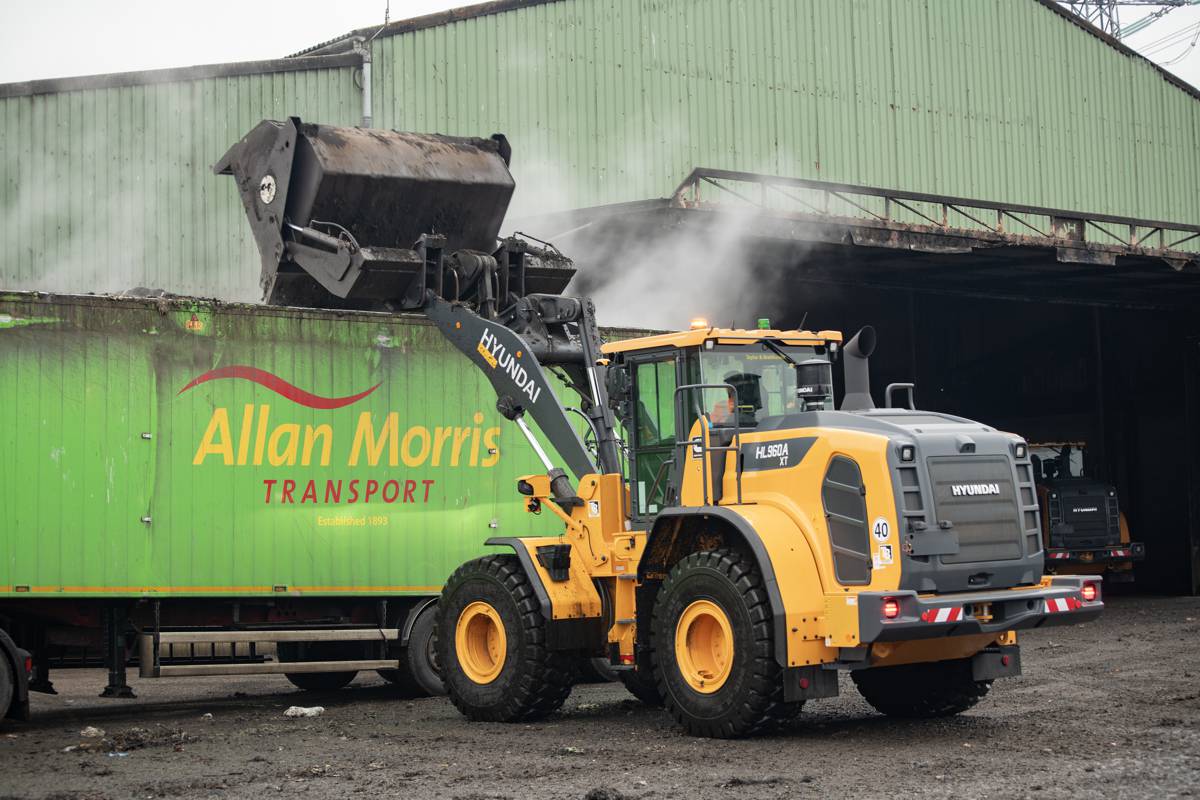
The company’s latest addition is a Hyundai HL960A XT wheel loader fitted with a high-tip Ulrich bulk handling bucket designed to load high-sided walking-floor trailers. The machine joins two existing HL960A units already working at the site.
The HL960A XT sits in the mid-weight category of wheel loaders, weighing around 20 tonnes depending on configuration. It is powered by a six-cylinder diesel engine producing 168 kW or roughly 225 horsepower and operates through a five-speed transmission with lock-up clutch for improved efficiency during loading operations.
The XT specification includes extended loader arms and linkage, increasing the hinge pin height to 4,535 mm, compared with 4,105 mm on the standard machine. Dump clearance at maximum height also rises significantly, enabling easier loading of high-sided trailers used in bulk waste transport.
With the addition of the high-tip bucket supplied by Ulrich, the machine gains further reach and dumping height, improving productivity during trailer loading operations.
Matching Equipment to Facility Constraints
Choosing the right size of loader is not always straightforward in specialised industrial environments. At Ryedale’s composting facility, the design of the in-vessel system imposes weight limits due to the aeration floor beneath the composting chambers.
These structural considerations mean that larger wheel loaders would place excessive loads on the system. The 20-tonne class machine therefore represents a practical compromise between lifting capability and floor load restrictions.
According to Ollie Kemp, the HL960A XT provides the right balance of performance and manoeuvrability for the site’s layout: “The Hyundai machines are really competitive pricewise. They haven’t let us down and we get a really good service from Taylor & Braithwaite. They are a family business like us and we find that everyone gets involved. We are really confident in their experience.”
That local support network plays a critical role in maintaining operational uptime. Waste processing facilities operate on tight schedules and unplanned downtime can quickly disrupt incoming waste flows.
The Importance of Dealer Relationships
For equipment-intensive industries, the relationship between operator and dealer often proves as important as the machine itself. In this case, Ryedale Organics has worked with Taylor & Braithwaite, a regional construction equipment supplier, for several years.
The dealer not only supplied the new wheel loader but also sourced the high-tip bucket attachment tailored to the facility’s specific loading requirements. Such partnerships are common in specialist industries where standard machine configurations often require modifications.
Operators typically run wheel loaders for extended operating hours before replacement. Ryedale aims to keep its machines for around 8,000 operating hours, though some units have remained in service for as long as 12,000 hours: “We have extended warranties to 6,000 hours and then we service the machines ourselves after that. Our business is about keeping things moving and we can’t have anything stopped. The back-up that we get from Taylor & Braithwaite is the biggest plus for us.”
This approach highlights a broader reality within the waste processing sector. Equipment uptime directly influences throughput, and throughput determines financial viability.
Rising Demand for Sustainable Waste Solutions
The expansion of facilities like Ryedale’s reflects a broader shift in how societies manage organic waste. Governments across Europe are introducing separate food waste collection schemes, while landfill bans on biodegradable waste are becoming increasingly common.
The United Kingdom alone generates millions of tonnes of organic waste each year from households, landscaping and food production. Redirecting that material toward composting facilities not only reduces landfill emissions but also produces valuable soil amendments.
Demand for peat-free alternatives is also reshaping horticulture and landscaping markets. Environmental concerns surrounding peat extraction have encouraged the development of compost-based growing media derived from recycled organic material.
For companies capable of processing large volumes of waste efficiently, these trends create long-term growth opportunities. Facilities that combine advanced sorting technology, controlled composting systems and reliable material handling equipment are well positioned to supply this expanding market.
Building a More Resilient Waste Infrastructure
Waste management rarely attracts headlines in the way major infrastructure projects do, yet it forms a critical foundation of modern environmental policy. Composting facilities, recycling centres and waste treatment plants quietly support urban sustainability goals by diverting waste streams away from landfill and transforming them into usable resources.
At Ryedale Organics’ Yorkshire site, that transformation happens every day. Lorry loads of food scraps, garden clippings and organic waste arrive as unwanted by-products of modern life and leave weeks later as nutrient-rich compost ready to improve agricultural soils.
The addition of another wheel loader may seem routine, but in reality it represents an investment in the machinery that keeps this cycle turning. As cities grow and environmental regulations tighten, the role of such facilities will only become more important.
For the global construction and infrastructure ecosystem, this shift underscores a simple truth. The circular economy depends not only on policy and environmental ambition, but also on the reliable equipment and operational expertise that turn waste into valuable resources.