Pressure Quenching Opens for High Temperature Superconductors
For decades, superconductivity has represented one of the most tantalising scientific frontiers with profound implications for energy systems, transport infrastructure, advanced manufacturing and digital technologies. Materials capable of transmitting electricity without resistance promise dramatic efficiency gains across industries. Yet despite steady scientific progress since the mid-20th century, practical superconductors that function at usable temperatures and pressures have remained frustratingly out of reach.
Now researchers at the University of Houston report a significant step forward. Scientists at the Texas Center for Superconductivity at the University of Houston have demonstrated a process known as pressure quenching that substantially increases the temperature at which a well-known superconducting material begins to operate, without requiring extreme pressure once the material is produced.
The findings, published in the Proceedings of the National Academy of Sciences, suggest that a long-standing barrier in superconductivity research may finally be starting to shift. If the technique can be refined and scaled, it could reshape technologies ranging from electrical grids to particle accelerators, and even future transport infrastructure.
In practical terms, superconductors that operate closer to everyday temperatures would reduce the need for expensive cryogenic cooling and enable wider industrial deployment. For infrastructure planners and energy policymakers, that prospect has enormous implications for how power is transmitted, stored and used.
Superconductors for Infrastructure and Energy Systems
Superconductors are materials that conduct electricity with zero electrical resistance once cooled below a specific threshold known as the critical temperature. When operating in this state, electric current flows indefinitely without energy loss.
The implications are profound. Electrical transmission networks currently lose roughly 5 to 8 percent of generated electricity during transport due to resistance in conventional conductors, according to data from the International Energy Agency. Superconducting transmission cables could virtually eliminate those losses while dramatically increasing power density within existing infrastructure corridors.
Such technology would support a wide range of strategic sectors:
- High capacity electricity grids for renewable energy
- Compact power distribution in dense urban environments
- Magnetic levitation transport systems
- Advanced medical imaging equipment
- Particle accelerators and scientific research facilities
- Quantum computing and cryogenic electronics
Despite these advantages, most superconductors currently require extremely low temperatures, often maintained with liquid helium or liquid nitrogen. Maintaining these conditions is expensive and technically complex, which has limited widespread deployment.
Researchers have therefore spent decades searching for materials capable of superconducting at progressively higher temperatures. Each incremental gain potentially brings the technology closer to commercial viability.
The Long Quest for Higher Temperature Superconductivity
The pursuit of higher temperature superconductors has been one of the defining challenges in modern materials science.
The discovery of copper-oxide superconductors in the late 1980s dramatically shifted expectations in the field. These materials, known as cuprates, operate at temperatures significantly higher than earlier metallic superconductors.
One compound in particular, a mercury-based ceramic known as Hg-1223, became a milestone. In 1993, researchers led by Paul C. W. Chu demonstrated that Hg-1223 could superconduct at approximately 133 Kelvin, or about −140 °C.
While still extremely cold, that threshold represented a major step forward. It raised hopes that further research might eventually deliver materials capable of superconducting near room temperature.
Yet progress slowed dramatically in the decades that followed. Although new superconducting compounds have been discovered, many require extraordinarily high pressures to function. Some of the highest temperature superconductors identified in recent years only operate under pressures hundreds or even thousands of times greater than those found in the deepest ocean trenches.
Such conditions make them impractical for real-world applications.
The challenge has therefore shifted from simply discovering new materials to finding ways of stabilising high-temperature superconducting behaviour under normal atmospheric pressure.
Locking in Superconductivity Through Pressure Quenching
The new research from the University of Houston team focuses precisely on that challenge.
Instead of searching for entirely new materials, the researchers explored whether the properties of Hg-1223 could be modified to retain high temperature superconducting behaviour even after extreme pressure is removed.
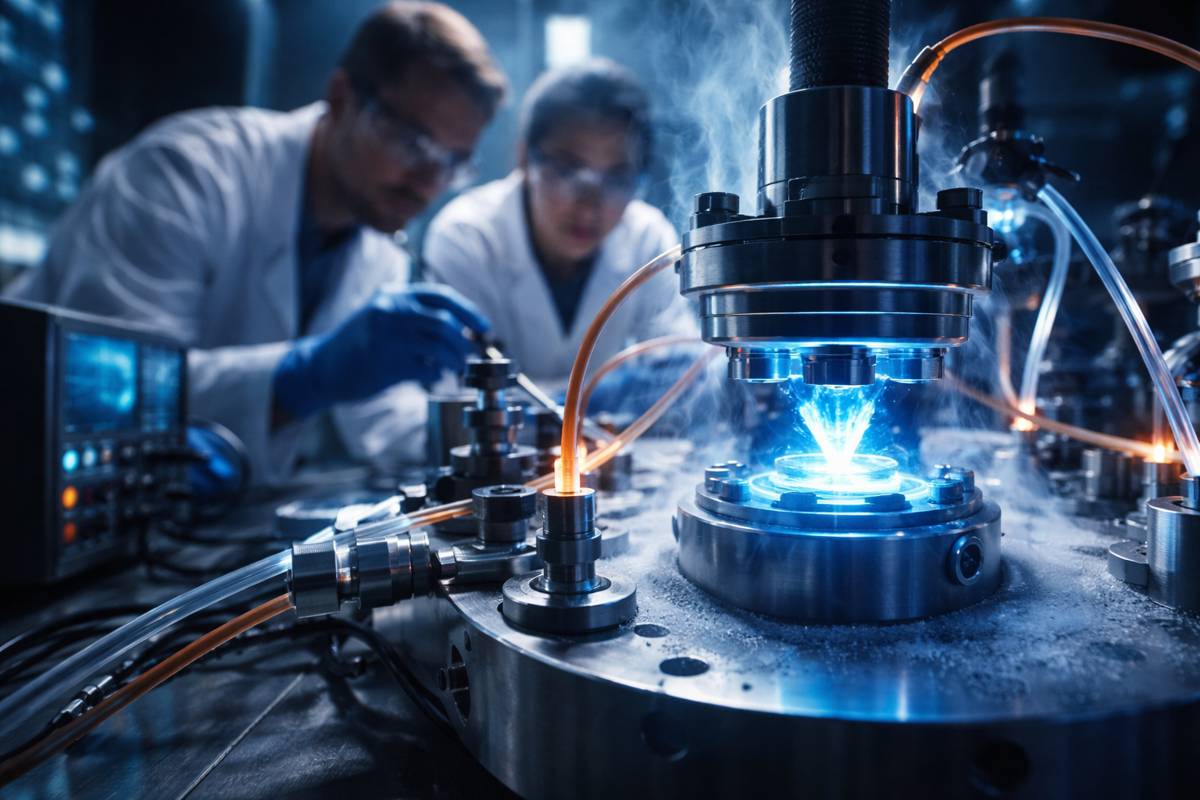
The approach involves a technique called pressure quenching. In the experiment, small samples of Hg-1223 were placed in a device known as a diamond anvil cell. This apparatus can generate enormous pressures by squeezing materials between two diamond tips.
The samples were cooled to temperatures approaching absolute zero using liquid helium while being compressed under pressures up to 300,000 times greater than atmospheric pressure.
Once the material had been stabilised under these conditions, the researchers rapidly released the pressure while allowing the temperature to increase. Surprisingly, the material retained a significantly higher superconducting critical temperature even after returning to normal pressure.
“We are very excited by our success in setting a new record,” says Paul C. W. Chu, who led the study at the Texas Center for Superconductivity. “We believe this is only the beginning, and that with further work on this process we can achieve superconductivity at even higher temperatures at ambient pressure.”
Measurements showed that pressure quenching increased the critical temperature of Hg-1223 from 133 Kelvin to as high as 151 Kelvin, an increase of approximately 18 degrees Celsius.
For superconductivity research, that margin represents a notable advance.
Independent Verification Strengthens the Findings
The research was conducted in collaboration with scientists from Argonne National Laboratory and the research organisation Intellectual Ventures.
Because superconductivity experiments can be extremely sensitive to measurement conditions, the team repeated the process across multiple samples to confirm that the results were reproducible.
“This process somehow causes Hg-1223 to superconduct at temperatures much higher than ever before at ambient pressure,” said Rohit Prasankumar, a physicist involved in the project. “It was such a strong effect that we repeated the process with five different samples, to prove to ourselves that it was real.”
The sustained increase in superconducting temperature was still observable when researchers checked the material two weeks later, suggesting that the pressure-quenched state remained stable over time.
While the precise physical mechanism responsible for the behaviour remains unclear, the results indicate that pressure quenching may fundamentally alter the internal structure of the material in a way that preserves its superconducting properties.
A Broader Strategy for Achieving Practical Superconductors
The breakthrough arrives amid renewed optimism in the superconductivity research community.
In a companion analysis published alongside the study in the same issue of PNAS, a group of sixteen researchers from eleven institutions outlined a broader programme for accelerating progress toward room-temperature superconductivity.
The Perspective article proposes several promising strategies for engineering materials capable of superconducting at higher temperatures. These include:
- Pressure quenching to stabilise high temperature phases
- Quantum metamaterials designed at nanoscale structures
- Layered superconducting materials with tailored interfaces
- Optical stimulation using short pulses of light
- Electron pairing guided by resonant cavities
- Chemical doping to adjust electronic properties
Many of these techniques borrow concepts already widely used in semiconductor engineering and nanotechnology.
“We believe it’s time for a concerted, long-term international effort that unites theorists, experimentalists, and the powerful new tools emerging from AI and computational science to boldly push the limits of superconductivity toward room temperature,” said Prasankumar.
Artificial intelligence and advanced computational modelling are expected to play an increasingly important role in this search. Machine learning algorithms can analyse enormous chemical and structural datasets to predict promising material combinations far more efficiently than traditional trial-and-error experimentation.
What This Means for Future Infrastructure
Although practical room-temperature superconductors remain elusive, the pressure-quenching breakthrough highlights a potentially powerful pathway forward.
For the infrastructure sector, the long-term implications could be transformative.
Electric power networks built using superconducting cables would allow vastly higher current densities within existing corridors. Urban utilities could deliver far more electricity through underground conduits without the need for additional transmission lines.
Transport systems could also benefit. Magnetic levitation trains already rely on superconducting magnets, but their cost and complexity have limited widespread deployment. Materials capable of operating at higher temperatures would significantly reduce operational costs and engineering challenges.
Industrial sectors including steel production, hydrogen generation and advanced manufacturing could also take advantage of superconducting power systems to improve efficiency and reduce emissions.
In the scientific domain, particle accelerators, fusion reactors and quantum computing systems all rely heavily on superconducting technologies.
Renewed Momentum in the Superconductivity Race
After more than three decades of slow progress, superconductivity research appears to be entering a new phase of innovation.
The pressure quenching experiments demonstrate that entirely new superconducting behaviour can be achieved not only through new materials, but also by manipulating existing ones in novel ways.
Equally important is the growing collaboration between national laboratories, universities, private research organisations and computational scientists. The complex nature of superconductivity requires expertise spanning physics, chemistry, materials science and engineering.
With the addition of powerful AI modelling tools, researchers now have capabilities that previous generations of scientists could only imagine.
If these approaches succeed, the discovery of superconductors operating closer to everyday temperatures could mark one of the most important technological breakthroughs of the century.
And for industries built on electricity, energy and advanced infrastructure, the impact would be nothing short of revolutionary.