Turning Ocean Plastic into Asphalt Roads in Hawaii
Hawaii’s relationship with plastic waste is complicated, costly and increasingly unsustainable. As one of the most geographically isolated regions in the world, the island state faces unique logistical barriers when it comes to waste management. Shipping recyclables to mainland processing facilities is expensive, landfill capacity is limited, and incineration brings its own environmental concerns. Add to that the relentless influx of marine debris drifting across the Pacific, and the challenge becomes as much environmental as it is economic.
Researchers are now exploring a practical, infrastructure-led solution that could reshape how island economies deal with plastic waste. Instead of exporting or disposing of it, what if that waste could be locked into something essential, durable and locally needed? Roads, after all, are a constant requirement, and in a place like Hawaii, they must withstand heat, humidity and heavy traffic without deteriorating quickly.
That idea is now moving from theory to testing. A research team from Hawaiʻi Pacific University’s Center for Marine Debris Research has been investigating whether discarded plastics, including derelict fishing nets and household waste, can be integrated into asphalt pavements without compromising performance or environmental safety.
Plastic in Roads for Global Infrastructure
The concept of incorporating recycled plastics into asphalt isn’t entirely new. Trials have taken place in countries such as the Netherlands, India and the United Kingdom, often with mixed but promising results. What makes the Hawaii project particularly significant is its context. Here, the solution addresses not just sustainability goals but also a pressing economic and logistical reality.
Globally, plastic production exceeds 400 million tonnes annually, according to the United Nations Environment Programme, with only a fraction effectively recycled. Meanwhile, infrastructure sectors are under pressure to reduce carbon footprints and embrace circular economy principles. Road construction, which consumes vast quantities of materials, presents a logical entry point for alternative inputs.
In Hawaii’s case, the stakes are even higher. Transporting waste off-island or importing construction materials adds layers of cost and emissions. If locally sourced waste can be repurposed into high-performance infrastructure, the benefits stack up quickly. Reduced landfill use, lower transport emissions and enhanced material circularity all contribute to a more resilient system.
From Marine Debris to Road Surface
At the heart of the initiative is a partnership between researchers and the Hawaii Department of Transportation. The agency set out to answer two fundamental questions. First, could waste plastics, particularly marine debris such as discarded fishing nets, be transformed into a usable component in asphalt? Second, would such materials introduce new environmental risks, particularly through microplastic release?
To address these questions, the research team sourced plastic waste from two primary streams. One came from Honolulu’s residential recycling system. The other, more strikingly, came from the ocean itself. Through an ongoing marine debris removal effort, large volumes of abandoned fishing gear have been recovered from the Pacific.
Jennifer Lynch, director of the research centre, highlighted the scale of the issue: “Foreign plastic derelict fishing gear is the largest contributor of Hawaii’s marine debris problem.” The team’s removal programme has already extracted tens of tonnes of such material, providing both an environmental service and a potential feedstock for recycling.
Once collected, the plastic waste was processed by a U.S.-based company into a form suitable for asphalt production. This material, primarily polyethylene, was then incorporated into asphalt mixes alongside traditional components.
Understanding Polymer Modified Asphalt
To appreciate the significance of the research, it helps to understand how modern asphalt works. Since 2020, Hawaii has largely adopted polymer-modified asphalt, or PMA, for its road network. This type of pavement uses synthetic polymers to enhance durability, flexibility and resistance to environmental stress.
Typically, PMA relies on styrene-butadiene-styrene, a petroleum-derived copolymer. When blended into the asphalt binder, it improves elasticity and helps the pavement resist cracking, rutting and water damage. These properties are particularly valuable in tropical climates, where heat and moisture can quickly degrade conventional surfaces.
The research question, then, was whether recycled polyethylene could perform a similar role. Could waste plastics replace or supplement conventional polymers without compromising quality? And crucially, could they do so without introducing unintended environmental consequences?
Real World Trials on Hawaiian Roads
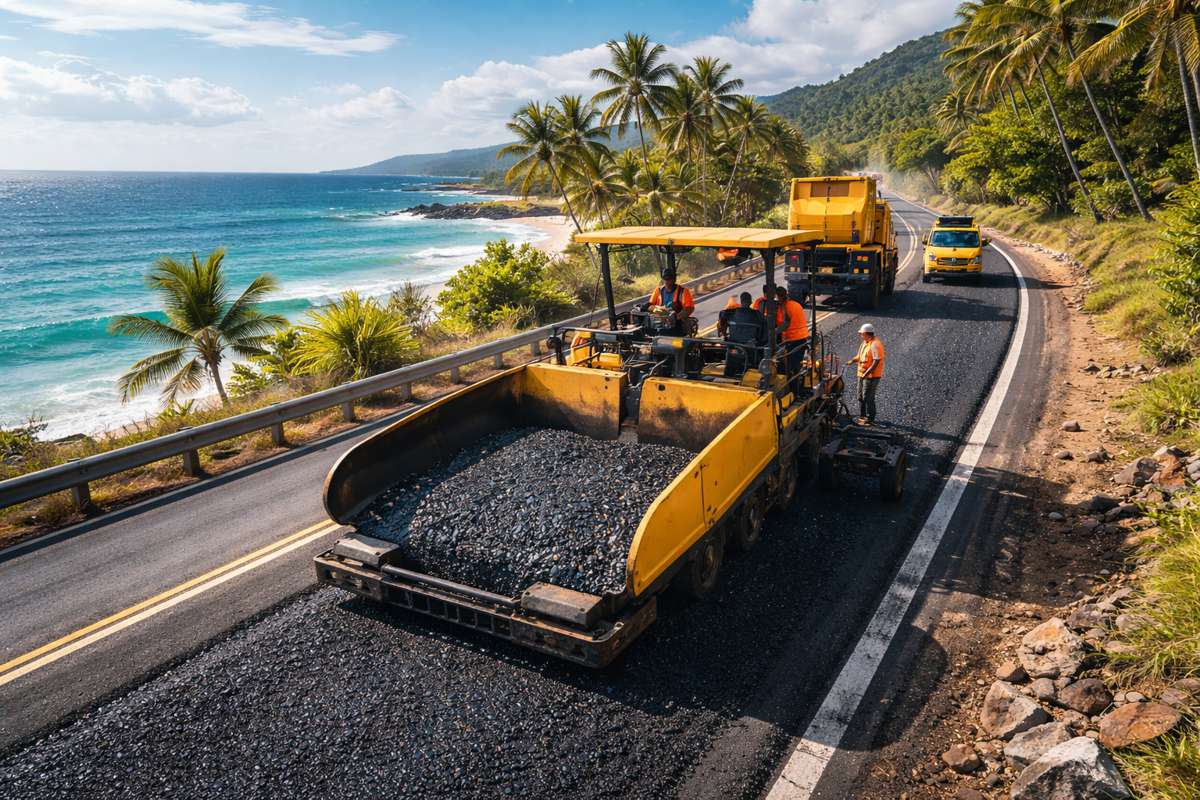
To move beyond laboratory theory, the team conducted real-world trials on the island of Oahu. Sections of a residential road were paved using three different asphalt formulations. One used standard polymer-modified asphalt. The second incorporated recycled polyethylene from household waste. The third used polyethylene derived from fishing nets.
The road was subjected to typical traffic conditions for nearly a year. After approximately 11 months, researchers returned to collect samples of road dust from each section. This material provided a window into how the pavement behaved under real-world wear and tear.
Using advanced analytical techniques, including pyrolysis gas chromatography-mass spectrometry, the team was able to identify and quantify different polymer types present in the dust. This allowed them to distinguish between contributions from the asphalt itself and from other sources, such as tyre wear.
Microplastics Under the Microscope
One of the central concerns surrounding plastic-modified asphalt is the potential release of microplastics into the environment. As roads degrade over time, tiny particles are generated and can be transported into soil and waterways through runoff.
The findings from Hawaii’s trials offer some reassurance. Initial results indicate that pavements containing recycled polyethylene did not release more polymer material than those using conventional synthetic additives. In both cases, microplastic-sized particles were detected, but only a small fraction could be attributed to polyethylene.
The explanation lies in how the materials are integrated. The plastic is not present as discrete fragments but is melted into the asphalt binder. As a result, any particles that break away are composite materials containing aggregates, binder and polymer chains rather than pure plastic.
Even more striking was the relative contribution of tyres. As Lynch explained: “In our initial Py-GC-MS data, we saw tire wear swamps the signal of polyethylene by orders of magnitude, like gigantic peaks! We had to search the weeds of the chromatogram to find signs of polyethylene.”
In other words, the dominant source of polymer particles on roads remains tyre wear, not the asphalt itself. That insight reframes the debate, suggesting that efforts to reduce road-related microplastics may need to focus more on vehicle components than on pavement materials.
Durability Still Under Evaluation
While the environmental findings are encouraging, performance remains a critical factor. Roads must endure heavy loads, temperature fluctuations and long-term wear. Any alternative material must match or exceed the durability of existing solutions to gain widespread acceptance.
The research team is continuing to assess mechanical performance, including resistance to cracking, deformation and moisture damage. Early indications suggest that recycled polyethylene can perform comparably to traditional polymer additives, but longer-term data will be needed to confirm this.
That said, the potential benefits extend beyond performance alone. By embedding waste materials into infrastructure, the approach offers a form of long-term sequestration. Instead of circulating through the environment or occupying landfill space, plastics become part of a stable, functional system.
A Model for Circular Infrastructure
The broader implications of this work reach far beyond Hawaii. Island economies around the world face similar challenges, from the Caribbean to the Pacific. Even in continental regions, the pressure to reduce waste and embrace circularity is intensifying.
Integrating recycled plastics into road construction could become part of a wider toolkit for sustainable infrastructure. When combined with innovations such as warm mix asphalt, recycled aggregates and low carbon binders, it contributes to a more resource-efficient model.
Jeremy Axworthy, one of the researchers involved, captured the underlying motivation: “This work investigates whether it’s responsible to use recycled plastics in Hawaii’s roads.” That emphasis on responsibility is key. It’s not enough for a solution to be technically feasible. It must also be environmentally sound and socially acceptable.
Science Driving Policy and Practice
The research was presented at the Spring 2026 meeting of the American Chemical Society, one of the largest scientific gatherings of its kind. With thousands of presentations spanning multiple disciplines, the event provides a platform for emerging ideas to gain visibility and scrutiny.
For policymakers and industry stakeholders, the findings offer a data-driven basis for decision making. If further studies confirm the initial results, recycled plastic-modified asphalt could move from experimental trials to standard practice, particularly in regions where waste management is a pressing concern.
Funding from the Hawaii Department of Transportation underscores the role of public agencies in driving innovation. By supporting research and pilot projects, they help bridge the gap between laboratory science and real-world application.
From Waste Burden to Infrastructure Resource
There’s a certain elegance to the idea of turning ocean plastic into roads. What was once a symbol of environmental neglect becomes part of the infrastructure that supports daily life. It’s not a complete solution to the global plastic crisis, but it’s a step towards a more pragmatic and circular approach.
Lynch summed up the broader message: “Some people think plastic recycling is a hoax — that it doesn’t work; it’s too challenging. But this work demonstrates that recycling can work when society prioritizes sustainability.”
As research continues and data accumulates, the question will shift from whether this approach is viable to how widely it can be implemented. For Hawaii, the answer could reshape both its roads and its relationship with waste. For the wider world, it offers a glimpse of infrastructure that doesn’t just consume resources but helps close the loop.