The Rise Of Autonomous Software Development In Infrastructure
The conversation around digital transformation in construction and infrastructure often circles back to skills shortages, rising project complexity, and the slow pace of software delivery. Yet, quietly, a different shift is taking hold. A new class of AI-native platforms is beginning to compress the distance between idea and execution, enabling non-engineers to build and deploy fully functional systems that would once have required dedicated development teams.
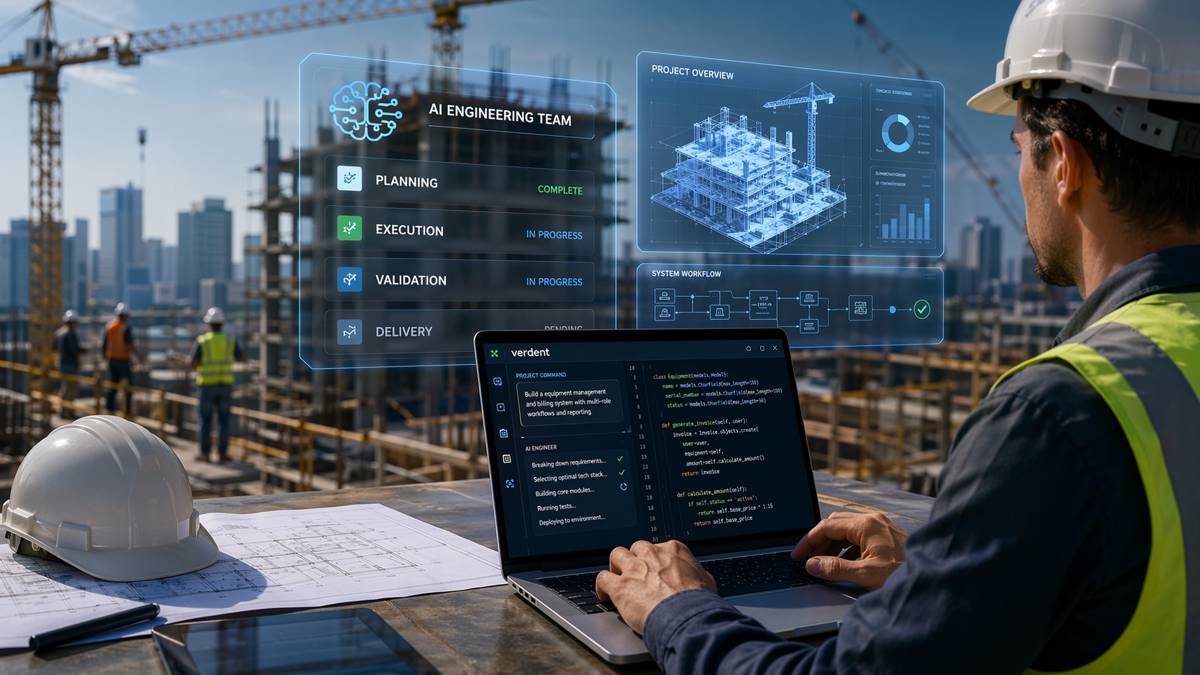
Verdent’s latest platform update sits squarely within that shift. Rather than positioning AI as a coding assistant, the company is pushing towards something more operational. Its software now behaves less like a tool and more like a coordinated engineering function, handling planning, execution, validation, and delivery as a continuous process. That change, while subtle on the surface, reflects a broader transformation in how digital tools are conceived and deployed across industries that rely on infrastructure, logistics, and complex workflows.
In construction, where digital adoption has historically lagged behind sectors such as finance or software, this evolution could carry significant implications. From project management systems to supply chain tracking and equipment monitoring, the ability to build tailored software quickly and without specialist teams has the potential to reshape how firms operate on the ground.
Briefing
- Verdent has updated its AI-native platform to function more like a full engineering team rather than a coding assistant
- The system now manages planning, execution, validation, and delivery in a continuous workflow
- Early users are building operational software without engineering backgrounds, including CRM systems and factory tools
- The platform is informed by research recognised at the International Conference on Software Engineering 2026
- The shift reflects a wider move from AI assistance towards autonomous execution in software development
Bridging the Gap Between Concept and Deployment
For decades, the bottleneck in software development has rarely been the idea itself. Organisations across construction and infrastructure generate no shortage of concepts for improving efficiency, reducing costs, or enhancing visibility. The challenge lies in turning those concepts into working systems that can be deployed, maintained, and scaled.
Traditionally, that gap has required skilled developers, project managers, and testing teams. Even relatively simple applications could take months to move from specification to production. In sectors where margins are tight and timelines are critical, that delay often means ideas never progress beyond internal discussions.
Verdent’s platform aims to close that gap by restructuring the workflow itself. Rather than requiring users to define every step manually, the system interprets goals, breaks them into tasks, selects appropriate tools, and executes the build process. It writes code, tests functionality, and continues progressing even when the user is not actively engaged.
This asynchronous capability is particularly relevant in industries such as construction, where decision-makers are often on-site, managing operations rather than sitting behind a desk. The ability to initiate a build process and return later to a functioning system changes the dynamic entirely, shifting software development from a continuous hands-on activity to a managed outcome.
From Assistance to Autonomous Execution
The evolution of AI in software development has followed a clear trajectory. Early tools focused on code completion and syntax suggestions. More recent platforms introduced conversational interfaces, allowing users to describe what they wanted and receive generated code in return.
Verdent moves beyond that model. Its platform operates as a continuous workflow engine rather than a prompt-response system. Once a project is initiated, it maintains context across sessions, including previous decisions, technology stacks, and completed components. That continuity allows it to build incrementally without restarting or losing direction.
This approach mirrors how human engineering teams operate. Work is rarely linear. Decisions evolve, priorities shift, and systems are refined over time. By retaining context and managing tasks dynamically, Verdent aligns more closely with real-world development practices.
The distinction matters. In infrastructure and construction, software systems are rarely standalone. They integrate with existing processes, equipment, and data flows. A tool that understands context and adapts accordingly is far more valuable than one that simply generates isolated code snippets.
Real-World Adoption Across Emerging Markets
One of the more striking aspects of Verdent’s early adoption is where it is taking place. Users are not limited to technology hubs or established software companies. Instead, examples are emerging from a wide range of regions and industries.
A photographer in Europe has built a custom e-commerce platform and client management system without prior engineering experience. In India, an equipment supplier has developed a workflow and billing application tailored to factory operations. Meanwhile, a consultant in West Africa has delivered multiple client projects simultaneously, spanning education platforms, banking systems, and corporate intranets.
These cases point to a broader trend. Access to software development capabilities is becoming less dependent on geography or formal training. For construction and infrastructure firms operating in emerging markets, this shift could be particularly significant. It offers a pathway to digital transformation without the need to recruit scarce technical talent or rely on external vendors.
At the same time, it raises questions around standardisation, governance, and long-term maintenance. As more organisations build their own systems, ensuring reliability and interoperability will become increasingly important.
Research-Driven Foundations
Verdent’s development is not purely iterative or market-driven. The platform draws on research into how AI systems can align with real-world engineering decision-making. Its work on SEAlign, which focuses on structuring AI reasoning across complex, multi-step tasks, received recognition at the International Conference on Software Engineering 2026.
That recognition signals a level of academic rigour that is not always present in commercial AI tools. It suggests that the platform’s capabilities are grounded in formal approaches to problem-solving rather than relying solely on large-scale language models.
For infrastructure applications, where errors can carry significant operational or financial consequences, that foundation is critical. Systems must not only function but also produce consistent and predictable outcomes. Aligning AI behaviour with established engineering principles helps address that requirement.
Implications for Construction and Infrastructure
The construction sector has long grappled with fragmentation. Projects involve multiple stakeholders, each using different systems and processes. Integrating these elements into a cohesive workflow remains a persistent challenge.
AI-native platforms like Verdent offer a potential route to greater cohesion. By enabling organisations to build bespoke tools quickly, they allow systems to be tailored to specific project requirements rather than forcing workflows into generic software.
This flexibility could improve coordination across project phases, from design and procurement to construction and handover. It may also support more effective data sharing, enabling real-time insights into progress, costs, and risks.
However, the shift is not without its challenges. Increased autonomy in software development raises questions around quality control, cybersecurity, and regulatory compliance. As more systems are built outside traditional frameworks, establishing standards and oversight mechanisms will become increasingly important.
Integration with Existing Development Ecosystems
Despite its focus on autonomy, Verdent does not operate in isolation. The platform supports integration with established development environments such as Visual Studio Code and tools from JetBrains. This compatibility ensures that professional developers can still engage with projects where needed, providing oversight or extending functionality.
For construction firms that already rely on digital tools, this interoperability is essential. It allows new systems to be integrated into existing workflows rather than requiring a complete overhaul. In practice, this means organisations can adopt AI-driven development incrementally, starting with specific use cases and expanding over time.
The platform’s chat-first interface also reflects broader trends in workplace collaboration. By enabling interaction through familiar channels such as Slack or Telegram, it reduces the learning curve for users and embeds development processes within existing communication structures.
A Shift in How Digital Capability Is Defined
Perhaps the most significant impact of platforms like Verdent lies in how they redefine digital capability. Historically, an organisation’s ability to build software has been tied to its access to technical talent. That constraint has shaped investment decisions, project timelines, and competitive dynamics.
By lowering the barrier to entry, AI-native platforms shift the focus from technical execution to problem definition. The critical question becomes not whether an organisation can build a system, but whether it can clearly articulate what it needs.
For construction and infrastructure firms, this shift aligns with their core strengths. These organisations excel at managing complex projects, coordinating resources, and solving practical challenges. Enabling them to translate those capabilities directly into digital systems could unlock new efficiencies and innovations.
Towards Continuous Delivery in Infrastructure Systems
The concept of continuous delivery is well established in software development, but its application in infrastructure has been limited. Projects are typically delivered in discrete phases, with digital systems implemented as supporting tools rather than evolving components.
Verdent’s approach introduces the possibility of continuous software evolution within infrastructure projects. Systems can be developed, tested, and refined in parallel with physical construction, adapting to changing requirements and conditions.
This dynamic capability could prove valuable in large-scale projects where uncertainty is a constant factor. Whether dealing with supply chain disruptions, regulatory changes, or unexpected site conditions, the ability to adjust digital systems in real time offers a clear advantage.
The Road Ahead for AI-Driven Development
The trajectory of AI in software development suggests that the boundary between human and machine roles will continue to shift. Platforms like Verdent are not replacing engineers outright but are redefining how engineering work is structured and delivered.
For the construction and infrastructure sectors, the implications extend beyond efficiency gains. They touch on how projects are conceived, managed, and executed. As digital tools become more accessible and adaptable, organisations will need to rethink their approaches to technology adoption and integration.
The transition will not be uniform. Some firms will embrace AI-driven development quickly, while others will proceed more cautiously. Yet the direction of travel is clear. The gap between idea and execution is narrowing, and with it, the barriers to innovation.
In practical terms, that means more organisations will be able to build the systems they need, when they need them. For an industry that thrives on solving complex problems under pressure, that is a development worth watching closely.