Synthetic Pendants Redefine Fatigue Management for High-Output Mining Equipment
Mining operations have always lived on the edge of mechanical limits, but the pressure to extract more material, faster and more efficiently, has pushed equipment into increasingly demanding territory.
Attention is now shifting toward a less visible but persistent issue: the cumulative impact of vibration and shock on structural integrity.
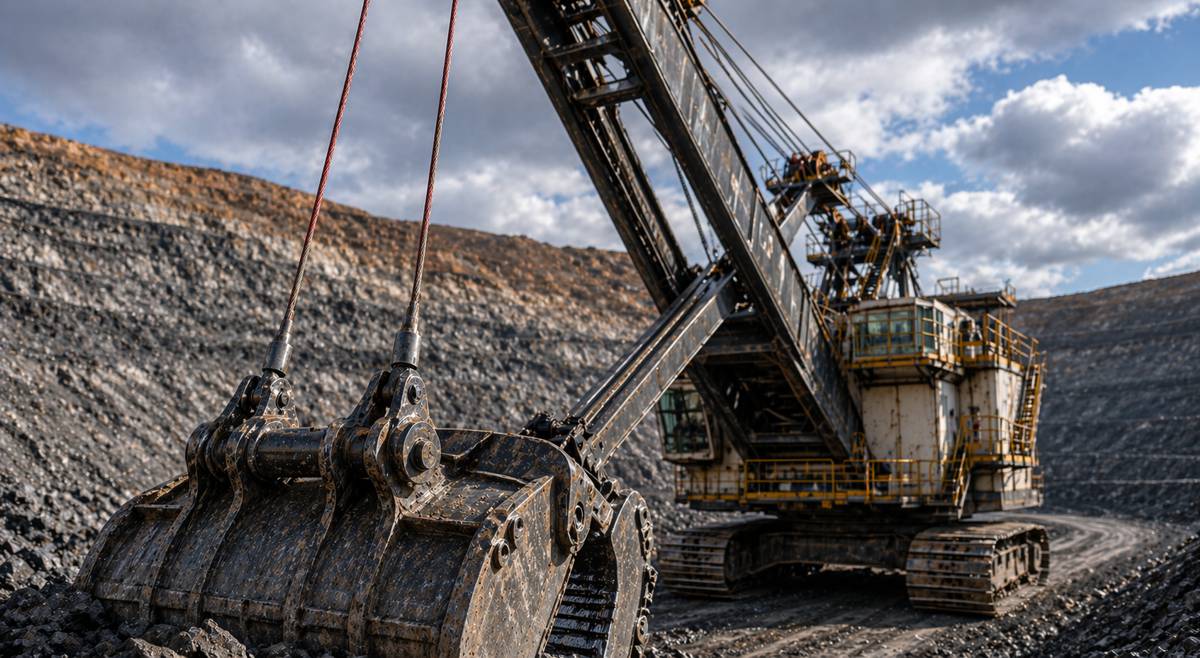
Recent engineering analysis from WireCo points to dynamic load transfer as a central factor in long-term fatigue damage in large-scale mining assets. In particular, the company’s work around synthetic pendants used in draglines and electric rope shovels highlights a growing recognition that managing energy flow through machinery can be just as important as managing the loads themselves.
For operators and asset owners, the implications run deep. Structural fatigue is rarely the result of a single catastrophic event. Instead, it builds gradually through repeated stress cycles, often concentrating at welds and critical junctions. By the time cracks emerge, the underlying damage has usually been accumulating for years, quietly eroding reliability and increasing the risk of unplanned downtime.
Briefing
- Synthetic pendants reduce vibration and shock transfer in mining equipment, limiting structural fatigue
- Comparative testing shows a 13 percent reduction in harmonic energy and 29 percent drop in sideloading stress
- Component lifespan improvements of around 14 percent have been observed in electric rope shovel applications
- Lower vibration levels also support operator comfort and align with Occupational Safety and Health Administration guidance
- Lifecycle cost benefits are driving adoption despite higher upfront investment
Understanding the Hidden Cost of Dynamic Loads
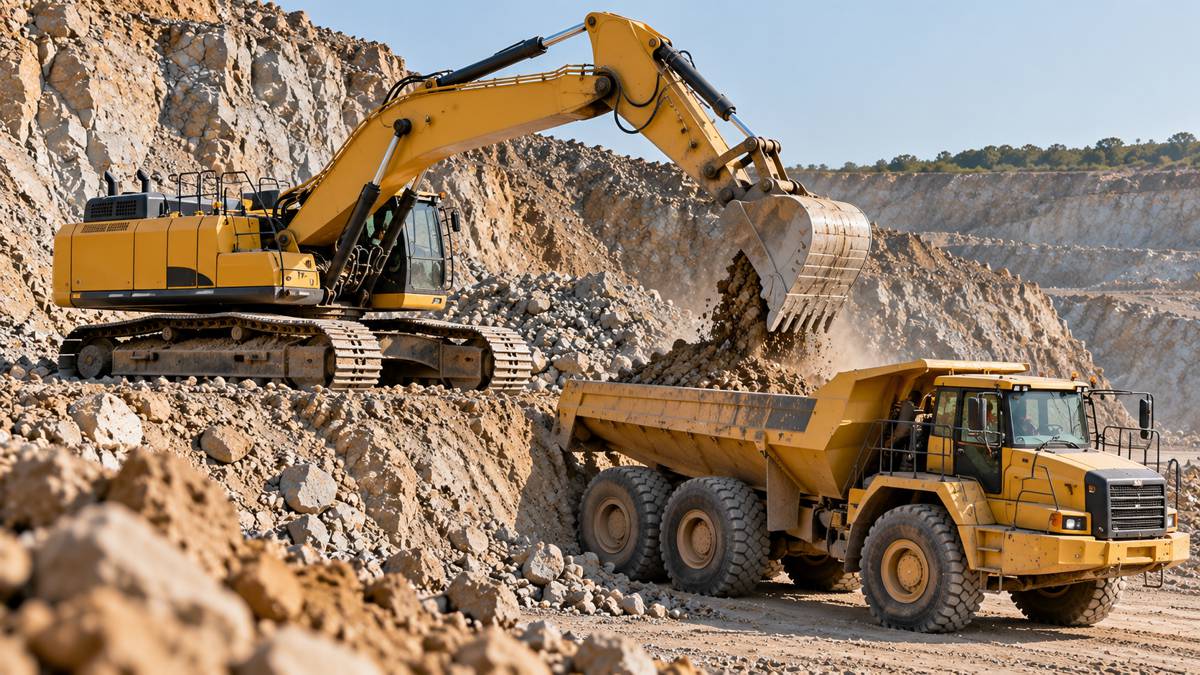
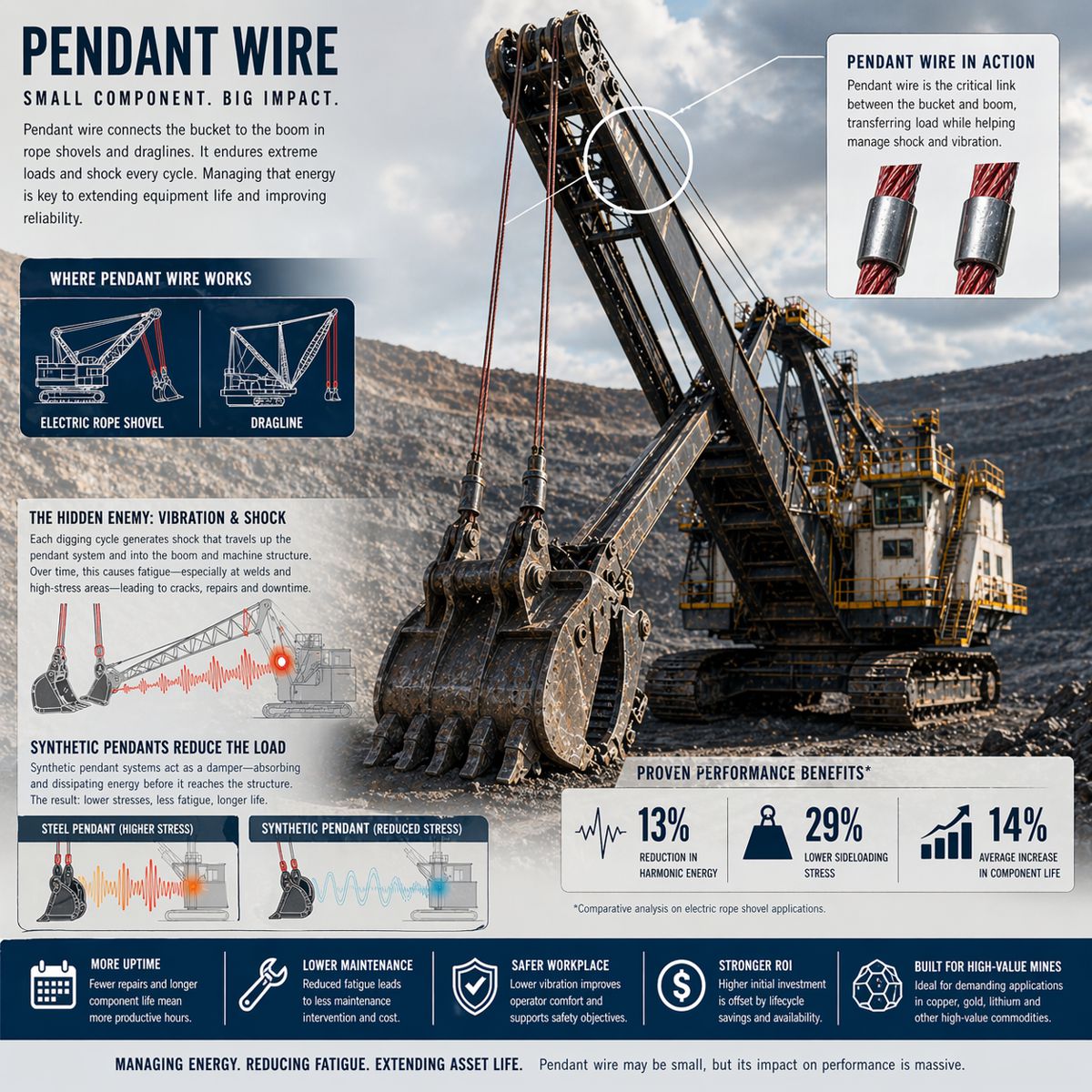
In large-scale surface mining, machines such as draglines and electric rope shovels operate under extreme and highly variable loads. Each digging cycle generates shock forces as buckets engage with dense material. These forces travel through the boom structure and into the machine frame, creating a complex pattern of vibrations and stress waves.
Over time, these repeated cycles become a primary driver of fatigue. Unlike static loads, which can be accounted for in design calculations with relative precision, dynamic loads are far less predictable. They fluctuate depending on material hardness, operator technique and environmental conditions, making them difficult to control through conventional engineering approaches alone.
Research across heavy industry has consistently shown that vibration-induced fatigue is a leading cause of structural degradation. Studies referenced by organisations such as the National Institute for Occupational Safety and Health have linked prolonged exposure to high vibration environments not only to equipment wear but also to human health concerns. This dual impact underscores the importance of addressing vibration at its source rather than treating it as an unavoidable by-product of mining activity.
Synthetic Pendants as Energy Dampers
Within this context, synthetic pendants are emerging as a practical solution for moderating how energy moves through mining equipment. Positioned within the load path between the bucket and the boom, these components act as a form of damping system, absorbing and dissipating a portion of the shock generated during digging.
Unlike traditional steel pendants, which transmit forces with minimal attenuation, synthetic materials introduce a degree of flexibility. This allows them to smooth out peak loads and reduce the intensity of stress concentrations. The effect is not to eliminate force, which would be impossible in such demanding applications, but to manage how that force is distributed across the structure.
Engineering comparisons on electric rope shovels indicate measurable benefits. Harmonic energy, which contributes to resonant vibrations within the structure, has been reduced by 13 percent in controlled analyses. At the same time, sideloading stress, often responsible for uneven wear and localised fatigue, has been lowered by approximately 29 percent. These improvements translate into a reported average increase in component life of around 14 percent.
“Vibration doesn’t always get the attention it deserves, but it’s a major driver of long-term structural damage,” said Brent Dein, Technical Services Engineering Manager at WireCo. “If you can control how that energy moves through the machine, you can reduce fatigue, limit repairs and keep equipment running more consistently.”
Extending Asset Life in High-Value Mining Operations
For mining companies, the financial implications of even modest improvements in equipment longevity can be significant. Assets such as electric rope shovels represent substantial capital investments, often expected to operate for decades under continuous load. Extending the service life of critical components by double-digit percentages can alter maintenance schedules, reduce spare parts consumption and improve overall asset utilisation.
This is particularly relevant in high-value commodities such as copper, gold and lithium, where production interruptions carry a disproportionate economic impact. A single hour of downtime on a major shovel can translate into lost output worth tens of thousands of pounds, depending on the operation’s scale and commodity pricing.
Synthetic pendants contribute to this equation by reducing the frequency and severity of maintenance interventions. By limiting the development of cracks and fatigue-related failures, they help maintain structural integrity over longer periods. This, in turn, supports more predictable maintenance planning and reduces the likelihood of unexpected shutdowns.
Operator Health and Workplace Considerations
Beyond equipment performance, vibration management also has direct implications for operator wellbeing. Prolonged exposure to high vibration levels has been associated with a range of health issues, including musculoskeletal disorders and fatigue. Regulatory frameworks, including those promoted by the Occupational Safety and Health Administration, emphasise the need to monitor and mitigate such exposure in industrial environments.
By reducing vibration transmission through the machine structure, synthetic pendants can contribute to a more stable operating environment. While they are not a standalone solution for workplace safety, they form part of a broader strategy to align operational practices with evolving health standards.
Improved operator comfort also carries indirect productivity benefits. Reduced fatigue over long shifts can support more consistent performance, lower the risk of errors and enhance overall job satisfaction. In an industry where skilled operators are in high demand, these factors are increasingly recognised as part of the wider operational equation.
Rethinking Cost Through a Lifecycle Lens
One of the key barriers to adopting synthetic pendants has traditionally been their higher upfront cost compared to steel alternatives. However, the economic calculation is shifting as mining companies place greater emphasis on total cost of ownership rather than initial expenditure.
Synthetic pendants are typically designed to last for the full operational life of the machine, reducing the need for replacement and associated downtime. When combined with the benefits of extended component life and reduced maintenance, this longevity can offset the initial investment over time.
“For high-output operations, the cost of downtime quickly outweighs the initial investment,” Dein added. “That’s why we’re seeing more mines evaluate these decisions based on long-term performance rather than upfront cost alone.”
This shift mirrors broader trends across the construction and mining sectors, where digitalisation and data analytics are enabling more sophisticated asset management strategies. By quantifying the long-term impact of design choices, operators can make more informed decisions about where to allocate capital for maximum return.
A Subtle Shift with Wide Implications
The adoption of synthetic pendants may appear incremental when viewed in isolation, but it reflects a broader evolution in how the industry approaches equipment design and maintenance. Rather than focusing solely on strength and capacity, there is a growing emphasis on resilience and energy management.
This shift aligns with wider developments in materials science and engineering, where advanced composites and synthetic materials are increasingly being used to enhance performance in demanding environments. From offshore energy to aerospace, the ability to control how forces are transmitted through structures is becoming a defining factor in long-term reliability.
In mining, where equipment operates at the limits of scale and intensity, these considerations take on added importance. As operations continue to push for higher productivity, the ability to manage the unseen forces within machinery will play a critical role in sustaining performance and controlling costs.
Building More Resilient Mining Systems
The conversation around synthetic pendants ultimately points to a deeper change in mindset. Mining companies are beginning to recognise that durability is not just about resisting force, but about managing it intelligently. By introducing elements that can absorb and redistribute energy, engineers are creating systems that are better equipped to handle the realities of modern extraction.
For the global construction and infrastructure ecosystem, the lessons extend beyond mining. Any sector that relies on heavy equipment operating under dynamic loads can benefit from a more nuanced understanding of fatigue and vibration. As projects grow in scale and complexity, these insights will become increasingly valuable in ensuring that assets deliver consistent performance over their intended lifespan.