Smarter Service Trucks and Cranes are Reshaping Field Operations
Across construction, infrastructure maintenance and utilities, the pressure to do more with less hasn’t eased. Labour shortages persist, projects are tighter on margins, and downtime carries a heavier cost than ever. Now incremental equipment improvements are no longer minor updates, they’re operational levers.
That’s the space where Stellar Industries is focusing its latest product refinements. The company’s early 2026 updates to its TMAX Mechanic Truck range and EC3200 Electric Service Crane point to a broader shift in how service fleets are being designed. Rather than chasing headline-grabbing specifications, the emphasis is landing squarely on usability, adaptability and efficiency in the field.
Unveiled at industry gatherings such as CONEXPO-CON/AGG and Work Truck Week, these updates reflect a clear direction of travel. Operators want equipment that fits their workflow, not the other way round. And manufacturers that listen closely are starting to deliver exactly that.
Briefing
- Stellar refines its TMAX Mechanic Truck and EC3200 Electric Service Crane for 2026
- Updates focus on visibility, modular storage and reduced equipment weight
- Nested boom design lowers crane profile and improves access in confined spaces
- Modular truck interiors reduce long-term maintenance risks and improve flexibility
- Industry trend shifts toward operator-driven design and efficiency gains
Visibility and Safety Take Centre Stage
Worksite safety remains a persistent challenge across construction and infrastructure sectors. According to organisations such as Occupational Safety and Health Administration, visibility-related incidents continue to rank among the most common causes of workplace injuries involving vehicles and machinery.
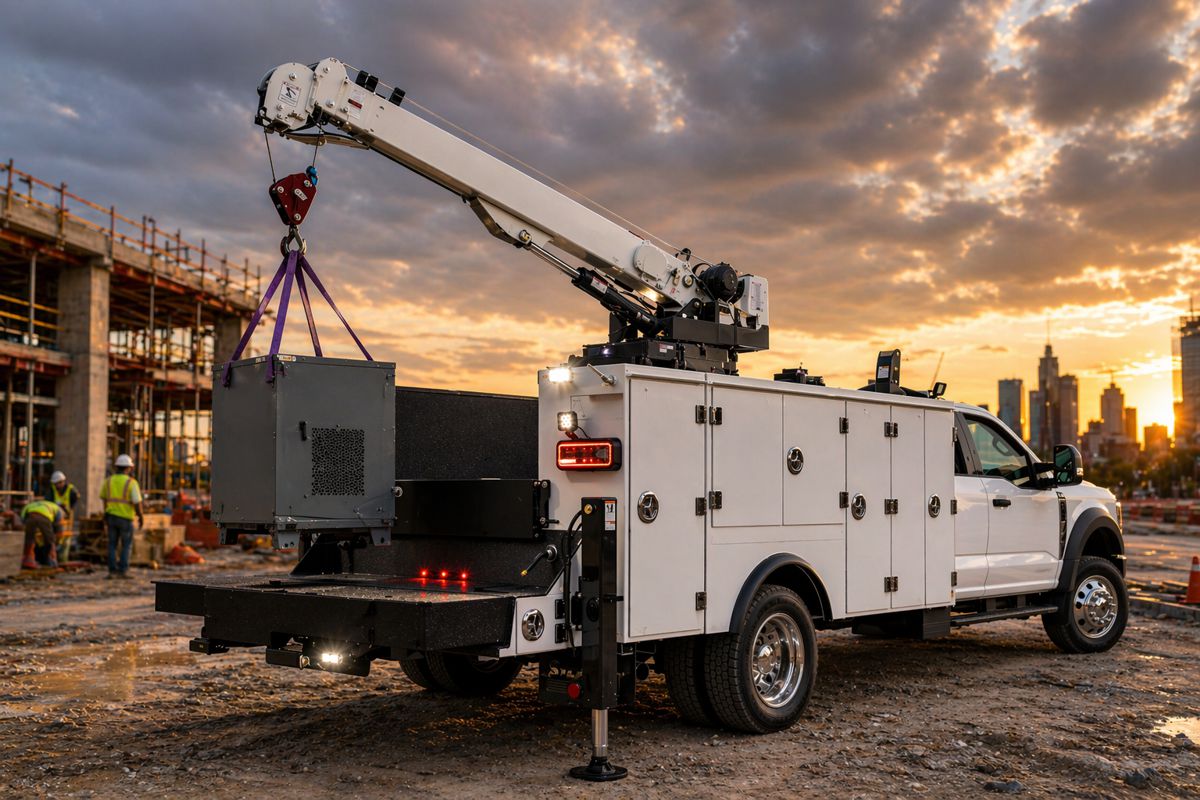
The 2026 TMAX Mechanic Truck addresses this head-on with a redesigned high-intensity LED taillight system. While lighting upgrades might appear modest on paper, their real-world impact is far from trivial. Improved visibility in low-light or high-dust environments can significantly reduce collision risks, particularly in dynamic worksites where multiple vehicles, personnel and moving equipment interact continuously.
The addition of cascading turn signals adds another layer of clarity. In congested or noisy environments, where visual cues often outweigh audible ones, clearer signalling improves communication between operators. It’s a small change that speaks directly to how work actually unfolds on site.
Modular Storage Reflects Real Working Practices
If there’s one consistent complaint from field technicians, it’s that standardised layouts rarely match the realities of daily work. Tools evolve, job requirements shift, and rigid storage systems often become inefficient within months of deployment.
The TMAX platform’s expanding modular storage system tackles that issue with a more flexible approach. Building on earlier iterations of adjustable shelving, the latest update allows operators to configure tool storage and control panel placement without drilling into compartments. That detail matters more than it first appears.
Drilling into truck bodies has long been a necessary compromise, but it introduces long-term risks including corrosion, water ingress and structural fatigue. By removing that requirement, the TMAX design extends the working life of the vehicle while preserving its integrity. It also simplifies reconfiguration, allowing fleets to adapt vehicles as roles change rather than replacing them outright.
This kind of adaptability aligns with wider fleet management strategies, where lifecycle cost is increasingly prioritised over upfront purchase price. In practice, that means equipment that can evolve alongside operations delivers stronger long-term value.
A Lighter, Lower Profile Crane for Tight Spaces
Space constraints are becoming more common, particularly in urban infrastructure projects and roadside maintenance. Equipment that can operate effectively in confined environments without sacrificing capability is increasingly valuable.
The redesigned EC3200 Electric Service Crane addresses this with a nested boom configuration. By allowing the boom sections to retract more compactly, the crane achieves a lower overall profile. That translates directly into improved access, whether working under bridges, inside industrial facilities or along constrained road corridors.
Weight reduction is another key element. By trimming approximately 130 pounds from the crane’s structure, the design improves payload capacity without compromising lifting performance. In practical terms, that gives operators more flexibility in how they use their trucks, particularly when weight limits are a factor.
Electric service cranes themselves have been gaining traction as an alternative to hydraulic systems. While hydraulic cranes still dominate heavy-duty applications, electric variants offer advantages in cost, maintenance and ease of operation for a wide range of service tasks. The EC3200 sits squarely within that evolving segment.
Integrating Crane and Truck as a Single System
One of the more understated aspects of these updates is how the crane and truck are designed to work together. The EC3200 is available for integration with the TMAX Mechanic Truck, creating a cohesive service platform rather than a collection of separate components.
That integration reflects a broader trend in equipment design. Instead of treating vehicles, cranes and storage systems as independent elements, manufacturers are increasingly developing them as unified systems. The result is better balance, improved weight distribution and more intuitive operation.
For operators, that translates into smoother workflows. Tasks that once required multiple adjustments or workarounds can be completed more efficiently when equipment is designed with compatibility in mind. Over time, those incremental efficiencies add up, particularly across large fleets or long-duration projects.
Listening to the Field and Acting on It
The most telling aspect of these updates is not any single feature, but the process behind them. As Tim Worman noted, “These recent product updates are a direct result of customer feedback and real-world application. By refining key features like visibility and payload, we’re helping our customers work more efficiently without adding unnecessary complexity to their equipment.”
That approach reflects a shift in how equipment development is being driven. Rather than relying solely on internal engineering priorities, manufacturers are placing greater emphasis on feedback loops from operators, fleet managers and technicians.
In industries where conditions vary widely from one project to another, that feedback becomes invaluable. It ensures that product updates are grounded in actual use cases rather than theoretical improvements. The result is equipment that feels more intuitive, more practical and ultimately more effective in the field.
A Broader Shift in Service Equipment Design
Looking beyond this specific launch, the updates point to wider changes across the construction and infrastructure equipment landscape. Several trends are becoming increasingly clear:
- Operator-centric design is gaining priority over specification-driven development
- Modularity and adaptability are replacing fixed configurations
- Weight and efficiency optimisation are influencing every aspect of equipment design
- Integration between systems is becoming standard rather than optional
These trends are being shaped by real-world pressures. Projects are more complex, margins are tighter and expectations around safety and productivity continue to rise. Equipment that can’t keep pace quickly becomes a liability.
At the same time, sustainability considerations are beginning to influence design decisions. Lighter equipment, more efficient systems and longer service lifespans all contribute to reduced environmental impact, even when that isn’t the primary driver behind a product update.
Supporting a Changing Workforce
Another factor shaping these developments is the changing nature of the workforce. Skilled technicians are in short supply in many regions, and attracting new entrants remains a challenge. Equipment that is easier to use, safer to operate and more adaptable can help bridge that gap.
Simplified configurations, improved visibility and intuitive controls reduce the learning curve for new operators. At the same time, experienced technicians benefit from reduced fatigue and improved efficiency. It’s a balance that’s becoming increasingly important as the industry looks to maintain productivity with a shifting labour base.
Steady Progress That Delivers Real Impact
There’s a tendency to focus on major breakthroughs when discussing equipment innovation. Yet, in practice, it’s often incremental improvements that deliver the most consistent value. Better lighting, smarter storage, reduced weight and improved integration might not dominate headlines, but they make a tangible difference on site every day.
The 2026 updates to the TMAX Mechanic Truck and EC3200 Electric Service Crane reflect that reality. They show how careful refinement, informed by real-world feedback, can enhance performance without introducing unnecessary complexity.
For construction and infrastructure professionals, that’s where the real gains lie. Equipment that works seamlessly, adapts to changing demands and supports operators in the field is what ultimately drives productivity. And in an industry where every hour counts, those gains are hard to ignore.