Isuzu D Max 2.2 Raises the Stakes for Workhorse Pick Ups
The arrival of the Isuzu D-Max 2.2 signals more than a routine model update. In a market where emissions pressure, rising operating costs and evolving fleet expectations are reshaping procurement decisions, Isuzu’s latest move reflects a broader shift in how light commercial vehicles are engineered and deployed. The introduction of a larger 2.2 litre diesel engine, paired with a new eight speed automatic transmission, positions the D Max squarely within a segment that is balancing regulatory compliance with real world capability.
Unveiled at the Commercial Vehicle Show 2026, the updated model lands at a time when pick ups are being asked to do more than ever. Contractors, utilities, infrastructure operators and rural businesses are increasingly relying on a single platform to cover towing, site access, long distance travel and urban compliance zones. Against that backdrop, incremental gains in torque, efficiency and driver assistance systems carry significant operational weight, particularly when multiplied across large fleets.
Briefing
- New 2.2 litre turbo diesel engine replaces previous 1.9 litre unit, delivering 400 Nm of torque
- Introduction of an eight speed automatic transmission alongside six speed manual option
- Maintains 3.5 tonne towing capacity and payload of up to 1,205 kg
- Expanded driver monitoring and safety systems aligned with evolving EU standards
- UK availability from July 2026 with pricing starting at £33,495 CVOTR
Powertrain Evolution Reflects Changing Fleet Demands
The shift from a 1.9 litre to a 2.2 litre diesel engine may appear modest on paper, yet it speaks volumes about how operators are using these vehicles. With 400 Nm of torque available, the D Max is better equipped for sustained towing and load carrying under demanding conditions. That matters in sectors such as construction and utilities, where vehicles often operate near maximum capacity for extended periods.
Producing 163 PS at 3,600 rpm, the engine combines turbocharging with electronically controlled fuel injection and intercooling. These are established technologies rather than experimental ones, which suggests a deliberate focus on durability and serviceability rather than headline grabbing innovation. For fleet managers, that consistency is often more valuable than marginal performance gains.
The addition of an eight speed automatic transmission is arguably the more significant development. Across Europe, automatic gearboxes are steadily gaining ground in commercial fleets due to their ability to reduce driver fatigue and improve fuel efficiency in mixed driving conditions. With tighter emissions standards and growing scrutiny on real world fuel consumption, transmission efficiency has become a key battleground.
Capability Still Anchors The Proposition
Despite the mechanical updates, the D Max remains firmly rooted in its core identity as a working vehicle. A maximum towing capacity of 3.5 tonnes keeps it aligned with regulatory limits in the UK, ensuring compatibility with trailers, plant equipment and site logistics requirements. Meanwhile, payload figures reaching 1,205 kg reinforce its role as a practical load carrier.
The shift on the fly four wheel drive system allows drivers to move between two and four wheel drive at speeds of up to 62 mph. This is particularly relevant for mixed terrain operations where road and off road conditions can change rapidly. Combined with a low range mode, rear differential lock and Rough Terrain Mode, the system provides the mechanical flexibility required for remote or undeveloped sites.
Ground clearance of 210 mm and a wading depth of 800 mm further underline its off road credentials. While such figures are often associated with lifestyle marketing, in practice they are critical for sectors such as forestry, mining support and infrastructure maintenance, where access can be unpredictable.
Design Updates Balance Function And Identity
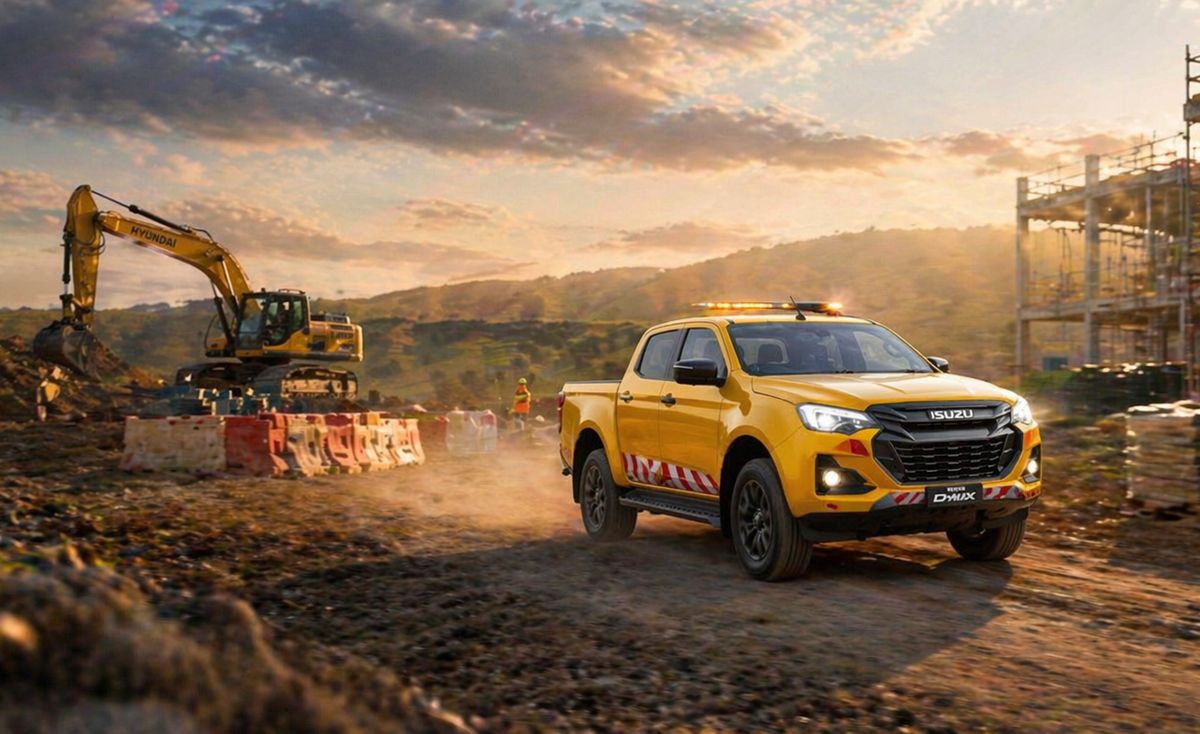
Externally, the redesign focuses on subtle but deliberate changes rather than a complete overhaul. A revised front grille and updated lighting elements give the vehicle a more contemporary appearance, yet the underlying structure remains recognisably D Max. This continuity is important for brand identity, particularly in markets where reliability and familiarity influence purchasing decisions.
The introduction of new alloy wheel designs and low rolling resistance tyres highlights another layer of optimisation. According to the manufacturer, the revised tyre compound delivers a seven percent improvement in fuel efficiency alongside better wet grip. In isolation, that may seem incremental, but across a fleet operating thousands of miles per year, such gains translate into measurable cost savings.
The addition of an Urban Moss metallic paint option may seem cosmetic, yet it reflects a broader trend in the pick up segment. Vehicles are increasingly expected to serve dual roles as both work tools and personal transport, particularly for owner operators.
Digital Visibility And Safety Take Centre Stage
Perhaps the most telling changes are found in the vehicle’s safety and monitoring systems. The inclusion of a Driver Monitoring System using an infra red camera marks a clear response to evolving regulatory requirements across Europe. Systems designed to detect driver distraction or fatigue are becoming standard, driven by both legislation and insurance considerations.
Emergency Lane Keeping and Advanced Driver Distraction warnings are part of a wider push towards semi automated safety interventions. While these systems do not replace driver responsibility, they provide an additional layer of risk mitigation, particularly for long distance or repetitive journeys.
The introduction of a 360 degree Surround View Camera on higher specifications adds practical value in urban and confined environments. For contractors operating in tight construction sites or congested city streets, improved visibility can reduce minor collisions and associated downtime.
Interior Refinement Meets Practical Needs
Inside the cabin, updates focus on materials and ergonomics rather than radical redesign. New seat designs and upgraded cloth and leather trims aim to improve comfort over long working days. This is not simply about aesthetics. Driver retention and wellbeing are increasingly recognised as operational priorities, particularly in sectors facing labour shortages.
Infotainment integration, combined with camera systems and driver alerts, transforms the cabin into a more connected workspace. For many operators, the vehicle is effectively a mobile office, making usability and clarity of information essential.
Market Context And Competitive Positioning
The UK pick up market has undergone notable changes in recent years, shaped by taxation policy, emissions standards and shifting buyer behaviour. Vehicles that were once seen purely as commercial tools are now positioned as multi purpose assets, blurring the line between work and lifestyle.
Within this landscape, the D Max competes against established rivals such as the Ford Ranger and the Toyota Hilux. Both have undergone their own cycles of technological and design updates, particularly in areas such as driver assistance and connectivity. Isuzu’s approach appears to prioritise incremental improvement and reliability over radical transformation, which may appeal to buyers seeking predictability and low total cost of ownership.
Industry data from organisations such as the Society of Motor Manufacturers and Traders indicates that demand for pick ups remains closely tied to construction activity, agricultural output and infrastructure investment. As governments continue to prioritise large scale projects and energy transition initiatives, demand for versatile light commercial vehicles is unlikely to diminish.
Ownership Costs And Long Term Value
The provision of a five year, 125,000 mile warranty, combined with roadside assistance across the UK and EU, reinforces the vehicle’s positioning as a dependable fleet asset. For operators, warranty coverage is not just a reassurance. It directly influences lifecycle cost calculations and residual value projections.
Fuel economy figures in the range of 31.4 to 32.8 mpg under WLTP testing place the D Max within a competitive bracket for its class. When combined with improved tyre efficiency and transmission optimisation, the overall package suggests a focus on reducing operating costs without compromising capability.
Pricing starting at £33,495 CVOTR positions the model within reach of both small businesses and larger fleet buyers. In a market where capital expenditure is closely scrutinised, maintaining a competitive entry point is essential.
A Workhorse Adapting To Modern Demands
The updated D Max does not attempt to reinvent the pick up formula. Instead, it refines it in ways that align with current industry pressures. Increased torque, improved transmission efficiency, enhanced safety systems and incremental design updates collectively create a vehicle that is better suited to today’s operating environment.
For construction professionals, infrastructure operators and fleet managers, the significance lies in how these improvements translate into day to day performance. Reduced fuel consumption, enhanced safety and sustained capability all contribute to operational efficiency, which ultimately drives profitability.
As the sector continues to evolve, vehicles like the D Max will play a critical role in bridging traditional mechanical reliability with emerging regulatory and technological demands. It is not a dramatic shift, but a calculated one, and in the commercial vehicle sector, that often proves to be the smarter move.