Hudson Tunnel Project Maintains Momentum Amid Federal Reimbursement Row
Federal funding has once again begun flowing into the US$16 billion Hudson Tunnel Project, easing concerns surrounding reimbursement delays that had created financial uncertainty for one of the most strategically important rail infrastructure programmes in the United States.
The latest federal disbursement of US$77 million follows an earlier release of earlier funding, with the Gateway Development Commission confirming that approximately US$375 million has now been reimbursed since payments resumed at the end of February. That figure includes previously withheld reimbursements dating back to October alongside additional project funding released in recent weeks.
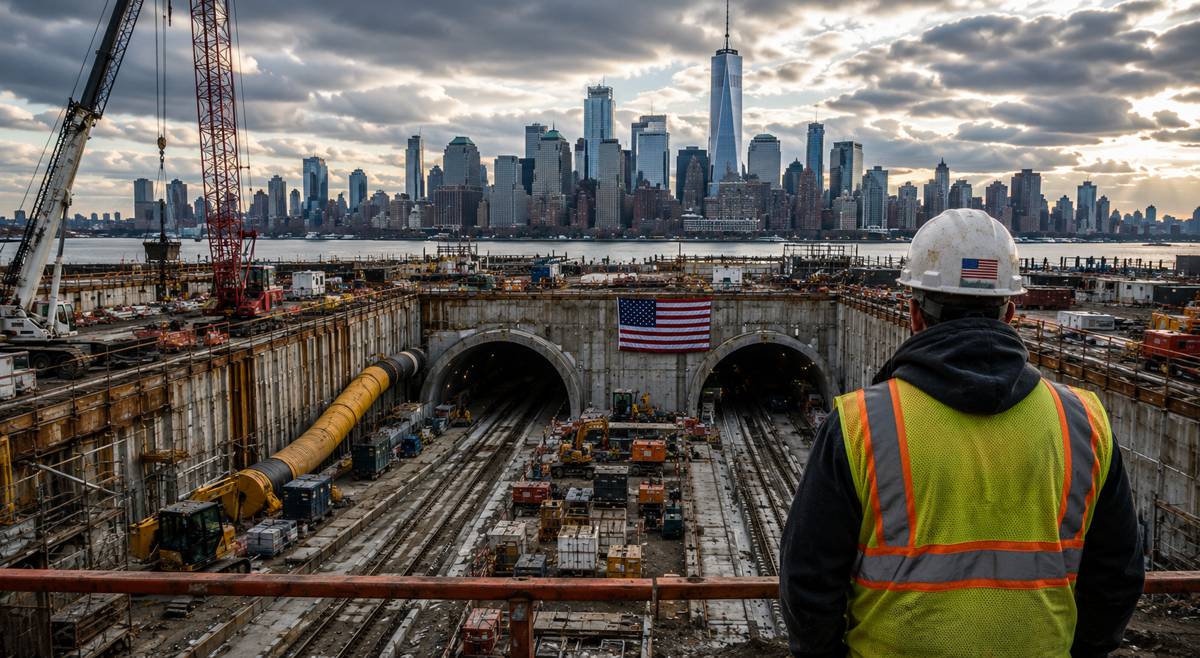
While political and legal tensions surrounding the reimbursement dispute triggered concern across the infrastructure sector, construction activity itself resumed at the end of February and has remained active since then. The project continues moving forward as contractors, engineers and public agencies work to modernise one of North America’s most economically critical transport corridors.
At the centre of the programme is the century-old rail tunnel beneath the Hudson River linking New Jersey and Manhattan. Opened in 1910 and heavily impacted by Hurricane Sandy in 2012, the existing infrastructure remains a vital but ageing component of the Northeast Corridor, which carries more than 200,000 daily passengers and over 400 trains every day between Washington DC, New York and Boston.
For infrastructure professionals, the reimbursement dispute nevertheless highlighted how political and administrative uncertainty can create operational pressures even on nationally significant projects backed by long-term federal commitments.
Briefing
- The Hudson Tunnel Project has received approximately US$375 million in federal reimbursements since funding resumed in February
- Construction activity resumed at the end of February and has continued since then
- The latest US$77 million federal disbursement follows earlier reimbursement releases this week
- The project will construct a new rail tunnel beneath the Hudson River and rehabilitate the existing century-old tunnel
- The scheme remains one of the most strategically important transport infrastructure projects in the United States
Modernising a Critical Rail Corridor
The Hudson Tunnel Project forms part of the wider Gateway Programme, a long-planned rail modernisation initiative designed to protect and expand passenger capacity along the Northeast Corridor. That corridor links Washington DC, Philadelphia, New York and Boston, supporting one of the largest economic regions in the United States and accounting for a substantial share of the country’s passenger rail activity.
The existing tunnel beneath the Hudson River has operated continuously for more than a century. Despite its resilience, the infrastructure suffered significant saltwater damage during Hurricane Sandy, accelerating long-term deterioration and increasing maintenance demands on both Amtrak and regional rail operators.
Repair and maintenance work inside the ageing tunnel has become increasingly difficult over the past decade, often forcing operational restrictions and temporary service disruption across the corridor. Transportation planners and economists have repeatedly warned that the lack of redundancy in the system leaves one of America’s busiest rail routes exposed to major operational risk.
The engineering challenge itself is substantial. The programme involves constructing a completely new two-track tunnel beneath the Hudson River while simultaneously planning the phased rehabilitation of the existing tunnel tubes. Once completed, the expanded capacity is expected to improve reliability, reduce delays and strengthen long-term operational resilience throughout the Northeast Corridor.
Without replacement infrastructure, experts have warned that a major failure in one of the existing tunnel tubes could significantly reduce passenger throughput between New Jersey and Manhattan, creating severe knock-on economic consequences across the northeastern United States.
Funding Delays Create Operational Pressures
The recent political dispute surrounding federal reimbursements emerged after the US Department of Transportation withheld approximately US$205 million in project funding beginning in October 2025. While construction activity resumed at the end of February following initial funding releases, uncertainty surrounding reimbursement schedules created operational and financial pressures across the programme.
Large infrastructure projects depend heavily on predictable funding flows to maintain labour deployment, procurement schedules and contractor mobilisation. Even temporary interruptions to reimbursement cycles can create planning complications for major tunnelling and rail engineering programmes operating on tightly coordinated schedules.
For contractors and subcontractors, uncertainty around payment timing can affect workforce planning, procurement sequencing and specialist equipment allocation. Complex infrastructure schemes rely on continuity and long-term coordination, particularly in tunnelling operations where logistics, safety management and construction sequencing must remain tightly integrated.
The Hudson Tunnel Project avoided a prolonged shutdown, but the reimbursement dispute still highlighted how sensitive major public infrastructure programmes can become when political or administrative disagreements interrupt established funding mechanisms.
Industry observers noted that the situation reinforced broader concerns surrounding long-term infrastructure governance and financing stability across major public works programmes in the United States.
Court Action and Political Scrutiny
The dispute eventually moved into the courts after New York and New Jersey pursued legal action against the federal government seeking the release of previously approved reimbursements. US District Judge Jeannette Vargas later ordered the release of withheld funds, with subsequent appeals failing to immediately overturn the decision.
That legal intervention helped restart the reimbursement pipeline, although political debate surrounding the project continued to intensify. Governor Kathy Hochul repeatedly argued that delayed reimbursements risked undermining confidence in nationally significant infrastructure investment programmes.
The situation also attracted wider political attention after reports emerged suggesting President Donald Trump had privately discussed linking funding discussions to proposals involving the renaming of New York Penn Station and Washington Dulles Airport. While the reports generated considerable media attention, the White House did not formally endorse the discussions.
For many across the construction and infrastructure sectors, the controversy highlighted the increasingly political environment surrounding large federally backed infrastructure programmes. Major transport schemes often span multiple administrations and require decades of planning, procurement and construction activity, making long-term governance consistency critically important.
Investors, contractors and infrastructure specialists generally rely on the assumption that approved funding agreements and project commitments will remain relatively stable regardless of political transitions. The Hudson Tunnel reimbursement dispute therefore prompted renewed discussion about the importance of predictable financing frameworks for nationally significant infrastructure delivery.
The High Cost of Delay
Concerns surrounding project costs have also remained part of the wider political discussion. President Trump publicly questioned aspects of the Gateway Programme budget, reflecting broader global scrutiny surrounding the rising cost of large infrastructure megaprojects.
Transport infrastructure costs have increased significantly worldwide over recent years due to inflationary pressure, supply chain disruption, labour shortages and higher financing costs. Rail tunnelling schemes remain particularly exposed because of their engineering complexity, long delivery schedules and specialist construction requirements.
Despite those pressures, transportation economists continue arguing that the long-term economic cost of failing to modernise ageing infrastructure often exceeds the upfront investment required for replacement and expansion projects.
In the case of the Hudson tunnels, the stakes extend well beyond regional commuting patterns. The Northeast Corridor represents one of the most economically productive regions in North America, supporting financial markets, business travel, labour mobility and intercity transportation across multiple states.
Amtrak has repeatedly warned that taking one of the existing tunnel tubes out of service without replacement capacity would substantially reduce rail throughput between New York and New Jersey, affecting commuter services, regional connectivity and wider economic activity throughout the corridor.
From a construction industry perspective, the project also supports thousands of jobs across engineering, tunnelling, concrete works, rail systems, electrical infrastructure and specialist manufacturing sectors.
A Long-Term Investment in US Infrastructure
The Hudson Tunnel Project remains one of the most ambitious and strategically important transport infrastructure schemes currently under construction in North America. Once completed, the new tunnel and rehabilitation works are expected to strengthen resilience, expand rail capacity and improve operational reliability across the Northeast Corridor for decades to come.
While recent reimbursement disputes generated political and legal friction, the project’s continued progress also reflects the long-term institutional commitment behind one of America’s most important infrastructure investments.
For the wider construction and infrastructure sector, the episode serves as a reminder that stable financing, predictable governance and long-term policy continuity remain just as important as engineering capability when delivering modern megaprojects successfully.